
Project Overview
Businesses often need to monitor publicly available information from websites to understand market activity, track competitors, analyze advertising trends, or maintain historical records. However, collecting this information manually is time-consuming and makes it difficult to understand how online content changes over time.
CnEL India worked on a web data collection and historical tracking solution designed to collect publicly available information from websites and store it in a structured format. The objective was not simply to scrape information once, but to create a system that could continuously collect relevant data and preserve previous versions for future reference.
A key requirement was the ability to look back at historical content. For example, if an advertisement was visible ten days ago, the system needed to preserve its text, images, and other relevant information so that the user could review exactly what had been collected at that point in time.
The project required a combination of backend development, web data extraction, structured database design, automated processing, media storage, historical version tracking, and a user-friendly interface for reviewing collected information.
CnEL India approached the project as a complete data-management workflow rather than treating scraping as an isolated technical task.
Business Challenge
The primary challenge was collecting publicly available website data in a consistent and organized manner.
When information is collected manually, several problems can occur. Content may change or disappear, images may be replaced, advertisements may expire, and important information can be difficult to retrieve later.
For example, imagine a business wants to monitor online advertisements. An advertisement displayed today may contain:
- A specific headline
- Promotional text
- Product information
- An image or creative
- A destination link
- Other visible details
After several days, the advertisement may change or disappear completely.
Without historical storage, there would be no reliable way to determine what the advertisement looked like previously.
The project therefore required two connected capabilities:
- Collect publicly available data from selected websites.
- Preserve historical versions of the collected data.
The second requirement made the project more complex than a standard scraping assignment.
The system needed to understand whether information was new, updated, unchanged, or no longer available. It also needed to maintain historical records instead of simply replacing old information with the latest version.
Understanding the Requirement
Before developing the solution, CnEL India focused on understanding the type of information that needed to be collected and how that information would be used.
The data collection process needed to be reliable enough to support repeated collection over time.
Instead of designing the system around a single one-time extraction, the architecture was planned around recurring data collection.
The system needed to answer questions such as:
- What information was available today?
- What information was available ten days ago?
- When was a particular record first detected?
- When was it last seen?
- Has its content changed?
- Has its image changed?
- Is this a completely new record?
- Was an existing record removed or replaced?
- What did the previous version look like?
These questions influenced the database structure and processing logic.
CnEL India’s Approach
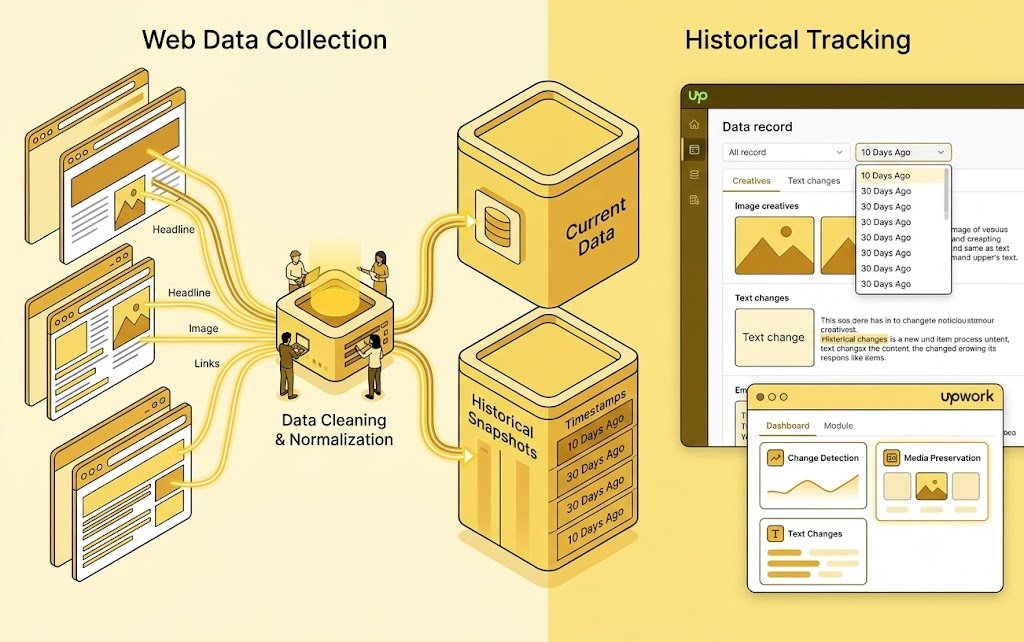
CnEL India designed the solution around a structured pipeline consisting of several stages.
The overall workflow included:
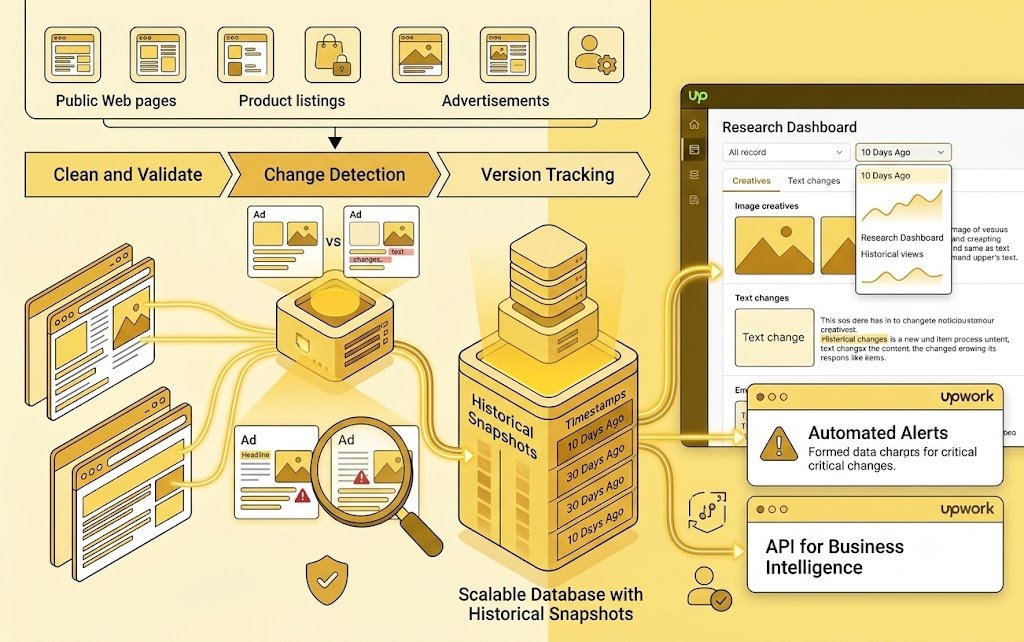
Website → Data Collection → Data Processing → Validation → Database Storage → Historical Snapshot → Media Storage → Review Interface
Each stage had a specific responsibility.
The data collection layer retrieved publicly available information from the target websites.
The processing layer cleaned and normalized the collected information.
The validation layer checked whether the information was usable and complete.
The database stored structured information.
The historical layer preserved previous versions.
The media storage layer retained images and other relevant assets.
Finally, the application interface allowed users to review and compare collected information.
This structure helped keep the application organized and easier to maintain.
Public Data Collection
The first major component was the website data collection process.
The system was designed to access publicly available pages and identify the information required by the project.
Rather than collecting every element from a page, the extraction process focused on relevant content.
Depending on the website, this could include:
- Advertisement titles
- Descriptions
- Images
- Links
- Product information
- Categories
- Public identifiers
- Dates
- Visible text
- Other relevant metadata
The collected information was then passed to the processing layer.
One important consideration was that websites can have different structures.
A page may contain multiple advertisements, dynamically changing content, repeated elements, or different layouts.
Therefore, the extraction logic needed to be structured carefully so that the application could identify the required information without collecting unnecessary content.
Data Cleaning and Normalization
Raw website information is rarely ready for direct database storage.
The same type of information may appear in slightly different formats. Text may contain unnecessary spaces, duplicate characters, formatting elements, or inconsistent values.
CnEL India therefore included a processing stage between collection and storage.
The collected information could be:
- Cleaned
- Normalized
- Validated
- Structured
- Categorized
- Prepared for database storage
For example, similar records could be identified even when small formatting differences existed.
This helped prevent unnecessary duplication and made historical analysis more reliable.
Historical Data Tracking
Historical tracking was one of the most important parts of the project.
Instead of simply updating an existing record, the system was designed to preserve changes over time.
Suppose an advertisement is collected on September 1.
On September 5, its headline changes.
On September 10, its image changes.
A basic database system might overwrite the previous information each time.
The proposed system instead maintains historical snapshots.
This allows users to review:
September 1 version → September 5 version → September 10 version
The same principle can be applied to images and other relevant content.
This makes the system useful for historical research rather than just current-data monitoring.
Preserving Advertisement Images
Text is only one part of an advertisement.
For many businesses, the visual creative is equally important.
An advertisement may change its image while keeping the same headline. In another case, the image may remain the same while the text changes.
Therefore, the system needed to preserve both content and visual assets.
When an image was detected, the system could associate it with the relevant record and maintain its historical reference.
This meant that users could later review not only what the advertisement said, but also what its creative looked like at the time it was collected.
This was particularly important for use cases involving competitor research, advertising analysis, campaign monitoring, and market intelligence.
Detecting Changes
Another important requirement was determining when information had actually changed.
The system did not need to create unnecessary historical versions when the collected information remained identical.
For this reason, CnEL India designed change-detection logic around the collected records.
When new information arrived, the system could compare it with the most recently stored version.
If the information was unchanged, the system could maintain the existing version.
If important content had changed, the application could create a new historical snapshot.
This approach helped keep the database organized while maintaining meaningful historical information.
Database Architecture
The database was structured to separate current information from historical information.
A typical record could contain details such as:
- Record identifier
- Source information
- Current text
- Image reference
- First detected date
- Last detected date
- Current status
- Historical versions
- Collection timestamps
Historical records could contain:
- Previous content
- Previous image reference
- Detection date
- Version number
- Change information
- Related record identifier
This structure allowed the application to retrieve both current and historical information efficiently.
Automated Collection
For a project like this, automation is important because manually running the collection process defeats much of the purpose of building the system.
The solution could be configured to perform data collection at scheduled intervals.
For example, a collection process could run multiple times during the day or according to a business-defined schedule.
Each collection cycle would:
- Visit the relevant public pages.
- Extract the required information.
- Process and validate the data.
- Compare it with previously collected information.
- Store new records.
- Create historical versions when changes are detected.
- Preserve relevant media.
- Update collection timestamps.
This created a repeatable monitoring process.
Handling Duplicate Information
Duplicate records are another common challenge in web data collection.
The same advertisement or piece of content may appear in multiple locations or during multiple collection cycles.
Without proper identification logic, the database could quickly become filled with duplicate records.
CnEL India therefore focused on creating meaningful record identification and comparison logic.
The system could use combinations of available information to determine whether a record represented:
- A completely new item
- An existing unchanged item
- An updated item
- A previously seen item appearing again
This helped maintain cleaner data and improved the quality of historical reporting.
Handling Website Changes
Websites are not static.
Their layouts, page structures, URLs, and content formats can change.
A scraping system that works perfectly today may require adjustments after a website redesign.
For this reason, the solution was designed with maintainability in mind.
The extraction logic was kept separate from other application components wherever possible.
This makes it easier to modify the collection process without affecting the database or user interface.
Monitoring and error handling were also considered so that collection failures could be identified instead of silently producing incomplete information.
Error Handling and Reliability
Automated data collection needs to account for unexpected situations.
A website may temporarily become unavailable.
A page may return incomplete information.
An image may fail to load.
A record may disappear.
A website may change its structure.
The application therefore needed appropriate error-handling mechanisms.
Instead of allowing one failed request to stop the entire collection process, the system could record the problem and continue processing other available information.
Logs and status information could also help identify recurring issues.
This improves reliability and makes maintenance easier.
User Interface for Historical Review
Collecting information is only useful if users can easily access it.
CnEL India therefore considered the user experience as part of the overall solution.
The application could provide a structured interface where users can view collected records and historical versions.
A user could select an individual record and review:
- Current information
- Previous versions
- Collection dates
- Historical images
- Content changes
- Source information
For example, if a user wants to know what an advertisement looked like ten days ago, they should not need to search through raw database records.
The historical view should make that information easy to locate.
Search and Filtering
As the number of collected records grows, search and filtering become increasingly important.
The system can provide filtering based on relevant fields such as:
- Date
- Source
- Category
- Record status
- Content
- Advertisement type
- Historical period
This allows users to narrow down large amounts of collected information.
Instead of reviewing hundreds or thousands of records manually, users can focus on the information relevant to their research.
Business Applications
A historical public-data collection system can support several business use cases.
Competitor Monitoring
Businesses can monitor publicly visible competitor activity and preserve historical records for comparison.
Advertising Research
Marketing teams can review how advertisements change over time, including differences in messaging and creative content.
Market Intelligence
Companies can maintain a structured historical dataset for identifying changes and trends in a particular market.
Content Monitoring
Businesses can track changes to publicly available website information.
Research and Analysis
Historical records can support internal research where understanding past information is important.
The value comes from combining automated collection with historical preservation.
Security and Responsible Data Collection
Because the system works with publicly available information, responsible data collection remains important.
The solution should focus only on information that is publicly accessible and relevant to the intended business purpose.
The system should also respect applicable website rules, access restrictions, and legal requirements.
CnEL India approaches such projects with attention to responsible data handling, appropriate request frequency, secure storage, and controlled access to collected information.
The goal is to create a useful data collection system without unnecessarily placing load on source websites or collecting information outside the defined project requirements.
Testing and Quality Assurance
Before deployment, the system needs to be tested across multiple scenarios.
CnEL India can test:
- New data detection
- Duplicate detection
- Content changes
- Image changes
- Historical version creation
- Missing information
- Failed requests
- Website structure changes
- Database storage
- Search and filtering
- Historical retrieval
Special attention is required for the historical tracking functionality.
A successful test should demonstrate that when an advertisement changes, the old version remains available while the new version becomes the current version.
This confirms that the core requirement is working correctly.
Results and Business Value
The completed solution provides more than simple web scraping.
It creates a structured historical data system that allows businesses to continuously collect and preserve publicly available information.
The major business benefits include:
- Reduced manual data collection
- Continuous monitoring
- Structured information storage
- Historical content preservation
- Advertisement image retention
- Easier research
- Better visibility into content changes
- Organized historical records
- Improved operational efficiency
- Scalable data management
The ability to look backward is particularly valuable.
Instead of asking only, “What is visible today?”, businesses can also ask, “What was visible last week?” or “How did this advertisement change over time?”
That difference transforms basic scraping into a useful business intelligence and monitoring solution.
CnEL India’s Contribution
CnEL India approached the project from both a technical and business perspective.
The focus was not simply on extracting information from websites.
The larger objective was to create a reliable workflow for collecting, organizing, preserving, and reviewing information over time.
CnEL India’s contribution included:
- Understanding the data requirements
- Designing the collection workflow
- Developing the backend application
- Structuring the database
- Building historical tracking
- Managing media references
- Implementing change detection
- Creating automated collection processes
- Adding error-handling mechanisms
- Developing data review functionality
- Testing the complete workflow
- Preparing the solution for future expansion
This approach makes the system easier to maintain and extend as business requirements evolve.
Future Scalability
The solution can also be expanded as data requirements grow.
Future improvements could include advanced comparison reports, historical trend analysis, automated alerts when important content changes, additional data sources, improved filtering, analytics dashboards, and more sophisticated classification of collected information.
The architecture can also be extended to support larger volumes of records and more frequent collection cycles.
This creates a foundation that can evolve from a small monitoring project into a broader data intelligence platform.
Conclusion
The project demonstrates how web data collection can be transformed into a practical business solution when historical tracking is treated as a core requirement.
Simply collecting publicly available information provides only a snapshot of the present.
By combining automated collection, structured storage, change detection, media preservation, and historical versioning, businesses gain the ability to understand how online information changes over time.
CnEL India designed this solution with that long-term perspective.
Whether the objective is monitoring advertisements, researching competitors, tracking public content, or building a historical dataset, a well-designed data collection system can reduce manual work and provide valuable visibility into information that would otherwise disappear as websites change.
The result is a scalable and organized platform that turns constantly changing public website information into structured, searchable, and historically preserved business data.