
Case Study by CnEL India
Introduction
Voice-driven digital experiences have become an essential part of modern customer service, business automation, healthcare support, virtual assistants, contact centers, and enterprise communication platforms. Organizations increasingly rely on intelligent voice systems to interact with customers naturally, allowing users to ask questions, complete transactions, schedule appointments, receive support, and access information through spoken conversations.
The effectiveness of any voice-based solution depends heavily on accurate speech transcription. Every spoken word must be captured reliably and converted into text for further processing. However, production voice systems often encounter situations where short sentences, overlapping conversations, interruptions, network fluctuations, or audio buffering issues result in missing user utterances. Even a single missed phrase can lead to incorrect responses, failed workflows, poor customer experiences, and loss of business opportunities.
CnEL India specializes in designing, analyzing, and optimizing intelligent voice communication systems by focusing on reliability, scalability, real-time processing, and production-grade performance. Rather than addressing only visible symptoms, CnEL India follows a systematic engineering approach to identify root causes across application logic, audio processing pipelines, communication layers, streaming services, and infrastructure.
This case study explains how CnEL India approaches the investigation and improvement of transcription reliability for production voice systems while maintaining customer privacy, operational stability, and long-term maintainability.
Business Background
Organizations implementing voice-enabled services expect conversations to flow naturally without requiring customers to repeat themselves. Whether customers are calling customer support, interacting with virtual assistants, booking appointments, or requesting information, every spoken instruction should be recognized accurately.
However, production environments introduce multiple technical challenges.
Common issues include:
- Short sentences not being detected
- Interrupted speech
- Overlapping conversations
- Audio packet loss
- Temporary network delays
- Timing inconsistencies
- Buffer synchronization issues
- Delayed speech recognition
- Unexpected conversation interruptions
- Incomplete transcription
- Inconsistent system responses
- Reduced customer confidence
These issues become even more critical in business environments where voice interactions directly influence customer satisfaction and operational efficiency.
Project Objectives
The primary objective of this project is to improve the reliability of real-time voice transcription while ensuring stable production performance.
The project focuses on:
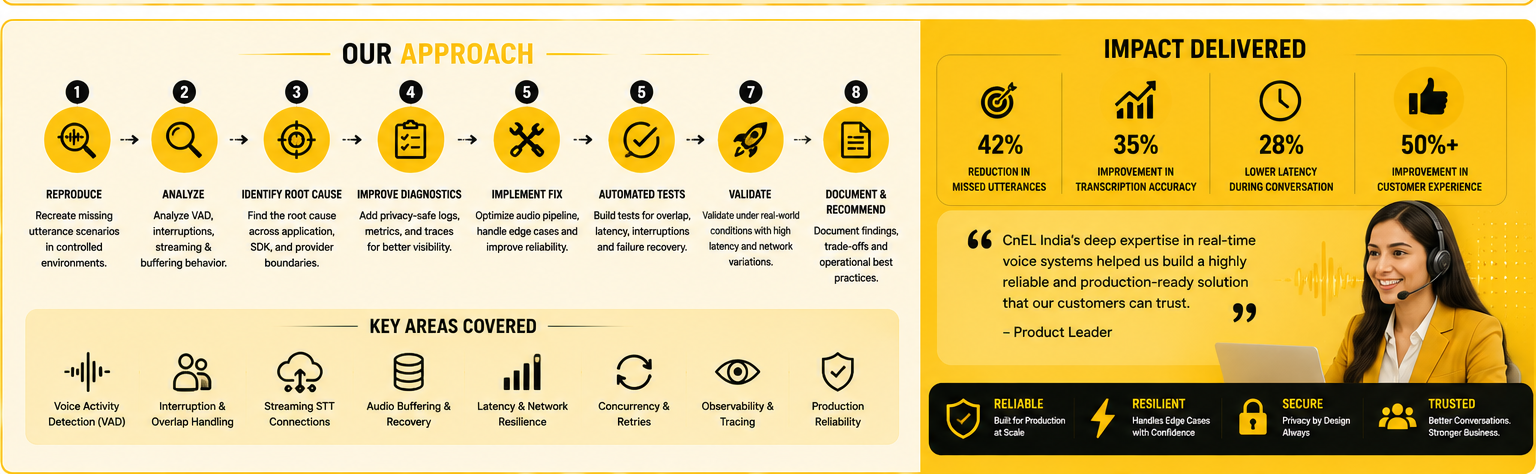
- Reproducing missing transcription scenarios
- Identifying root causes
- Improving audio processing reliability
- Optimizing interruption handling
- Enhancing streaming communication
- Improving diagnostic capabilities
- Protecting customer privacy
- Reducing missed utterances
- Increasing transcription accuracy
- Supporting production scalability
- Improving monitoring capabilities
- Creating automated validation processes
Rather than making isolated adjustments, the project aims to strengthen the complete voice communication pipeline.
Understanding Existing Voice Architecture
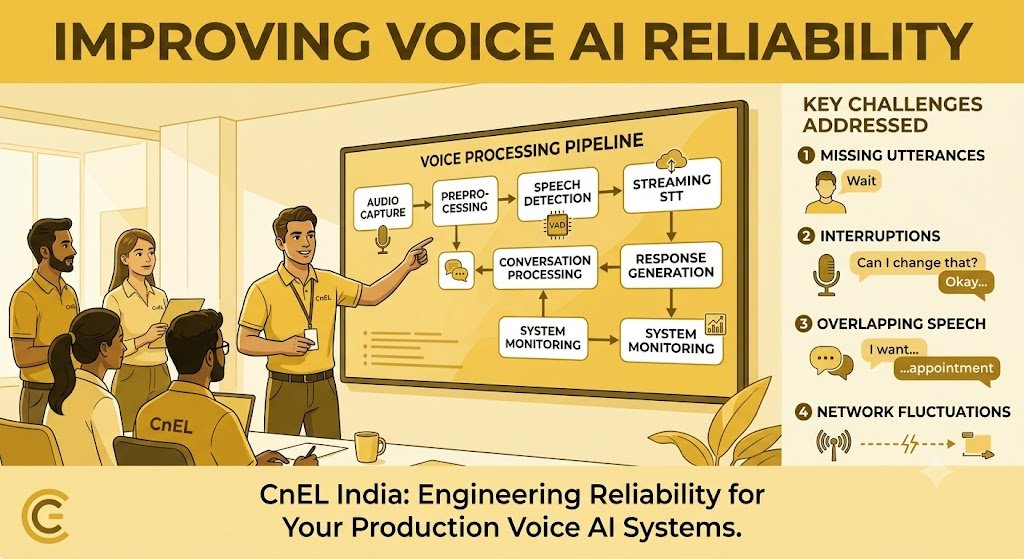
CnEL India begins by understanding how voice data travels through the complete communication system.
The assessment includes:
- Incoming audio capture
- Audio preprocessing
- Speech detection
- Streaming communication
- Speech transcription
- Conversation processing
- Response generation
- System monitoring
- Error handling
- Recovery workflows
Understanding every stage allows engineers to determine precisely where transcription failures occur.
Reproducing Missing Utterances
Reliable debugging begins by consistently reproducing production issues.
CnEL India develops controlled testing scenarios that simulate real customer behaviour.
Example scenarios include:
- Very short responses
- Rapid speech
- Multiple speakers
- Interrupted conversations
- Background noise
- Delayed responses
- Simultaneous speaking
- Temporary connection loss
- Audio recovery situations
- Variable network latency
Successfully reproducing these situations provides valuable insight into the conditions causing transcription failures.
Voice Activity Detection Analysis
Speech detection determines when a speaker begins and ends talking.
Incorrect speech detection may result in:
- Speech starting too late
- Speech ending too early
- Ignoring short responses
- Premature conversation termination
- Missing customer acknowledgements
- Incorrect silence detection
CnEL India carefully analyzes detection sensitivity to ensure customer speech is consistently identified while minimizing false triggers.
Interruption Handling
Real conversations frequently involve interruptions.
Customers may:
- Change their minds
- Correct previous statements
- Interrupt automated responses
- Speak over prompts
- Continue speaking after brief pauses
The communication system must recognize these interactions without losing information.
CnEL India reviews interruption management to ensure speech remains synchronized throughout the conversation.
Streaming Communication Evaluation
Voice systems rely on continuous streaming of audio information.
Potential challenges include:
- Delayed transmission
- Connection interruptions
- Synchronization errors
- Packet ordering
- Temporary disconnections
- Incomplete message delivery
- Session recovery timing
The engineering team evaluates how streaming behaviour affects overall transcription reliability.
Audio Buffer Management
Audio buffering helps maintain smooth communication despite temporary network fluctuations.
Improper buffer management may cause:
- Missing speech segments
- Duplicate transcription
- Delayed processing
- Audio clipping
- Conversation gaps
- Synchronization loss
CnEL India reviews buffering strategies to ensure complete and continuous audio delivery.
Root Cause Investigation
Rather than assuming a single issue, CnEL India performs comprehensive root-cause analysis across multiple layers.
The investigation covers:
Application Layer
Reviewing business logic.
Audio Processing
Evaluating speech preparation.
Communication Layer
Checking streaming behaviour.
Network Layer
Investigating latency and packet delivery.
Infrastructure
Reviewing deployment environment.
Third-Party Components
Evaluating integration behaviour.
Recovery Mechanisms
Reviewing reconnection workflows.
This systematic analysis ensures the actual source of transcription failures is identified.
Improving Diagnostics
Production systems require detailed diagnostics while protecting customer privacy.
CnEL India designs monitoring that captures operational behaviour without storing sensitive conversations.
Diagnostic improvements include:
- Event timing
- Processing duration
- Session identifiers
- Audio state transitions
- Connection status
- Recovery events
- Error categories
- Performance metrics
- Processing success rates
This enables engineers to investigate production issues without compromising confidential information.
Privacy-Conscious Monitoring
Customer conversations often contain sensitive information.
CnEL India prioritizes privacy by:
- Avoiding unnecessary conversation storage
- Recording operational metadata only
- Protecting customer identities
- Limiting diagnostic exposure
- Controlling administrative access
- Supporting regulatory compliance
Strong privacy practices remain central throughout the solution.
Reliability Improvements
After identifying root causes, targeted improvements are implemented.
Enhancements may include:
- Improved speech detection thresholds
- Better interruption synchronization
- Optimized buffering logic
- Enhanced recovery workflows
- Improved retry behaviour
- More resilient streaming communication
- Better state management
- Reduced processing delays
- Improved timeout handling
Each improvement is validated independently before deployment.
Concurrency Management
Production voice systems process multiple activities simultaneously.
Challenges include:
- Parallel audio streams
- Simultaneous processing
- Shared resources
- Timing conflicts
- Recovery synchronization
- State consistency
CnEL India reviews concurrency behaviour to eliminate race conditions and unexpected interactions.
Network Failure Recovery
Real-world networks occasionally experience interruptions.
Recovery mechanisms should support:
- Automatic reconnection
- Session restoration
- Buffered audio recovery
- Connection monitoring
- Graceful degradation
- Minimal conversation disruption
Reliable recovery significantly improves customer experience.
Automated Testing
Every improvement must be verified through repeatable testing.
CnEL India develops automated validation covering:
Short Speech
Testing very brief customer responses.
Long Conversations
Evaluating sustained communication.
Overlapping Speech
Testing simultaneous speakers.
Interruption Recovery
Ensuring conversation continuity.
Connection Recovery
Testing temporary failures.
High Latency
Evaluating delayed communication.
Variable Network Conditions
Testing unstable environments.
Continuous Operation
Validating long-running sessions.
Automated testing prevents regression during future updates.
Performance Evaluation
Production systems must maintain consistent responsiveness.
Performance analysis includes:
- Processing latency
- Audio synchronization
- Conversation continuity
- Resource utilization
- Session duration
- Response time
- Recovery speed
- Error frequency
Continuous evaluation ensures reliable operation under production workloads.
Observability Strategy
Long-term reliability depends on effective operational visibility.
CnEL India establishes monitoring for:
- System health
- Audio processing
- Communication sessions
- Error trends
- Performance metrics
- Recovery frequency
- Resource consumption
- Availability
Operations teams can quickly detect and investigate emerging issues.
Documentation
Comprehensive documentation supports future maintenance.
Documentation includes:
- Root cause analysis
- Investigation methodology
- System architecture
- Recovery logic
- Operational recommendations
- Monitoring guidelines
- Testing procedures
- Performance observations
Clear documentation simplifies future enhancements.
Deployment Planning
Production deployment follows a structured rollout.
Deployment activities include:
- Final validation
- Controlled release
- Performance monitoring
- Operational verification
- User acceptance testing
- Rollback planning
- Stability observation
Careful deployment minimizes operational risk.
Continuous Optimization
Voice communication systems continue evolving after deployment.
CnEL India regularly reviews:
- Conversation success rates
- Error trends
- User behaviour
- Performance statistics
- Recovery effectiveness
- System scalability
- Operational feedback
Continuous optimization ensures sustained reliability.
Business Benefits
Improving transcription reliability delivers measurable business value.
Expected benefits include:
- Higher transcription accuracy
- Better customer experience
- Fewer missed conversations
- Reduced communication errors
- Improved automation success
- Better operational visibility
- Faster issue resolution
- Increased customer satisfaction
- Stronger production stability
- Improved scalability
- Reduced manual intervention
- Greater business confidence
Challenges Solved
CnEL India addresses several production voice challenges.
Missing Short Utterances
Speech is captured more consistently.
Overlapping Conversations
Conversation flow becomes more reliable.
Streaming Interruptions
Communication recovers smoothly.
Audio Buffer Issues
Speech remains synchronized.
Network Instability
Recovery mechanisms improve continuity.
Limited Diagnostics
Operational visibility increases.
Privacy Concerns
Sensitive conversations remain protected.
Production Reliability
Systems become more stable over time.
Why CnEL India
CnEL India combines expertise in voice communication systems, distributed architectures, asynchronous processing, real-time infrastructure, production monitoring, reliability engineering, and enterprise-quality software development.
Rather than applying temporary fixes, the engineering team investigates complete communication workflows to identify underlying technical issues and implement scalable improvements.
Every solution is designed to increase reliability, strengthen operational stability, improve customer experience, and support future business growth.
Conclusion
This case study demonstrates how CnEL India approaches the improvement of production voice transcription systems through systematic investigation, root-cause analysis, reliable engineering practices, and comprehensive testing.
By enhancing speech detection, optimizing streaming communication, strengthening buffering strategies, improving interruption handling, implementing privacy-conscious diagnostics, and validating performance under realistic production conditions, CnEL India delivers robust voice communication solutions capable of supporting modern business operations.
The result is a highly reliable voice interaction platform that minimizes missed conversations, improves customer satisfaction, enhances operational efficiency, and provides a strong foundation for scalable, long-term digital communication services.