
Case Study by CnEL India
Introduction
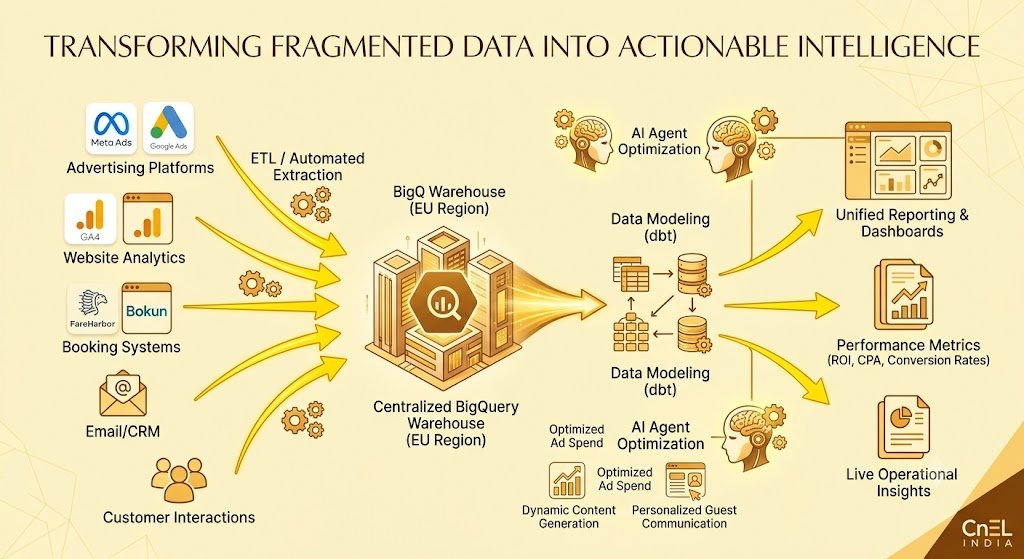
In today’s digital economy, businesses generate enormous amounts of marketing, customer, booking, advertising, and operational data every day. Companies in industries such as travel, hospitality, tourism, retail, and e-commerce rely on this information to understand customer behavior, optimize marketing investments, forecast demand, improve customer experiences, and increase profitability. However, valuable business data is often scattered across multiple platforms, making it difficult to obtain a unified view of performance.
Travel businesses, in particular, collect information from advertising platforms, website analytics, booking systems, customer relationship management platforms, email marketing channels, payment systems, and internal business applications. Without a centralized data infrastructure, organizations struggle with fragmented reporting, inconsistent metrics, duplicated records, delayed decision-making, and inefficient marketing optimization.
CnEL India specializes in designing scalable marketing data platforms that consolidate information from multiple business systems into a unified environment. These platforms enable organizations to automate data collection, maintain high data quality, generate consistent business metrics, and provide reliable information for intelligent business applications. Instead of relying on disconnected reports and manual spreadsheets, businesses gain access to accurate, real-time operational insights that support better strategic decisions.
This case study explains how CnEL India develops a modern marketing data platform capable of supporting live business intelligence, advanced automation, scalable reporting, and intelligent business optimization for the travel industry.
Business Background
Travel businesses operate in highly competitive markets where pricing, occupancy, advertising costs, customer demand, and booking patterns change continuously. Marketing teams invest across multiple advertising channels while reservation systems capture customer bookings from various sources. Operational teams monitor occupancy, availability, customer communications, cancellations, and seasonal demand.
When each department maintains separate data sources, organizations experience several operational challenges.
Common problems include:
- Disconnected marketing data
- Multiple reporting systems
- Inconsistent business metrics
- Manual data consolidation
- Delayed reporting
- Poor campaign visibility
- Duplicate information
- Inaccurate customer insights
- Limited forecasting capabilities
- Difficult performance measurement
- Lack of operational transparency
- Slow business decision-making
Without centralized data management, organizations struggle to identify which marketing investments generate actual bookings and revenue.
Project Objectives
The primary objective of this project is to build a centralized marketing data platform that continuously collects, organizes, validates, and prepares business data for reporting and intelligent decision-making.
The project focuses on:
- Centralizing business information
- Automating data collection
- Standardizing business metrics
- Improving reporting accuracy
- Supporting real-time analytics
- Enhancing marketing optimization
- Improving booking visibility
- Increasing operational efficiency
- Supporting intelligent automation
- Strengthening data quality
- Preparing scalable infrastructure
- Enabling future business expansion
The platform serves as the foundation for reliable business intelligence across the organization.
Understanding Business Requirements
CnEL India begins by understanding how the business operates before designing any technical architecture.
The discovery phase includes:
- Business objectives
- Marketing strategy
- Customer acquisition process
- Booking workflows
- Revenue generation
- Campaign management
- Customer communication
- Business reporting
- Operational challenges
- Growth plans
Understanding these workflows ensures the platform aligns with real business needs rather than simply collecting technical data.
Data Source Identification
Travel businesses typically generate information from multiple operational systems.
Potential business sources include:
- Advertising platforms
- Website analytics
- Reservation systems
- Customer databases
- Email marketing
- Customer inquiries
- Website forms
- Payment records
- Customer support systems
- Internal operational software
CnEL India evaluates each source to understand available information, update frequency, and integration complexity.
Centralized Data Collection
One of the largest challenges organizations face is inconsistent data collection.
CnEL India develops automated collection processes that:
- Reduce manual work
- Minimize duplication
- Synchronize information
- Maintain consistency
- Handle incremental updates
- Support scheduled synchronization
- Detect failed transfers
- Maintain operational reliability
Automated collection improves both efficiency and data accuracy.
Data Standardization
Different business systems often represent identical information in different formats.
For example:
- Customer names
- Booking references
- Campaign identifiers
- Date formats
- Currency values
- Geographic locations
- Product categories
CnEL India standardizes these records into consistent business structures.
Standardization simplifies reporting while eliminating confusion across departments.
Marketing Performance Integration
Marketing effectiveness depends on connecting advertising activities with actual business outcomes.
The platform combines information such as:
- Advertising spend
- Campaign performance
- Website visitors
- Customer inquiries
- Booking conversions
- Revenue generation
- Customer acquisition
- Occupancy trends
- Seasonal demand
This unified approach provides a complete understanding of marketing effectiveness.
Booking Data Consolidation
Reservation systems contain valuable operational information.
The centralized platform organizes:
- Booking dates
- Customer information
- Reservation status
- Occupancy rates
- Travel schedules
- Package selections
- Revenue information
- Cancellation trends
This creates a reliable operational dataset for business analysis.
Customer Journey Analysis
Modern businesses benefit from understanding complete customer interactions.
The platform supports visibility into:
- Advertisement engagement
- Website visits
- Inquiry submissions
- Reservation completion
- Customer communication
- Repeat bookings
- Customer loyalty
- Revenue contribution
This complete customer journey improves marketing optimization.
Business Metric Development
Different departments often calculate business metrics differently.
CnEL India develops standardized business measurements for:
- Marketing investment
- Conversion rates
- Booking performance
- Revenue generation
- Customer acquisition
- Occupancy levels
- Campaign profitability
- Customer retention
- Seasonal performance
Consistent metrics improve organizational decision-making.
Data Quality Management
Reliable reporting depends on trustworthy information.
CnEL India implements continuous quality validation through:
- Missing value detection
- Duplicate identification
- Data consistency checks
- Range validation
- Relationship verification
- Format standardization
- Synchronization monitoring
High-quality information increases confidence in business reports.
Automated Monitoring
Continuous monitoring ensures operational reliability.
Monitoring includes:
- Data freshness
- Synchronization status
- Missing updates
- Processing duration
- Transfer failures
- Schema changes
- Quality alerts
- System availability
Operations teams receive early warning before problems affect business reporting.
Error Handling
Large data platforms must manage unexpected failures gracefully.
Recovery mechanisms include:
- Automatic retries
- Partial recovery
- Failed record isolation
- Logging
- Recovery notifications
- Validation after restoration
- Historical tracking
Robust recovery minimizes business disruption.
Scalable Architecture
Business growth requires flexible infrastructure.
CnEL India designs platforms capable of supporting:
- Additional customers
- New business units
- More marketing channels
- Increased transaction volumes
- Larger historical datasets
- Expanded reporting
- Additional operational systems
Scalability protects future investments.
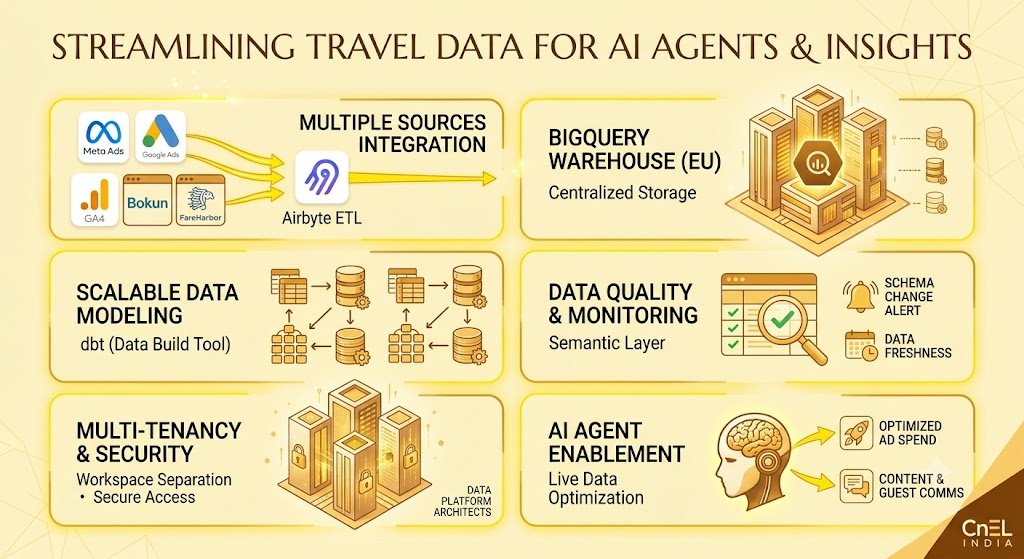
Multi-Client Environment
As organizations expand, multiple business units may require independent access.
The platform supports:
- Workspace separation
- Customer isolation
- Secure permissions
- Independent reporting
- Controlled administrative access
- Shared infrastructure
- Individual business metrics
This architecture supports long-term expansion.
Security
Business data requires strong protection.
CnEL India focuses on:
- Secure authentication
- Access management
- Data encryption
- Administrative controls
- Audit logging
- Backup procedures
- Secure communication
- Compliance practices
Security remains a priority throughout the platform.
Reporting Capabilities
The centralized platform enables comprehensive reporting across departments.
Business reports may include:
- Marketing performance
- Booking trends
- Revenue growth
- Customer acquisition
- Seasonal demand
- Campaign profitability
- Occupancy analysis
- Customer retention
- Operational efficiency
Reliable reporting supports faster strategic decisions.
Intelligent Business Applications
Once centralized, business data becomes valuable for advanced automation.
Possible capabilities include:
- Advertising optimization
- Customer communication
- Personalized marketing
- Revenue forecasting
- Booking recommendations
- Customer segmentation
- Demand prediction
- Business planning
Clean data forms the foundation for future intelligent systems.
Performance Optimization
Large-scale platforms must operate efficiently.
CnEL India optimizes:
- Processing speed
- Synchronization efficiency
- Storage utilization
- Query performance
- Resource consumption
- Data retrieval
- Historical processing
Efficient architecture supports growing workloads.
Testing
Comprehensive testing ensures production readiness.
Testing covers:
Data Accuracy
Verifying imported records.
Synchronization
Confirming updates.
Performance
Evaluating processing speed.
Quality Validation
Testing business rules.
Security
Verifying controlled access.
Scalability
Testing increasing workloads.
Recovery
Validating failure handling.
Monitoring
Ensuring alerts function correctly.
Documentation
Complete documentation supports long-term maintenance.
Documentation includes:
- Architecture overview
- Data sources
- Business metrics
- Processing workflows
- Validation procedures
- Monitoring strategy
- Security policies
- Maintenance recommendations
Well-documented systems remain easier to manage.
Deployment Strategy
Production deployment follows structured planning.
Activities include:
- Final validation
- Controlled rollout
- Performance observation
- Business verification
- User acceptance testing
- Operational monitoring
Careful deployment reduces operational risk.
Continuous Improvement
Business requirements evolve continuously.
CnEL India supports:
- New data sources
- Additional reports
- Improved quality rules
- Expanded automation
- Performance tuning
- Infrastructure scaling
- Business metric refinement
Continuous improvement keeps the platform valuable.
Business Benefits
A centralized marketing data platform delivers measurable advantages.
Expected outcomes include:
- Unified business reporting
- Better marketing visibility
- Improved campaign optimization
- Faster decision-making
- Higher reporting accuracy
- Reduced manual effort
- Better customer insights
- Increased operational efficiency
- Improved forecasting
- Stronger business intelligence
- Scalable infrastructure
- Better long-term growth
Challenges Solved
CnEL India addresses several common business challenges.
Fragmented Data
Business information becomes centralized.
Manual Reporting
Automation reduces repetitive work.
Inconsistent Metrics
Standardized calculations improve accuracy.
Marketing Visibility
Advertising performance becomes measurable.
Poor Data Quality
Continuous validation improves reliability.
Scalability Issues
Infrastructure supports future growth.
Operational Delays
Real-time updates improve responsiveness.
Limited Business Intelligence
Organizations gain deeper operational insights.
Why CnEL India
CnEL India combines expertise in enterprise data engineering, business intelligence, scalable architecture, automation, cloud infrastructure, operational analytics, data governance, and intelligent business systems.
Rather than simply integrating business data, CnEL India develops complete platforms that transform fragmented operational information into valuable business assets. Every solution emphasizes reliability, scalability, security, maintainability, and measurable business outcomes.
By understanding both technical architecture and business strategy, CnEL India helps organizations create data platforms that support informed decision-making, optimize marketing investments, improve customer experiences, and enable long-term digital transformation.
Conclusion
This case study demonstrates how CnEL India develops modern marketing data platforms that centralize business information, automate data collection, improve reporting accuracy, and create a reliable foundation for intelligent business applications.
Through structured data integration, standardized business metrics, continuous monitoring, strong security, scalable architecture, comprehensive testing, and ongoing optimization, CnEL India enables travel businesses to transform disconnected operational data into actionable business intelligence.
The result is a secure, scalable, and future-ready platform that enhances operational efficiency, improves marketing performance, supports strategic decision-making, and prepares organizations for sustainable long-term growth.