

Case Study by CnEL India
Introduction
As organizations grow, employees spend a significant amount of time handling repetitive internal tasks, searching for information, preparing summaries, coordinating workflows, monitoring processes, and making routine operational decisions. Although these activities are essential to business operations, they can consume valuable employee time and create delays.
CnEL India approached this challenge by designing an internal AI agent capable of supporting company workflows, improving operational efficiency, and assisting employees with decision-making.
The objective was not to create a basic conversational assistant. The focus was on developing an intelligent internal system that could understand business requests, access authorized company information, follow defined processes, assist employees with routine tasks, and provide useful recommendations while keeping humans involved in important decisions.
The solution was designed as a scalable foundation that could initially support a limited number of internal workflows and later expand across departments.
Understanding the Business Challenge
Most companies have information distributed across multiple internal systems and documents.
Employees may need to search through:
- Internal documents
- Policies
- Project information
- Customer records
- Business reports
- Operational procedures
- Previous communications
- Task information
- Department-specific knowledge
Finding the right information manually can take significant time.
The same problem occurs with routine workflows.
For example, an employee may need to:
- Receive a request.
- Understand what is required.
- Find relevant information.
- Check company policies.
- Prepare a response.
- Update internal records.
- Notify another team.
- Track the next action.
An internal AI agent can help coordinate many of these steps.
The goal is to reduce repetitive work while allowing employees to focus on higher-value activities.
Project Objectives
CnEL India’s implementation was structured around several major objectives:
- Build an intelligent internal AI agent.
- Understand natural-language employee requests.
- Retrieve relevant company information.
- Support internal workflows.
- Automate repetitive operational tasks.
- Provide contextual answers.
- Assist employees with decision-making.
- Maintain appropriate access controls.
- Keep humans involved in sensitive decisions.
- Create a scalable architecture for future workflows.
- Provide clear monitoring and operational visibility.
The system was designed to become an internal productivity layer rather than a standalone chatbot.
AI Agent Concept
A conventional chatbot generally responds to questions.
An AI agent can go further.
It can understand an objective, determine the appropriate steps, retrieve information, perform permitted actions, and return a structured result.
For example, an employee might ask:
“Prepare a summary of the latest project status and identify anything that needs management attention.”
Instead of simply answering from a static knowledge base, the internal agent can:
- Identify the relevant project.
- Retrieve current information.
- Review recent updates.
- Organize the information.
- Identify outstanding items.
- Highlight potential issues.
- Prepare a concise management summary.
This creates a much more useful internal experience.
Understanding Employee Requests
The first stage of the system involves interpreting an employee’s request.
Employees rarely use standardized commands.
One person may write:
“Give me the status of this project.”
Another might say:
“What is pending on the current project?”
Another may ask:
“Can you prepare a quick update for management?”
Although the wording is different, the underlying objective may be similar.
The AI agent therefore needs to understand intent rather than relying only on exact keywords.
Requests can be categorized into areas such as:
- Information retrieval
- Document analysis
- Reporting
- Workflow initiation
- Task assistance
- Summarization
- Decision support
- Internal communication
- Operational queries
Internal Knowledge Access
One of the most important components is access to company knowledge.
The agent needs to retrieve relevant information before generating an answer.
This could include information from:
- Company documents
- Internal policies
- Project records
- Process documentation
- Knowledge repositories
- Structured business data
The system should not simply generate an answer based on general knowledge when company-specific information is required.
Instead, it should identify relevant internal sources and use them as the foundation for its response.
Context-Aware Responses
An internal AI system becomes significantly more useful when it understands context.
For example, if an employee asks:
“What should we do next?”
The correct response depends on what they are working on.
The agent may need to understand:
- Current project
- Previous actions
- Outstanding tasks
- Relevant policies
- Deadlines
- Assigned responsibilities
The system can then provide a contextual recommendation rather than a generic answer.
Workflow Automation
A major objective of the project was to connect intelligence with action.
For example, an internal request could trigger a workflow such as:
Employee Request → Intent Identification → Information Retrieval → Validation → Action Recommendation → Human Approval → Workflow Completion
Depending on permissions, the system could assist with activities such as:
- Creating internal tasks
- Preparing reports
- Organizing information
- Generating summaries
- Drafting communications
- Updating workflow status
- Escalating issues
- Preparing decision-support information
Automation should remain controlled, especially when an action can have financial, legal, customer, or operational consequences.
Human-in-the-Loop Decision Making
CnEL India recognizes that an internal AI agent should not automatically make every important decision.
Some decisions require human judgment.
Therefore, the system can distinguish between:
Low-Risk Actions
These may be suitable for automated execution.
Examples include:
- Generating summaries
- Organizing information
- Preparing routine reports
- Creating draft responses
Higher-Risk Actions
These should require employee approval.
Examples include:
- Financial decisions
- Sensitive customer actions
- Policy exceptions
- Important operational changes
- External communications
This creates a balance between automation and control.
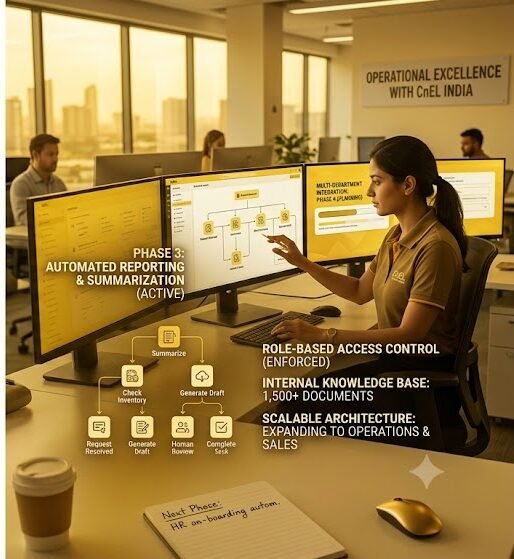
Role-Based Access
Internal company information can be highly sensitive.
Not every employee should have access to every piece of information.
The system therefore requires role-aware access controls.
For example:
Employee
Can access information relevant to their responsibilities.
Manager
Can access broader project and team information.
Department Administrator
Can manage specific operational workflows.
Senior Management
Can access high-level business information and decision-support reports.
The agent should respect these permissions when retrieving information.
Data Privacy and Security
Security is a critical consideration for an internal AI system.
The platform should protect:
- Company documents
- Internal communications
- Customer information
- Business records
- Employee information
- Operational data
The architecture should include appropriate authentication, authorization, secure data handling, and controlled access to internal sources.
Sensitive information should not be exposed simply because an employee asks a broad question.
Decision Support
Another major capability is helping employees make better-informed decisions.
The AI agent can organize information and highlight relevant factors.
For example, a manager may ask:
“Which projects require attention this week?”
The system could review available project information and identify:
- Upcoming deadlines
- Delayed tasks
- Outstanding dependencies
- Resource concerns
- Unresolved issues
Instead of replacing the manager’s judgment, the agent provides a structured overview that makes decision-making faster.
Automated Summarization
Businesses frequently deal with large amounts of information.
Employees may not have time to read every document or update.
The internal AI agent can transform large information sets into concise summaries.
Possible outputs include:
- Executive summaries
- Project summaries
- Meeting summaries
- Task summaries
- Document overviews
- Issue reports
- Action-item lists
This can significantly reduce information overload.
Internal Reporting
Management reporting can also benefit from automation.
Instead of manually collecting information from different sources, the system can assist in preparing structured reports.
A report could include:
Current Status
Completed Work
Pending Activities
Risks
Upcoming Deadlines
Required Decisions
This provides management with a consistent reporting format.
Knowledge Search
One of the most practical uses of the internal agent is intelligent company search.
Traditional search often requires employees to know exactly what keyword they are looking for.
An AI-powered system can understand questions expressed naturally.
For example:
“What is our process for handling this type of customer request?”
The system can locate relevant internal information and present it in a concise answer.
Where appropriate, the response can identify the supporting source so employees can verify the information.
Reducing Repetitive Work
The project focuses heavily on reducing low-value repetitive activities.
Employees frequently perform tasks such as:
- Copying information
- Searching documents
- Creating summaries
- Preparing repetitive reports
- Drafting routine messages
- Checking workflow status
- Organizing information
Automating or accelerating these activities can create substantial productivity improvements.
The time saved can then be redirected toward customer service, strategy, problem-solving, and other higher-value responsibilities.
Department-Level Applications
The internal AI agent can eventually support multiple departments.
Sales
Help employees locate customer and sales information and prepare summaries.
Operations
Monitor workflows, identify pending activities, and prepare operational reports.
Human Resources
Assist with internal policies, employee processes, and administrative information.
Finance
Support reporting and information retrieval while maintaining strict access controls.
Management
Prepare executive summaries and decision-support information.
Project Teams
Track project information, identify pending tasks, and summarize progress.
This makes the architecture reusable across the organization.
Scalable Architecture
CnEL India designed the concept so that new capabilities could be added gradually.
Instead of creating one large system containing every possible workflow, the platform can begin with a small number of high-value use cases.
For example:
Phase 1
Internal knowledge assistant and document search.
Phase 2
Reporting and summarization.
Phase 3
Workflow automation.
Phase 4
Decision-support capabilities.
Phase 5
Cross-department automation.
This phased approach reduces implementation risk and allows the organization to measure value at every stage.
Monitoring and Evaluation
An internal AI agent needs continuous evaluation.
Important metrics may include:
- Response accuracy
- Task completion rate
- User satisfaction
- Workflow processing time
- Automation rate
- Escalation frequency
- Error rate
- Information retrieval quality
These measurements help determine whether the system is genuinely improving productivity.
If users frequently correct the same type of response, the workflow can be reviewed and improved.
Error Handling
No intelligent system will be perfect.
The agent should therefore be designed to recognize uncertainty.
If the required information cannot be found, it should not confidently invent an answer.
Instead, it can communicate that:
- Information was unavailable.
- Additional clarification is required.
- Human review is recommended.
This is particularly important for business environments where inaccurate information can result in operational problems.
User Experience
The system should be easy for employees to use.
Employees should not need technical knowledge to interact with the agent.
A natural-language interface allows them to describe what they need in ordinary language.
For example:
“Summarize the pending work for this week.”
“Find the policy related to this request.”
“Prepare a management update.”
“What issues need attention?”
The system can then determine the appropriate workflow.
This simplicity is one of the key benefits of an internal AI interface.
Expected Business Benefits
The implementation can provide several measurable benefits.
Improved Productivity
Employees spend less time on repetitive information-processing tasks.
Faster Information Access
Relevant company knowledge becomes easier to locate.
Better Decision Support
Managers receive structured information faster.
Consistent Processes
Standard workflows can be followed more consistently.
Reduced Administrative Work
Routine reporting and summarization become easier.
Improved Collaboration
Teams can access shared information more efficiently.
Scalable Automation
Additional workflows can be introduced over time.
Implementation Strategy
CnEL India would recommend beginning with a focused proof of concept.
The first stage would identify the internal workflows that consume the most employee time.
These workflows would then be prioritized based on:
- Frequency
- Business impact
- Automation potential
- Data availability
- Risk level
- Implementation complexity
The highest-value, lowest-risk workflows should be automated first.
This creates a practical path toward broader AI adoption.
Future Expansion
Once the core system proves successful, additional capabilities can be introduced.
Potential future functionality includes:
- Multi-department agents
- Advanced workflow orchestration
- Automated business reporting
- Predictive insights
- Intelligent task prioritization
- Document comparison
- Internal compliance assistance
- Advanced analytics
- Approval workflows
- Personalized employee assistance
The long-term vision is to create an internal intelligence layer that supports employees throughout their daily work.
Why CnEL India
CnEL India’s approach focuses on solving the actual business problem rather than introducing AI simply for the sake of using AI.
The internal agent would be designed around:
- Business workflows
- Employee needs
- Existing company knowledge
- Security
- Access control
- Human oversight
- Measurable productivity improvements
- Future scalability
This ensures that the technology remains connected to practical business outcomes.
Conclusion
The Internal AI Agent project demonstrates how CnEL India can help organizations move from conventional manual workflows toward intelligent, AI-assisted operations.
The proposed solution goes beyond a simple question-and-answer interface. It combines natural-language understanding, internal knowledge retrieval, workflow support, reporting, decision assistance, access controls, and human approval mechanisms into a unified internal productivity system.
The most important principle is that automation should support employees rather than remove necessary human judgment. Routine and low-risk tasks can be accelerated, while sensitive decisions can remain under human control.
Starting with a focused MVP allows the organization to validate the technology against real workflows, measure productivity improvements, gather employee feedback, and gradually expand the system.
Ultimately, the internal AI agent can become a central intelligent assistant for business operations, helping employees find information faster, automate repetitive work, prepare better reports, and make more informed decisions. With a scalable foundation, the solution can evolve from a small internal productivity project into a broader enterprise AI platform supporting multiple departments and increasingly sophisticated workflows.