
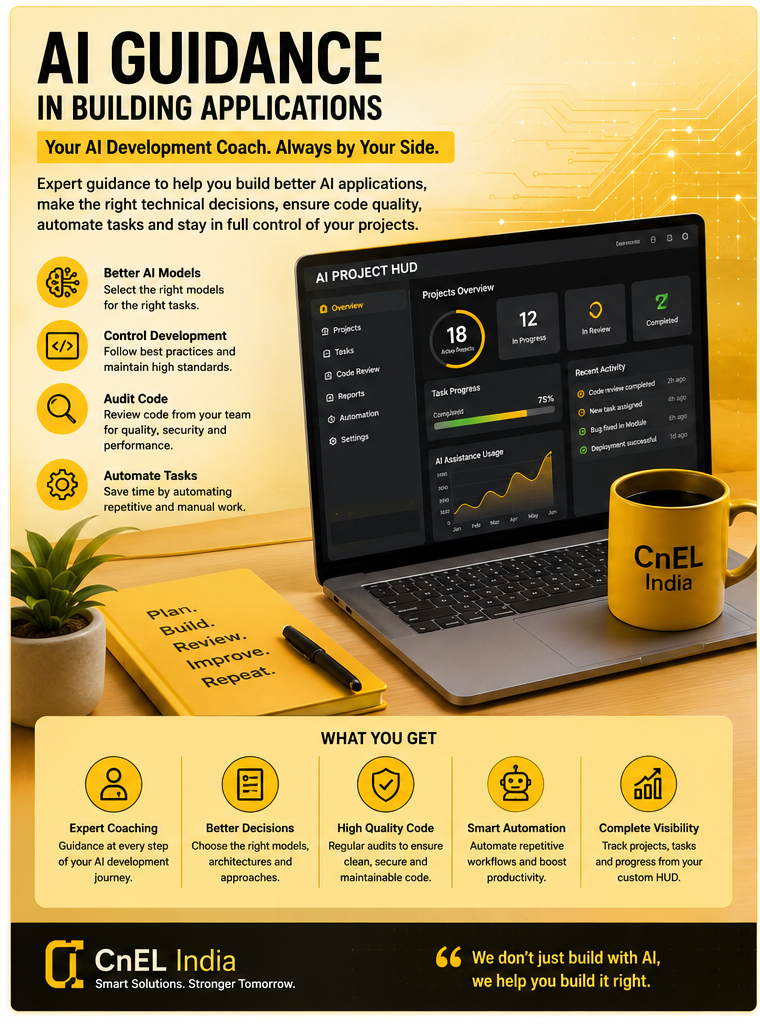
Case Study by CnEL India
Introduction
As artificial intelligence becomes an important part of modern application development, businesses and independent developers are increasingly using AI to accelerate coding, automate repetitive processes, analyze information, and improve software quality. However, using AI effectively in development is not simply about selecting a powerful model and asking it to generate code. Without proper technical direction, AI-generated solutions can introduce architectural problems, security risks, unnecessary complexity, inconsistent coding practices, and maintenance challenges.
CnEL India approached this type of challenge as an AI development guidance and technical coaching engagement, where the objective was not merely to build an application but to provide continuous technical direction throughout the development lifecycle.
The project required an experienced AI-focused technical partner who could remain involved during development and act as a reliable second layer of technical validation. The role included helping select appropriate AI models, reviewing development decisions, auditing code produced by other team members, identifying potential weaknesses, and finding opportunities for automation.
The ultimate goal was to create a development environment where AI could increase productivity without compromising application quality, security, maintainability, or business objectives.
Understanding the Business Challenge
The client was already actively building AI applications and developing a personal HUD (Human User Dashboard) to monitor projects and development activities. This indicated that the client had already invested significant effort into creating an AI-driven development ecosystem.
However, as the number of projects and development activities increased, several challenges could emerge.
One major challenge was decision-making around AI models. Different models may perform differently depending on the task. A model suitable for generating code may not necessarily be the best choice for reasoning, document analysis, structured outputs, or complex technical tasks.
Another challenge was maintaining development control when AI was involved in coding. AI can generate large amounts of code very quickly, but speed does not automatically mean correctness. Generated code needs to be reviewed for architecture, logic, security, performance, scalability, and maintainability.
The client also needed assistance with auditing code written by other developers. When multiple team members contribute to an AI-based project, differences in coding style, architecture, assumptions, and implementation quality can gradually create technical debt.
Finally, there was an opportunity to automate repetitive development and operational activities so that developers could spend more time on higher-value engineering tasks.
CnEL India’s role therefore focused on establishing a structured layer of AI guidance, technical governance, code quality control, and workflow optimization.
Project Objectives
The primary objectives of the engagement were:
- Provide ongoing technical guidance for AI application development.
- Help determine which AI model approach is appropriate for different tasks.
- Establish better development practices around AI-assisted coding.
- Review and audit code created by internal team members.
- Identify architectural and security weaknesses early.
- Introduce automation wherever repetitive work could be reduced.
- Improve development consistency across projects.
- Help the client make informed technical decisions.
- Establish measurable quality and performance standards.
- Create a scalable development methodology for future AI applications.
Rather than functioning as a traditional development vendor, CnEL India could operate as an AI technical advisor and engineering partner.
AI Development Coaching
One of the most important parts of the project was continuous technical coaching.
AI application development often involves rapidly changing requirements. Developers may experiment with different approaches, models, prompts, workflows, and architectures. Without experienced guidance, teams can spend significant time experimenting without knowing whether their chosen direction is technically sound.
CnEL India’s guidance approach would involve reviewing the development process at regular intervals.
For example, before implementing a major feature, the team could evaluate:
- What problem is the feature solving?
- Is AI actually required?
- What type of AI capability is appropriate?
- What information does the system need?
- How should the AI output be validated?
- What happens when the AI produces an incorrect result?
- How will the feature scale?
- What security considerations exist?
- How will the feature be monitored?
This creates a structured decision-making process instead of allowing development to progress through trial and error alone.
Selecting Better AI Models
A major requirement was helping the client use AI models more effectively.
The objective would not simply be to choose the most powerful model available. Instead, model selection should depend on the actual application requirement.
For example, a lightweight model may be sufficient for simple classification or repetitive processing, while a more advanced reasoning model may be appropriate for complex analysis.
CnEL India could establish a model evaluation framework based on factors such as:
- Accuracy
- Reasoning capability
- Response consistency
- Speed
- Cost
- Context handling
- Output structure
- Reliability
- Privacy requirements
- Scalability
This allows the client to select models based on measurable requirements rather than assumptions.
Model evaluation could also be performed using representative project data and predefined test scenarios. This makes the selection process more objective and repeatable.
Controlling AI-Assisted Development
AI can significantly accelerate software development, but it can also create a new form of technical risk.
A developer may receive a seemingly correct AI-generated solution that contains hidden problems. These may include inefficient algorithms, insecure data handling, unnecessary dependencies, duplicated logic, poor error handling, or architecture that becomes difficult to maintain.
CnEL India could establish development controls around AI-assisted coding.
Every AI-generated implementation would be treated as developer-assisted output rather than automatically trusted code.
The development process could include:
- Requirement analysis.
- Architecture planning.
- AI-assisted implementation.
- Human technical review.
- Automated validation.
- Security inspection.
- Performance testing.
- Integration testing.
- Final approval.
This approach allows the team to benefit from AI’s speed while maintaining professional engineering standards.
Code Auditing
Another important responsibility would be auditing code produced by other team members.
Code auditing is particularly important when multiple developers work on AI applications because the quality of implementation can vary significantly.
CnEL India’s review process could examine several dimensions.
Architecture
The review would determine whether the code fits the overall application architecture and whether components are properly separated.
Logic
The underlying logic would be evaluated for correctness, edge cases, and unexpected behavior.
Security
Potential vulnerabilities involving authentication, authorization, data exposure, input validation, and sensitive information handling would be identified.
Performance
The code would be evaluated for unnecessary processing, inefficient database operations, excessive AI requests, and scalability concerns.
Maintainability
The review would determine whether another developer can easily understand, modify, and extend the implementation.
Reliability
Error handling, fallback mechanisms, retry strategies, and failure scenarios would also be examined.
This creates a consistent quality-control layer across the client’s development projects.
Establishing Development Standards
A growing AI development environment needs clear standards.
CnEL India could help establish development guidelines covering areas such as:
- Code organization
- Naming conventions
- Documentation
- Error handling
- Security practices
- AI output validation
- Testing requirements
- Logging
- Version management
- Review procedures
- Deployment readiness
These standards would become a shared reference for the development team.
As a result, developers would have clearer expectations and the client would have greater visibility into the quality of ongoing work.
Automating Repetitive Tasks
Automation was another major component of the proposed engagement.
Development teams often spend considerable time on repetitive activities such as:
- Preparing project summaries
- Organizing development tasks
- Generating reports
- Checking application status
- Reviewing recurring errors
- Processing structured information
- Preparing documentation
- Monitoring project progress
- Performing repetitive validation
These activities can potentially be automated through carefully designed workflows.
The goal would not be to automate everything. Instead, CnEL India would identify processes where automation can deliver measurable value while maintaining appropriate human oversight.
For example, the client’s HUD could eventually become a central interface for monitoring project status, identifying pending actions, highlighting potential problems, and presenting important development information.
Intelligent Project Monitoring
The client’s HUD represented an important opportunity for creating a centralized project intelligence layer.
Instead of simply displaying project information, the dashboard could eventually help answer questions such as:
- Which projects are currently active?
- Which projects have unresolved issues?
- Which development tasks are delayed?
- Which components require review?
- Where are repeated errors occurring?
- Which projects require human attention?
- What work has been completed?
- What should be prioritized next?
This transforms the dashboard from a simple monitoring interface into a decision-support system.
Human Oversight
One of the most important principles in the project would be maintaining human control over critical decisions.
AI can provide recommendations, generate code, summarize information, and identify patterns. However, important technical and business decisions should remain subject to human approval.
For example, an AI system could identify a potential security problem in a codebase and explain why it may be risky. A technical expert would then review the finding and decide whether changes are required.
Similarly, an automated workflow could identify a project that appears to be delayed but should not automatically change project priorities without human confirmation.
This human-in-the-loop approach provides a balance between automation and accountability.
Quality Measurement
A successful AI development environment requires measurable outcomes.
CnEL India could establish performance indicators such as:
- Development time saved
- Number of defects detected before deployment
- Code review turnaround time
- Automated task completion rate
- AI response accuracy
- Model cost per task
- Number of recurring technical issues
- Project delivery consistency
- Developer productivity
- Reduction in manual work
These measurements would help determine whether AI adoption was genuinely improving the development process.
Security and Privacy
Security would remain a critical consideration throughout the engagement.
AI-assisted development can involve application code, business information, internal documentation, and other sensitive data. Therefore, clear rules should determine what information can be processed by AI systems and how that information is protected.
Access control should ensure that developers only have access to information relevant to their responsibilities.
Sensitive information should be handled carefully, and AI-generated outputs should not automatically receive access to production systems or confidential resources.
Security reviews should also be incorporated into the development lifecycle rather than being treated as a final-stage activity.
Scalable Architecture
The guidance framework should be designed to support multiple applications rather than solving only one immediate problem.
A scalable structure could contain several layers:
Project Layer → Development Layer → AI Assistance Layer → Validation Layer → Monitoring Layer → Human Review
Each project could follow the same fundamental principles while maintaining its own requirements.
This allows the client to experiment with new AI applications without rebuilding the entire development methodology every time.
Expected Business Benefits
The proposed approach could provide several long-term benefits.
Faster Development
AI-assisted development combined with proper technical guidance can reduce time spent on repetitive implementation work.
Better Code Quality
Regular technical audits can identify issues before they become expensive problems.
Improved AI Utilization
Model selection and evaluation can help the client use AI more effectively for different tasks.
Reduced Technical Debt
Consistent architecture and development standards can prevent unnecessary complexity.
Greater Automation
Repetitive operational and development activities can gradually be converted into automated workflows.
Better Visibility
The centralized HUD can provide a clearer picture of project progress and technical health.
Stronger Decision-Making
AI-generated insights combined with human expertise can help the client make better development decisions.
Scalable AI Adoption
A structured methodology allows new AI applications to be introduced without creating completely independent development processes.
Implementation Strategy
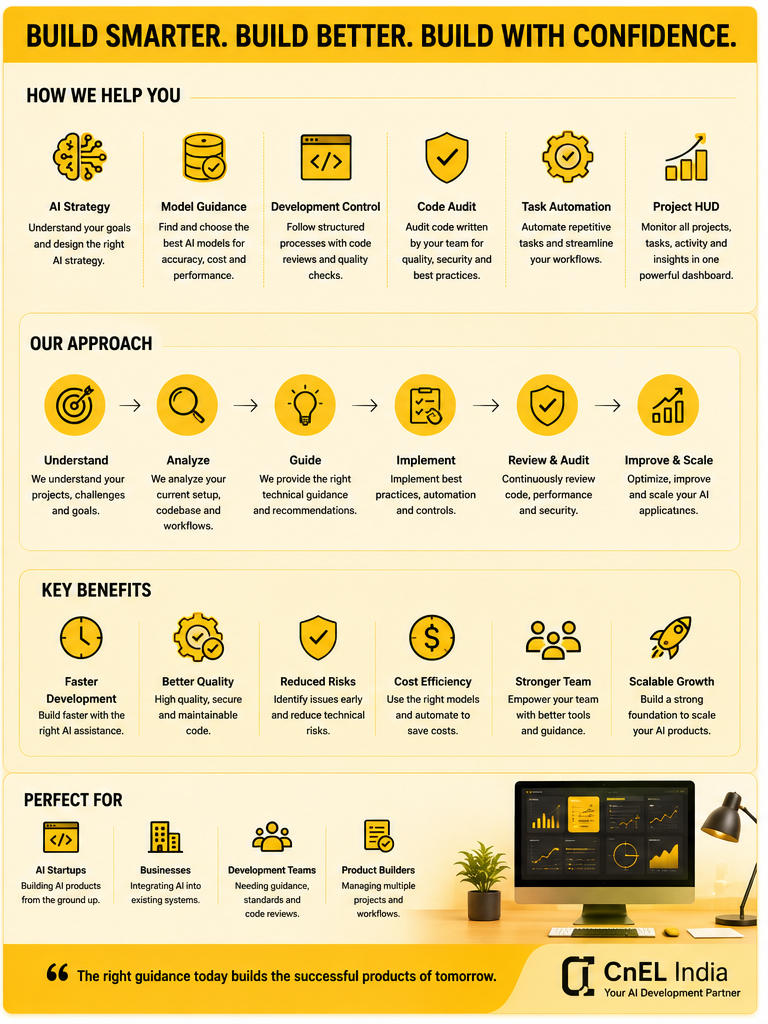
CnEL India could approach the engagement through several stages.
Phase 1 – Assessment:
Review existing applications, development practices, architecture, AI usage, and the current project dashboard.
Phase 2 – Standards:
Establish development, testing, security, model-selection, and code-review standards.
Phase 3 – Coaching:
Provide ongoing technical guidance during active development.
Phase 4 – Code Auditing:
Regularly review implementations created by team members and identify technical risks.
Phase 5 – Automation:
Identify repetitive processes and introduce appropriate automated workflows.
Phase 6 – Monitoring:
Track development quality, productivity, AI performance, and project progress.
Phase 7 – Continuous Improvement:
Use collected insights to continuously improve development practices and AI usage.
Future Expansion
As the client’s AI development environment matures, the guidance framework could expand into more advanced areas.
The system could eventually support automated project health analysis, intelligent documentation, development risk detection, technical knowledge management, automated testing assistance, architecture recommendations, and advanced workflow orchestration.
The HUD could also evolve into a central command center where the client can monitor multiple AI applications, review technical alerts, understand development progress, and make informed decisions from a single interface.
Why CnEL India
CnEL India’s role in this type of engagement extends beyond conventional software development.
The value comes from combining AI understanding, software engineering principles, technical review, automation thinking, and continuous guidance.
Instead of simply delivering isolated features, the objective is to help establish a sustainable development environment where AI becomes a productive and controlled part of the engineering process.
The focus remains on practical outcomes: better development decisions, stronger code quality, reduced repetitive work, improved visibility, and a scalable foundation for future AI applications.
Conclusion
Building AI applications successfully requires more than access to advanced AI capabilities. Teams also need technical direction, development controls, code quality standards, security practices, and a clear understanding of when and how AI should be used.
This case study demonstrates how CnEL India can support a client as an AI development coach and technical partner, helping evaluate AI approaches, guide application development, audit team code, automate repetitive tasks, and improve overall development quality.
The combination of AI-assisted development and experienced human oversight creates a balanced approach: AI provides speed and capability, while engineering governance provides reliability and control.
Ultimately, the goal is to create an environment where the client can build AI applications faster without sacrificing quality, security, maintainability, or long-term scalability.