
Case Study by CnEL India
Introduction
Modern businesses generate enormous amounts of data through their websites, applications, customer interactions, marketing activities, sales processes, and other digital operations. While this data can provide valuable insights, many organizations struggle to turn it into information that business owners and decision-makers can easily understand and act upon.
Raw data is often spread across multiple systems. Managers may need to log into different platforms to check performance, compare business metrics, monitor customer activity, review financial information, and understand operational trends. This fragmented approach consumes time and makes it difficult to obtain a complete picture of business performance.
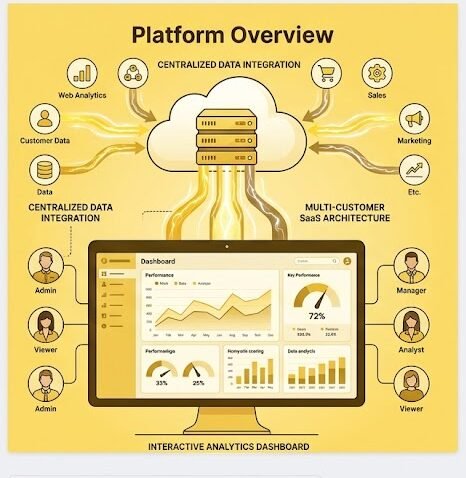
A centralized SaaS analytics dashboard can solve this problem by bringing information from multiple external sources into a single, easy-to-use platform. Instead of manually collecting reports, users can log into one application and view important metrics through interactive dashboards, charts, reports, and performance indicators.
CnEL India provides full-stack SaaS development solutions focused on creating scalable web applications, centralized analytics systems, third-party data integrations, secure user management, and subscription-based platforms. This case study explains how CnEL India can approach the development of a complete SaaS analytics dashboard that combines data integration, visualization, user management, subscription billing, security, and scalable architecture.
Business Background
The proposed platform is designed for businesses that need centralized access to operational and performance data.
Traditional reporting environments often create several challenges:
- Data is distributed across multiple systems
- Reports require manual preparation
- Business metrics are difficult to compare
- Managers lack real-time visibility
- Users have limited customization options
- Subscription management becomes complicated
- Data synchronization can fail
- Different customers require separate data access
- Large datasets can affect application performance
A SaaS-based analytics platform provides a centralized solution where customers can securely access their own business information through an intuitive dashboard.
The system can support multiple customers while maintaining strict separation between their information and account settings.
Project Objectives
The primary objective is to build a reliable web-based SaaS analytics platform that allows customers to connect external data sources, monitor business performance, and access insights through a centralized dashboard.
The project focuses on:
- SaaS application development
- User registration and authentication
- Customer account management
- Third-party data integration
- Automated data synchronization
- Centralized data processing
- Interactive analytics dashboards
- Subscription management
- Billing workflows
- Role-based access
- Secure data storage
- Performance optimization
- Scalable architecture
The ultimate goal is to create a platform that is simple for customers to use while remaining technically robust enough to support future growth.
Understanding Business Requirements
CnEL India begins by understanding how customers will use the platform.
The discovery process identifies:
- Target customer types
- Key business metrics
- Required data sources
- Dashboard requirements
- User roles
- Subscription plans
- Billing rules
- Reporting requirements
- Data refresh frequency
- Security expectations
- Future expansion plans
This stage ensures that the platform is designed around actual business requirements rather than unnecessary features.
SaaS Architecture
Unlike a traditional website designed for one organization, a SaaS platform must support multiple customers.
The architecture therefore needs to manage:
- Customer accounts
- User accounts
- Permissions
- Subscription information
- Connected data sources
- Customer-specific analytics
- Usage information
- Billing records
Each customer should have an isolated environment within the shared application architecture.
This approach makes the system easier to maintain and allows new customers to be added without creating a separate application for every business.
User Registration and Authentication
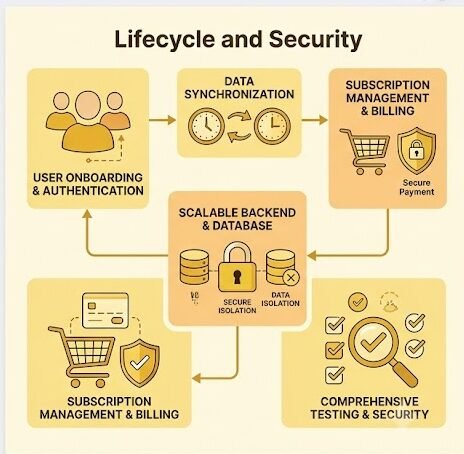
The first interaction for most customers is account creation.
CnEL India can design a simple onboarding process where users can:
- Create an account
- Verify their identity
- Set up their organization
- Select a subscription
- Connect their data sources
- Configure dashboard preferences
- Begin viewing analytics
Secure authentication ensures that only authorized users can access protected information.
Role-Based Access
Different users within an organization may require different permissions.
For example:
Administrator
Can manage users, subscriptions, integrations, and account settings.
Manager
Can view analytics, reports, and performance information.
Analyst
Can analyze data and create reports according to assigned permissions.
Viewer
Can access approved dashboards without modifying configurations.
This permission structure provides better security and operational control.
Third-Party API Integration
One of the most important parts of the project is connecting the SaaS platform with external data sources.
External systems may provide information through APIs.
CnEL India develops integration layers that can:
- Authenticate with external systems
- Retrieve required information
- Process incoming data
- Handle pagination
- Manage API limits
- Detect errors
- Retry failed requests
- Store synchronized information
- Track synchronization status
This creates a reliable connection between external services and the analytics platform.
Data Synchronization
External data may change frequently.
The platform therefore requires an automated synchronization mechanism.
Depending on the business requirement, synchronization can occur:
- In real time
- Every few minutes
- Hourly
- Daily
- On demand
The system records synchronization status so users can understand when their information was last updated.
Data Processing
Raw information received from external sources may not be suitable for direct presentation.
CnEL India processes the information by:
- Cleaning records
- Standardizing formats
- Removing unnecessary duplicates
- Validating values
- Organizing data
- Calculating business metrics
- Preparing analytics-ready datasets
This creates a reliable foundation for dashboard reporting.
Analytics Dashboard
The dashboard serves as the central interface of the application.
A well-designed dashboard can display:
- Revenue
- Customer activity
- Sales performance
- Conversion metrics
- Growth trends
- Operational statistics
- Performance indicators
- Period comparisons
The exact metrics depend on the customer’s business requirements.
Interactive Data Visualization
Simply displaying numbers is not always sufficient.
CnEL India can create visual representations such as:
- Line charts
- Bar charts
- Trend graphs
- Comparison tables
- Performance indicators
- Summary cards
- Progress indicators
Interactive visualization allows users to identify trends quickly.
Filtering and Date Selection
Different customers need to analyze different time periods.
The dashboard can provide filters for:
- Today
- Yesterday
- Current week
- Previous week
- Current month
- Previous month
- Current year
- Custom date ranges
Additional filters can allow users to examine specific products, campaigns, locations, customer groups, or other business dimensions.
Custom Dashboard Experience
Different organizations have different priorities.
The platform can allow customers to customize their dashboard by:
- Selecting important metrics
- Rearranging widgets
- Hiding unnecessary information
- Creating preferred views
- Saving filters
- Creating custom reports
Personalization improves usability.
Subscription Management
Since the platform follows a SaaS model, subscription management is an important component.
The system can support multiple plans such as:
- Basic
- Professional
- Business
- Enterprise
Each plan can have different limitations and features.
For example, plans may differ based on:
- Number of users
- Number of integrations
- Data volume
- Dashboard features
- Reporting capabilities
- Data refresh frequency
This provides a flexible pricing structure.
Billing Workflow
Subscription billing should be simple and transparent.
The platform manages:
- Plan selection
- Subscription activation
- Recurring payments
- Billing status
- Invoice information
- Upgrades
- Downgrades
- Renewal dates
- Cancellation requests
Users should be able to manage their subscription from their account settings.
Payment Security
Financial transactions require secure handling.
CnEL India designs the billing architecture so sensitive payment information is handled through secure payment infrastructure rather than unnecessarily stored within the application’s own database.
The platform maintains appropriate subscription and transaction references while protecting sensitive financial information.
Backend Development
The backend acts as the core processing layer.
It manages:
- Authentication
- User accounts
- Permissions
- API communication
- Data processing
- Dashboard queries
- Subscription information
- Billing events
- Notifications
- System logs
A modular backend architecture makes the application easier to maintain and expand.
Database Architecture
The database stores structured information required by the application.
Important entities can include:
- Users
- Organizations
- Roles
- Subscriptions
- Plans
- Integrations
- Data records
- Dashboard configurations
- Reports
- Billing records
- System events
Customer-specific data must remain logically isolated to prevent unauthorized access.
Performance Optimization
Analytics applications may process large amounts of information.
Without proper optimization, dashboards can become slow.
CnEL India can improve performance through:
- Efficient database queries
- Indexed data
- Caching
- Pre-calculated metrics
- Background processing
- Pagination
- Optimized API requests
- Data aggregation
These techniques help maintain responsive dashboards as customer numbers increase.
Error Handling and Reliability
External integrations can fail for many reasons.
Possible problems include:
- Expired credentials
- Network failures
- API changes
- Temporary service outages
- Invalid data
- Rate limitations
The system therefore needs reliable error handling, retry mechanisms, status tracking, and clear administrative notifications.
Users should be informed when synchronization problems occur without exposing unnecessary technical details.
Security
Security is a major requirement for any SaaS analytics platform.
CnEL India focuses on:
- Secure authentication
- Permission management
- Encrypted communication
- Protected API credentials
- Customer data isolation
- Secure database access
- Activity monitoring
- Backup strategies
Security controls are incorporated throughout the application rather than added only at the end.
Testing and Quality Assurance
Before deployment, the platform undergoes comprehensive testing.
Testing covers:
User Management
Registration, login, password recovery, and permissions.
Data Integration
Connection, synchronization, and error recovery.
Dashboard
Charts, filters, calculations, and responsive behavior.
Billing
Subscription activation, renewal, cancellation, and plan changes.
Security
Access restrictions and customer data isolation.
Performance
Large datasets, multiple users, and concurrent requests.
Compatibility
Desktop, tablet, and mobile experiences.
Responsive Design
Business users may access dashboards from different devices.
CnEL India ensures that the interface adapts to:
- Desktop computers
- Laptops
- Tablets
- Mobile devices
Important analytics should remain readable without requiring excessive scrolling or zooming.
Deployment and Monitoring
After development, the application is prepared for production deployment.
The deployment process includes:
- Production configuration
- Database setup
- Environment configuration
- Security verification
- Performance testing
- Data integration testing
- Backup configuration
- Monitoring setup
Ongoing monitoring helps identify errors and performance issues before they significantly affect customers.
Future Scalability
The platform should be designed with future growth in mind.
Potential future features include:
- Additional integrations
- Advanced analytics
- Automated reports
- Email notifications
- Export functionality
- Team collaboration
- Forecasting
- AI-powered insights
- Custom reporting
- Enterprise account management
A modular architecture makes these enhancements easier to introduce.
Business Benefits
The SaaS analytics dashboard provides several important benefits:
- Centralized business information
- Faster decision-making
- Reduced manual reporting
- Better performance visibility
- Automated data synchronization
- Improved customer experience
- Recurring revenue opportunities
- Scalable business model
- Secure multi-customer architecture
- Flexible subscription management
- Improved operational efficiency
The platform can become a central source of truth for business performance.
Challenges Solved
Fragmented Data
Information from different systems is brought into one centralized platform.
Manual Reporting
Automated synchronization and dashboards reduce repetitive reporting work.
Poor Visibility
Management receives a clear overview of important metrics.
Complex Data
Raw information is transformed into understandable business insights.
Subscription Complexity
Plans, billing, upgrades, and renewals are managed within one system.
Scalability
The architecture supports multiple customers and future growth.
Security Concerns
Authentication, permissions, and customer data isolation protect sensitive information.
Why CnEL India
CnEL India combines expertise in full-stack development, SaaS application architecture, API integration, database engineering, analytics interfaces, subscription systems, security, and scalable web applications.
The focus is not simply on creating a dashboard but on developing a complete business platform capable of managing users, data, integrations, analytics, subscriptions, and future expansion within one reliable ecosystem.
CnEL India’s approach emphasizes clean architecture, intuitive user experience, secure data management, performance, scalability, and long-term maintainability.
Conclusion
This case study demonstrates how CnEL India can transform fragmented business information into a centralized SaaS analytics platform.
By combining a secure multi-customer architecture, third-party data integration, automated synchronization, structured data processing, interactive dashboards, subscription management, billing workflows, role-based access, and scalable backend infrastructure, the platform provides businesses with a reliable way to monitor their most important performance indicators.
The result is a modern, scalable, and user-friendly SaaS solution that reduces manual reporting, improves business visibility, simplifies decision-making, and creates a strong foundation for long-term digital growth.