
Case Study by CnEL India
Introduction
In today’s fast-paced business environment, design teams are expected to manage multiple projects simultaneously while maintaining high quality, meeting strict deadlines, and collaborating efficiently across departments. Whether working on architectural designs, engineering drawings, product development, manufacturing layouts, construction documentation, branding assets, or creative deliverables, organizations often struggle to maintain visibility over project progress when work is assigned directly to individual employees instead of being structured around projects.
Traditional task management methods typically organize work according to team members, making it difficult to understand the real status of projects. When employees become unavailable due to leave, workload balancing, department transfers, or changing priorities, managers must manually reassign tasks, resulting in broken workflows, duplicated work, delayed deliveries, and inaccurate reporting.
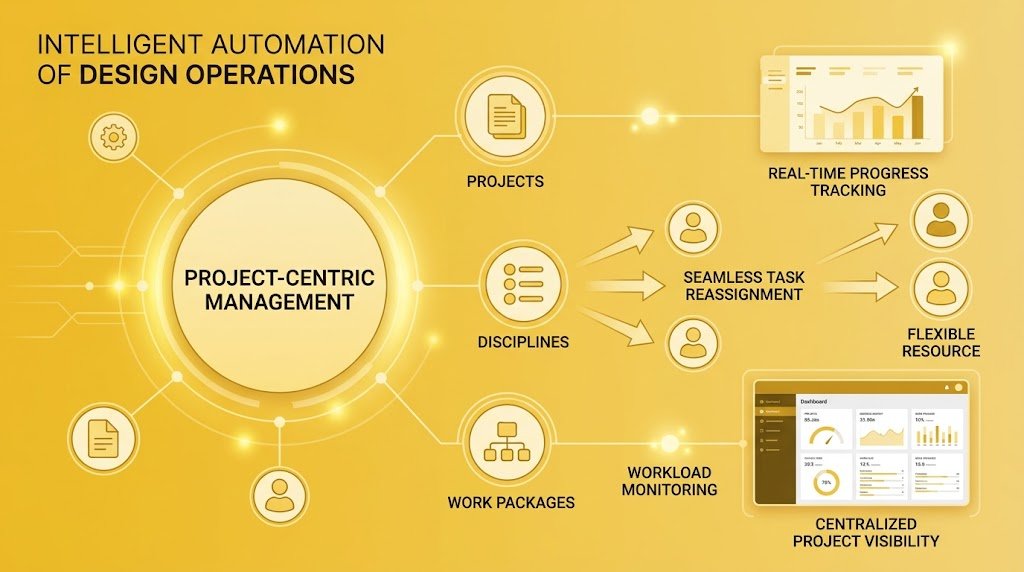
CnEL India specializes in developing intelligent project management automation solutions that organize work around projects, disciplines, and work packages rather than individual resources. This approach creates a flexible operational environment where assignments can move seamlessly between team members while preserving project integrity, ensuring accurate reporting, improving workload visibility, and enabling better management decisions.
This case study explains how CnEL India designed and implemented an automated project management framework that transformed design operations through structured workflows, intelligent task allocation, real-time progress tracking, workload monitoring, and centralized project visibility.
Business Background
Organizations handling engineering, design, consulting, manufacturing, and creative projects often manage hundreds of concurrent work packages across multiple departments.
Common operational challenges include:
- Employee-based task management
- Limited project visibility
- Uneven workload distribution
- Delayed task reassignment
- Missed project deadlines
- Manual reporting
- Inconsistent workflow management
- Poor collaboration
- Resource conflicts
- Lack of project transparency
- Difficulty tracking package readiness
- Limited management insights
As project complexity grows, these challenges significantly reduce operational efficiency.
CnEL India developed a centralized automation framework that shifts the focus from employees to structured project delivery.
Project Objectives
The primary objective was to create a project management system where work is organized according to projects, disciplines, and work packages rather than individual employees.
The project focused on:
- Project-centric organization
- Work package management
- Discipline-based planning
- Flexible task assignments
- Automated workflow management
- Workload balancing
- Deadline tracking
- Progress monitoring
- Package readiness evaluation
- Team collaboration
- Centralized reporting
- Scalable project operations
The overall goal was to improve project visibility while simplifying resource management.
Understanding Business Requirements
CnEL India began by analyzing the organization’s complete project lifecycle.
Requirement gathering included:
- Project hierarchy
- Department structure
- Design disciplines
- Work package flow
- Approval processes
- Team responsibilities
- Reporting requirements
- Management expectations
- Resource allocation
- Future scalability
Understanding operational workflows ensured that the automation aligned with existing business practices.
Project-Centric Work Organization
Instead of assigning work directly to employees, CnEL India organized the system around project structures.
Each project contains:
- Project information
- Client details
- Design disciplines
- Work packages
- Deliverables
- Milestones
- Deadlines
- Approval stages
This structure keeps projects intact regardless of personnel changes.
Discipline-Based Project Structure
Large design projects involve multiple specialized disciplines.
Examples include:
- Architectural design
- Structural engineering
- Electrical systems
- Mechanical systems
- Interior design
- Landscape planning
- Documentation
- Quality review
Each discipline operates independently while remaining connected to the overall project.
Work Package Management
Projects are divided into manageable work packages.
Each package includes:
- Scope of work
- Deliverables
- Assigned discipline
- Priority level
- Current status
- Estimated effort
- Due date
- Approval requirements
Breaking projects into structured packages improves planning accuracy.
Flexible Resource Assignment
One of the biggest challenges in traditional systems is dependency on individual employees.
CnEL India designed flexible assignments where:
- Work belongs to the project
- Employees perform tasks
- Assignments can change anytime
- Project history remains intact
- Deadlines stay connected
- Documentation remains centralized
This improves operational continuity.
Workload Visibility
Managers require real-time visibility into team capacity.
The automation platform provides insights into:
- Active assignments
- Pending work
- Completed tasks
- Department workload
- Individual capacity
- Project priorities
- Upcoming deadlines
- Resource availability
This enables better planning.
Intelligent Work Distribution
Balanced workload improves productivity.
CnEL India developed intelligent assignment logic based on:
- Current workload
- Skill requirements
- Discipline expertise
- Availability
- Priority level
- Project deadlines
- Resource capacity
Balanced distribution prevents bottlenecks.
Deadline Monitoring
Timely project delivery depends on continuous monitoring.
The system tracks:
- Upcoming deadlines
- Overdue work
- Milestone completion
- Work package progress
- Department performance
- Schedule variance
Automatic monitoring reduces project delays.
Package Readiness Tracking
Each work package progresses through predefined stages.
Typical workflow includes:
- Planning
- Assignment
- Design
- Internal review
- Quality verification
- Client review
- Revision
- Final approval
- Completion
Managers always know which packages are ready for the next phase.
Workflow Automation
Manual task movement often creates delays.
CnEL India automated workflow transitions by defining structured process stages.
Automation supports:
- Status updates
- Assignment changes
- Approval routing
- Notification triggers
- Deadline reminders
- Progress tracking
This reduces administrative work.
Cross-Team Collaboration
Multiple departments frequently collaborate on the same project.
The system improves communication through:
- Shared project information
- Common documentation
- Unified timelines
- Progress visibility
- Centralized discussions
- Coordinated approvals
Collaboration becomes significantly more efficient.
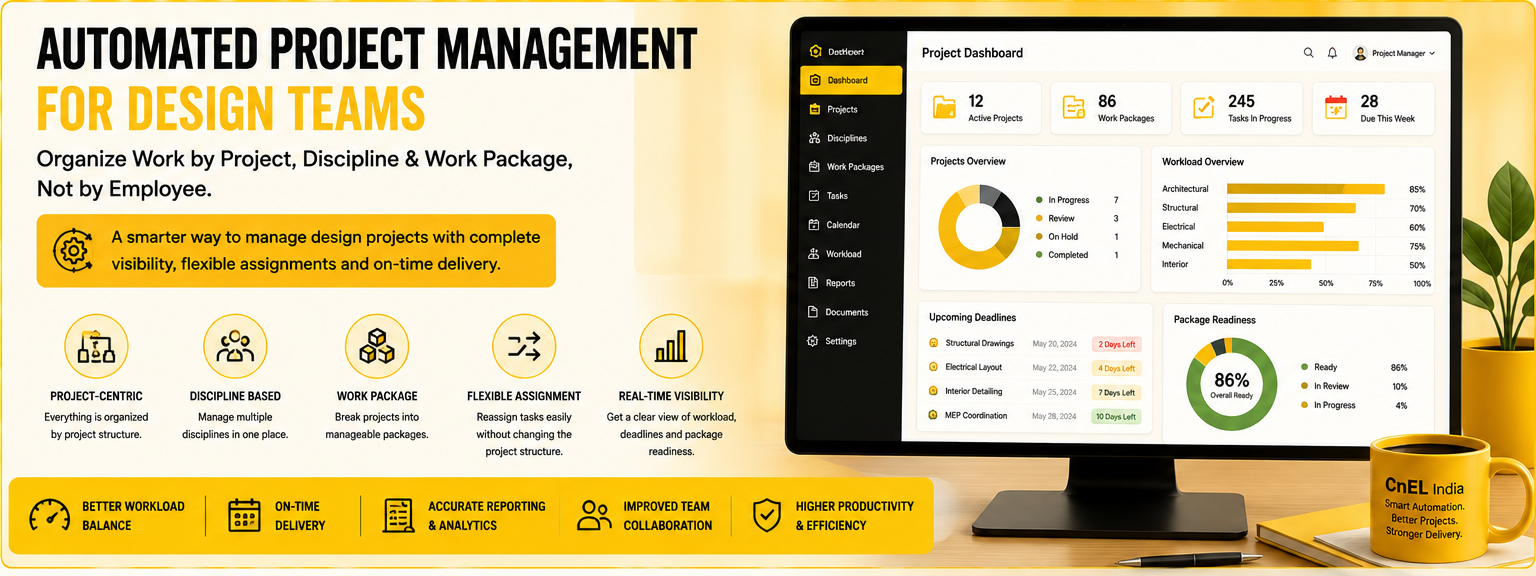
Progress Dashboards
Management requires clear project visibility.
CnEL India developed dashboards displaying:
- Overall project status
- Discipline progress
- Work package completion
- Resource utilization
- Deadline performance
- Pending approvals
- Project health indicators
Visual dashboards simplify decision-making.
Resource Planning
Effective planning requires accurate capacity management.
The system supports:
- Future assignments
- Team forecasting
- Capacity planning
- Leave management
- Resource balancing
- Project scheduling
Planning improves operational efficiency.
Reporting and Analytics
Decision-makers need reliable project information.
Reports include:
- Project progress
- Package completion
- Discipline performance
- Workload distribution
- Deadline adherence
- Resource utilization
- Productivity metrics
- Project summaries
Automated reporting saves valuable management time.
Document Management
Each work package maintains associated documentation.
The platform organizes:
- Design files
- Drawings
- Specifications
- Revision history
- Client comments
- Approval documents
- Supporting references
Centralized storage improves accessibility.
Quality Control
Quality assurance is integrated throughout the workflow.
Review stages verify:
- Design completeness
- Documentation accuracy
- Technical compliance
- Revision management
- Approval consistency
- Final deliverables
Structured reviews improve output quality.
Security and Access Control
Project information requires controlled access.
CnEL India implemented role-based permissions for:
- Project managers
- Team leaders
- Designers
- Reviewers
- Department heads
- Administrators
Users access only authorized information.
Scalability
The platform supports organizational growth.
Future expansion includes:
- Additional departments
- Larger project portfolios
- More work packages
- Multiple office locations
- External collaborators
- Client portals
The architecture remains flexible for long-term growth.
Testing and Validation
Before deployment, the automation system underwent extensive testing.
Testing included:
Workflow Validation
Ensuring task movement follows defined processes.
Assignment Testing
Verifying flexible resource allocation.
Deadline Monitoring
Checking notification accuracy.
Reporting
Validating management dashboards.
Access Control
Testing user permissions.
Performance
Evaluating system responsiveness under large workloads.
Comprehensive testing ensured operational reliability.
Deployment Strategy
CnEL India followed a phased implementation approach.
Deployment activities included:
- Project migration
- Workflow configuration
- User onboarding
- Data validation
- Team training
- Live monitoring
- Performance optimization
Gradual deployment minimized business disruption.
Business Benefits
The automated project management system delivered significant operational improvements.
Expected benefits include:
- Better project visibility
- Flexible task assignments
- Improved collaboration
- Balanced workloads
- Faster decision-making
- Accurate reporting
- Reduced administrative effort
- Better deadline management
- Higher productivity
- Improved resource utilization
- Greater project transparency
- Scalable operations
Challenges Solved
CnEL India successfully addressed several operational challenges.
Employee-Centric Task Management
Work is now organized around projects instead of individuals.
Limited Visibility
Management gains complete project transparency.
Resource Conflicts
Balanced workload improves efficiency.
Manual Reassignment
Flexible assignments reduce disruption.
Missed Deadlines
Continuous monitoring improves delivery performance.
Reporting Delays
Automated dashboards provide real-time insights.
Collaboration Gaps
Centralized workflows improve communication.
Scalability Issues
The platform supports future organizational growth.
Why CnEL India
CnEL India combines expertise in enterprise workflow automation, project management systems, digital transformation, business process optimization, resource planning, collaborative platforms, reporting solutions, and scalable software development.
Rather than creating a simple task management solution, CnEL India develops intelligent project management ecosystems that improve operational visibility, simplify resource allocation, strengthen collaboration, and enable organizations to deliver complex projects with greater efficiency and consistency.
Every solution is designed with flexibility, scalability, transparency, and long-term business value at its core.
Conclusion
This case study demonstrates how CnEL India transformed traditional design project management into a structured, project-centric operational framework.
By organizing work around projects, disciplines, and work packages instead of individual employees, the solution enables seamless task reassignment, balanced resource utilization, automated workflow management, real-time progress monitoring, centralized reporting, and improved collaboration across teams.
The result is a scalable, efficient, and future-ready project management environment that enhances productivity, improves decision-making, strengthens project control, and supports the successful delivery of complex design projects while providing management with complete visibility into workload, deadlines, and project readiness.