
Introduction
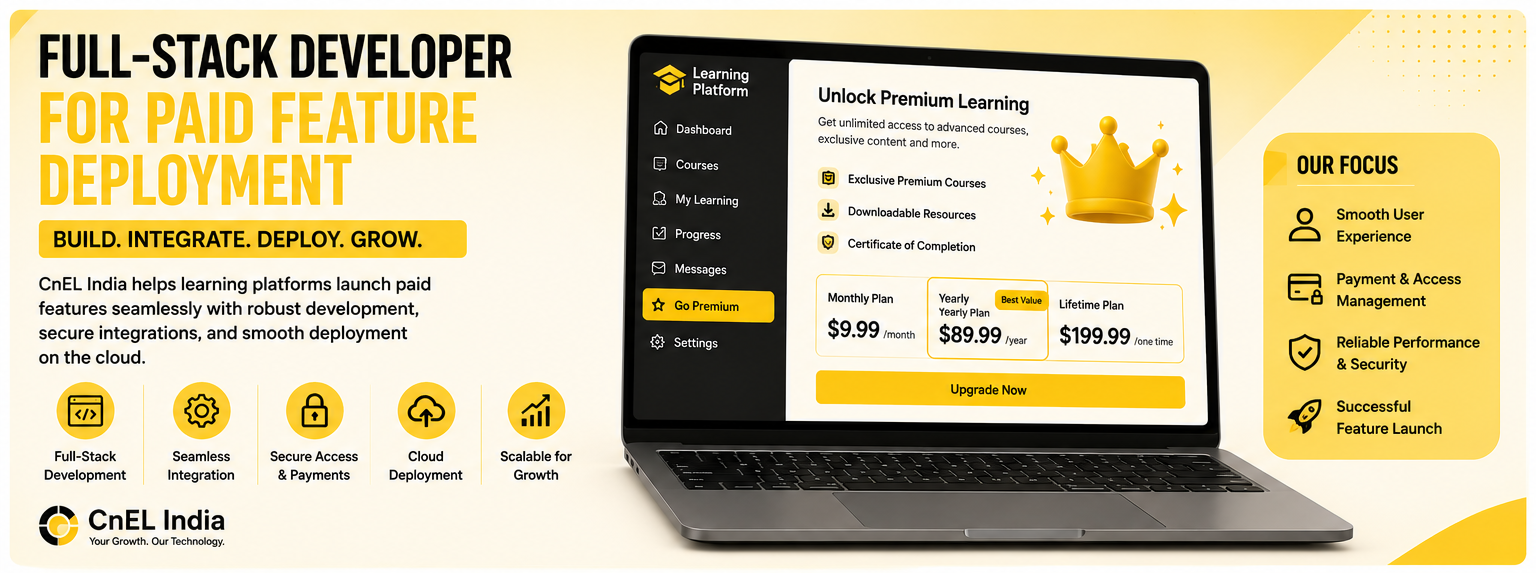
Digital learning platforms continue to evolve beyond content delivery and increasingly depend on sustainable monetization strategies to support growth, improve user experiences, and unlock long-term business value. Introducing paid functionality inside an existing platform is no longer a simple development task—it becomes a business transformation initiative that touches architecture, user experience, platform reliability, billing readiness, release management, and customer adoption.
This case study explains how CnEL India approaches the deployment and launch of a new paid capability within an existing learning ecosystem.
The platform already operates in production and includes a modern frontend experience, backend services, cloud infrastructure, and a structured database environment. The objective is to introduce a revenue-generating feature without disrupting current users while maintaining performance, security, and scalability.
This engagement focuses on:
- Product enhancement
- Paid feature deployment
- Platform integration
- User journey optimization
- Subscription readiness
- Backend scalability
- Release execution
- Growth enablement
CnEL India treats feature deployment not as isolated development work but as a structured launch process that balances business outcomes and technical reliability.
Business Background
Learning platforms often begin with free access models to acquire users and validate demand.
As usage grows, businesses begin introducing premium capabilities to:
- Generate recurring revenue
- Offer advanced learning experiences
- Differentiate service tiers
- Improve retention
- Increase customer lifetime value
However, launching monetized functionality inside an existing environment introduces complexity.
The challenge is maintaining operational continuity while introducing controlled access and payment-driven experiences.
CnEL India solves this through structured deployment planning.
Understanding Existing Platform Architecture
Before introducing any enhancement, understanding the current ecosystem is essential.
CnEL India begins with a full assessment of:
- Existing application architecture
- Data relationships
- Service dependencies
- User access flows
- Current deployment structure
- Performance characteristics
The objective is ensuring the paid capability becomes a natural extension of the platform.
Defining the Paid Feature Strategy
A successful launch starts with clarity.
CnEL India identifies:
Business Objective
What revenue outcome is expected.
User Value
Why customers would upgrade.
Access Rules
Who receives access.
Growth Path
How future premium capabilities may evolve.
These decisions guide technical implementation.
Designing a Seamless User Experience
Introducing payment should never create friction.
CnEL India designs user journeys that support:
- Clear feature visibility
- Smooth upgrade experiences
- Consistent navigation
- Minimal disruption
Users should understand value before purchasing.
Mapping the User Lifecycle
Every monetized platform must understand user progression.
CnEL India structures journeys across:
Discovery
Users explore available features.
Evaluation
Users understand premium value.
Activation
Access is enabled.
Engagement
Users consume premium experiences.
Retention
Customers continue receiving value.
Journey mapping supports long-term growth.
Building Controlled Feature Access
Premium functionality requires structured access management.
CnEL India develops mechanisms to control:
- User permissions
- Access duration
- Entitlement validation
- Upgrade pathways
This ensures reliable operations.
Feature Integration Without Disruption
The platform already supports active users.
CnEL India ensures the new capability:
- Fits existing architecture
- Avoids breaking dependencies
- Preserves performance
- Supports backward compatibility
Integration quality protects the user experience.
Frontend Experience Enhancement
Paid functionality must feel native.
CnEL India enhances the platform experience through:
- Improved interface consistency
- Clear premium indicators
- Responsive interaction design
- Seamless navigation patterns
The objective is creating intuitive adoption.
Backend Enablement and Business Logic
Behind every premium experience sits operational logic.
CnEL India enables workflows for:
- Access validation
- Feature activation
- Session handling
- Status tracking
Business rules remain controlled.
Database Planning and Data Integrity
Monetized environments generate additional data requirements.
CnEL India structures data handling for:
- Subscription relationships
- Usage tracking
- Historical records
- Access history
Data integrity becomes critical.
Managing Feature Dependencies
Premium releases often depend on existing workflows.
CnEL India identifies:
- Shared services
- Existing modules
- API dependencies
- User account relationships
Dependency mapping reduces risk.
Release Readiness Planning
Deployment preparation is essential.
CnEL India creates launch readiness processes including:
- Validation environments
- Configuration reviews
- Dependency checks
- Rollback preparation
Prepared launches reduce incidents.
Scalability and Performance Preparation
Paid features often attract increased usage.
CnEL India prepares infrastructure to support:
- Higher traffic volumes
- Concurrent users
- Data growth
- Expansion opportunities
Scalability protects customer experience.
Security and Access Governance
Monetized platforms require stronger controls.
CnEL India introduces:
- Access boundaries
- Session protection
- Permission validation
- Controlled user visibility
Security supports trust.
Monitoring Platform Health
Visibility after deployment is essential.
CnEL India establishes monitoring around:
- Feature usage
- Error rates
- User engagement
- Operational stability
Issues become measurable.
Deployment and Launch Execution
Successful launches require coordination.
CnEL India structures execution across:
Environment Preparation
Ensure readiness.
Controlled Deployment
Release in stages.
Validation
Confirm functionality.
Monitoring
Track platform health.
Optimization
Improve post-launch.
Structured execution minimizes disruption.
Testing and Quality Assurance
Quality becomes increasingly important in paid experiences.
CnEL India validates:
- Access behavior
- Workflow completion
- User interactions
- Data consistency
- Cross-device functionality
Testing improves launch confidence.
Handling Existing User Migration
Existing users must transition smoothly.
CnEL India prepares migration plans for:
- Existing accounts
- Access continuity
- Communication readiness
- Customer support workflows
Transition management improves adoption.
Supporting Product Analytics
Paid launches generate strategic insights.
CnEL India prepares analytics visibility around:
- Upgrade rates
- Feature engagement
- Customer behavior
- Retention trends
Analytics guide growth decisions.
Operational Ownership and Maintenance
Launch is only the beginning.
CnEL India supports long-term operational readiness through:
- Maintenance planning
- Performance optimization
- Process documentation
- Support frameworks
Sustainability becomes achievable.
Future Expansion Planning
The architecture should support future growth.
CnEL India prepares for:
- Additional premium tiers
- Expanded capabilities
- Market growth
- Operational scaling
Future readiness reduces redevelopment.
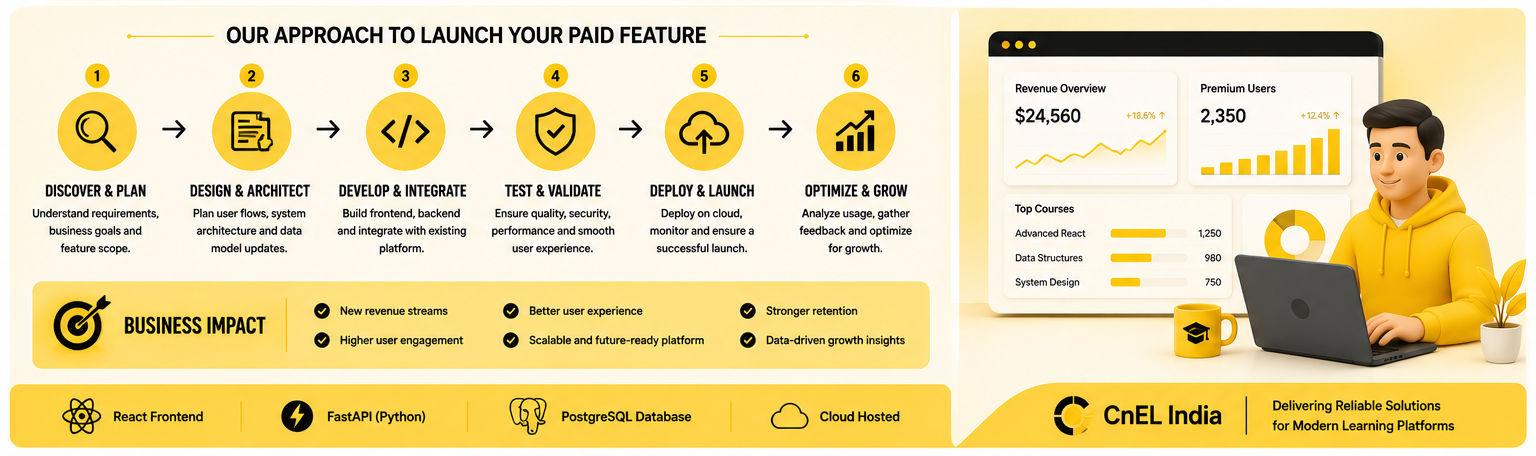
Delivery Framework
Execution follows a structured approach.
Phase 1 — Discovery
Review current platform.
Phase 2 — Solution Design
Define monetization architecture.
Phase 3 — Integration
Build feature connectivity.
Phase 4 — Validation
Perform testing and readiness checks.
Phase 5 — Launch
Deploy to production.
Phase 6 — Optimization
Improve based on usage.
Challenges Solved by CnEL India
This engagement addresses:
- Complex feature deployment
- Revenue enablement challenges
- Platform dependency risks
- User disruption concerns
- Scaling requirements
The result is a controlled and reliable launch.
Business Outcomes Delivered
Organizations implementing this approach gain:
- Faster monetization capability
- Improved platform reliability
- Better user experiences
- Scalable growth infrastructure
- Increased operational confidence
Paid functionality becomes sustainable.
Why CnEL India
CnEL India combines:
- Full-stack delivery expertise
- Product thinking
- Platform modernization capability
- Release management experience
- Growth-oriented execution
The objective is delivering launch-ready digital experiences that support business outcomes.
Conclusion
This case study demonstrates how CnEL India can successfully deploy and launch a paid feature inside an existing learning platform through structured architecture planning, seamless integration, scalable deployment, and operational readiness.
Rather than treating monetization as a simple release activity, the approach transforms it into a scalable growth initiative that strengthens platform value, improves customer experience, and enables sustainable business expansion.
By combining technical execution, launch governance, performance optimization, and long-term planning, CnEL India helps organizations move from feature development to successful revenue activation.