
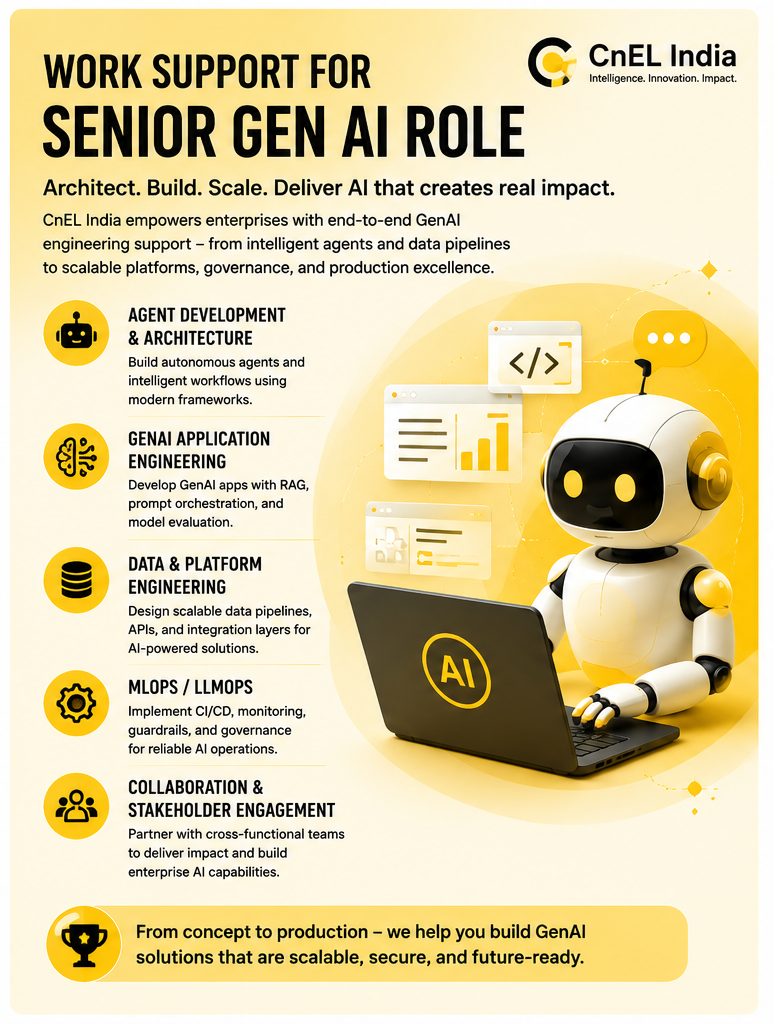
Case Study by CnEL India
Introduction
As organizations accelerate adoption of advanced artificial intelligence capabilities, the demand has shifted from experimentation to production-grade implementation. Businesses are no longer looking for isolated prototypes—they require scalable systems that connect data, reasoning, automation, governance, and measurable business outcomes.
Senior Gen AI roles now sit at the intersection of architecture, engineering, operations, and business transformation. These professionals are expected to design intelligent workflows, enable enterprise-scale deployments, build reusable foundations, and guide teams toward sustainable adoption.
This case study explains how CnEL India supports a Senior Gen AI function by designing and operationalizing enterprise-grade intelligent systems across application engineering, workflow orchestration, platform development, governance, and delivery operations.
Rather than viewing AI as a standalone feature, CnEL India treats it as an operational capability embedded into business processes.
This engagement focuses on:
- Agent architecture
- Intelligent workflow design
- Application engineering
- Retrieval and knowledge systems
- Platform scalability
- Distributed data operations
- Deployment governance
- Enterprise enablement
The objective is to transform advanced AI concepts into reliable business infrastructure.
Business Context
Modern enterprises generate large volumes of:
- Documents
- Operational records
- Customer interactions
- Reports
- Internal knowledge
- Analytical outputs
Traditional software architectures struggle when decisions require context, adaptation, and continuous learning.
The role of a Senior Gen AI leader becomes enabling systems that can:
- Interpret information
- Execute workflows
- Generate outputs
- Support operators
- Improve productivity
CnEL India approaches this challenge through layered architecture and scalable delivery.
Defining the Enterprise AI Vision
Before implementation, a clear operating model must exist.
CnEL India begins by identifying:
Business Goals
Desired outcomes.
Process Opportunities
Areas suitable for automation.
Human Interaction Requirements
Approval and oversight layers.
System Boundaries
What remains controlled.
This ensures AI adoption remains practical.
Agent Development and Intelligent Workflow Architecture
One of the core responsibilities of a Senior Gen AI environment is designing autonomous workflow systems.
CnEL India structures intelligent workflows around:
- Input interpretation
- Decision routing
- Context retrieval
- Action execution
- Feedback loops
- Observability
The focus is creating systems that behave predictably while adapting intelligently.
Designing Autonomous Processing Layers
Autonomous systems must operate with structure.
CnEL India separates execution into layers:
Intake Layer
Receives inputs.
Processing Layer
Transforms information.
Decision Layer
Evaluates outputs.
Execution Layer
Performs actions.
Review Layer
Maintains oversight.
This architecture increases reliability.
Supporting Data Validation Workflows
Data quality directly influences outcomes.
CnEL India develops validation pipelines capable of:
- Detecting anomalies
- Comparing datasets
- Enforcing rules
- Flagging inconsistencies
Validation becomes part of system intelligence.
Document Understanding and Structured Processing
Enterprises manage large volumes of content.
CnEL India enables workflows that:
- Interpret documents
- Extract structured information
- Organize content
- Support downstream operations
This reduces manual effort.
Building Domain-Specific Intelligence
General intelligence alone is insufficient.
CnEL India structures business-aware systems that align with:
- Industry terminology
- Internal processes
- Organizational rules
- Decision requirements
Domain alignment improves relevance.
GenAI Application Engineering
Application engineering converts intelligence into usable products.
CnEL India focuses on building experiences that integrate:
- Natural interaction
- Business logic
- Data access
- Operational workflows
The objective is delivering production-ready capabilities.
Structured Knowledge Retrieval
Intelligent systems perform best when grounded in trusted information.
CnEL India develops retrieval strategies that support:
- Context awareness
- Information precision
- Reduced hallucination risk
- Controlled knowledge access
Knowledge becomes accessible without overwhelming the system.
Prompt and Context Orchestration
Quality outputs require structured instructions.
CnEL India establishes orchestration frameworks that manage:
- Input normalization
- Context assembly
- Dynamic instructions
- Output validation
This improves consistency.
Evaluation and Reliability Engineering
Enterprise adoption requires measurable performance.
CnEL India introduces evaluation frameworks covering:
- Accuracy
- Relevance
- Consistency
- Safety
- Business impact
Evaluation becomes continuous.
Transitioning Prototypes into Production
Many organizations create successful experiments but struggle with deployment.
CnEL India bridges this gap by focusing on:
- System readiness
- Operational requirements
- Architecture alignment
- Long-term maintainability
Production becomes achievable.
Data Engineering for Enterprise Scale
Modern intelligent systems depend on strong data foundations.
CnEL India supports:
- Distributed processing
- Pipeline orchestration
- Transformation workflows
- Data accessibility
Scalable infrastructure enables growth.
Building Integration Layers
Enterprise environments contain multiple systems.
CnEL India develops integration capabilities for:
- Internal platforms
- Business applications
- Analytical systems
- External services
Connected ecosystems increase value.
Performance Optimization
Advanced systems require efficiency.
CnEL India optimizes:
- Latency
- Throughput
- Resource utilization
- Cost management
Performance supports adoption.
Scalable Architecture Design
Scalability is not only technical.
CnEL India plans for:
- User growth
- Workflow expansion
- Data growth
- Geographic scale
Architecture evolves with demand.
Governance and Operational Controls
Enterprise AI requires control frameworks.
CnEL India implements:
- Access governance
- Workflow restrictions
- Output review
- Operational boundaries
Governance protects business outcomes.
Establishing Deployment Pipelines
Deployment becomes repeatable and controlled.
CnEL India structures processes for:
- Environment consistency
- Controlled releases
- Validation stages
- Rollback readiness
Operational maturity increases reliability.
Monitoring and Observability
Visibility supports continuous improvement.
CnEL India establishes monitoring for:
- Workflow execution
- System health
- Response quality
- Operational performance
Issues become detectable.
Governance and Guardrail Systems
Intelligent systems require boundaries.
CnEL India introduces:
- Approval checkpoints
- Usage policies
- Validation rules
- Quality standards
Guardrails reduce operational risk.
Building Reusable Frameworks
Every new project should not begin from zero.
CnEL India creates reusable foundations including:
- Workflow templates
- Processing modules
- Integration standards
- Deployment patterns
Reuse accelerates delivery.
Collaboration Across Teams
Senior AI initiatives succeed through coordination.
CnEL India supports collaboration across:
- Analytics teams
- Product teams
- Engineering teams
- Operations teams
Shared ownership improves outcomes.
Architecture Review Process
Architecture evolves through structured decision-making.
CnEL India evaluates:
- Scalability
- Maintainability
- Security
- Performance
This improves technical confidence.
Knowledge Transfer and Capability Building
Long-term success requires internal adoption.
CnEL India enables:
- Documentation
- Team enablement
- Process education
- Governance alignment
Organizations become self-sustaining.
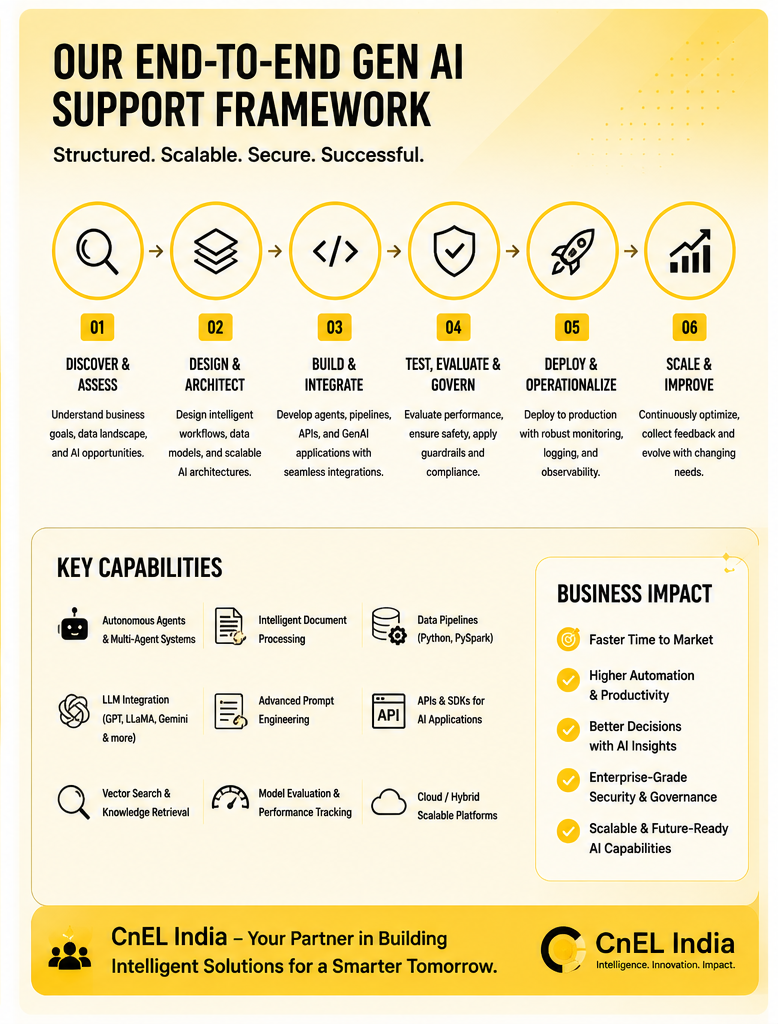
Delivery Framework
Execution follows a structured model.
Phase 1 — Discovery
Understand requirements.
Phase 2 — Architecture
Design system structure.
Phase 3 — Build
Develop intelligent workflows.
Phase 4 — Integration
Connect business systems.
Phase 5 — Validation
Measure performance.
Phase 6 — Scale
Expand operational capability.
Challenges Solved by CnEL India
This engagement addresses:
- Prototype stagnation
- Workflow fragmentation
- Scaling difficulties
- Knowledge accessibility
- Governance concerns
The result is a production-ready operational foundation.
Business Outcomes Delivered
Organizations implementing this model gain:
- Faster delivery cycles
- Better operational efficiency
- Improved decision support
- Scalable intelligent workflows
- Stronger governance and reliability
Intelligence becomes operational.
Why CnEL India
CnEL India combines:
- Enterprise architecture thinking
- Workflow engineering expertise
- Platform scalability knowledge
- Operational governance practices
- Long-term transformation focus
The objective is building intelligent systems that deliver measurable business value.
Conclusion
This case study demonstrates how CnEL India supports Senior Gen AI initiatives by transforming advanced intelligence concepts into scalable enterprise solutions.
Rather than treating AI as isolated automation, the approach integrates intelligent workflows, structured retrieval, platform engineering, deployment governance, and operational enablement into a unified business capability.
By combining architecture, engineering discipline, scalable delivery practices, and continuous improvement, CnEL India enables organizations to move from experimentation to production-ready intelligent operations.