
Introduction
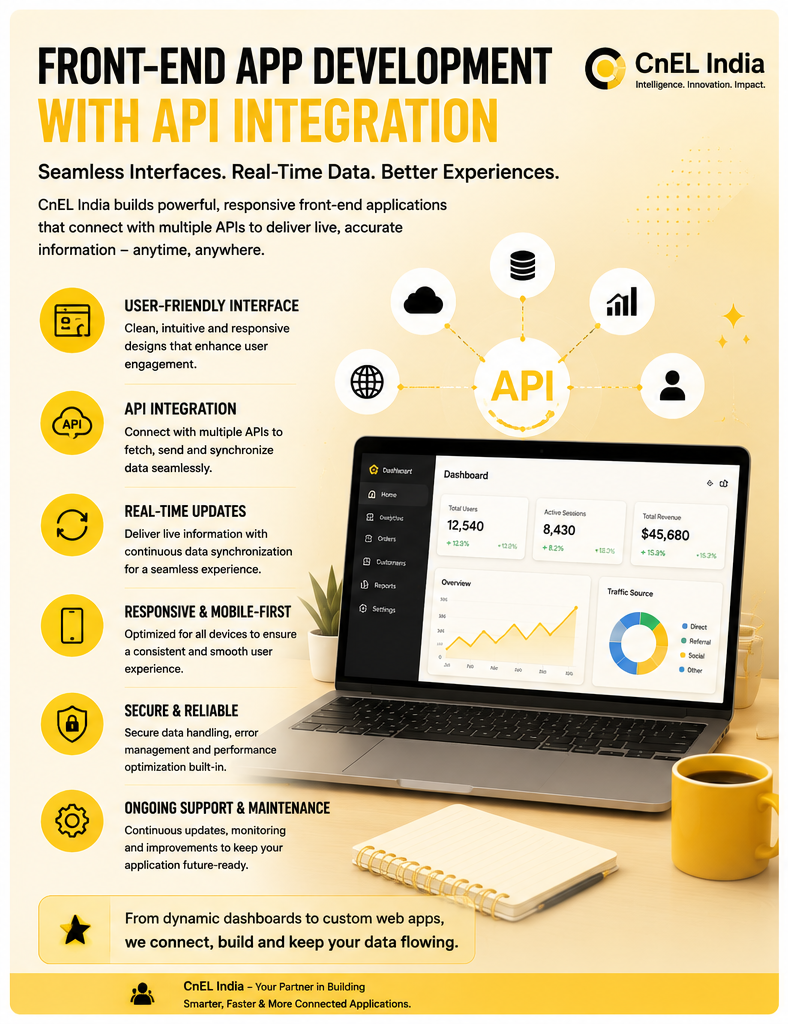
In today’s digital-first business environment, users expect applications to be fast, responsive, visually appealing, and capable of delivering real-time information. Whether customers are tracking orders, monitoring business performance, accessing dashboards, reviewing analytics, or interacting with online services, they expect data to update seamlessly without delays or manual intervention.
This growing demand has increased the importance of modern front-end application development combined with robust API integration. Businesses no longer rely on static websites. Instead, they require dynamic applications capable of communicating with multiple systems, aggregating information from various sources, and presenting that information through intuitive user experiences.
This case study explains how CnEL India approaches front-end application development projects that require continuous API connectivity, responsive user interfaces, real-time data synchronization, and long-term maintenance support.
The engagement focuses on creating scalable applications that provide users with accurate information while maintaining excellent usability across devices.
Business Background
Organizations today operate using multiple digital platforms.
Business data may exist across:
- Customer management systems
- Payment platforms
- Analytics systems
- Inventory databases
- Marketing tools
- Internal applications
- Third-party services
The challenge is that users often need access to information from several sources simultaneously.
Without integration, users are forced to:
- Switch between applications
- Manually compile information
- Duplicate tasks
- Deal with outdated data
This creates inefficiencies and poor user experiences.
CnEL India solves this challenge by developing centralized application interfaces connected to multiple data sources.
Understanding the Project Objectives
The primary objective of this engagement is to build a modern application that:
- Provides an intuitive user experience
- Displays information dynamically
- Connects with multiple external services
- Updates data continuously
- Remains responsive across devices
- Supports long-term scalability
Rather than treating the interface as a visual layer alone, CnEL India approaches it as the operational center of the user’s digital experience.
Discovery and Requirement Analysis
Every successful application begins with a detailed understanding of business requirements.
CnEL India starts by identifying:
User Groups
Who will use the application.
User Goals
What users need to accomplish.
Data Sources
Where information originates.
Access Requirements
Who can view specific information.
Performance Expectations
How quickly data must load.
This discovery phase ensures the solution aligns with business objectives.
User Experience Strategy
A powerful application must also be easy to use.
CnEL India prioritizes user experience by focusing on:
- Clear navigation
- Logical workflows
- Minimal friction
- Fast interactions
- Consistent layouts
The objective is helping users accomplish tasks quickly and efficiently.
Designing a Modern Interface
Visual design directly influences adoption.
CnEL India creates interfaces that are:
Clean
Avoiding unnecessary complexity.
Responsive
Adapting to all screen sizes.
Accessible
Supporting diverse user needs.
Consistent
Maintaining uniform experiences.
Professional
Reflecting business credibility.
A well-designed interface improves engagement and retention.
Mobile-First Development Approach
A significant portion of users access applications through mobile devices.
CnEL India adopts a mobile-first approach that ensures:
- Fast loading times
- Touch-friendly interactions
- Flexible layouts
- Optimized performance
Users receive a consistent experience regardless of device.
Building Dynamic User Experiences
Modern applications must respond to user actions instantly.
CnEL India develops dynamic experiences that support:
- Real-time updates
- Interactive dashboards
- Live notifications
- Instant filtering
- Responsive search
These capabilities improve usability and productivity.
API Integration Strategy
The heart of this project lies in data connectivity.
APIs allow applications to communicate with external systems and exchange information automatically.
CnEL India develops integration frameworks that support:
- Data retrieval
- Data synchronization
- Real-time updates
- Secure communication
- Error handling
This ensures reliable information flow.
Connecting Multiple Data Sources
Most businesses rely on several platforms.
CnEL India structures integrations that combine information from:
- Internal databases
- External services
- Customer platforms
- Reporting systems
- Business applications
Users gain access to centralized information without switching platforms.
Continuous Data Synchronization
One of the project’s key requirements is ongoing information updates.
CnEL India develops synchronization mechanisms that:
- Monitor changes
- Refresh information automatically
- Reduce manual intervention
- Improve accuracy
This ensures users always access current information.
Real-Time Information Delivery
Certain applications require immediate visibility into changing data.
Examples include:
- Operational dashboards
- Tracking systems
- Customer portals
- Reporting environments
CnEL India enables near real-time information delivery to improve decision-making.
Handling Large Volumes of Data
Applications often process substantial amounts of information.
CnEL India designs systems capable of:
- Managing high data volumes
- Reducing loading delays
- Supporting scalability
- Maintaining responsiveness
Performance remains consistent even as usage grows.
Search and Filtering Capabilities
As data grows, users need efficient ways to locate information.
CnEL India incorporates:
Smart Search
Quick information retrieval.
Advanced Filters
Targeted data exploration.
Sorting Options
Organized presentation.
Categorization
Improved navigation.
These features increase productivity.

Security and Data Protection
Data security is a critical component of application development.
CnEL India implements safeguards including:
- Secure authentication
- Access controls
- User permissions
- Data protection mechanisms
Security becomes part of the architecture rather than an afterthought.
User Role Management
Different users require different levels of access.
CnEL India develops role-based structures that support:
- Administrators
- Managers
- Team Members
- Customers
- External Stakeholders
Access remains controlled and secure.
Error Handling and Reliability
External systems occasionally experience interruptions.
CnEL India develops resilient architectures that:
- Detect failures
- Recover gracefully
- Notify users appropriately
- Maintain stability
Reliability improves user confidence.
Performance Optimization
Application speed significantly impacts user satisfaction.
CnEL India optimizes:
- Data requests
- Rendering performance
- Network efficiency
- Resource usage
Users experience smooth interactions even under heavy usage.
Scalability Planning
Applications must support future growth.
CnEL India designs systems capable of handling:
- Increased users
- Expanded datasets
- Additional integrations
- New features
Scalable architecture reduces future redevelopment costs.
Long-Term Maintenance Strategy
This project includes ongoing support and maintenance.
CnEL India establishes processes for:
Monitoring
Tracking application health.
Updates
Implementing improvements.
Bug Resolution
Addressing issues quickly.
Performance Reviews
Maintaining responsiveness.
Continuous support ensures long-term success.
Monitoring User Behavior
Understanding how users interact with the application provides valuable insights.
CnEL India tracks:
- Usage patterns
- Popular features
- Navigation flows
- User engagement
These insights guide future enhancements.
Future Feature Expansion
The platform should be capable of evolving.
CnEL India prepares the application for future additions such as:
- Advanced analytics
- Additional integrations
- Custom dashboards
- Workflow automation
- Reporting enhancements
Future growth becomes easier to manage.
Project Delivery Framework
CnEL India follows a structured delivery methodology.
Phase 1: Discovery
Understand business objectives and user requirements.
Phase 2: Planning
Define architecture and integration strategy.
Phase 3: Interface Design
Create user-focused experiences.
Phase 4: Development
Build application functionality.
Phase 5: Integration
Connect external systems.
Phase 6: Testing
Validate performance and reliability.
Phase 7: Deployment
Launch the application.
Phase 8: Ongoing Maintenance
Support and optimize continuously.
Challenges Solved by CnEL India
This engagement addresses several common business challenges:
- Fragmented information sources
- Outdated data visibility
- Poor user experiences
- Limited scalability
- Manual data handling
- Integration complexity
The result is a centralized and efficient application ecosystem.
Business Outcomes Delivered
Organizations implementing this approach gain:
- Improved operational efficiency
- Faster access to information
- Better user experiences
- Reduced manual processes
- Enhanced decision-making
- Stronger scalability
- Greater system reliability
The application becomes a valuable business asset.
Why CnEL India
CnEL India combines:
- Front-end development expertise
- Integration experience
- User experience design
- Scalable architecture planning
- Long-term support capabilities
The objective is building applications that not only look professional but also deliver meaningful business value.
Conclusion
This case study demonstrates how CnEL India approaches front-end application development with continuous API integration as a complete business solution rather than a simple development project.
By combining modern user experiences, reliable data connectivity, responsive design, scalability planning, security controls, and ongoing maintenance, CnEL India helps organizations create dynamic applications that improve productivity, enhance customer experiences, and support long-term growth.
The result is a powerful digital platform capable of delivering real-time information, seamless interactions, and sustainable business value in an increasingly connected world.