
Introduction
In industries where precision data acquisition is essential, software reliability is just as important as hardware accuracy. Portable Data Acquisition (DAQ) instruments are widely used in manufacturing, electronics, automotive, aerospace, energy, research laboratories, and industrial testing environments to capture, process, and store critical measurement data. While the hardware often performs flawlessly, even small software defects can interrupt workflows, compromise data integrity, and reduce operational efficiency.
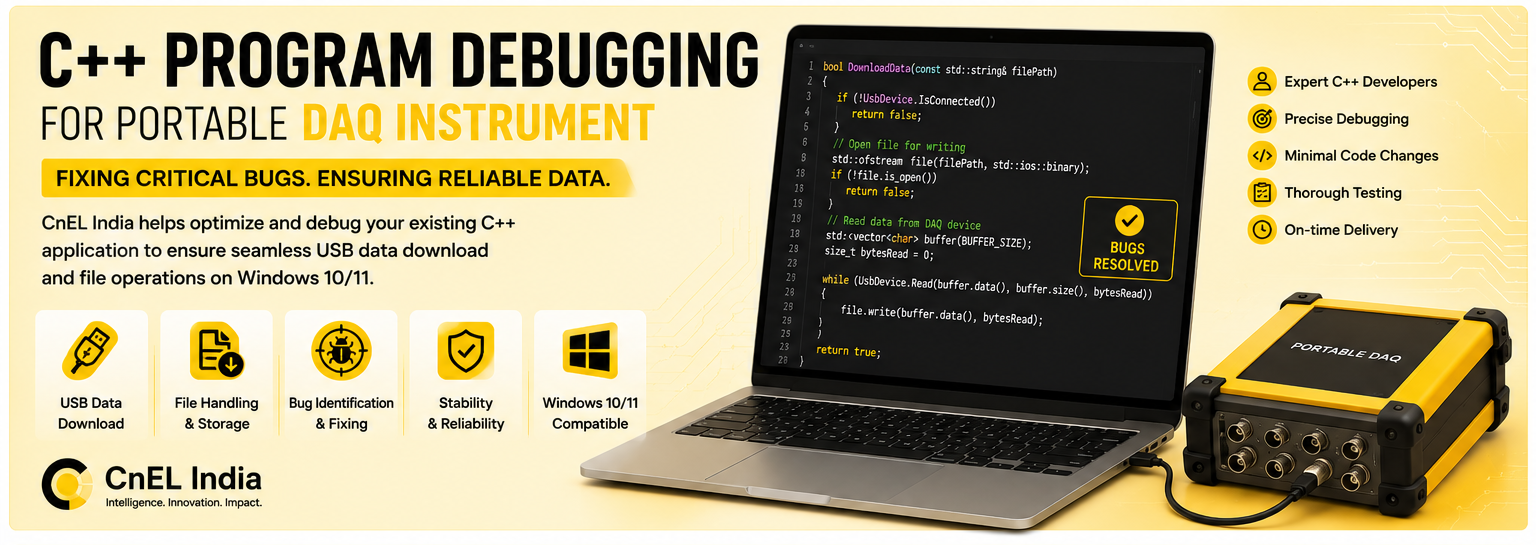
This case study explains how CnEL India approaches the debugging and enhancement of an existing C++-based user interface application designed for a portable DAQ instrument. The software is already fully operational, but two documented issues related to USB-based data download and file storage on Windows systems require resolution.
Rather than redesigning the application, the engagement focuses on identifying the root causes of the defects, implementing precise code corrections, validating the fixes, and ensuring the software remains stable and reliable without affecting existing functionality.
The objective is to deliver targeted improvements that strengthen performance while preserving the application’s proven architecture.
Business Background
Portable DAQ instruments are commonly deployed where engineers need accurate measurement data in real time.
Typical applications include:
- Industrial equipment testing
- Laboratory experiments
- Environmental monitoring
- Electrical diagnostics
- Mechanical performance testing
- Quality assurance
- Field inspections
These instruments collect valuable measurement data that must later be transferred to a computer for analysis, reporting, and archival purposes.
The software interface acts as the communication bridge between the hardware device and the computer.
Any interruption in this communication process can delay operations and reduce user confidence.
Understanding the Existing System
Unlike new software development projects, this engagement involves maintaining an already operational application.
The current solution already supports:
- Device communication
- User interface operations
- Data acquisition
- Configuration management
- Measurement visualization
- USB connectivity
- File management
The software has proven reliability in most operational areas.
The project focuses only on correcting two specific software defects.
Project Objectives
CnEL India begins by clearly defining the project objectives.
The goals include:
- Resolve documented software bugs
- Improve USB data download reliability
- Ensure proper file generation
- Preserve existing application behavior
- Prevent introduction of new defects
- Validate compatibility with modern Windows environments
The emphasis remains on precision debugging rather than extensive redevelopment.
Understanding the Reported Issues
The documented problems primarily involve the transfer of collected measurement data from the portable DAQ instrument to a specified location on a Windows computer.
Potential symptoms may include:
- Failed downloads
- Incorrect file creation
- Interrupted transfer processes
- Inconsistent communication
- Improper file handling
Since the issues have already been documented with suggested code locations, troubleshooting becomes significantly more efficient.
Initial Code Assessment
Before modifying any code, CnEL India performs a structured assessment of the existing application.
The review includes:
Application Architecture
Understanding software organization.
Communication Flow
Reviewing device interactions.
Data Handling
Examining transfer mechanisms.
File Operations
Analyzing storage procedures.
Error Handling
Identifying exception management.
This assessment minimizes unnecessary code changes.
Debugging Strategy
Rather than making broad modifications, CnEL India follows a targeted debugging methodology.
The process includes:
- Reproducing the issue
- Isolating the fault
- Reviewing related modules
- Identifying root causes
- Applying minimal corrective changes
- Validating functionality
This structured approach reduces risk.
USB Communication Analysis
Reliable communication between the DAQ instrument and the computer is essential.
CnEL India reviews:
- Connection initialization
- Device recognition
- Data transmission
- Transfer completion
- Communication recovery
The objective is ensuring stable and uninterrupted data movement.
File Download Workflow
The download process involves multiple coordinated steps.
CnEL India evaluates:
- File destination selection
- Data buffering
- Transfer completion
- File creation
- Save confirmation
- User feedback
Each stage must operate correctly for successful downloads.
Windows Compatibility Review
The application operates on both Windows 10 and Windows 11.
CnEL India verifies compatibility across:
- File system behavior
- User permissions
- USB device handling
- Operating system updates
- Directory management
Compatibility testing helps ensure consistent performance across supported environments.
Root Cause Investigation
Effective debugging requires identifying the true source of the problem rather than treating symptoms.
CnEL India investigates:
Communication Timing
Potential synchronization issues.
Memory Management
Data handling consistency.
File Path Validation
Correct destination handling.
Buffer Processing
Complete transfer verification.
Error Responses
Proper exception reporting.
Understanding root causes enables permanent fixes.
Safe Code Modification
Maintaining software stability is a priority.
CnEL India follows conservative coding practices by:
- Limiting changes to affected modules
- Preserving existing architecture
- Maintaining code readability
- Documenting modifications
- Reducing dependency impacts
Minimal changes often produce maximum reliability.
User Interface Verification
Although the defects involve data transfer, user interactions must remain intuitive.
CnEL India verifies:
- Download buttons
- Progress indicators
- Status messages
- Success notifications
- Error alerts
Users should clearly understand application behavior.
Error Handling Improvements
Robust applications respond gracefully to unexpected situations.
CnEL India strengthens:
- Connection failure handling
- Missing device detection
- Invalid file locations
- Interrupted transfers
- Permission-related errors
Improved feedback reduces user confusion.
Data Integrity Validation
Accurate measurement data is valuable only if transferred correctly.
CnEL India validates:
- Complete file generation
- Data consistency
- File accuracy
- Transfer completion
- Content verification
Integrity testing protects critical measurement records.
Regression Testing
Correcting one issue should never introduce another.
CnEL India performs regression testing across:
- Device connectivity
- Existing application features
- User workflows
- File operations
- Interface functionality
Comprehensive validation preserves application stability.
Performance Optimization
Although debugging is the primary objective, performance opportunities are also reviewed.
CnEL India evaluates:
- Transfer efficiency
- Resource utilization
- Memory usage
- Processing delays
- Application responsiveness
Even small improvements enhance the overall experience.
Documentation of Fixes
Maintainable software requires clear documentation.
CnEL India records:
- Root cause analysis
- Code modifications
- Testing results
- Validation procedures
- Future recommendations
Documentation simplifies future maintenance.
Deployment Readiness
Before delivering the updated application, CnEL India verifies:
- Stable execution
- Successful file downloads
- Operating system compatibility
- Reliable USB communication
- User acceptance
Deployment occurs only after successful validation.
Long-Term Maintainability
Software maintenance extends beyond fixing current issues.
CnEL India recommends practices that improve long-term reliability, including:
- Modular code organization
- Consistent documentation
- Structured testing
- Version control
- Preventive maintenance
These practices reduce future debugging efforts.
Delivery Framework
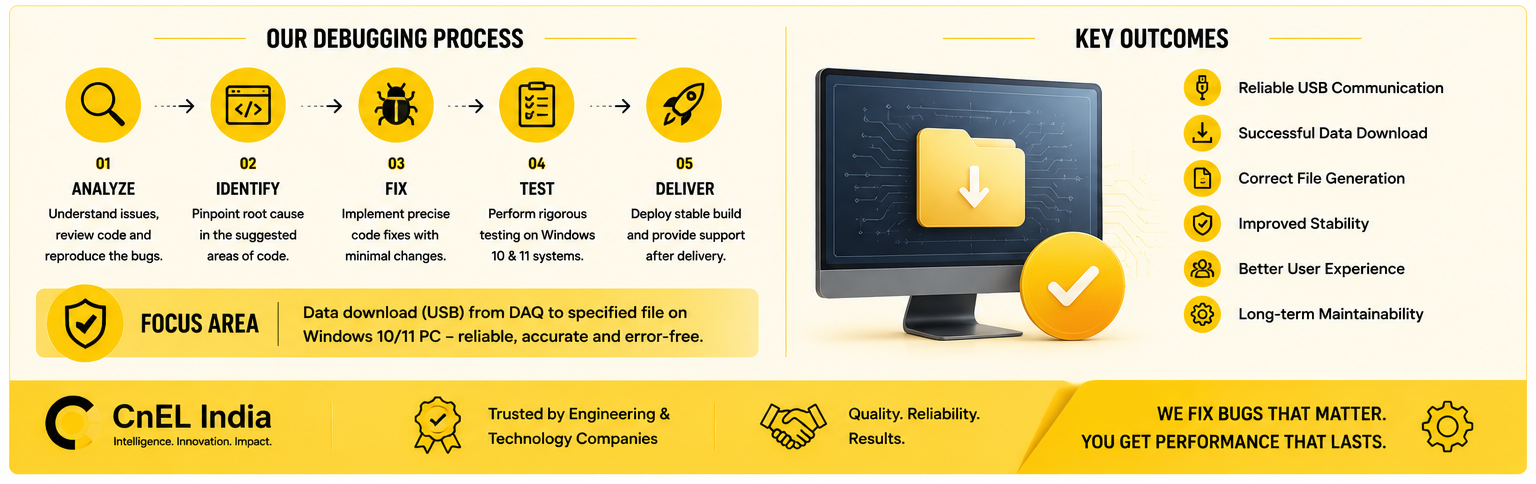
CnEL India follows a structured debugging process.
Phase 1 – Requirement Review
Understand documented issues and expected behavior.
Phase 2 – Code Assessment
Review application architecture and affected modules.
Phase 3 – Root Cause Analysis
Identify the actual source of defects.
Phase 4 – Bug Resolution
Implement focused code corrections.
Phase 5 – Testing
Validate fixes across supported environments.
Phase 6 – Deployment
Deliver the corrected application.
Phase 7 – Support
Provide post-deployment assistance if required.
Challenges Solved by CnEL India
This engagement addresses several critical challenges:
- USB communication failures
- File download inconsistencies
- Operating system compatibility concerns
- Data transfer reliability
- Application stability
- Long-term maintainability
The result is a more dependable software solution with minimal disruption to existing functionality.
Business Outcomes Delivered
Organizations implementing this approach gain:
- Reliable USB data transfers
- Accurate file generation
- Improved software stability
- Reduced operational interruptions
- Better user confidence
- Extended application lifespan
- Lower maintenance costs
These improvements strengthen both operational efficiency and customer satisfaction.
Why CnEL India
CnEL India combines:
- Strong C++ software development expertise
- Desktop application maintenance experience
- Hardware-software integration knowledge
- Debugging and root cause analysis capabilities
- Structured quality assurance processes
The objective is delivering precise, reliable, and maintainable software solutions without unnecessary redevelopment.
Conclusion
This case study demonstrates how CnEL India approaches C++ application debugging for a portable DAQ instrument through careful analysis, targeted code correction, structured testing, and comprehensive validation.
Instead of rewriting a stable application, the focus remains on preserving proven functionality while eliminating documented defects related to USB data transfer and file handling.
By combining disciplined debugging practices, compatibility verification, performance validation, and maintainable code improvements, CnEL India helps organizations extend the life of existing software, improve operational reliability, and ensure dependable communication between hardware devices and modern computing environments.