
Case Study by CnEL India
Introduction
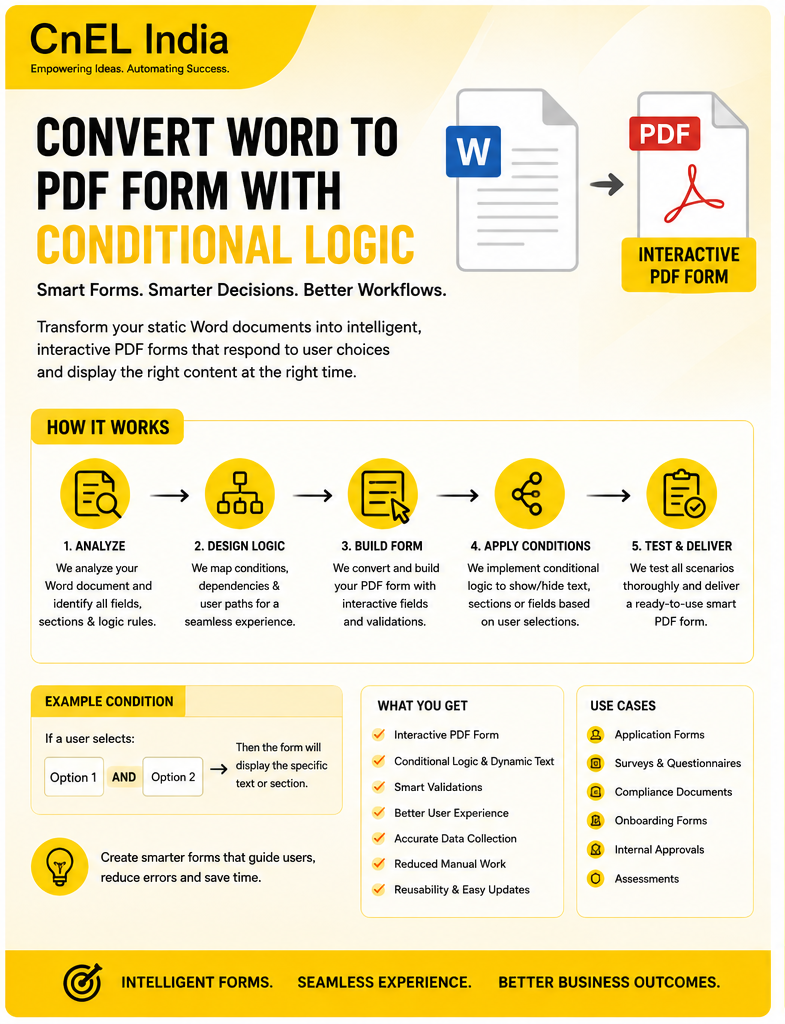
As organizations continue moving toward paperless operations, digital forms have become an essential part of modern business workflows. Companies increasingly rely on structured digital documents to collect information, guide users through decision-making processes, automate approvals, and improve operational efficiency.
Traditional Word documents are excellent for creating content, but they are often limited when businesses need interactive behavior, structured inputs, conditional responses, validation rules, and guided user experiences.
This case study explains how CnEL India can transform a standard Word document into an intelligent PDF form with conditional logic capabilities that improve usability, reduce manual errors, and create a more efficient document experience.
The project requirement focuses on converting an existing Word document into a fully interactive PDF form where specific outputs appear dynamically depending on user selections.
Example scenarios include:
- Showing additional text if users select Option 1 and Option 2
- Displaying hidden sections based on responses
- Triggering instructions conditionally
- Revealing follow-up fields only when necessary
- Simplifying form completion through guided interactions
CnEL India specializes in:
- Interactive document systems
- Digital form architecture
- Workflow automation
- Conditional logic implementation
- Business document optimization
- User experience design
- Operational process improvement
The objective is not simply converting file formats but transforming static documents into intelligent digital workflows.
Understanding the Business Requirement
The client already has a Word document containing business information and form structure.
However, the document currently behaves as static content.
Users must:
- Read all sections manually
- Ignore irrelevant fields
- Navigate unnecessary instructions
- Interpret requirements independently
This often creates:
- User confusion
- Incorrect submissions
- Increased processing time
- Higher support requests
- Data inconsistency
The requirement is to create a PDF form that responds intelligently to user choices.
For example:
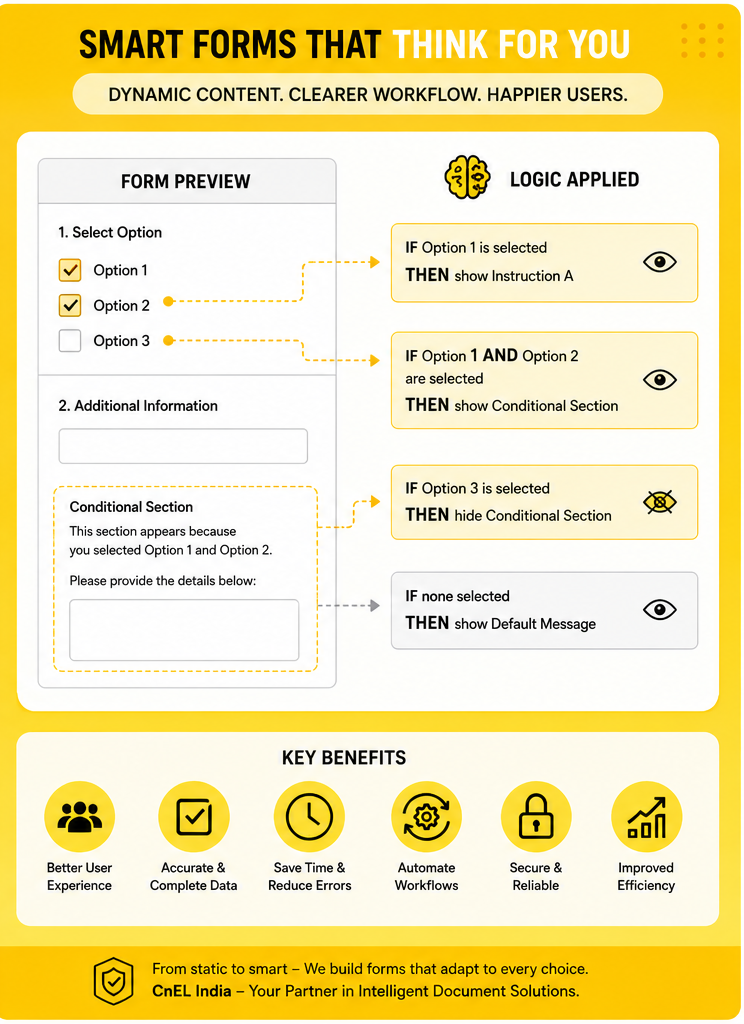
If a user selects:
Option 1 → Show Additional Instructions
If a user selects:
Option 1 + Option 2 → Display Specific Text
If another option is selected:
Hide unrelated sections
The final document should guide users automatically.
CnEL India’s Smart Document Transformation Approach
CnEL India approaches document transformation as a workflow optimization project rather than simple file conversion.
The process includes:
- Document analysis
- User journey mapping
- Conditional rule planning
- Interactive field architecture
- Logic implementation
- Validation workflows
- Output optimization
The goal is to reduce complexity while improving user experience.
Initial Document Assessment
Before conversion begins, CnEL India performs a structured assessment of the existing Word document.
Key evaluation areas include:
Content Structure
Understanding sections, fields, and dependencies.
User Flow
Identifying how users move through the document.
Conditional Requirements
Mapping interactions and expected outcomes.
Data Dependencies
Understanding relationships between form elements.
This stage creates the foundation for intelligent document behavior.
Designing Interactive PDF Experiences
Unlike traditional documents, interactive PDFs behave more like lightweight applications.
CnEL India transforms forms into responsive experiences capable of:
- Dynamic field visibility
- Guided decision-making
- Smart validation
- Conditional instructions
- Automated user assistance
This improves usability without increasing complexity.
Conditional Logic Architecture
Conditional logic is the core functionality of this project.
CnEL India structures rules around user behavior.
Examples include:
Single Selection Conditions
If:
User selects Option A
Then:
Display explanatory text.
Multiple Condition Rules
If:
Option A AND Option B
Then:
Reveal additional form sections.
Alternative Conditions
If:
Option C
Then:
Hide unnecessary inputs.
Sequential Conditions
If:
User completes Step 1
Then:
Enable Step 2.
These interactions create adaptive user experiences.
Dynamic Content Display
One major benefit of interactive forms is showing only relevant information.
CnEL India designs systems capable of:
- Showing text conditionally
- Revealing instructions dynamically
- Expanding sections automatically
- Displaying recommendations
- Simplifying decision pathways
This prevents users from becoming overwhelmed.
Improving User Experience Through Smart Forms
Traditional forms often suffer from:
- Information overload
- Excessive scrolling
- User confusion
- Incorrect selections
CnEL India improves the experience through:
- Progressive disclosure
- Cleaner interfaces
- Simplified interactions
- Context-aware instructions
The result is a more intuitive form completion process.
Intelligent Validation Workflows
Interactive forms must prevent incomplete or incorrect submissions.
CnEL India introduces validation mechanisms such as:
- Required field checks
- Dependency validation
- Conditional completion rules
- Selection verification
This improves submission accuracy.
Business Logic Mapping
Many business documents contain hidden operational rules.
CnEL India extracts these rules and transforms them into structured workflows.
Examples include:
If:
Department = Sales
Then:
Display sales-specific fields.
If:
Project Type = Internal
Then:
Skip external approval sections.
This converts manual processes into automated guidance.
Conditional Text Generation
The client specifically requires text to appear based on user selections.
CnEL India builds content logic capable of generating:
- Contextual messages
- Customized instructions
- Decision summaries
- Next-step recommendations
This helps users understand exactly what actions to take.
Form Navigation Optimization
Interactive forms should reduce friction.
CnEL India designs navigation experiences that:
- Minimize unnecessary clicks
- Hide completed sections
- Focus attention progressively
- Reduce user fatigue
Better navigation improves completion rates.
Data Collection Standardization
Structured digital forms improve data quality.
CnEL India ensures:
- Consistent inputs
- Standardized selections
- Improved reporting readiness
- Reduced interpretation errors
Better data collection improves downstream business operations.
Accessibility Considerations
Interactive forms should remain usable for different user groups.
CnEL India prioritizes:
- Clear labeling
- Logical tab ordering
- Readable layouts
- Consistent interactions
Accessibility improves overall usability.
Maintaining Document Flexibility
Business requirements evolve over time.
CnEL India designs forms that remain adaptable.
Future modifications may include:
- Additional conditions
- New fields
- Updated workflows
- Expanded business logic
This reduces redevelopment costs.
Error Reduction Through Intelligent Documents
Static forms often generate:
- Missing information
- Incorrect selections
- Invalid responses
CnEL India reduces these risks through:
- Automated guidance
- Conditional restrictions
- Structured workflows
The result is cleaner and more reliable submissions.
Integration with Existing Business Processes
Interactive forms frequently become part of larger workflows.
CnEL India designs solutions that support:
- Internal approvals
- Digital records
- Business process automation
- Operational reporting
This improves organizational efficiency.
Testing and Quality Assurance
Every interactive form requires extensive validation.
CnEL India performs testing across:
- User scenarios
- Conditional paths
- Field behavior
- Data accuracy
- Document consistency
Testing ensures predictable performance.
Security and Document Integrity
Business forms often contain sensitive information.
CnEL India considers:
- Controlled editing
- Document protection
- Data integrity
- Permission controls
Security becomes an important part of document design.
Future Expansion Possibilities
The intelligent document architecture can later support:
- Digital approvals
- Workflow tracking
- Automated notifications
- Analytics dashboards
- Multi-stage submissions
- Operational automation
The foundation remains scalable.
Business Value Delivered by CnEL India
Through this project, CnEL India helps organizations achieve:
- Faster form completion
- Reduced user confusion
- Better submission quality
- Lower operational workload
- Improved digital workflows
- Higher process efficiency
The form becomes more than a document—it becomes an interactive business system.
Challenges Solved by CnEL India
Organizations commonly struggle with:
- Complex documents
- High submission errors
- Manual interpretation
- User frustration
- Inconsistent information
CnEL India addresses these issues through intelligent document transformation.
Why CnEL India for Interactive Document Solutions
CnEL India combines:
- Document workflow expertise
- Conditional logic design
- Interactive form engineering
- Business process understanding
- User experience optimization
- Scalable digital architecture
The company focuses on building solutions that simplify operations while improving user engagement.
Conclusion
This case study demonstrates how CnEL India can successfully transform a static Word document into an intelligent PDF form with conditional logic, creating a more interactive, accurate, and user-friendly experience.
Rather than simply converting one file format into another, the project focuses on building a guided digital workflow where content appears dynamically, user interactions become easier, and business processes become more efficient.
By combining interactive design, conditional rules, validation systems, dynamic content display, and scalable document architecture, CnEL India helps organizations modernize traditional paperwork into smart digital experiences that improve both usability and operational performance.