
Introduction
As businesses increasingly adopt artificial intelligence to streamline operations, many organizations are moving beyond public-facing chatbots and simple automation tools. The next stage of digital transformation involves building sophisticated internal production systems that combine structured workflows, proprietary knowledge, user management, content automation, and intelligent decision-making.
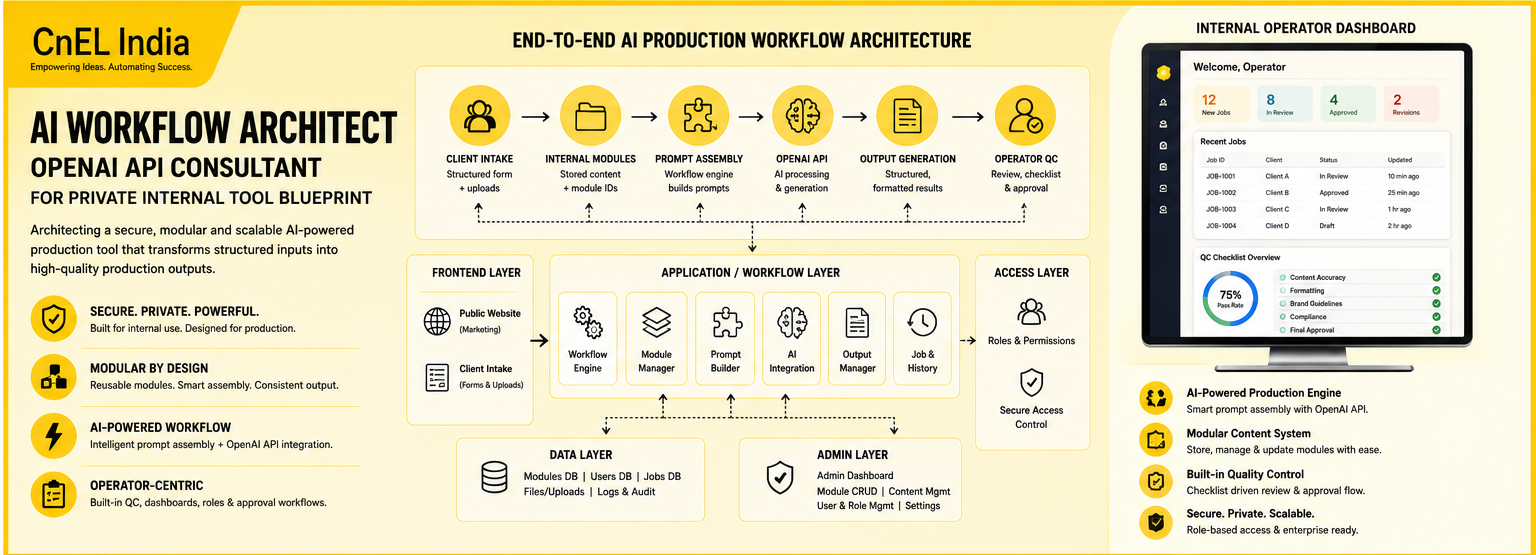
This case study explores how CnEL India can architect a secure, scalable, and modular AI-powered internal production platform designed to automate complex content generation and production workflows while maintaining complete control over proprietary business processes.
Unlike basic AI applications that simply generate responses from user prompts, this project focuses on creating an enterprise-grade internal workflow system capable of handling structured client inputs, modular content management, automated prompt assembly, production output generation, quality control processes, and administrative oversight.
The organization requires a comprehensive technical blueprint before development begins. The objective is not immediate implementation but the creation of a developer-ready architecture specification that eliminates uncertainty and provides a clear roadmap for future development.
CnEL India specializes in:
- AI workflow architecture
- Enterprise automation planning
- Internal platform design
- Production workflow engineering
- Modular content systems
- Secure data architecture
- Technical product planning
- AI-powered operational systems
The goal is to design an intelligent production ecosystem that supports both operational efficiency and long-term scalability.
Understanding the Business Requirement
The client plans to build a private internal production tool that combines multiple business processes into a single workflow.
The platform must support:
- Client intake processes
- Internal operations management
- Modular content storage
- AI-assisted content generation
- Administrative controls
- Production quality assurance
- Workflow tracking
- Secure content management
The business already understands its operational requirements but needs a structured architecture that developers can implement without making assumptions.
This is particularly important because the system will eventually contain proprietary business content that represents significant intellectual property.
CnEL India’s Architecture-First Approach
CnEL India approaches projects of this nature through strategic planning before development begins.
The process focuses on:
- Business workflow analysis
- System architecture planning
- Data structure design
- User access modeling
- Security planning
- Scalability assessment
- Development roadmap creation
Rather than immediately building software, CnEL India first creates a detailed blueprint that defines exactly how every component should interact.
This significantly reduces development risk.
Designing the Overall System Architecture
The platform consists of several interconnected layers.
These include:
Client Layer
The client-facing environment where users submit requests and provide information.
Processing Layer
The internal system responsible for organizing workflows and preparing production tasks.
Content Layer
The repository that stores modular business content.
AI Assembly Layer
The component that dynamically combines selected modules with client information.
Output Layer
The area where generated production outputs are reviewed and approved.
Administrative Layer
The environment where authorized personnel manage system content and workflows.
CnEL India creates clear boundaries between these layers to improve maintainability and security.
Separation Between Public and Private Systems
One of the most important architectural requirements involves separating public-facing functionality from private operational workflows.
CnEL India recommends maintaining distinct environments for:
- Public website operations
- Client intake processes
- Internal production activities
- Administrative controls
This separation provides several benefits:
- Improved security
- Better access control
- Easier maintenance
- Reduced operational risk
- Enhanced scalability
The architecture ensures proprietary production assets remain protected from public access.
Client Intake Workflow Design
The client intake process serves as the entry point into the production workflow.
CnEL India designs intake systems capable of collecting:
- Structured selections
- Uploaded files
- Project requirements
- Custom instructions
- Business-specific variables
The intake process must standardize information before it enters production workflows.
This ensures consistency and reduces operational errors.
Modular Content Management Strategy
The business intends to use modular production content that can be combined dynamically.
CnEL India designs content systems around reusable modules.
Each module contains:
- Structured content
- Metadata
- Classification tags
- Version history
- Usage tracking
This modular approach creates flexibility while maintaining operational consistency.
Content can be updated without requiring changes to the underlying workflow system.
Module Identification Framework
The platform requires a robust module identification strategy.
CnEL India designs unique module structures that support:
- Easy retrieval
- Version control
- Categorization
- Relationship mapping
- Content organization
A structured module identification system improves scalability as the content library grows.
It also simplifies maintenance and administrative management.
Dynamic Prompt Assembly Architecture
One of the most critical aspects of the platform is prompt assembly.
Rather than manually creating prompts, the system automatically assembles production instructions based on:
- Client selections
- Uploaded content
- Internal modules
- Workflow logic
- Business rules
CnEL India designs prompt assembly systems that remain:
- Flexible
- Transparent
- Scalable
- Easy to modify
This enables continuous optimization without major architectural changes.
Intelligent Production Workflow Design
The platform acts as a production engine rather than a conversational application.
CnEL India structures workflows around:
- Input collection
- Content selection
- Prompt construction
- Output generation
- Review processes
- Final approval
Each stage is clearly defined and documented for developers.
This improves reliability and operational consistency.
AI Integration Strategy
The AI component serves as a production assistant within the workflow.
CnEL India designs integration strategies that focus on:
- Predictable outputs
- Structured formatting
- Controlled prompt execution
- Error handling
- Performance optimization
The objective is not creativity alone but reliable production outcomes aligned with business requirements.
Structured Output Generation
Generated outputs must follow predefined formats.
CnEL India designs output frameworks capable of producing:
- Consistent formatting
- Organized sections
- Structured content blocks
- Review-ready documents
This reduces manual editing and improves operational efficiency.
Job Tracking and Production History
Every production workflow generates valuable operational data.
CnEL India includes job tracking systems that record:
- Submission history
- Processing status
- Generated outputs
- Revision records
- Approval actions
This creates transparency across the production lifecycle.
Historical records also support auditing and quality assurance efforts.
Operator Dashboard Design
Internal operators require visibility into ongoing production activities.
CnEL India designs dashboards that provide:
- Active job queues
- Processing status updates
- Review requirements
- Workflow metrics
- Approval controls
The dashboard becomes the operational command center for production teams.
Quality Control Workflow Integration
Quality assurance is a core business requirement.
CnEL India embeds review processes directly into the production workflow.
Quality control stages may include:
- Content verification
- Formatting validation
- Completeness checks
- Compliance reviews
- Operator approval
This prevents low-quality outputs from progressing through the system.
Administrative Management System
The platform requires a dedicated administrative environment.
CnEL India designs administrative functionality for:
- Module creation
- Module editing
- Content organization
- User management
- Workflow configuration
- System monitoring
Administrators maintain operational control without requiring technical intervention.
User Roles and Permission Management
Access control is essential for protecting business assets.
CnEL India designs role-based permission structures such as:
Administrators
Full system control.
Operators
Production workflow access.
Reviewers
Quality control responsibilities.
Clients
Limited intake and status visibility.
Role separation improves both security and operational accountability.
Proprietary Content Protection
The client specifically requires separation between development content and proprietary production content.
CnEL India designs content isolation strategies that:
- Protect intellectual property
- Support safe development environments
- Enable testing with placeholder content
- Prevent accidental exposure
This is particularly important for businesses with unique production methodologies.
Security and Confidentiality Planning
The platform contains valuable operational knowledge.
CnEL India prioritizes:
- Access restrictions
- Authentication controls
- Secure content storage
- Data encryption
- Audit logging
Security planning is integrated into the architecture from the beginning rather than added later.
Scalability Planning
The platform must support future growth.
CnEL India designs architecture capable of accommodating:
- Larger content libraries
- Increased user activity
- Additional workflow types
- Expanded production teams
- New automation features
Scalability planning ensures the platform remains viable for years.
Development Roadmap Strategy
A key deliverable is defining what should be built first.
CnEL India organizes development into phases.
Phase 1: Core MVP
- Intake system
- Module management
- Production workflows
- Operator dashboard
Phase 2: Advanced Automation
- Enhanced workflows
- Additional user roles
- Reporting systems
Phase 3: Optimization and Scaling
- Advanced analytics
- Expanded automation
- Operational intelligence features
This phased approach reduces development complexity.
Developer-Ready Documentation
One of the primary project goals is eliminating guesswork.
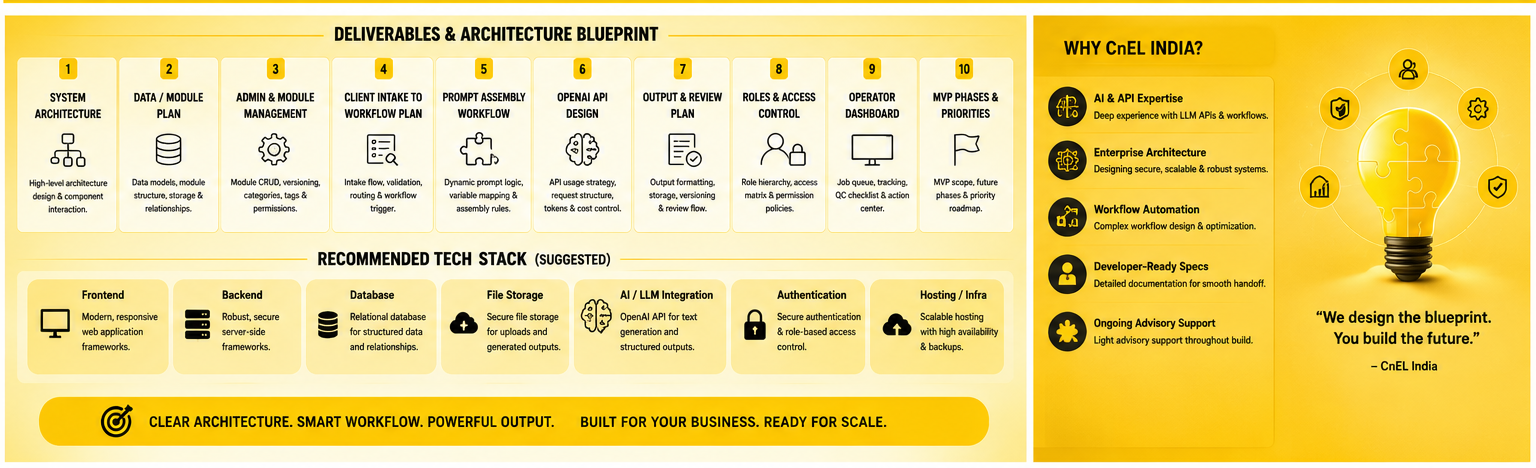
CnEL India delivers comprehensive specifications that include:
- Architecture diagrams
- Data models
- Workflow maps
- User role definitions
- Feature requirements
- Security guidelines
Developers receive clear instructions before implementation begins.
Business Value Delivered by CnEL India
Through this architecture project, CnEL India helps organizations achieve:
- Reduced development risk
- Faster implementation
- Better system scalability
- Improved security
- Stronger operational efficiency
- Clear development direction
The architecture becomes the foundation for successful long-term platform growth.
Challenges Solved by CnEL India
Organizations building internal AI systems often struggle with:
- Unclear requirements
- Poor workflow design
- Security concerns
- Content management complexity
- Development uncertainty
CnEL India addresses these challenges through strategic architecture planning and technical blueprint creation.
Why CnEL India for AI Workflow Architecture
CnEL India combines:
- Enterprise workflow expertise
- AI architecture experience
- Internal platform planning
- Process optimization knowledge
- Security-focused design principles
- Scalable system engineering
The company focuses on building structured foundations that enable successful software development and long-term operational growth.
Conclusion
This case study demonstrates how CnEL India can successfully design the complete architecture and technical blueprint for a secure, modular, AI-powered internal production platform.
Rather than simply integrating artificial intelligence into an existing workflow, the project focuses on creating a fully structured operational ecosystem where client intake, content management, prompt assembly, production workflows, quality control, and administrative oversight function together seamlessly.
By combining workflow architecture, modular content systems, access control planning, production automation strategies, scalability considerations, and developer-ready documentation, CnEL India helps businesses transform complex internal processes into efficient, secure, and future-ready digital production platforms.