

Introduction: When Accuracy Meets Accessibility
In today’s data-driven world, advanced concepts are no longer limited to researchers and specialists. Working professionals, entrepreneurs, and business leaders are increasingly exploring technical domains to make better strategic decisions. One such emerging area is graph machine learning—a field focused on understanding relationships, networks, and connections within complex data.
However, writing a book for beginners in such a specialized field is not easy.
The challenge is not just explaining concepts—but explaining them in a way that is accurate, relevant, and understandable for non-technical or semi-technical audiences.
Our client was preparing a book on graph machine learning targeted at professionals rather than academic researchers. They wanted to ensure the content was:
- Technically accurate
- Easy to understand
- Relevant to real-world use cases
- Structured for practical learning
- Up-to-date with modern industry understanding
To achieve this, they required subject matter experts who could review the manuscript and provide meaningful, actionable feedback.
This case study explains how CnEl India successfully delivered a structured, high-quality review process that improved the book’s clarity, accuracy, and overall impact.
This was not just proofreading.
It was intellectual refinement of knowledge for real-world application.
Client Background
The client was developing a professional-level book focused on introducing graph machine learning concepts to a broader audience.
Unlike academic textbooks, this book aimed to:
- Simplify complex ideas
- Connect theory with business applications
- Provide practical insights
- Engage professionals from non-technical backgrounds
The audience included:
- Business leaders
- Startup founders
- Product managers
- Analysts
- Technology enthusiasts
The client had already completed a draft but needed expert validation before publication.
They wanted to ensure the book would not only educate—but also build trust among readers.
The Core Challenge
Reviewing a technical book is different from writing one.
The reviewer must balance two critical aspects:
1. Technical Accuracy
The content must be correct, logically structured, and aligned with real-world practices.
2. Reader Accessibility
The content must be understandable for beginners without oversimplifying or distorting key concepts.
The project presented several challenges:
- Complex concepts needing simplified explanation
- Risk of technical inaccuracies
- Lack of real-world context in some sections
- Possible outdated references
- Inconsistent explanation depth across chapters
- Need for clarity without removing essential complexity
The goal was to refine—not rewrite.
Project Objective
Our objective at CnEl India Private Limited was to provide a professional review that would:
- Improve technical correctness
- Enhance clarity and readability
- Align concepts with real-world applications
- Strengthen logical flow across chapters
- Ensure consistency in explanations
- Provide actionable feedback for improvements
The final result needed to make the book stronger without changing its original intent.
Our Review Approach
We designed a structured multi-layer review strategy to ensure quality and consistency.
Our approach included:
Content Understanding
Technical Validation
Clarity Enhancement
Practical Relevance Check
Structural Consistency Review
Feedback Documentation
This ensured that every aspect of the book was carefully evaluated.
Phase 1: Deep Content Understanding
Before giving any feedback, we first read the manuscript completely.
This step was critical.
Reviewing without understanding leads to shallow suggestions.
We focused on:
- Overall narrative flow
- Chapter structure
- Concept progression
- Intended audience level
- Writing tone and style
This helped us align our feedback with the author’s vision rather than imposing external ideas.
Phase 2: Technical Accuracy Validation
The next step was verifying the correctness of all concepts.
We carefully evaluated:
- Definitions and explanations
- Concept relationships
- Logical consistency
- Interpretation of examples
- Alignment with current industry understanding
Where needed, we suggested:
- Corrections in technical explanations
- Improved definitions
- Clarification of confusing sections
- Better examples for concept understanding
Accuracy builds credibility.
Without it, even simple books lose trust.
Phase 3: Simplifying Without Oversimplifying
One of the biggest risks in beginner-level books is oversimplification.
If content becomes too basic, it loses value.
If it remains too complex, readers lose interest.
We balanced this by:
- Rewriting complex sentences into simpler forms
- Breaking long explanations into smaller parts
- Adding clarity to abstract ideas
- Suggesting relatable explanations
- Improving transitions between concepts
The goal was clarity—not dilution.
Good explanation makes complex ideas feel simple without making them incorrect.
Phase 4: Real-World Relevance Enhancement
Professionals learn better when they see practical applications.
We evaluated whether the book connected concepts with real-world use cases.
Where gaps existed, we suggested:
- Practical scenarios
- Business applications
- Industry examples
- Decision-making relevance
- Use-case-driven explanations
This made the content more engaging and valuable for working professionals.
Theory becomes powerful only when it connects to reality.
Phase 5: Logical Flow and Structure Improvement
A good book must guide the reader step by step.
We analyzed:
- Chapter sequencing
- Concept progression
- Topic dependencies
- Repetition and redundancy
- Missing connections between sections
We suggested:
- Reordering certain sections
- Improving chapter transitions
- Removing unnecessary repetition
- Strengthening concept continuity
This made the book easier to follow.
Readers should feel guided—not confused.
Phase 6: Consistency Across the Manuscript
In long manuscripts, consistency often becomes a challenge.
We checked for:
- Terminology consistency
- Explanation depth uniformity
- Writing tone alignment
- Concept repetition with variation
- Formatting consistency
We provided suggestions to ensure the entire book felt cohesive.
Consistency improves readability and professionalism.
Phase 7: Reader Experience Optimization
Beyond technical content, we focused on how the reader would experience the book.
We evaluated:
- Engagement level
- Clarity of examples
- Ease of understanding
- Information density
- Learning flow
We suggested improvements that made the book more reader-friendly without reducing its value.
A good book teaches.
A great book keeps the reader engaged while teaching.
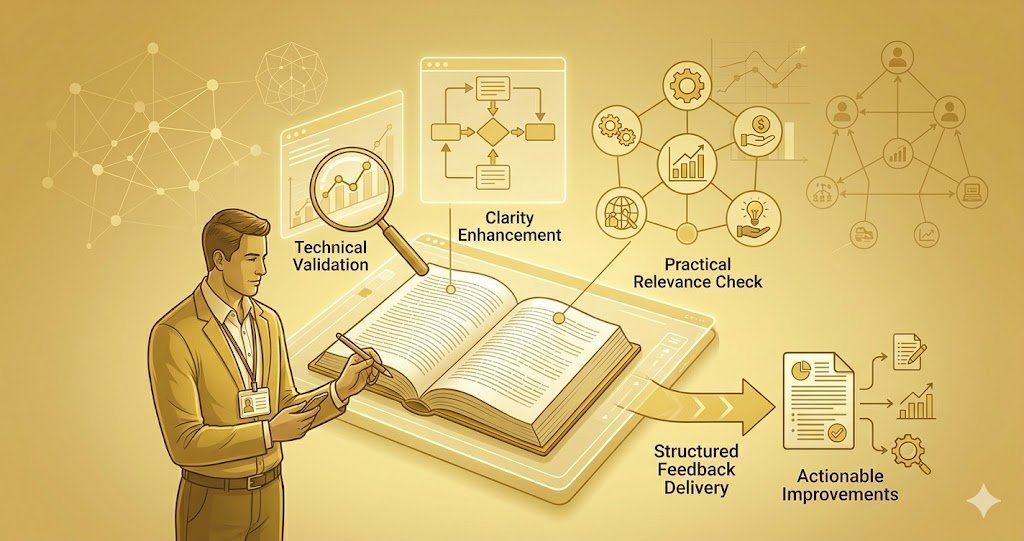
Phase 8: Structured Feedback Delivery
Our final deliverable was not just corrections—it was structured feedback.
We provided:
- Section-wise review comments
- Clear improvement suggestions
- Highlighted strengths of the manuscript
- Areas needing clarification
- Recommendations for enhancement
- Reader-focused improvement points
This made it easy for the client to apply changes.
Clear feedback saves time and improves results.
Results Achieved
The review process significantly improved the quality of the manuscript.
1. Improved Technical Accuracy
Errors and unclear explanations were corrected, increasing credibility.
2. Better Readability
Simplified explanations made the content accessible to beginners.
3. Stronger Practical Relevance
Added real-world context improved usefulness for professionals.
4. Enhanced Structure
Logical flow improvements made the book easier to follow.
5. Higher Reader Engagement
Improved clarity and examples made the content more engaging.
6. Publication Readiness
The manuscript became more polished and ready for professional release.
What Made This Project Different
Many reviews focus only on grammar.
This project focused on value.
What made CnEl India Private Limited different:
- Deep subject understanding
- Balanced technical and practical perspective
- Reader-first approach
- Structured feedback methodology
- Focus on clarity and impact
- Respect for the author’s original vision
We did not just review the book.
We helped shape its effectiveness.
Key Learnings from the Project
This project reinforced several important insights:
Clarity Is More Important Than Complexity
Readers value understanding more than technical depth.
Structure Defines Learning Experience
A well-organized book improves knowledge retention.
Real-World Examples Increase Impact
Professionals connect better with practical applications.
Consistency Builds Trust
Uniform explanations improve credibility.
Feedback Should Be Actionable
Clear suggestions create better outcomes.
Long-Term Value Delivered
The client now has:
- A more accurate and reliable manuscript
- Improved readability for target audience
- Stronger professional positioning
- Better engagement potential
- Higher confidence before publication
The book evolved from a draft into a refined knowledge resource.
Conclusion
Writing a technical book is an achievement.
Making it understandable and impactful is a greater one.
Through structured review, clarity enhancement, and practical refinement, CnEl India helped transform a complex subject into a professional, beginner-friendly learning resource.
This project proved that expert review is not about criticism.
It is about making knowledge stronger, clearer, and more useful.
Because when information is easy to understand, it becomes powerful.