
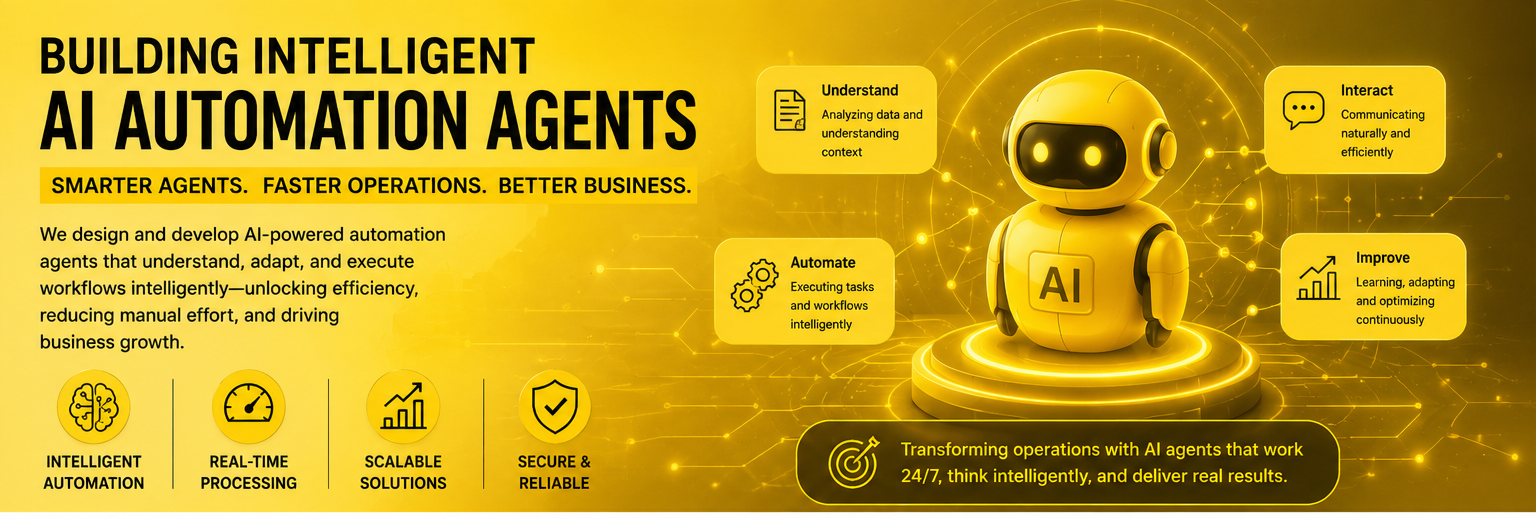
The Shift from Software to Intelligent Systems
Modern businesses are no longer looking for software that simply performs tasks.
They want systems that can:
- Think intelligently
- Automate decisions
- Reduce repetitive workload
- Adapt dynamically
- Operate continuously with minimal human intervention
This shift has created a new category of digital transformation:
AI-powered automation agents.
Unlike traditional automation systems that follow fixed rules, intelligent agents can analyze information, respond to changing conditions, and support real-world business operations in a far more advanced way.
This case study explains how CnEl India partnered with a growing technology-driven company to design and develop intelligent AI automation agents capable of streamlining operations, improving efficiency, and supporting scalable growth.
The Client’s Situation
The client operated in a fast-paced digital environment where teams were overwhelmed with repetitive operational tasks.
Their internal workflow included:
- Data handling
- Process monitoring
- Information routing
- Task coordination
- Customer interaction workflows
- Internal reporting and decision support
Although many processes were partially automated, they still required constant manual supervision.
This created several problems:
- Delays in execution
- Human dependency
- Operational bottlenecks
- Reduced scalability
- Increased costs
- Inconsistent process handling
The client realized that traditional automation was no longer enough.
They wanted intelligent systems that could:
- Understand context
- Respond dynamically
- Execute tasks intelligently
- Improve over time
In short, they wanted AI agents—not basic scripts.
The Real Challenge
At first glance, building AI agents may sound like a technical implementation task.
But the real complexity was deeper.
The system needed to behave like a reliable digital workforce.
That meant the agents had to:
- Handle real-world unpredictability
- Process structured and unstructured information
- Operate securely
- Integrate with existing workflows
- Scale across departments
- Deliver consistent performance
The challenge was not just automation.
It was intelligence + reliability + scalability combined together.
Our Vision: Building “Operational Intelligence”
At CnEl India, we approached the project differently.
We did not see the agents as standalone bots.
We designed them as part of a connected operational intelligence ecosystem.
Our objective was to create AI systems that could:
- Assist teams
- Reduce repetitive effort
- Improve decision speed
- Increase workflow efficiency
- Support long-term business growth
The goal was not to replace humans.
The goal was to eliminate unnecessary operational friction.
Phase 1: Understanding Business Behavior
Before development began, we spent significant time understanding how the business actually operated.
Instead of jumping directly into coding, we analyzed:
- Team workflows
- Repetitive activities
- Process dependencies
- Data movement patterns
- Communication bottlenecks
- Decision-making structures
This allowed us to identify where intelligent automation would create the biggest impact.
One important realization emerged early:
Most inefficiencies were caused not by lack of technology—but by disconnected workflows.
This insight shaped the entire architecture.
Phase 2: Designing the AI Agent Framework
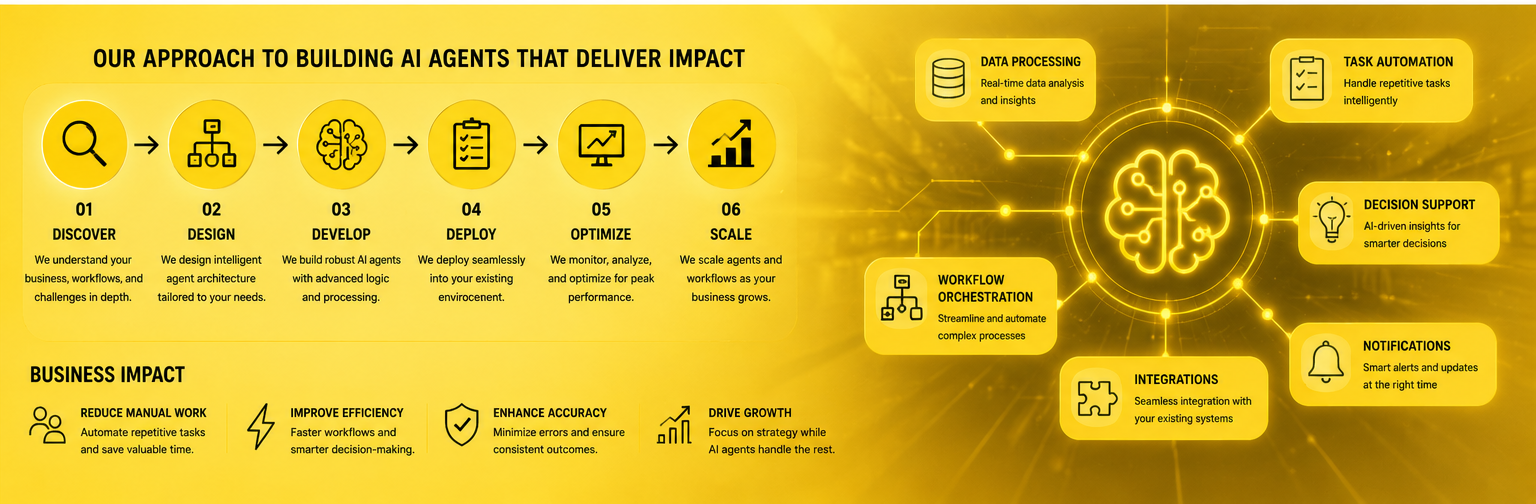
The next step was building a flexible agent framework.
Instead of creating one large system, we designed multiple specialized agents that could work together.
Each agent had a dedicated responsibility, such as:
- Information processing
- Workflow coordination
- Task monitoring
- Response generation
- Notification handling
- Decision assistance
This modular structure made the system more scalable and easier to improve over time.
Think of it as building a team of digital specialists instead of one overloaded system.
Phase 3: Intelligent Workflow Automation
Traditional automation follows fixed rules.
But real businesses are unpredictable.
We designed the agents to:
- Analyze incoming data
- Interpret context
- Prioritize actions
- Trigger workflows dynamically
- Escalate issues intelligently
For example:
Instead of simply forwarding information, the system could determine:
- What was urgent
- What required review
- What could be handled automatically
- Which team should receive the task
This transformed automation into operational intelligence.
Phase 4: Real-Time Data Processing
One of the client’s biggest problems was delayed information flow.
Teams often worked with outdated or incomplete information.
We solved this by creating agents capable of:
- Continuous monitoring
- Real-time updates
- Instant response handling
- Dynamic workflow execution
This significantly improved operational speed.
Processes that previously required hours could now happen within minutes.
Phase 5: Building Human-Like Interaction Logic
A key requirement was making the system easy to work with.
We designed conversational interaction layers where users could communicate naturally with the agents.
The focus was on:
- Simplicity
- Clarity
- Fast response generation
- Context awareness
Instead of forcing users to learn complicated workflows, the system adapted to the user.
This improved adoption dramatically.
Phase 6: Production-Ready Architecture
Many AI systems work well in testing environments but fail in real-world production.
We ensured the platform was production-ready by focusing on:
- Stability
- Error handling
- Security
- Scalable infrastructure
- Performance optimization
- Continuous monitoring
The agents were designed to operate reliably under real business conditions.
Phase 7: Scalability and Future Expansion
The client’s long-term goal was expansion.
So we designed the system to support:
- Additional workflows
- New departments
- More integrations
- Larger data volumes
- Increased operational complexity
The architecture was built to evolve continuously.
The Transformation
Before implementation:
- Teams were overloaded with repetitive tasks
- Workflow delays were common
- Decision-making was slow
- Operational visibility was limited
After implementation:
- Processes became automated and intelligent
- Teams focused on strategic work
- Information moved faster
- Operations became more scalable
- Efficiency improved significantly
The difference was immediate.
Results Achieved
1. Reduced Manual Workload
Operational tasks that previously consumed hours became automated.
Teams saved substantial time.
2. Faster Decision-Making
Real-time information flow improved responsiveness across departments.
3. Improved Workflow Efficiency
Processes became smoother, faster, and more reliable.
4. Increased Scalability
The business could now handle higher operational demand without proportional staffing increases.
5. Better System Reliability
Automation reduced human errors and inconsistencies.
6. Strong User Adoption
The conversational and intuitive interaction model made the system easy to use.
What Made This Project Different
Many automation projects fail because they focus only on tasks.
We focused on operational behavior.
What made CnEl India Private Limited unique:
- Business-first AI strategy
- Modular intelligent agent architecture
- Real-world workflow understanding
- Human-centric interaction design
- Production-focused implementation
- Long-term scalability planning
We did not just automate operations.
We redesigned how operations function.
Key Insight from the Project
One major realization stood out:
The future of business systems is not static automation.
It is adaptive intelligence.
Companies no longer need software that only executes commands.
They need systems that can assist, respond, and evolve.
Long-Term Impact
The client now has:
- Intelligent operational agents
- Faster workflows
- Improved efficiency
- Reduced operational dependency
- A scalable AI-ready foundation
Most importantly, they now have a system capable of growing with the business instead of slowing it down.
Conclusion
This project demonstrated how intelligent automation can move beyond simple task execution and become a true operational advantage.
Through strategic planning, scalable architecture, and real-world workflow intelligence, CnEl India Private Limited successfully developed AI-powered automation agents that transformed how the client’s business operated.
The result was not just automation.
It was operational evolution.
Because the next generation of digital systems will not simply follow instructions.
They will understand workflows, support decisions, and help businesses operate smarter than ever before. 🚀