
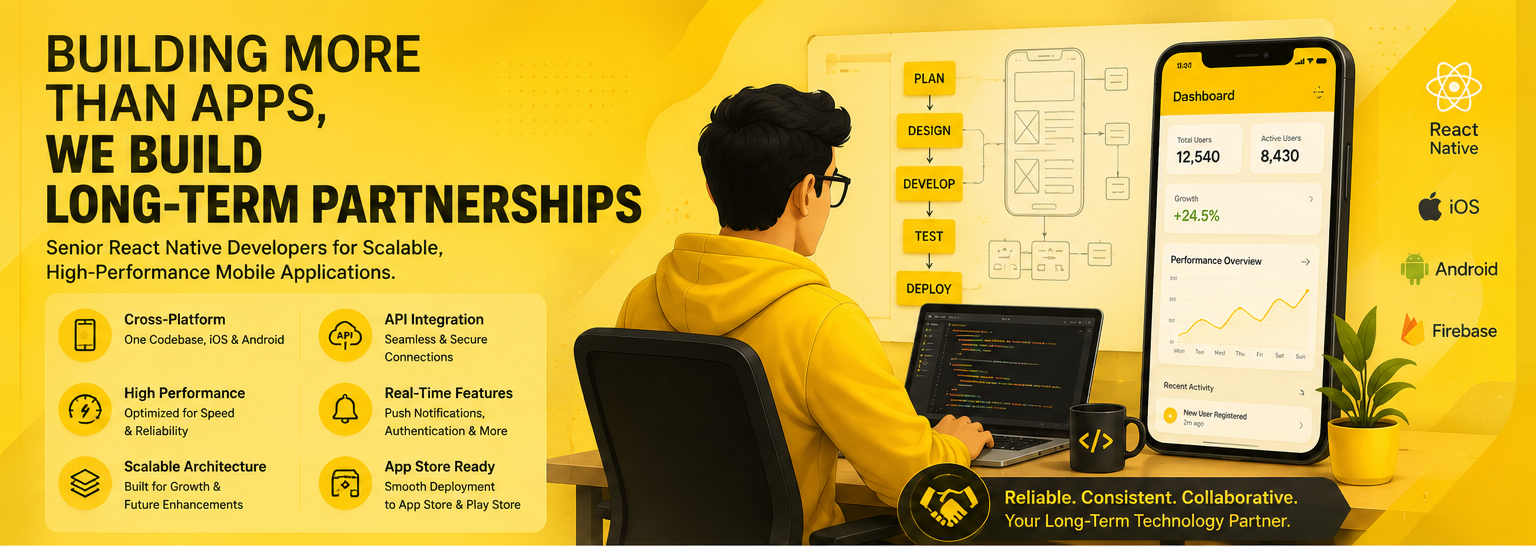
Not Just Hiring a Developer — Building a Technical Partnership
Most companies hire developers to complete tasks.
But the most successful products are not built by task-based contributors.
They are built by long-term partners who understand the product, the users, and the vision behind it.
This case study is about how a growing digital business moved away from short-term hiring and built a scalable, high-performance mobile app ecosystem by collaborating with a senior React Native developer as a long-term technical partner.
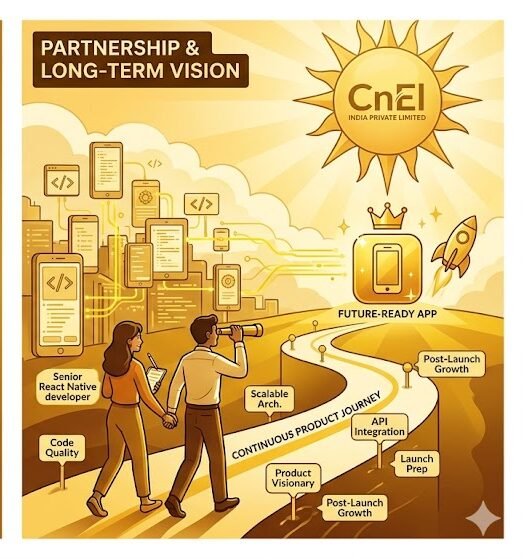
At the center of this transformation was CnEl India Private Limited, which approached the project not as a one-time delivery—but as a continuous product journey.
The Starting Point: A Growing Product with Growing Challenges
The client had already taken the first step into the mobile space.
They had an application idea, initial designs, and some development progress. However, as the product began evolving, several issues started appearing:
- Inconsistent code quality
- Performance bottlenecks
- Delays in feature delivery
- Difficulty integrating APIs smoothly
- Poor user experience across devices
- Lack of long-term architecture planning
The biggest problem was not technical—it was structural.
The product lacked a clear development direction.
Different developers had worked on different parts, but there was no unified strategy.
This created a fragile system that could not scale.
The Real Requirement: Stability, Scalability, and Ownership
The client realized that hiring freelancers for short-term tasks was no longer sustainable.
They needed someone who could:
- Take ownership of the application
- Understand the business logic
- Build scalable architecture
- Optimize performance continuously
- Maintain consistency across updates
- Contribute ideas—not just code
In simple terms, they were not looking for a developer.
They were looking for a technical partner.
Our Approach: Product Thinking Over Task Execution
At CnEl India Private Limited, we reframed the project immediately.
Instead of asking:
“What features need to be built?”
We asked:
“How should this product evolve over the next 2–3 years?”
This shift in thinking helped us design a system that was not just functional—but future-ready.
Step 1: Cleaning the Foundation
Before building anything new, we analyzed the existing codebase.
We identified:
- Redundant logic
- Poorly structured components
- Inefficient state management
- Performance issues
- Inconsistent UI behavior
Instead of patching problems, we focused on rebuilding the foundation.
We introduced:
- Clean code structure
- Reusable components
- Organized file hierarchy
- Standardized development practices
This created a strong base for future development.
Step 2: Designing Scalable Architecture
A mobile app is not just a collection of screens—it is a system.
We designed an architecture that could support:
- Rapid feature development
- Smooth API integrations
- Efficient state management
- Easy debugging and updates
- Long-term scalability
The system was structured in a way that new developers could easily understand and contribute without disrupting the existing flow.
This reduced dependency and improved collaboration.
Step 3: API Integration with Stability
The application required multiple backend connections.
However, previous integrations were inconsistent and unreliable.
We redesigned the integration layer to ensure:
- Stable data flow
- Error handling mechanisms
- Secure communication
- Faster response handling
- Consistent data structure
This made the app more reliable and reduced unexpected crashes.
Step 4: Performance Optimization
Performance is what users notice first.
Even a powerful app fails if it feels slow.
We optimized the app by focusing on:
- Reducing unnecessary re-renders
- Improving screen load time
- Optimizing data handling
- Enhancing responsiveness
- Minimizing lag during navigation
The result was a smooth and fast user experience across devices.
Step 5: Building a Polished User Experience
The client wanted the app to feel premium.
We worked on:
- Consistent UI across screens
- Responsive layouts for different devices
- Smooth animations and transitions
- Clear navigation flow
- User-friendly interactions
The goal was to create an experience that felt natural and intuitive.
Users should not have to think—they should just use.
Step 6: Notifications and Real-Time Features
Modern apps rely heavily on real-time communication.
We implemented a robust notification system that allowed:
- Instant updates
- User engagement triggers
- Action-based alerts
- Seamless background handling
This improved user retention and engagement.
Step 7: Authentication and Security
User data protection was critical.
We ensured that the authentication system was:
- Secure
- Reliable
- Fast
- Easy to use
The login and signup flow was simplified without compromising security.
Step 8: Preparing for App Store and Play Store Launch
Launching an app is not just about uploading it.
It requires:
- Stability testing
- Performance validation
- Compliance checks
- Proper configuration
- Error handling
We prepared the application for smooth deployment, ensuring it met all platform requirements.
The Shift: From Project to Partnership
What made this case different was the transition from a one-time project to a long-term collaboration.
Instead of delivering and leaving, we:
- Continued improving the product
- Added new features
- Optimized performance regularly
- Suggested product enhancements
- Maintained code quality over time
This created consistency.
And consistency builds great products.
Results That Changed the Game
The impact of this collaboration was significant.
1. Faster Development Cycle
New features were developed and deployed more efficiently.
2. Improved App Performance
Users experienced faster load times and smoother navigation.
3. Better User Retention
A polished experience led to higher user engagement.
4. Reduced Technical Debt
Clean architecture made the system easier to manage and scale.
5. Strong Product Direction
The app evolved with a clear strategy instead of random updates.
6. Reliable System Stability
Crashes and bugs were minimized significantly.
What Made This Approach Unique
Many developers focus on completing tasks.
We focused on building a system.
What made CnEl India Private Limited different:
- Long-term product thinking
- Strong architectural planning
- Continuous performance optimization
- Clear communication and collaboration
- Proactive problem-solving approach
- Focus on user experience
We didn’t just write code.
We built a product ecosystem.
Key Insight
This project reinforced an important idea:
“Great apps are not built in phases. They are built through consistent evolution.”
Hiring developers for tasks creates fragments.
Building partnerships creates products.
Future Growth Possibilities
With a strong foundation in place, the application is now ready for:
- New feature expansions
- Integration with additional systems
- Advanced user engagement features
- Scalable user growth
- Continuous improvement cycles
The system is no longer fragile—it is adaptable.
Conclusion
In the fast-moving world of mobile applications, success is not defined by launching an app.
It is defined by how well the app evolves.
Through this project, CnEl India Private Limited helped transform a scattered development process into a structured, scalable, and high-performing mobile ecosystem.
The result was not just a better app.
It was a stronger product, a clearer vision, and a long-term partnership built on trust and consistency.
Because in the end, the best products are not built by developers.
They are built by teams that think, adapt, and grow together. 🚀