
Project Overview
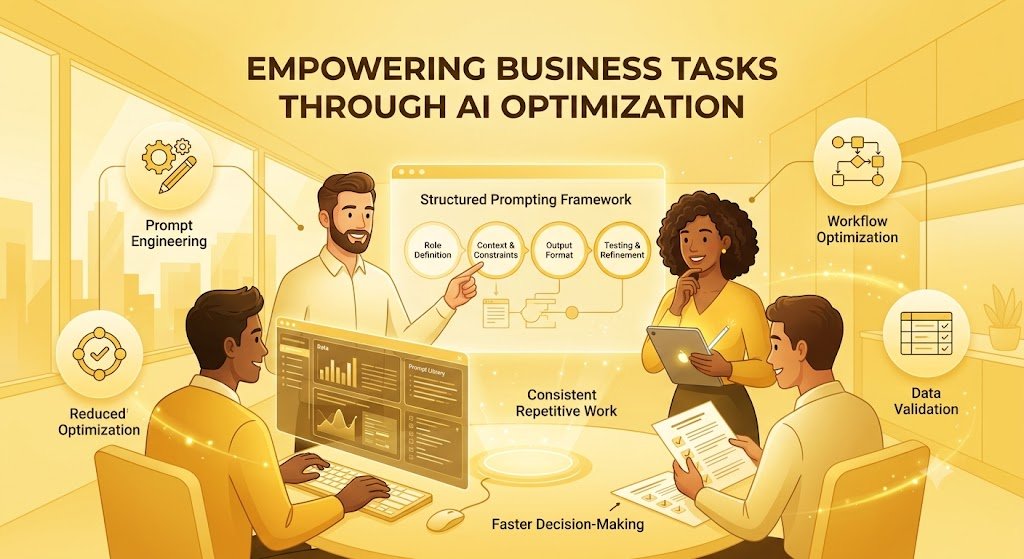
CnEL India worked on an AI-focused optimization project designed to improve the quality, reliability, and consistency of AI-assisted business workflows.
The project involved supporting a range of AI-related tasks, with particular attention to prompt engineering, workflow refinement, response quality, and ongoing performance improvement. Rather than treating AI as a simple question-and-answer system, the project approached it as a practical business capability that could support research, content generation, analysis, structured decision-making, documentation, and repetitive operational tasks.
The main challenge was to create a reliable process for interacting with an advanced language model so that it could consistently produce useful outputs across different types of tasks.
AI systems can generate impressive responses with relatively simple instructions. However, business applications often require more than a good response occasionally. They require predictable quality, clear formatting, relevant context, appropriate reasoning, and outputs that match specific business requirements.
CnEL India therefore focused on designing better instructions, refining workflows, testing outputs, identifying weaknesses, and continuously improving the overall AI process.
Business Challenge
Organizations increasingly use AI to accelerate everyday work. However, simply introducing an AI system does not automatically create a reliable workflow.
The quality of an AI-generated result depends on several factors, including:
- The clarity of the instructions.
- The amount and quality of context provided.
- The expected output format.
- The sequence of tasks.
- The quality of examples.
- The way information is validated.
- The handling of unexpected responses.
- The consistency of the underlying workflow.
A vague instruction may produce a technically relevant response but fail to meet the actual business requirement.
For example, an organization may need a concise report with a specific structure, but the AI may produce a long explanation. Another task may require consistent terminology, but the generated output may use different wording each time.
These challenges become more important when AI is integrated into ongoing business operations.
The project therefore focused on transforming AI interactions from informal conversations into structured, repeatable workflows.
Project Objectives
CnEL India established several objectives for the AI optimization initiative:
- Improve the quality of AI-generated responses.
- Develop clearer and more effective prompts.
- Create reusable prompt structures for recurring tasks.
- Improve consistency across different outputs.
- Provide sufficient context to the AI system.
- Define clear output formats.
- Reduce irrelevant or unnecessary responses.
- Improve workflow efficiency.
- Identify and correct recurring AI response problems.
- Establish practical testing and evaluation methods.
- Support ongoing AI-related business initiatives.
- Create workflows that could be maintained and improved over time.
The overall objective was to make AI more dependable as part of everyday business operations.
Understanding Prompt Engineering
Prompt engineering was one of the central components of the project.
A prompt is more than a question. For business applications, an effective prompt can define the role of the AI system, provide relevant background information, explain the task, establish constraints, specify the desired output, and identify quality expectations.
CnEL India approached prompt development systematically.
Instead of repeatedly changing a prompt without understanding why a response was weak, the team could identify the specific issue first.
For example, if the response was too general, additional context might be required.
If the response was too long, the output requirements could be made more specific.
If the structure varied between responses, a defined output format could be introduced.
If the AI misunderstood the intended audience, audience information could be added to the instructions.
This systematic approach helped convert trial-and-error prompting into a more structured optimization process.
Defining the AI’s Role
One important technique was clearly defining what the AI system was expected to do.
Different tasks require different approaches.
An AI system supporting research may need to behave differently from one generating customer communication or analyzing business information.
CnEL India therefore considered role definition as part of the prompt structure.
A workflow could establish that the AI should act as:
- A research assistant.
- A content reviewer.
- A business analyst.
- A data summarization assistant.
- A customer-support drafting assistant.
- A process documentation assistant.
- A quality reviewer.
- A workflow assistant.
The role description helped establish the appropriate context before the main task was provided.
Providing Better Context
Context is one of the most important factors in AI output quality.
An AI system may produce a reasonable answer when given a general question, but business workflows usually require more specific information.
CnEL India focused on identifying what context was necessary for each task.
This could include:
- Business background.
- Target audience.
- Purpose of the task.
- Existing content.
- Relevant business rules.
- Desired communication style.
- Output requirements.
- Restrictions.
- Examples of acceptable results.
The objective was to provide enough information for the AI to understand the task without unnecessarily overwhelming the workflow.
Structured Prompt Design
A structured prompt can make complex tasks easier for an AI system to interpret.
CnEL India organized instructions into logical components where appropriate.
A typical structure could include:
Role → Context → Objective → Instructions → Constraints → Output Format → Quality Requirements
This structure creates a clearer relationship between the business requirement and the expected AI output.
For example, instead of simply asking the AI to “analyze this information,” a structured workflow could explain what is being analyzed, why the analysis is required, which factors should be considered, and how the final result should be presented.
This makes the workflow more repeatable.
Output Format Optimization
Business users often need AI results in a specific format.
A response may need to become a report, table, checklist, summary, email draft, structured data object, action plan, or other predefined format.
Without explicit instructions, the AI may choose its own structure.
CnEL India therefore incorporated output-format requirements into relevant workflows.
The instructions could define:
- Required sections.
- Maximum response length.
- Number of recommendations.
- Required fields.
- Heading structure.
- Bullet-point format.
- Summary requirements.
- Priority indicators.
- Action items.
This helped reduce unnecessary variation between responses.
Improving Response Consistency
Consistency was a major objective of the project.
An AI system can respond differently to similar requests because small changes in context or wording can influence the generated output.
For business operations, excessive variation can make AI outputs difficult to review or integrate into existing processes.
CnEL India therefore focused on creating reusable prompt patterns.
Instead of designing every instruction from scratch, common structures could be reused and adapted for different tasks.
This created greater consistency while still allowing individual workflows to contain task-specific requirements.
Workflow Optimization
Prompt engineering was only one part of the project.
The broader workflow surrounding the AI system also needed to be considered.
A typical AI workflow could include:
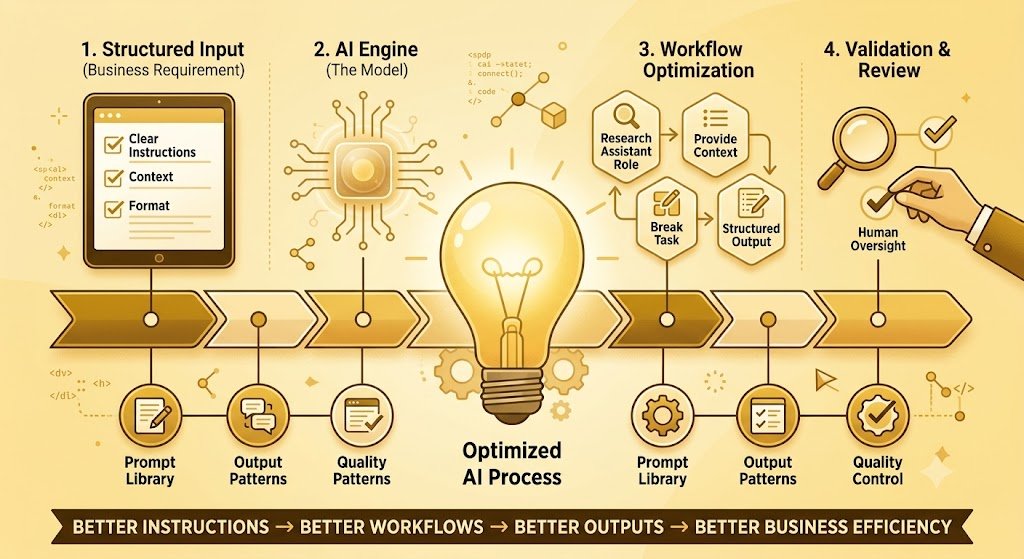
Input → Context Preparation → AI Processing → Output Review → Validation → Final Result
CnEL India examined each stage to identify opportunities for improvement.
For example, poor output quality may not always be caused by the prompt itself.
The input information may be incomplete.
The context may be poorly structured.
The output may lack validation.
The workflow may be asking the AI to perform too many unrelated tasks at once.
Breaking a complex process into logical stages can therefore improve reliability.
Breaking Complex Tasks into Stages
Large AI tasks can sometimes become more reliable when divided into smaller steps.
Instead of asking the AI to research, analyze, summarize, evaluate, and format information in one instruction, the workflow can separate these activities where appropriate.
A multi-stage workflow might involve:
- Collecting the required information.
- Organizing the information.
- Identifying important patterns.
- Performing analysis.
- Producing recommendations.
- Formatting the final output.
- Reviewing the result.
This approach allows each stage to have a clear objective.
It also makes it easier to identify where a problem occurred if the final output is not satisfactory.
Testing AI Responses
Prompt optimization requires testing.
A prompt that works well for one example may fail when different information is introduced.
CnEL India therefore approached AI workflows as systems that need continuous evaluation.
Different test scenarios could be used to examine:
- Normal inputs.
- Short inputs.
- Long inputs.
- Incomplete information.
- Unexpected wording.
- Conflicting information.
- Edge cases.
- Different audiences.
- Different output requirements.
The purpose was to understand how reliably the workflow performed beyond the initial example.
Handling Unexpected Outputs
AI-generated responses can sometimes contain irrelevant information, misunderstand instructions, use inconsistent formatting, or provide more detail than required.
A reliable workflow needs to anticipate these possibilities.
CnEL India incorporated clear constraints and validation practices where appropriate.
If the AI was expected to return structured information, the output could be checked against the required structure.
If the AI was expected to produce a concise response, unnecessary content could be identified during review.
If a workflow required specific terminology, the generated output could be checked for consistency.
This created an additional quality layer around AI generation.
Improving Business Workflow Efficiency
One of the key reasons for implementing AI is to reduce the amount of repetitive manual work.
CnEL India identified opportunities where AI could assist with tasks such as:
- Information summarization.
- Content drafting.
- Research organization.
- Data interpretation.
- Document preparation.
- Internal communication.
- Customer response drafting.
- Business analysis.
- Process documentation.
- Idea generation.
The goal was not to automate every human decision.
Instead, AI was used where it could reduce repetitive effort while allowing people to maintain oversight over important decisions.
Human Review and Quality Control
AI optimization does not mean removing human judgment from the process.
For important business tasks, human review can remain an essential part of quality assurance.
CnEL India considered workflows where AI generated an initial result and a human reviewed or approved it before final use.
This can be particularly valuable for:
- Customer-facing communication.
- Business decisions.
- Sensitive information.
- Strategic analysis.
- Important documents.
- High-impact recommendations.
The AI therefore functioned as an accelerator rather than an uncontrolled replacement for human oversight.
Reusable Prompt Library
Another potential outcome of the project was the creation of reusable prompt patterns.
Instead of storing prompts as isolated pieces of text, they could be organized according to their purpose.
Examples could include:
- Research prompts.
- Summarization prompts.
- Analysis prompts.
- Content-generation prompts.
- Review prompts.
- Classification prompts.
- Customer communication prompts.
- Documentation prompts.
A reusable prompt library can reduce development time when new AI workflows are introduced.
It also helps maintain consistency across teams.
Documentation and Knowledge Sharing
Clear documentation was important for ongoing AI initiatives.
AI workflows often evolve over time as teams discover better ways of providing instructions and evaluating results.
CnEL India therefore emphasized documenting important workflow principles.
Documentation could include:
- Purpose of each workflow.
- Required inputs.
- Prompt structure.
- Expected outputs.
- Quality standards.
- Known limitations.
- Review procedures.
- Examples of successful outputs.
This made the system easier for other team members to understand and maintain.
Continuous Improvement
AI workflows should not be considered permanently finished.
As business requirements change, new use cases emerge and users provide feedback, prompts and workflows may need to evolve.
CnEL India adopted an iterative improvement model:
Test → Review → Identify Issue → Refine → Test Again
This process allowed improvements to be based on actual performance rather than assumptions.
Over time, repeated optimization could improve both output quality and workflow efficiency.
Business Benefits
Improved AI Output Quality
Better prompts and structured workflows can produce more relevant and useful results.
Greater Consistency
Reusable instructions and defined output structures help maintain consistency across recurring tasks.
Reduced Manual Effort
AI can assist with repetitive research, writing, analysis, and documentation activities.
Faster Workflow Execution
Structured AI processes can reduce the time required to complete certain business tasks.
Better Scalability
Reusable workflows allow AI capabilities to be extended to additional business processes.
Improved Team Productivity
Employees can focus more on higher-value decisions while AI assists with repetitive work.
Easier Maintenance
Documented prompt structures and workflow standards make ongoing improvements easier.
Better AI Reliability
Testing, validation, and human review help reduce the impact of inconsistent or unsuitable AI outputs.
CnEL India’s Contribution
CnEL India approached the project from both a technical and business-process perspective.
The focus was not simply on writing individual prompts. The broader objective was to create practical AI workflows that could support ongoing business operations.
The team worked on understanding task requirements, structuring instructions, improving context, defining outputs, testing responses, identifying weaknesses, and refining workflows.
This approach helped turn AI from an experimental capability into a more organized business resource.
CnEL India also emphasized independent problem-solving and clear communication so that AI initiatives could continue evolving without requiring constant external intervention.
Future Scalability
The framework developed through the project can support a broader AI adoption strategy.
Once effective prompt structures and workflow patterns have been established, they can be adapted to additional departments and business processes.
Potential future applications include:
- Sales support.
- Customer service.
- Marketing content.
- Business research.
- Internal reporting.
- Recruitment support.
- Data analysis.
- Documentation.
- Process automation.
- Knowledge management.
The same principles can be applied across different use cases while maintaining common standards for quality and review.
Conclusion
The AI optimization project demonstrated that successful AI adoption requires more than access to a powerful language model.
Businesses need well-designed instructions, relevant context, structured workflows, clear output requirements, testing processes, and continuous improvement.
CnEL India approached the project by combining prompt engineering with workflow design, response evaluation, quality control, documentation, and practical business-process optimization.
The resulting framework provided a more reliable way to use AI for recurring tasks while maintaining human oversight where appropriate.
The central principle was simple:
Better Instructions → Better Workflows → Better Outputs → Better Business Efficiency
By treating AI workflows as systems that can be designed, tested, measured, and improved, CnEL India created a foundation for more scalable and dependable AI adoption across future business initiatives.