

Introduction
Artificial Intelligence systems are becoming increasingly capable of performing complex programming, data analysis, statistical reasoning, and machine-learning tasks. As these systems improve, evaluating their actual capabilities becomes more difficult.
Simple data labeling is no longer enough to determine whether an advanced AI model can genuinely solve a problem. Modern evaluation requires carefully designed challenges that test reasoning, coding accuracy, statistical understanding, data interpretation, and the ability to produce reproducible results.
This case study focuses on a long-term requirement for an AI Training and Evaluation Specialist with strong Python, statistics, machine-learning, and data-science expertise.
The objective is to support authorized AI evaluation projects by creating challenging technical tasks, preparing high-quality datasets, assessing AI-generated responses, developing scoring standards, and identifying meaningful weaknesses in advanced AI systems.
CnEL India can approach this type of engagement as a structured AI evaluation and quality-assurance initiative, combining technical expertise, dataset development, model assessment, documentation, and continuous quality improvement.
Understanding the Client’s Requirement
The client is looking for a specialist for a long-term freelance collaboration rather than a one-time assignment.
The role requires someone who can work independently while maintaining strict quality standards over an extended period.
The specialist is expected to contribute to several areas:
- Designing advanced data-science and coding tasks
- Creating and validating datasets
- Evaluating AI-generated responses
- Developing reference solutions
- Creating detailed evaluation rubrics
- Identifying statistical and coding errors
- Checking reproducibility
- Reviewing model reasoning
- Maintaining accurate records
- Communicating progress and quality concerns
The requirement is therefore much broader than traditional data annotation.
The specialist needs to understand both the technical subject being evaluated and the behavior of AI models.
Why AI Evaluation Is Important
As AI systems become more advanced, organizations need reliable methods for determining whether their outputs are actually correct.
A response can appear convincing while still containing serious problems.
For example, an AI-generated data-science solution may contain:
- Incorrect statistical assumptions
- Faulty calculations
- Inappropriate model selection
- Data leakage
- Incorrect interpretation of results
- Coding mistakes
- Missing edge cases
- Unsupported conclusions
- Non-reproducible results
These problems may not be obvious to someone without technical expertise.
This is why expert evaluation is essential.
A strong evaluator does not simply ask whether an answer looks reasonable. They investigate whether the solution is logically correct, technically valid, complete, reproducible, and appropriate for the problem.
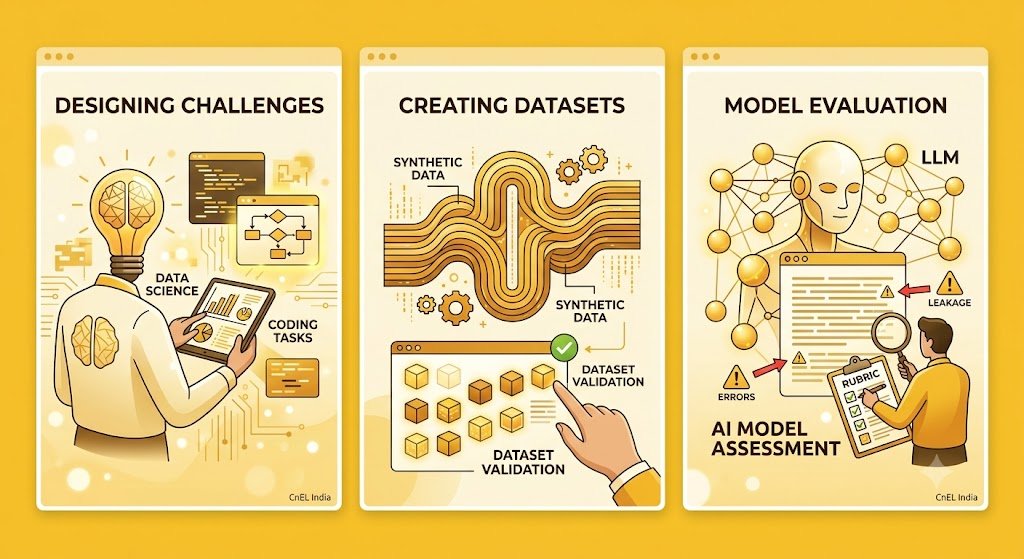
Designing Challenging Evaluation Tasks
One of the most important responsibilities in this project is creating original technical tasks that expose weaknesses in AI models.
A good evaluation task should not be unnecessarily complicated. Instead, it should test a specific capability in a meaningful way.
For example, a task might require a model to analyze a dataset, identify a statistical relationship, develop a predictive approach, explain its reasoning, and provide a reproducible solution.
The task can contain carefully designed conditions that test whether the AI understands the underlying problem rather than simply generating a familiar answer.
High-quality evaluation tasks should have:
- Clear objectives
- Well-defined inputs
- Expected outputs
- Relevant constraints
- Realistic scenarios
- Known evaluation criteria
- A reliable reference solution
This makes the resulting evaluation meaningful.
Data-Science Task Development
Data-science evaluation requires a combination of theoretical and practical knowledge.
A task may involve data cleaning, statistical analysis, predictive modeling, feature engineering, model evaluation, or interpretation of results.
The evaluator needs to understand what a correct solution should look like before assessing an AI response.
This means developing a reference solution first.
The reference solution acts as a benchmark against which AI-generated answers can be compared.
However, evaluation should not always depend on whether the AI produces exactly the same code or wording as the reference.
There may be multiple technically correct approaches to a problem.
Therefore, the evaluation process should focus on correctness, reasoning, methodology, and expected outcomes rather than superficial similarity.
Dataset Creation and Validation
High-quality datasets are essential for reliable AI training and evaluation.
The specialist may need to create synthetic datasets designed for specific technical scenarios.
Synthetic data can be useful when real-world data is unavailable, restricted, sensitive, or unsuitable for a particular evaluation.
However, creating synthetic data is not simply about generating random values.
The dataset must have meaningful characteristics that correspond to the problem being tested.
It should also be validated to ensure that:
- The expected patterns are present
- The data is internally consistent
- Edge cases are represented where appropriate
- Unintended shortcuts are avoided
- Evaluation objectives can actually be tested
- The dataset does not introduce misleading signals
Poor-quality data can produce misleading evaluation results, so validation is a critical part of the process.
Identifying Data Leakage
Data leakage is one of the important issues that the evaluator needs to identify.
Data leakage occurs when information that should not be available to a model becomes available during training or evaluation.
This can create artificially strong results.
An AI system may appear to perform extremely well not because it genuinely understands the task, but because the evaluation setup unintentionally gives it access to information that reveals the answer.
A strong evaluation specialist must therefore examine datasets, task design, and evaluation conditions carefully.
The objective is to ensure that the model is being tested fairly.
Evaluating Statistical Reasoning
Statistical reasoning is another important area.
AI systems can generate explanations that sound statistically sophisticated while still being incorrect.
An evaluator needs to determine whether the model has selected appropriate methods and interpreted results correctly.
Evaluation may consider areas such as:
- Sampling assumptions
- Probability
- Correlation
- Statistical significance
- Confidence intervals
- Regression
- Hypothesis testing
- Model evaluation
- Interpretation of uncertainty
The evaluator should also identify situations where a model reaches a conclusion that is not supported by the available evidence.
This is particularly important because incorrect statistical reasoning can lead to poor business or scientific decisions.
Evaluating Coding Accuracy
Python and data-science coding are central to the role.
An AI-generated solution should be evaluated not only for whether the code appears syntactically correct but also for whether it actually solves the requested problem.
Evaluation can include:
- Logical correctness
- Data handling
- Algorithm selection
- Edge-case handling
- Efficiency
- Reproducibility
- Output correctness
- Code clarity
A response may produce an answer for one example while failing on other inputs.
Therefore, robust evaluation should consider multiple scenarios.
The specialist should also check whether the code depends on assumptions that were not stated in the task.
Reproducibility
Reproducibility is an important quality standard for technical AI evaluation.
A solution should be capable of producing the expected results when the same conditions are provided again.
If an AI-generated analysis works only under a particular undocumented setup, its reliability is questionable.
Evaluation should therefore consider whether:
- The necessary assumptions are documented
- The methodology is clearly explained
- The data-processing steps are consistent
- The solution can be executed again
- Results can be independently verified
This helps distinguish genuinely reliable AI solutions from responses that merely appear correct.
Developing Evaluation Rubrics
A major responsibility of the specialist is developing clear scoring rubrics.
A rubric provides a structured method for evaluating AI responses.
Instead of relying on subjective judgment, the evaluator can define specific criteria.
For example, a data-science task might evaluate:
- Understanding of the problem
- Data preparation
- Method selection
- Statistical reasoning
- Coding correctness
- Result interpretation
- Handling of edge cases
- Reproducibility
Each criterion can have defined expectations.
A strong rubric improves consistency between evaluators and makes evaluation results more useful for AI development.
Evaluating Correctness and Completeness
AI responses should be reviewed for both correctness and completeness.
A technically correct response may still be incomplete if it ignores important requirements.
For example, an AI model may correctly build a predictive model but fail to explain how performance should be evaluated.
Another response may provide accurate calculations but ignore a critical condition in the original problem.
Therefore, evaluation needs to consider the entire task.
The evaluator should ask whether the response:
- Understood the requirement
- Addressed every important component
- Produced technically correct results
- Used appropriate reasoning
- Avoided unsupported claims
- Provided enough information to reproduce the solution
Model Red-Team Evaluation
Advanced AI evaluation also involves deliberately testing where models fail.
This can be viewed as a form of technical stress testing.
Instead of asking only simple questions, evaluators design challenging situations that expose weaknesses.
These may involve ambiguous conditions, misleading assumptions, edge cases, complex datasets, or multi-step reasoning.
The purpose is not to make the model fail unfairly.
The purpose is to understand its limitations.
These findings can then help improve future AI systems and evaluation methods.
Documentation and Quality Records
Long-term AI evaluation requires disciplined documentation.
Every task should have sufficient information for another qualified person to understand what was evaluated and how the result was determined.
Documentation can include:
- Task description
- Dataset information
- Expected outcome
- Reference solution
- Evaluation criteria
- Model response
- Identified errors
- Final score
- Reviewer notes
Accurate records make the overall evaluation process more transparent and repeatable.
They also make it easier to analyze trends across many projects.
Independent Work and Communication
Although the role is technical, communication is equally important.
The specialist may work independently and need to identify issues without constant supervision.
If a task contains a problem, the evaluator should communicate it clearly.
If the model behaves unexpectedly, the issue should be documented with enough context for the wider team to understand.
Similarly, progress, blockers, quality concerns, and unusual evaluation findings should be communicated proactively.
This becomes particularly important in a long-term collaboration where multiple projects may be active at different times.
Quality Control
Because AI evaluation can influence future model development, quality control is critical.
An incorrect evaluation can produce misleading conclusions about model capabilities.
CnEL India’s approach would therefore include multiple layers of quality checking.
Tasks can be reviewed before use to ensure that they test the intended capability.
Datasets can be validated for consistency.
Reference solutions can be checked independently.
Evaluation rubrics can be reviewed for clarity.
Final assessments can be sampled for quality.
This structured approach reduces the risk of evaluation errors.
Long-Term Collaboration Model
The client is specifically interested in a relationship lasting two years or more.
This means the engagement should be designed for continuity rather than isolated assignments.
Over time, the evaluator can develop a deeper understanding of the client’s quality standards, preferred task structures, evaluation requirements, and recurring project patterns.
This can improve efficiency without compromising accuracy.
A long-term collaboration also makes it possible to build a reusable knowledge base around evaluation methodologies and common model failure patterns.
CnEL India’s Approach
CnEL India can approach this project as a specialized AI quality and evaluation partnership.
The first stage would be understanding the client’s evaluation requirements and quality standards.
The next stage would involve designing or reviewing sample tasks, preparing reference solutions, validating datasets, and establishing evaluation criteria.
Once the process is approved, the work can expand into continuous task development and model evaluation.
Each evaluation cycle can follow a structured process:
Task Design → Dataset Preparation → Reference Solution → Model Evaluation → Error Identification → Scoring → Quality Review → Documentation
This provides a consistent framework for long-term work.
Expected Business Benefits
A strong AI evaluation program can provide several benefits.
Better Model Quality
Detailed evaluations help identify weaknesses that may not be visible through basic testing.
Reliable Training Data
Carefully prepared datasets can improve the quality of future AI development.
Consistent Evaluation
Clear rubrics reduce subjective judgment.
Improved Technical Accuracy
Expert review can identify coding, statistical, and reasoning errors.
Better Understanding of AI Limitations
Challenging evaluations reveal where models struggle.
Long-Term Scalability
A structured evaluation framework can support multiple projects over time.
Stronger Quality Assurance
Detailed documentation and review processes improve confidence in evaluation results.
Conclusion
The AI Training and Evaluation Specialist requirement represents a sophisticated AI quality-assurance and model assessment project.
The role goes far beyond traditional data labeling. It requires strong technical knowledge, critical thinking, dataset design, statistical understanding, coding expertise, evaluation methodology, and careful documentation.
The central objective is to determine whether advanced AI systems can genuinely solve complex technical problems rather than simply generate convincing-looking answers.
CnEL India can support this type of engagement by combining AI expertise with structured evaluation processes, high-quality dataset development, reference solutions, scoring frameworks, technical review, and continuous quality control.
With a long-term approach, the evaluation process can become increasingly consistent and valuable, helping identify model weaknesses, improve training quality, and create more reliable AI systems.
The most important principle is that effective AI evaluation should measure real capability, not just apparent intelligence. A well-designed evaluation system makes it possible to understand where AI performs well, where it fails, why those failures occur, and how future systems can be improved.