
Introduction
Artificial Intelligence is rapidly changing the way businesses operate, and the construction industry is beginning to experience significant opportunities from these developments. From planning and documentation to communication, project management, customer engagement, and business operations, AI can help construction professionals save time, improve decision-making, and reduce repetitive work.
However, the challenge for many businesses is not simply understanding that AI is important. The real challenge is knowing which AI developments matter, which applications are practical, how they can be implemented, and how professionals can learn to use them effectively.
This case study focuses on a coaching program operating within the construction industry that wanted dedicated AI expertise to support its students and continuously integrate relevant AI developments into its educational program.
The objective was to create an AI-focused learning and implementation environment where students could understand practical AI applications, experiment with useful solutions, and apply AI concepts to real construction-business scenarios.
CnEL India can approach such a requirement by combining AI consulting, practical implementation, educational content development, workflow analysis, and continuous AI research into one structured program.
Understanding the Client’s Requirement
The client already operates a coaching program focused on the construction industry. The goal is to make AI an important part of that program.
Instead of treating AI as a separate technical subject, the client wants students to understand how AI can become part of their everyday professional activities.
The AI specialist is expected to perform several interconnected responsibilities:
- Stay updated with important AI developments
- Identify AI applications relevant to construction
- Help the business implement useful AI solutions
- Teach AI concepts within the coaching program
- Provide students with practical AI resources
- Help students understand how to apply AI
- Continuously evaluate new opportunities
This means the role combines AI consulting, implementation, education, research, and ongoing innovation.
Why AI Matters in Construction
Construction companies manage large amounts of information and perform many repetitive activities.
Professionals may spend significant time preparing documents, reviewing project information, communicating with clients, creating reports, organizing schedules, preparing estimates, responding to inquiries, and managing administrative work.
Many of these activities involve structured information and repetitive processes, which makes them suitable for AI-assisted improvement.
AI can potentially support areas such as:
- Document preparation
- Information organization
- Project communication
- Customer communication
- Proposal preparation
- Business administration
- Knowledge management
- Training and education
- Report generation
- Data analysis
- Internal workflow improvement
The objective should not be to introduce AI simply because it is popular. The focus should be on identifying situations where AI can provide measurable value.
Building an AI Strategy
The first step in the project would be developing a clear AI strategy for the coaching program.
Without a strategy, businesses can easily become overwhelmed by the number of new AI developments appearing every week.
New technologies, features, applications, and AI capabilities are continuously emerging. However, not every development is relevant to construction professionals.
An AI strategy helps separate useful developments from unnecessary complexity.
The strategy can focus on three major questions:
What is changing?
The program needs to stay aware of important developments in AI.
What is relevant?
The team needs to determine which developments can actually benefit construction professionals.
How can it be applied?
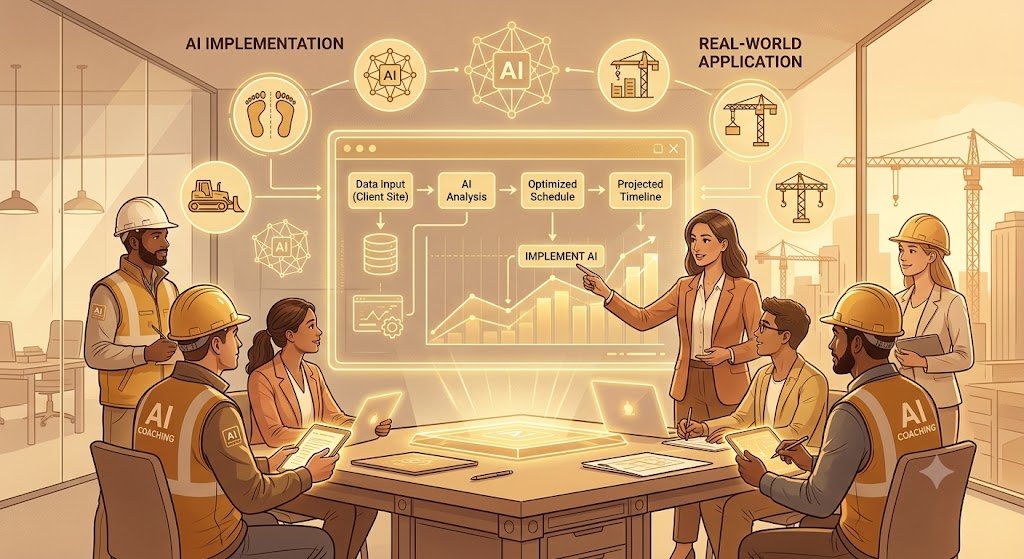
The final step is converting useful AI capabilities into practical workflows, lessons, and student resources.
This approach ensures that AI adoption remains focused on business value.
Continuous AI Research
One of the most important responsibilities in this project is staying on top of AI developments.
AI is evolving extremely quickly. A solution that was considered advanced several months ago may become common or be replaced by a newer approach.
For a coaching program, this creates an opportunity.
Instead of teaching students outdated concepts, the program can continuously update its curriculum based on relevant developments.
However, continuous research needs structure.
Developments can be evaluated based on:
- Practical usefulness
- Relevance to construction
- Ease of adoption
- Potential time savings
- Business impact
- Reliability
- Learning value
- Cost considerations
- Data and privacy requirements
Only developments that provide meaningful value should be considered for inclusion in the program.
AI Implementation for the Coaching Business
The second major responsibility is implementing AI within the coaching business itself.
Before implementing any AI solution, the existing business processes should be reviewed.
The objective is to identify activities where AI can reduce manual work or improve the experience for students and the coaching team.
For example, administrative activities may involve repetitive communication, content organization, student support, scheduling, information management, or documentation.
AI can potentially assist with these activities when implemented carefully.
The implementation process should begin with identifying the problem rather than starting with a particular technology.
This prevents the business from adopting AI solutions simply because they are available.
Teaching AI to Construction Professionals
Teaching AI to construction professionals requires a different approach from teaching AI to software engineers.
Most construction professionals do not need to become AI developers.
Instead, they need to understand how to use AI effectively within their existing professional responsibilities.
The curriculum can therefore focus on practical AI literacy.
Students can learn:
- What AI can and cannot do
- How to identify useful AI opportunities
- How to communicate effectively with AI systems
- How to verify AI-generated information
- How to protect sensitive business information
- How to incorporate AI into daily workflows
- How to evaluate AI-generated results
- How to continuously improve their AI usage
The goal is to make AI understandable and practical rather than overly technical.
Practical Learning Instead of Theory
An effective coaching program should prioritize practical learning.
Students are more likely to understand AI when they can immediately connect it with their own work.
For example, instead of explaining AI concepts only through theoretical lessons, the program can demonstrate how AI can assist with common construction-business activities.
A student could learn how to organize project information, prepare professional communications, summarize lengthy documents, structure business information, or improve repetitive administrative processes.
The same principle can be applied across different construction roles.
This creates a learning environment where students can immediately see the value of AI.
Providing AI Resources to Students
Another important part of the project is providing students with practical AI resources.
The purpose of these resources is to help students continue using AI after completing individual lessons.
Resources can include:
- Practical AI guides
- Workflow examples
- Industry-specific instructions
- Templates
- Checklists
- Learning exercises
- Use-case libraries
- AI adoption frameworks
- Best-practice documentation
These resources can become part of the long-term value of the coaching program.
Instead of students learning AI once and forgetting it, they can return to the resources whenever they encounter a new business problem.
Construction-Specific AI Use Cases
A major advantage of this project is the opportunity to create AI education specifically for construction.
Generic AI education may not fully address the needs of construction professionals.
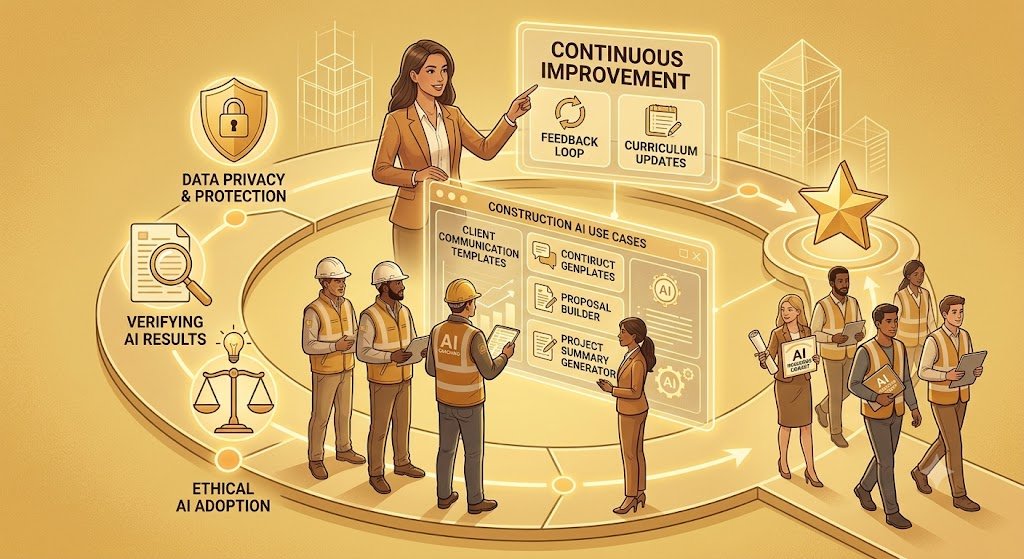
A construction-focused AI program can explore use cases related to:
Project Administration
AI can assist with organizing project information and preparing routine documentation.
Client Communication
AI can help professionals structure clear and professional communications.
Proposal Preparation
AI can support the preparation of business proposals and other written materials.
Documentation
Large amounts of project information can be organized and summarized more efficiently.
Business Operations
Administrative workflows can be reviewed to identify repetitive tasks suitable for automation.
Training
AI can help create personalized learning exercises and educational materials.
The objective is to demonstrate practical applications rather than simply discuss AI as a concept.
AI-Assisted Student Learning
AI can also improve the coaching experience itself.
Students have different levels of knowledge, different business challenges, and different learning speeds.
A structured AI learning environment can provide additional support between coaching sessions.
For example, students can use AI-assisted resources to explore concepts, practice workflows, organize information, and receive guidance on specific scenarios.
This can make learning more flexible.
However, students should also be taught that AI-generated information needs to be reviewed.
AI should be treated as an assistant rather than an unquestionable source of truth.
Responsible AI Education
Responsible AI usage should be a fundamental part of the program.
Construction businesses may handle confidential project information, customer details, contracts, pricing information, and other sensitive data.
Students therefore need to understand the importance of protecting confidential information.
The program can teach principles such as:
- Avoiding unnecessary exposure of sensitive data
- Reviewing generated information
- Checking important facts
- Maintaining human oversight
- Understanding AI limitations
- Using AI responsibly in professional communication
This helps students adopt AI without creating unnecessary business risks.
AI Workflow Transformation
The larger objective is not merely to teach students how to use AI applications.
The program should teach them how to think in terms of AI-enabled workflows.
A workflow may contain several steps.
For example, a professional may collect information, organize it, analyze it, create a response, review the result, and communicate it to another person.
AI may be able to assist with several of these steps.
Students can learn to identify which steps should remain human-controlled and which can be supported or automated.
This way of thinking is more valuable than learning one specific AI application.
Building an AI-First Coaching Program
The long-term opportunity is to make AI a continuous component of the coaching program.
Instead of adding one AI lesson and considering the project complete, AI can become part of the program’s overall structure.
New developments can be reviewed regularly.
Relevant developments can be converted into lessons.
Students can receive updated resources.
Real-world construction use cases can be added over time.
This creates a living curriculum that evolves alongside the technology.
CnEL India’s Approach
CnEL India can approach this project as an ongoing AI consulting and education partnership.
The first phase would involve understanding the coaching program, its students, existing curriculum, business processes, and major challenges faced by construction professionals.
The next stage would identify high-value AI opportunities.
These opportunities could be divided into three categories:
Internal AI Implementation — improving the coaching business itself.
Student Education — teaching practical AI concepts and workflows.
Student Resources — providing reusable AI learning materials and practical resources.
The AI roadmap can then be continuously updated based on new developments and feedback from students.
Measuring Success
The success of an AI-focused coaching program should not be measured only by the number of AI lessons delivered.
More meaningful indicators include:
- Student adoption of AI
- Time saved through AI-assisted workflows
- Number of practical use cases implemented
- Student confidence with AI
- Improvements in business productivity
- Student engagement with AI resources
- Number of workflows improved
- Quality of AI-generated outcomes
- Reduction in repetitive work
These measurements can help the coaching business understand which AI initiatives are actually delivering value.
Continuous Improvement
AI education should never be considered finished.
As new developments emerge, the curriculum can be reviewed and updated.
Student feedback can reveal which concepts are difficult to understand.
Real-world implementation can reveal which workflows provide the greatest value.
The program can then continuously improve its content and resources.
This creates a cycle of:
Research → Evaluation → Implementation → Teaching → Feedback → Improvement
Such a cycle allows the coaching program to remain relevant even as AI continues to evolve.
Expected Business Benefits
A successful AI integration program can provide significant benefits to the coaching business and its students.
Stronger Coaching Program
AI becomes a valuable part of the program rather than an isolated topic.
Better Student Outcomes
Students learn practical skills that can be applied to real construction-business situations.
Increased Productivity
AI-assisted workflows can reduce repetitive administrative work.
Competitive Advantage
A construction coaching program with practical AI education can differentiate itself in a rapidly changing market.
Continuous Innovation
The program can stay aligned with important AI developments.
Greater Student Value
Providing practical resources and ongoing AI guidance can increase the long-term value of the coaching program.
Conclusion
The AI specialist requirement for this construction coaching program represents an opportunity to create much more than a traditional AI training course.
The real objective is to build an ongoing AI ecosystem for construction professionals.
This ecosystem combines continuous AI research, practical implementation, student education, industry-specific use cases, reusable resources, responsible AI practices, and continuous improvement.
CnEL India can support this vision by helping the client understand where AI can create value, implementing practical solutions within the business, developing construction-focused educational content, and providing students with resources that help them apply AI in their own professional environments.
The most important principle is to keep AI practical.
Construction professionals do not necessarily need to become AI experts in a technical sense. They need to understand how AI can help them work smarter, reduce repetitive tasks, improve business processes, and make better use of information.
By creating a continuously evolving AI-focused coaching environment, the client can help construction professionals prepare for the changing future of work while also creating a stronger, more innovative, and scalable coaching program.