
Introduction
For coaching businesses and digital education companies, generating leads is only the first step toward revenue growth. The bigger challenge is managing those leads effectively, building trust, following up at the right time, and converting interested prospects into booked sales calls.
When lead management is handled manually, businesses can easily lose opportunities. New leads may not receive an immediate response, follow-ups may be delayed, appointment reminders may be missed, and prospects who do not attend their scheduled calls may never be contacted again.
This case study focuses on the development of a complete lead-to-sales-call automation system for a growing information business offering coaching and digital programs.
The objective of the project is to create a structured customer journey where leads can move from their first interaction with the business toward a sales conversation through automated and personalized communication.
CnEL India can approach such a project by combining CRM organization, funnel development, lead nurturing, appointment automation, customer communication, and conversion-focused workflow design into one connected system.
Understanding the Business Challenge
The client already operates in the coaching and digital-program space, where potential customers usually need to understand the value of an offer before making a purchasing decision.
Unlike simple online purchases, coaching and higher-value digital programs often require a sales conversation. Prospects may have questions about the program, pricing, outcomes, suitability, implementation, or expected results.
This makes the follow-up process extremely important.
A lead who is interested today may not be ready to book a call immediately. Another prospect may watch a sales video but become distracted before booking. Someone else may book an appointment but forget to attend.
Without an organized system, these different situations require significant manual effort.
The project therefore focuses on creating an automated journey that responds appropriately to different lead behaviors.
The Goal of the Automation System
The primary objective is to improve the complete journey from lead capture to booked sales call.
The system should help the business:
- Capture and organize leads
- Segment prospects based on their behavior
- Respond quickly to new inquiries
- Educate prospects through automated follow-ups
- Build trust before the sales conversation
- Encourage qualified prospects to book appointments
- Confirm scheduled appointments
- Reduce missed appointments
- Follow up with no-shows
- Give the sales team better visibility into each prospect
- Reduce repetitive administrative work
The larger goal is to create a predictable and scalable sales process.
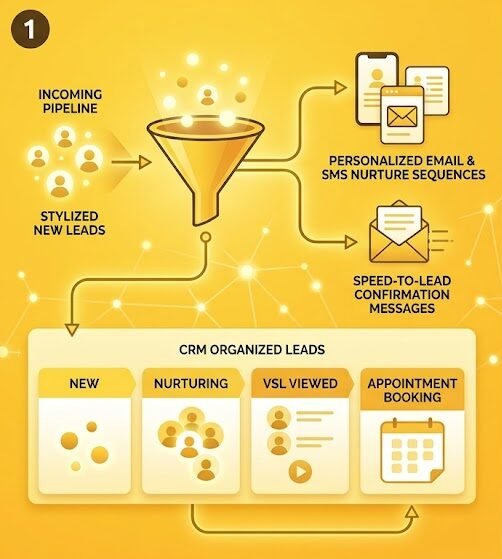
CRM and Lead Management
A strong CRM structure is the foundation of the project.
Every incoming lead should be stored in an organized manner so that the business can understand where that prospect currently stands.
Instead of treating every lead in the same way, the system can categorize prospects according to their journey.
For example, a prospect may be:
- A newly captured lead
- Someone who has shown initial interest
- A prospect who has watched the sales presentation
- A prospect ready to book a call
- An appointment scheduled
- An appointment completed
- A no-show
- A prospect requiring additional nurturing
- A converted customer
This structured approach gives the sales team a clear understanding of the pipeline.
It also allows automated actions to be connected to each stage.
Custom Lead Information
Different businesses need different information to understand their prospects.
For a coaching business, this may include the prospect’s interests, goals, challenges, source of inquiry, program interest, appointment status, and other relevant details.
The system can use custom fields and structured information to keep these details organized.
This makes future communication more relevant.
For example, prospects interested in different programs can receive different follow-up communication instead of receiving identical messages.
This level of organization is particularly valuable when lead volume increases.
VSL Funnel Development
A major part of the project is the creation of a Video Sales Letter, or VSL, funnel.
The purpose of a VSL funnel is to introduce the offer, communicate its value, address common objections, build interest, and encourage the visitor to take the next step.
The landing page needs to be simple, focused, and conversion-oriented.
Instead of overwhelming visitors with too much information, the page should guide them through a clear journey.
A typical structure can include:
- A strong headline
- A clear explanation of the problem
- The desired outcome
- The sales presentation
- Key benefits
- Trust-building information
- Common objections or questions
- A clear call to action
- Appointment booking
The overall experience should lead the prospect naturally toward scheduling a sales conversation.
Conversion-Focused Customer Journey
A successful funnel is not only about attractive design.
The complete customer journey must be considered.
A visitor may arrive on the landing page but not immediately schedule a call. Therefore, the system should provide appropriate follow-up opportunities.
If the prospect provides contact information but does not book, an automated sequence can encourage the next step.
If the prospect schedules a call, the communication should change from lead nurturing to appointment preparation.
If the prospect does not attend the appointment, another sequence can attempt to recover the opportunity.
This creates a connected journey instead of a collection of disconnected marketing activities.
Email and SMS Lead Nurturing
Lead nurturing is one of the most important parts of the project.
Not every prospect is ready to speak with the sales team immediately. Some need additional information before making a decision.
Automated email and SMS communication can help maintain engagement during this period.
A nurture sequence can focus on several objectives:
Education
The prospect can receive useful information related to their problem or goal.
Trust Building
The business can communicate its experience, approach, success stories, and value proposition.
Objection Handling
Common concerns can be addressed before the sales call.
Motivation
Prospects can be reminded about the potential benefits of taking action.
Call Booking
The communication can repeatedly provide an appropriate opportunity to schedule a conversation.
The important point is that these messages should not feel random or excessive.
Each communication should have a clear purpose and should correspond to the prospect’s position in the journey.
Speed-to-Lead
One of the most valuable improvements in lead management is faster response time.
When someone submits an inquiry, their interest is usually highest immediately after taking action.
If the business waits too long to respond, the prospect may lose interest or contact another provider.
Automation can therefore trigger an immediate acknowledgement after lead capture.
The first communication can confirm that the inquiry has been received and provide the prospect with the appropriate next step.
Additional follow-ups can then continue the conversation without requiring a team member to manually remember every lead.
This creates a faster and more consistent customer experience.
Appointment Booking Automation
Once a prospect is ready to speak with the sales team, the booking process should be simple.
The prospect should be able to view available appointment times and select a suitable slot.
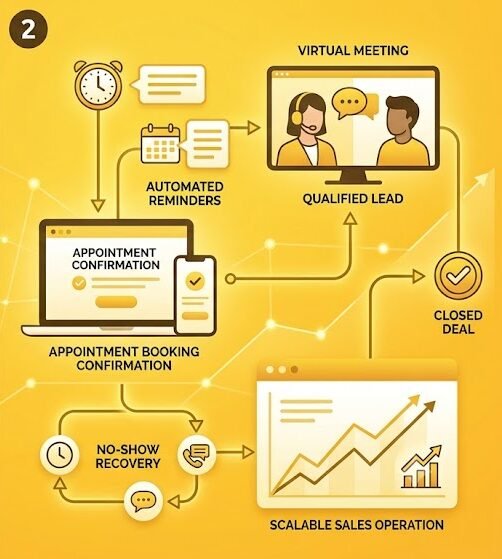
After the appointment is booked, the automation system can trigger confirmation communication.
The purpose is to make sure the prospect knows:
- The appointment has been successfully scheduled
- When the appointment will happen
- What they should expect
- Whether they need to prepare anything
- How they can attend the meeting
This reduces uncertainty and improves the overall appointment experience.
Appointment Reminders
One of the biggest challenges in sales-call funnels is appointment attendance.
People may book calls and later forget about them.
Automated reminders can significantly improve communication before the appointment.
Different reminders can be scheduled before the meeting, allowing the prospect to remain aware of the upcoming conversation.
The reminders should be useful rather than repetitive.
For example, an earlier message can confirm the appointment, while a later reminder can provide the meeting details and encourage the prospect to attend on time.
This creates a more professional experience while reducing manual work for the sales team.
No-Show Recovery
Even with reminders, some prospects will not attend their appointments.
Instead of considering a missed appointment as a lost lead, the system can initiate a no-show recovery process.
The prospect can receive a polite follow-up asking whether they would like to reschedule.
Additional communication can be used to encourage them to choose another suitable time.
This is an important part of the sales automation strategy because acquiring a lead requires effort and marketing investment.
Recovering an interested prospect is often more valuable than simply allowing that lead to disappear from the pipeline.
Lead-to-Sales Automation
The most important aspect of this project is connecting every stage together.
The system should not operate as separate components.
Lead capture, CRM management, funnel activity, nurturing, appointment booking, reminders, and sales follow-up should work as one customer journey.
For example:
Lead Captured → Lead Organized → Initial Response → Nurturing → Sales Presentation → Call Invitation → Appointment Booked → Confirmation → Reminder → Sales Call → Follow-Up
If the prospect does not book, the journey can continue with additional nurturing.
If the prospect books, the communication changes to appointment preparation.
If the prospect does not attend, the system moves into recovery.
This logic makes the entire sales process more structured.
Behavioral-Based Automation
An advanced automation system should respond to customer behavior rather than simply sending identical messages to everyone.
Different actions can indicate different levels of interest.
For example, someone who has only submitted their information may require educational communication.
Someone who has actively engaged with the sales presentation may be closer to making a decision.
Someone who has booked a call should no longer receive the same messages designed for unqualified leads.
Behavior-based workflows allow communication to become more relevant.
This can improve customer experience and reduce unnecessary messages.
Improving Sales Team Efficiency
Automation is not intended to replace the sales team.
Its purpose is to remove repetitive administrative tasks so the sales team can spend more time speaking with qualified prospects.
Without automation, sales representatives may need to manually:
- Check new leads
- Send initial messages
- Follow up repeatedly
- Confirm appointments
- Send reminders
- Track no-shows
- Request rescheduling
- Update lead statuses
An automated system can handle much of this routine work.
The sales team can therefore focus on conversations, qualification, relationship building, and closing.
Tracking the Sales Pipeline
Visibility is another major benefit of a structured CRM and automation system.
Business owners should be able to understand how many leads are entering the system, how many are being nurtured, how many are booking calls, and how many are progressing toward sales.
This helps identify bottlenecks.
For example, if many people enter the funnel but very few book appointments, the problem may exist in the offer, sales presentation, messaging, or booking process.
If many people book but fail to attend, the business may need to improve its reminder and confirmation strategy.
This data-driven approach allows the system to be continuously improved.
Optimization and Continuous Improvement
Building the automation system is only the beginning.
As the business collects more data, different parts of the customer journey can be optimized.
Possible improvements may include:
- Testing different landing-page messages
- Improving calls to action
- Adjusting follow-up timing
- Refining nurture content
- Improving appointment reminders
- Identifying common objections
- Improving no-show recovery
- Segmenting leads more effectively
The objective is to create a system that becomes more efficient over time.
CnEL India’s Approach
For this type of project, CnEL India would focus on building a complete and connected automation ecosystem around the client’s sales process.
The first stage would be understanding the existing customer journey and identifying where leads currently enter, how they are handled, and where prospects are being lost.
The next stage would involve designing the CRM structure, lead stages, customer information, funnel journey, communication sequences, appointment process, and recovery workflows.
The system would then be tested across different customer scenarios.
For example, testing would include a new lead who does not book, a lead who books immediately, a prospect who needs additional nurturing, a customer who reschedules, and a prospect who misses the appointment.
This ensures that the automation behaves correctly across the complete journey.
Expected Business Benefits
A well-designed lead-to-sales automation system can provide significant benefits.
More Booked Sales Calls
Consistent follow-up and clear appointment opportunities can encourage more qualified prospects to schedule conversations.
Better Lead Management
Every prospect can be organized according to their current stage.
Faster Response
New leads can receive immediate communication instead of waiting for manual follow-up.
Reduced No-Shows
Confirmation and reminder sequences can improve appointment attendance.
Better Lead Recovery
No-show and inactive prospects can be brought back into the sales process.
Reduced Administrative Work
Sales teams spend less time performing repetitive follow-up tasks.
Scalable Operations
The system can handle increasing lead volumes without requiring the same increase in manual effort.
Conclusion
The GoHighLevel automation requirement represents a complete sales-process optimization project for a coaching and digital-program business.
The real value is not simply creating a funnel or sending automated messages. The objective is to connect every stage of the customer journey into one structured process.
From the first lead interaction to nurturing, sales presentation, appointment booking, reminders, sales conversations, and no-show recovery, every stage should work together.
CnEL India can support such an initiative by combining funnel development, CRM organization, customer communication, workflow automation, appointment management, and continuous optimization.
When these components are designed correctly, the business can respond to leads faster, nurture prospects more effectively, increase booked sales calls, reduce missed appointments, and create a scalable sales operation that can support long-term growth.