
Introduction
Modern software businesses depend on reliable platforms, efficient development processes, and well-structured operational workflows. As applications become more complex and customer expectations increase, manual operational work can become a major challenge. Repetitive deployment activities, environment management, operational checks, infrastructure configuration, and support processes can consume significant time while also increasing the possibility of human error.
This case study focuses on a requirement for a Senior Automation Engineer who can help transform manual technical and operational processes into reliable, maintainable, and scalable automated workflows.
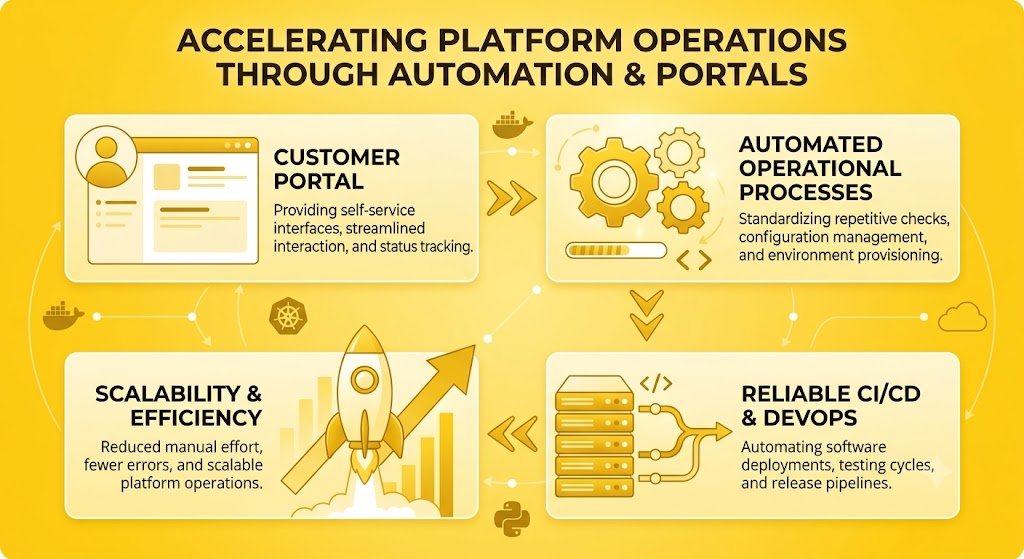
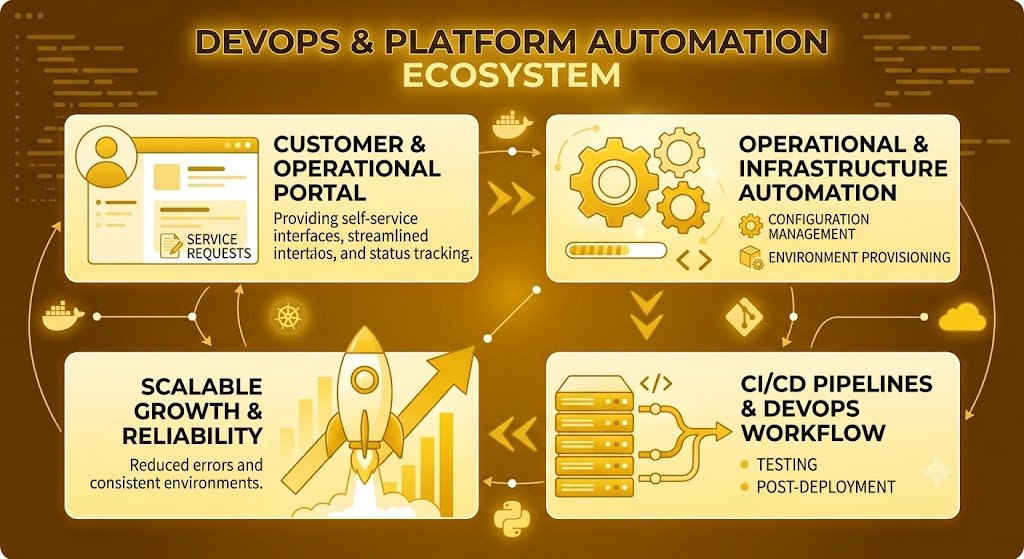
The project involves three major areas: developing a customer-facing portal, improving DevOps processes, and creating platform-level automations. The overall objective is not simply to automate individual tasks, but to create a dependable operational environment where development, deployment, infrastructure, and platform activities can work together efficiently.
CnEL India can approach such a requirement by combining software development, automation engineering, infrastructure knowledge, and process optimization into one structured solution.
Understanding the Client’s Requirement
The client is looking for a full-time senior engineer with strong experience in automation and DevOps. The ideal professional needs to understand both software development and operational requirements.
The role goes beyond writing scripts. The engineer is expected to analyze existing processes, identify repetitive or inefficient activities, design automation workflows, maintain them over time, and ensure that the resulting systems remain reliable as the platform grows.
A key part of the requirement is the ability to translate manual processes into dependable automation.
For example, a development team may currently perform several deployment steps manually. Each step may be simple on its own, but when repeated frequently, the process can become slow and error-prone. A well-designed automation workflow can standardize those activities, reduce unnecessary manual intervention, and make deployments more predictable.
The same principle applies to infrastructure operations, configuration management, monitoring-related activities, environment preparation, and other repetitive platform tasks.
The Importance of Platform Automation
Platform automation is becoming increasingly important for organizations operating modern software products.
When operational processes are handled manually, businesses can face several challenges:
- Increased possibility of human error
- Slower deployment cycles
- Inconsistent environments
- Difficult troubleshooting
- Higher operational workload
- Limited scalability
- Dependence on individual technical employees
- Greater difficulty maintaining consistent processes
Automation addresses these challenges by establishing repeatable workflows.
Instead of depending on someone to remember every step of a process, the organization can define that process once and allow the system to execute it consistently.
However, effective automation requires careful planning. Poorly designed automation can simply move complexity from one place to another. Therefore, the engineer needs to understand the business process before deciding how it should be automated.
Building a Customer Portal
One important part of the engagement is the development of a customer portal.
A customer portal can provide a centralized interface through which customers interact with services, information, requests, or operational processes. The exact functionality can vary depending on the client’s business model, but the portal should be designed with usability, security, reliability, and scalability in mind.
From a development perspective, the portal should have a clear structure and an architecture that allows future functionality to be added without major redevelopment.
The engineering approach would begin with understanding customer workflows and identifying the information and actions that should be available through the portal.
The portal can then be connected with internal processes so that customer activities trigger appropriate operational workflows.
This creates an important relationship between application development and automation. Instead of building a portal that operates independently, the system can be designed to become part of the organization’s wider operational platform.
Automating DevOps Workflows
A major responsibility of the engineer is automating DevOps workflows.
Software development typically involves several stages between writing code and making a new version available to users. These stages may include code validation, testing, packaging, deployment, environment preparation, and post-deployment verification.
When these activities are performed manually, deployment can become inconsistent.
A strong automation strategy creates a controlled workflow where each stage follows predefined rules.
For example, when new software changes are ready, the automation process can validate the changes, perform appropriate checks, prepare the application, and move it through the required deployment stages.
This reduces unnecessary manual work and creates greater consistency between releases.
The objective is not simply faster deployment. Reliability is equally important.
A fast process that frequently produces errors is not useful. Therefore, automation should include appropriate validation and safeguards to ensure that speed does not compromise stability.
Automating Operational Processes
Beyond deployment, many organizations have repetitive operational processes that can be automated.
These processes may involve:
- Preparing environments
- Managing configurations
- Performing routine checks
- Updating application settings
- Handling recurring operational requests
- Managing system states
- Supporting release activities
- Maintaining consistent environments
The engineer’s responsibility is to identify these opportunities and determine which processes provide the greatest benefit from automation.
A useful approach is to prioritize activities based on frequency, business impact, complexity, and risk.
A process that takes only a few minutes but occurs hundreds of times every month may be an excellent automation candidate. Similarly, a process that is difficult to perform manually and frequently causes mistakes may provide significant value when automated.
Scripting and Automation Logic
Scripting is an important foundation of the proposed solution.
Automation scripts can connect different operational activities and execute repeatable processes according to predefined rules.
However, scripts should not be treated as temporary shortcuts. For a professional production environment, automation code needs to be organized, documented, maintainable, and capable of handling failures appropriately.
A senior engineer should consider what happens when an expected condition does not occur.
For example, if one stage of an automated process fails, the system should provide useful information about the failure rather than simply stopping without explanation.
Good automation therefore includes error handling, logging, validation, and clear execution logic.
Deployment Reliability
One of the biggest benefits of automation is improved deployment reliability.
Manual deployments often depend on individual knowledge. Different people may perform the same deployment in slightly different ways, which can result in inconsistent outcomes.
Automation creates a standardized process.
Once a deployment workflow has been properly designed, every execution can follow the same defined sequence.
This makes troubleshooting easier because the engineering team knows exactly how the process operates.
It also makes onboarding easier. New team members do not need to memorize a large number of manual deployment procedures because the standardized workflow already contains the required process.
Infrastructure and Environment Management
Modern applications often operate across multiple environments.
Development, testing, staging, and production environments may require different configurations while still maintaining a consistent underlying structure.
Infrastructure automation helps organizations manage these environments more effectively.
Instead of manually creating and configuring every environment, infrastructure definitions can be used to establish repeatable setups.
This reduces configuration differences and makes it easier to reproduce an environment when necessary.
The engineer can also establish structured configuration practices so that application settings and environment-specific information are managed consistently.
This is particularly valuable when the platform needs to scale or when new environments must be created quickly.
Containerized Application Environments
Another important requirement is knowledge of containerized environments and orchestration.
Containers provide a standardized way to package and run applications with their required dependencies. This can make applications easier to move between environments and simplify deployment processes.
However, managing containers at scale requires appropriate operational practices.
The engineer must understand application lifecycle management, resource requirements, deployment behavior, service communication, scaling, and failure recovery.
Automation can be used to simplify these activities and provide consistent management across environments.
The ultimate objective is to create an environment where applications can be deployed and operated predictably.
Infrastructure as Code
Infrastructure as Code is another important part of modern platform automation.
Instead of relying entirely on manual infrastructure configuration, infrastructure requirements can be represented through structured definitions.
This provides several advantages.
Infrastructure changes become easier to review, reproduce, and manage. Teams can maintain a history of configuration changes and reduce the possibility of undocumented modifications.
It also makes scaling easier because the same infrastructure structure can be reproduced when additional environments or resources are required.
For the client, this can contribute significantly to operational consistency and long-term maintainability.
Troubleshooting and Reliability
Automation does not eliminate technical problems. Instead, well-designed automation makes problems easier to identify and resolve.
A senior automation engineer should therefore design workflows with troubleshooting in mind.
Automation should provide meaningful logs, clear failure information, validation steps, and appropriate recovery procedures.
When something goes wrong, the engineering team should be able to determine:
- What failed?
- At which stage did it fail?
- What caused the failure?
- Which component was affected?
- Can the process safely be retried?
- What action is required?
This approach reduces downtime and allows technical teams to resolve problems more efficiently.
Security Considerations
Platform automation also needs to consider security.
Automated workflows may interact with application environments, infrastructure, configurations, and sensitive operational information. Therefore, access should be carefully controlled.
The solution should follow principles such as least-privilege access, secure handling of sensitive information, controlled permissions, and proper separation between environments.
Security should be included during the design stage rather than added later.
For a customer portal, security becomes even more important because customer-facing functionality may involve account information and business data.
Scalability
The client specifically requires automation that improves scalability.
Scalability means that the platform should be able to handle increased workloads and additional customers without requiring a proportional increase in manual operational effort.
A well-designed automation system supports this goal by reducing repetitive human intervention.
As the number of customers, deployments, environments, and operational activities increases, automated processes can continue to execute consistently.
This allows the technical team to focus more on engineering improvements and less on repetitive administration.
Maintainability
Automation must also remain useful over the long term.
A quick solution may work initially but become difficult to maintain as the platform evolves.
For this reason, CnEL India’s approach would emphasize clean architecture, reusable automation components, clear documentation, structured workflows, and understandable code.
Automation should be designed so that another engineer can understand and modify it when requirements change.
This is particularly important for a full-time platform engineering engagement because the automation environment will continue to evolve alongside the business.
CnEL India’s Approach
For a project of this nature, CnEL India would begin with an assessment of the client’s current development and operational processes.
The first step would be to identify manual activities, repetitive workflows, deployment challenges, infrastructure requirements, and areas where operational reliability can be improved.
The next stage would involve prioritizing automation opportunities based on business value.
High-impact workflows would be automated first, followed by additional processes as the platform matures.
The engineering approach would focus on creating reusable and maintainable automation rather than isolated scripts.
Customer portal development, deployment workflows, infrastructure management, and operational automation would be treated as connected parts of one platform strategy.
Regular testing and validation would also be important to ensure that automation continues to function correctly as the environment changes.
Expected Business Benefits
A successful automation initiative can provide several business benefits.
Reduced Manual Work
Employees spend less time performing repetitive operational activities and can focus on higher-value engineering work.
Faster Processes
Automated workflows can execute repetitive tasks much faster than manual processes.
Improved Reliability
Standardized workflows reduce variation and help minimize human error.
Better Scalability
The organization can increase its operational capacity without increasing manual effort at the same rate.
Easier Troubleshooting
Structured automation with appropriate logging and validation makes problems easier to identify.
Consistent Environments
Automated infrastructure and configuration processes help maintain consistency across environments.
Better Customer Experience
A reliable customer portal combined with efficient backend operations can provide faster and more dependable service.
Conclusion
The Senior Automation Engineer requirement represents a broader platform engineering initiative rather than a simple scripting project.
The goal is to create an environment where software development, deployment, infrastructure, customer-facing services, and operational workflows work together efficiently.
By transforming repetitive manual activities into reliable automation, organizations can reduce operational effort, improve deployment consistency, increase platform reliability, and prepare their infrastructure for future growth.
CnEL India can support this type of engagement through a structured combination of software development, automation engineering, DevOps process improvement, infrastructure management, and ongoing technical support.
The most important principle is that automation should be designed around real business processes. When implemented correctly, automation becomes more than a way to save time—it becomes a foundation for a more reliable, scalable, maintainable, and efficient technology platform.