
Project Overview
Accuracy and consistency are critical in medical coding. Healthcare organizations depend on properly coded clinical information for billing, documentation, reporting, compliance, reimbursement, and internal operations. Even small coding errors can create significant downstream problems, particularly when they occur repeatedly across a team.
CnEL India worked on a medical coding quality assessment project designed to evaluate the professional proficiency and accuracy of a coding team. The objective was not simply to determine whether team members could complete coding tasks, but to establish a structured assessment process that could measure their knowledge, identify gaps, and provide reliable feedback.
The project focused on creating a practical evaluation framework that could be used to assess coding professionals against defined quality expectations. It included assessment design, coding scenario development, answer evaluation, accuracy measurement, error categorization, feedback, and recommendations for improving overall coding quality.
The broader goal was to help the organization establish a repeatable quality-control process that could support ongoing employee development and maintain consistent coding standards.
Business Challenge
Medical coding requires attention to detail, knowledge of coding standards, understanding of clinical documentation, and the ability to interpret information accurately.
A team may have experienced professionals, but experience alone does not guarantee consistent performance.
Different team members may interpret documentation differently, overlook important details, select inappropriate codes, or apply coding rules inconsistently.
When these issues are not identified early, they can become part of the organization’s regular workflow.
The business therefore needed a structured way to answer several important questions:
- Are team members applying coding standards correctly?
- How accurate is their coding?
- Which areas create the most errors?
- Are errors caused by lack of knowledge or misunderstanding?
- Do team members interpret documentation consistently?
- Which employees require additional training?
- Is the team’s overall performance meeting the organization’s expectations?
A simple review of daily work was not sufficient to answer all these questions.
The organization needed an independent and structured assessment that could evaluate employees under consistent conditions.
Project Objectives
CnEL India structured the project around several key objectives.
1. Evaluate Professional Knowledge
The assessment needed to determine whether team members understood the principles and standards required for accurate medical coding.
2. Measure Coding Accuracy
Participants needed to demonstrate their ability to apply their knowledge to realistic coding situations.
3. Identify Knowledge Gaps
The assessment needed to reveal areas where employees were making repeated or significant mistakes.
4. Create Consistent Evaluation Standards
Every participant needed to be evaluated against the same expectations.
5. Provide Reliable Feedback
The results needed to be useful for both employees and management.
6. Support Continuous Quality Improvement
The assessment was designed not as a one-time examination, but as a foundation for an ongoing quality-control process.
Understanding the Medical Coding Workflow
Before designing the assessment, it was important to understand how medical coding work is performed.
Medical coding typically requires reviewing clinical documentation and translating relevant information into standardized codes according to established coding rules and guidelines.
This requires several skills at the same time.
A coding professional needs to:
- Read clinical documentation carefully
- Identify relevant diagnoses and procedures
- Understand terminology
- Distinguish documented information from assumptions
- Apply appropriate coding principles
- Identify supporting documentation
- Avoid unsupported coding
- Maintain consistency
- Review work before final submission
The assessment therefore needed to evaluate more than memorization.
It needed to test practical decision-making.
Designing the Assessment Framework
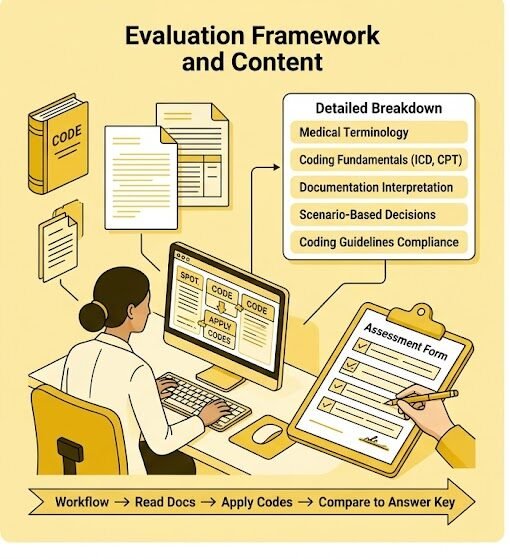
CnEL India developed a structured assessment framework rather than relying on random questions.
The assessment could be divided into multiple sections based on the organization’s requirements.
Possible areas included:
- Medical terminology
- Coding fundamentals
- Diagnosis coding
- Procedure coding
- Documentation interpretation
- Coding guidelines
- Scenario-based decision-making
- Error identification
- Quality and accuracy
- Professional judgment
The exact distribution could be adjusted according to the team’s responsibilities.
This approach allowed the organization to evaluate both theoretical knowledge and practical application.
Creating Realistic Coding Scenarios
One of the most important parts of the project was creating realistic assessment scenarios.
A strong assessment should reflect the type of work employees actually perform.
Instead of relying only on simple definition-based questions, the assessment could include clinical documentation scenarios requiring participants to review information and determine the appropriate coding approach.
For example, a scenario might contain:
- Patient information
- Clinical documentation
- Relevant symptoms
- Diagnoses
- Procedures
- Supporting information
- Additional documentation
The participant would then need to analyze the information and provide the appropriate coding response.
This type of assessment provides a better understanding of how an employee performs in practical situations.
Testing Attention to Documentation
Accurate medical coding depends heavily on documentation.
A coding professional should code based on the information supported by the documentation rather than making assumptions.
The assessment therefore needed scenarios where careful reading was important.
Some cases could contain:
- Similar diagnoses
- Multiple conditions
- Relevant and irrelevant information
- Documentation that requires careful interpretation
- Details that affect code selection
- Missing information
These scenarios help determine whether participants carefully analyze documentation before making a coding decision.
Evaluating Coding Accuracy
Accuracy was a central measurement of the assessment.
Each response could be reviewed against an established answer key and coding standard.
The evaluation could consider several dimensions:
- Correct code selection
- Documentation support
- Proper interpretation
- Correct application of guidelines
- Completeness
- Consistency
- Avoidance of unsupported coding
Rather than looking only at the final answer, the assessment process could also examine the type and pattern of errors.
This makes the results more useful for training and quality improvement.
Categorizing Errors
Not every coding error has the same cause.
CnEL India designed the evaluation process so that errors could be grouped into meaningful categories.
Examples could include:
Knowledge Errors
The employee may not understand a particular coding rule or concept.
Documentation Errors
The employee may have overlooked relevant information in the documentation.
Interpretation Errors
The documentation may have been read incorrectly.
Selection Errors
The employee may understand the case but select an inappropriate code.
Process Errors
The employee may skip an important review or validation step.
Consistency Errors
The employee may handle similar cases differently.
Categorizing errors provides management with more actionable information than simply reporting a percentage score.
Measuring Individual Performance
The assessment results could be converted into structured performance indicators.
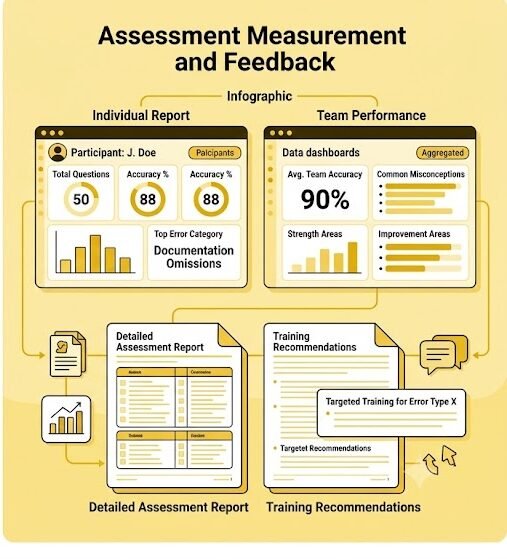
For each participant, the organization could track:
- Total questions
- Correct responses
- Incorrect responses
- Accuracy percentage
- Error categories
- Areas of strength
- Areas requiring improvement
This creates a clear individual performance profile.
However, the purpose of these results was not simply to label employees.
The more important objective was to understand where additional training or support could improve performance.
Evaluating Team-Level Performance
Individual assessment results can also be combined to understand overall team performance.
Management could review:
- Average accuracy
- Common error categories
- Frequently misunderstood concepts
- Areas with strong performance
- Areas requiring team-wide training
For example, if multiple employees make similar mistakes in one area, the issue may not be limited to individual performance.
It could indicate that the team needs clearer training materials or additional guidance.
This makes team-level analysis especially valuable.
Establishing Professional Standards
Another important part of the project was defining what acceptable performance should look like.
Organizations need clear expectations when evaluating coding quality.
CnEL India helped structure assessment criteria around measurable standards.
These could include:
- Accuracy requirements
- Documentation adherence
- Consistent application of coding principles
- Error tolerance
- Quality-review expectations
- Professional consistency
Having clearly defined standards makes evaluations more objective.
It also helps employees understand what is expected from them.
Feedback and Reporting
Assessment results are most valuable when they are communicated clearly.
CnEL India structured the reporting process so that management could understand both the overall results and individual areas of concern.
A report could include:
Overall Assessment Summary
A high-level view of team performance.
Individual Performance
Performance information for each participant.
Error Analysis
A breakdown of common mistakes.
Strength Areas
Topics where employees demonstrated strong understanding.
Improvement Areas
Topics requiring additional training.
Recommended Actions
Practical next steps for improving performance.
This transforms assessment data into an actionable quality-improvement plan.
Training Recommendations
The assessment could also be used to design targeted training.
Instead of providing the same training to everyone, management can identify specific knowledge gaps.
For example, if several employees struggle with documentation interpretation, training can focus on that area.
If the team performs well in one category but struggles with another, training resources can be allocated accordingly.
This makes employee development more focused and efficient.
Creating a Repeatable Quality Process
One of the long-term objectives was to make the assessment repeatable.
A single assessment provides a snapshot of performance.
A recurring assessment provides information about improvement over time.
The organization could periodically conduct similar evaluations and compare results.
This allows management to determine:
- Whether accuracy is improving
- Whether training is effective
- Whether common errors are decreasing
- Whether new knowledge gaps are appearing
- Whether professional standards are being maintained
Over time, this can become part of a broader quality-assurance program.
Quality Control and Review
Medical coding quality should not depend entirely on an occasional assessment.
The assessment framework can complement regular quality-control activities.
For example, organizations can combine:
Employee Assessment + Routine Quality Review + Error Analysis + Targeted Training + Follow-Up Assessment
This creates a continuous improvement cycle.
When an error pattern appears, the organization can identify the cause, provide appropriate training, and later evaluate whether performance has improved.
Maintaining Assessment Integrity
For an assessment to provide useful results, consistency is important.
Participants should receive comparable levels of difficulty and be evaluated according to the same standards.
The evaluation process should also minimize subjective interpretation.
Clearly defined answer criteria and scoring rules can help maintain consistency.
This makes results more reliable when management compares performance across different employees or assessment periods.
Confidentiality and Responsible Handling
Healthcare-related information requires careful handling.
When assessment scenarios involve clinical information, organizations need to ensure that the information used for testing is handled appropriately.
Where possible, assessment material can be designed using controlled or appropriately anonymized information.
Access to assessment results should also be limited to authorized personnel.
CnEL India considers responsible information handling an important part of designing technology-supported healthcare workflows.
Testing and Validation of the Assessment
Before using the assessment with the complete team, the evaluation framework should be reviewed and validated.
CnEL India focused on checking:
- Question clarity
- Scenario relevance
- Difficulty level
- Answer accuracy
- Scoring consistency
- Evaluation criteria
- Reporting structure
- Error categorization
The objective was to ensure that the assessment measured actual coding proficiency rather than simply testing the participant’s ability to understand poorly written questions.
A well-designed assessment needs to be challenging while remaining clear and relevant.
Business Value
The medical coding assessment provides several benefits to an organization.
Improved Visibility
Management gains a clearer understanding of team capabilities.
Better Quality Control
Coding errors can be identified systematically.
Targeted Training
Training can focus on actual areas of weakness.
Consistent Standards
Employees are evaluated using common criteria.
Reduced Repeated Errors
Identifying recurring problems allows organizations to address them systematically.
Better Employee Development
Professionals receive clearer feedback on their performance.
Continuous Improvement
Repeated assessments can demonstrate whether quality is improving over time.
The biggest value is the transition from subjective evaluation to measurable quality management.
CnEL India’s Contribution
CnEL India approached the project as a structured quality-assurance and assessment initiative.
The work focused on creating a practical framework that could evaluate professional coding knowledge while also producing useful information for management.
CnEL India’s contribution included:
- Understanding the organization’s assessment requirements
- Structuring the evaluation framework
- Developing practical coding scenarios
- Creating standardized evaluation criteria
- Designing scoring methods
- Categorizing coding errors
- Reviewing individual performance
- Analyzing team-level patterns
- Preparing feedback structures
- Supporting targeted training recommendations
- Designing a repeatable assessment process
- Establishing a foundation for ongoing quality monitoring
The approach emphasized measurable results and continuous improvement rather than treating the assessment as a one-time test.
Future Scalability
The assessment framework can be expanded as the organization grows.
Future versions could include multiple assessment levels based on employee experience.
For example:
- Beginner-level assessments
- Intermediate assessments
- Advanced assessments
- Specialized coding assessments
- Periodic quality evaluations
- Role-specific assessments
Organizations could also maintain historical performance records to understand how individual and team accuracy changes over time.
This creates a structured professional development system rather than an isolated evaluation exercise.
Conclusion
Medical coding quality directly depends on professional knowledge, documentation accuracy, consistency, and attention to detail.
For organizations managing a coding team, it is important to have a reliable way to measure these capabilities.
CnEL India developed a structured medical coding assessment approach that combines realistic scenarios, standardized evaluation, accuracy measurement, error analysis, feedback, and continuous improvement.
The project goes beyond simply testing whether employees know coding concepts.
It evaluates how effectively they apply those concepts to practical situations.
By identifying individual knowledge gaps and team-wide error patterns, organizations can make better decisions about training, quality control, and professional development.
Most importantly, the assessment framework can become part of an ongoing quality-management process.
Regular evaluation, targeted training, and follow-up measurement can help organizations maintain consistent coding standards while giving employees a clear path for improvement.
Through this approach, CnEL India helps transform medical coding evaluation from a subjective review process into a structured, measurable, and repeatable quality-assurance workflow.