
Project Overview
Modern businesses manage a large number of repetitive tasks every day. Employees read and respond to emails, update spreadsheets, organize documents, follow up with creators or business contacts, prepare reports, and move information between different systems.
Although these activities are essential, they often consume valuable time and create opportunities for human error. Important emails may be missed, follow-ups may be delayed, records may not be updated correctly, and the same task may be processed more than once.
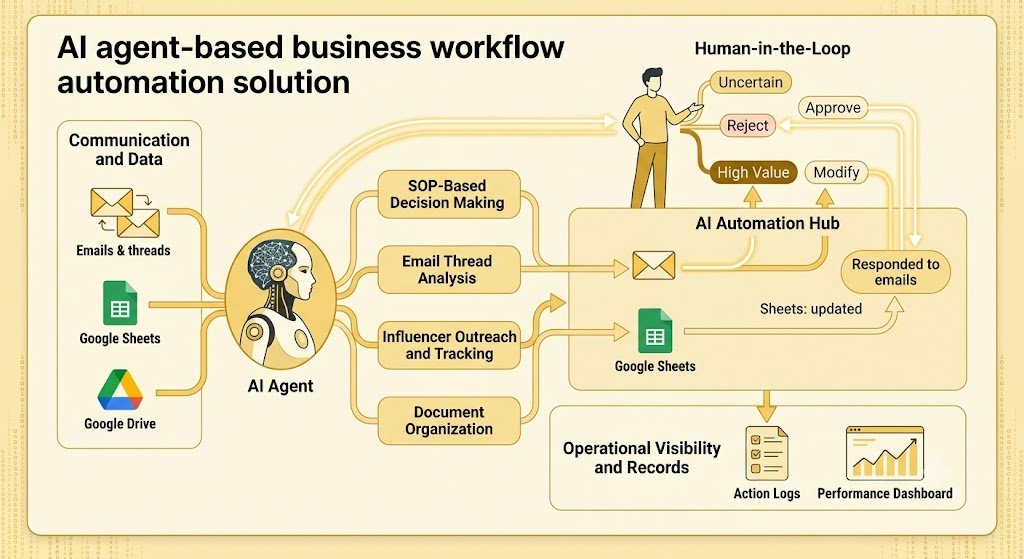
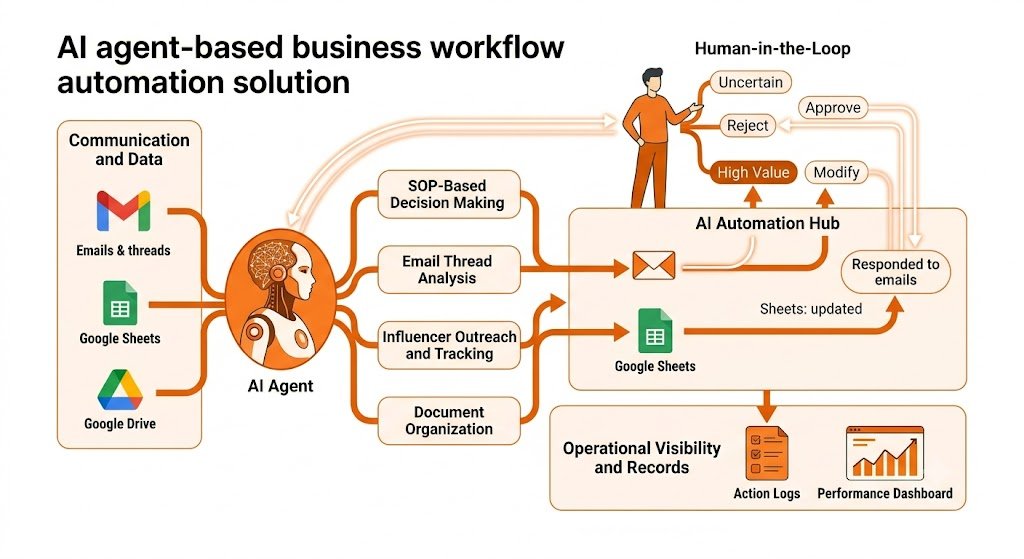
CnEL India worked on an AI agent-based business workflow automation solution designed to reduce repetitive manual work while maintaining proper controls, logging, and human review.
The objective was not to build a basic chatbot that only answers questions. The requirement was to create intelligent workflow agents capable of reading business information, understanding instructions, making decisions according to standard operating procedures, completing approved actions, and requesting human intervention whenever a situation was uncertain.
The solution was designed around practical business operations, including email monitoring, thread analysis, spreadsheet updates, document organization, creator outreach, follow-up tracking, reporting, and multi-step approval workflows.
The larger goal was to create a reliable automation framework that could support several business processes and continue expanding as the organization identified new opportunities for automation.
Business Challenge
Businesses often have documented processes, but employees still need to perform each step manually.
For example, an employee may receive an email from a creator or business partner. The employee must read the entire conversation, understand the latest response, check the relevant standard operating procedure, determine the next action, update the tracking sheet, and schedule a follow-up if required.
The process becomes more complex when multiple people are involved or when the same contact has several ongoing conversations.
Common challenges include:
- Repetitive email monitoring
- Manual reading of long email threads
- Inconsistent application of standard procedures
- Delayed follow-ups
- Duplicate processing
- Incorrect spreadsheet updates
- Unorganized files
- Missing action history
- Limited visibility into workflow progress
- Lack of clear human approval stages
The organization needed a solution that could automate these tasks without removing human control.
The system had to be intelligent enough to handle routine situations independently, but cautious enough to ask for human review when the available information was incomplete or unclear.
Project Objectives
CnEL India structured the project around several important objectives.
Automate Repetitive Operations
The system needed to handle routine tasks that otherwise required continuous manual effort.
Follow Business SOPs
The agents needed to make decisions according to documented rules, instructions, and decision trees.
Maintain Human Control
Actions involving uncertainty, sensitive information, or important business decisions needed to be routed for approval.
Prevent Duplicate Processing
The system needed to recognize previously processed emails, files, and records.
Maintain Action Logs
Every important action needed to be recorded for transparency and troubleshooting.
Improve Operational Visibility
Managers needed to understand what had been completed, what was pending, and what required attention.
Create a Scalable Framework
The solution needed to support additional workflows in the future without requiring a complete redesign.
Understanding the Business Workflows
Before developing the agents, CnEL India focused on understanding the organization’s existing processes.
The client provided information such as:
- Standard operating procedures
- Workflow rules
- Decision trees
- Spreadsheet structures
- Expected outcomes
- Approval requirements
- Communication guidelines
- Follow-up timelines
These documents were used to understand how employees currently complete tasks.
The goal was to convert informal or manual processes into clearly defined workflow steps.
For example, an email-handling process could include:
- Detect a new email.
- Read the complete conversation.
- Identify the sender and topic.
- Determine the current status.
- Compare the situation with the relevant SOP.
- Decide the next action.
- Complete the action if it is authorized.
- Update the tracking record.
- Save the action history.
- Request human review if uncertainty exists.
This structure helped create predictable and measurable automation.
AI Agent Architecture
CnEL India designed the system around multiple coordinated components rather than one general-purpose agent.
Each agent or workflow component could have a specific responsibility.
Possible components included:
- Email monitoring agent
- Email understanding agent
- SOP decision agent
- Spreadsheet update agent
- File organization agent
- Outreach and follow-up agent
- Reporting agent
- Approval management component
- Action logging component
- Error monitoring component
Separating responsibilities made the system easier to test and maintain.
It also reduced the risk of one incorrect decision affecting the entire workflow.
The agents could exchange structured information through a central workflow layer, allowing each stage to perform its task and pass the result to the next stage.
Email Monitoring and Thread Analysis
Email processing was one of the key workflow requirements.
The system needed to monitor incoming messages and identify emails that required action.
However, reading only the latest message would not always be sufficient.
Important information may exist earlier in the conversation, including:
- Previous commitments
- Earlier questions
- Agreed timelines
- Pricing discussions
- Follow-up history
- Previous objections
- Pending requests
- Status changes
CnEL India designed the email workflow to consider the full conversation whenever required.
The agent could analyze the thread, identify the latest intent, summarize the relevant context, and determine which business process applied.
This helped reduce the risk of making decisions based on incomplete information.
SOP-Based Decision-Making
The agents were designed to follow documented business rules instead of making unrestricted decisions.
An SOP could define what should happen when a particular type of email is received.
For example:
- If a contact confirms interest, update the status and prepare the next step.
- If a contact requests more information, create a follow-up task.
- If a contact declines, record the response and stop further outreach.
- If a message is unclear, send it for human review.
- If an approval is required, pause the workflow until a person confirms.
This approach makes automation more consistent.
The agent is not expected to invent a process. It is expected to interpret the available information and apply the approved workflow rules.
Human Review and Approval Stages
Human review was an important part of the solution.
Fully automated systems can create risks when they act on incomplete, ambiguous, or sensitive information.
CnEL India therefore included controlled review stages.
The system could route a task to a human when:
- The email intent is unclear.
- Multiple SOPs appear applicable.
- Required information is missing.
- The proposed action has business consequences.
- The agent has low confidence.
- A message requires personal judgment.
- The action involves an external commitment.
- A manager’s approval is required.
The human reviewer could approve, reject, modify, or redirect the proposed action.
This created a balance between automation and human oversight.
Spreadsheet Automation
Many business teams use spreadsheets to maintain operational records.
These records may include:
- Contact names
- Email addresses
- Outreach status
- Response status
- Follow-up dates
- Assigned team members
- Notes
- Next actions
- Campaign information
- Performance details
Manually updating these records can be repetitive and inconsistent.
CnEL India designed workflows that could update structured records based on approved events.
For example, when a creator replied to an email, the system could update the contact status, record the response date, add a note, and identify the next action.
The system also needed to avoid overwriting useful information or creating duplicate rows.
Creator and Influencer Outreach
Creator outreach was another important business workflow.
The process may include identifying contacts, sending initial messages, tracking responses, scheduling follow-ups, and maintaining communication history.
The automation framework could support these activities while following defined communication rules.
A typical workflow might include:
- Identify a contact from an approved list.
- Check whether the contact has already been approached.
- Review previous communication.
- Prepare an appropriate message.
- Request approval when required.
- Send the message.
- Record the activity.
- Monitor the response.
- Schedule the next action.
- Stop communication when the contact declines or requests no further messages.
This approach helps maintain organized outreach while reducing repeated manual work.
Follow-Up Management
Follow-up activities are often lost when they are managed manually.
A contact may request a response after a few days, or a team member may need to reconnect after a specific event.
The system could track these requirements and identify tasks that were due.
Follow-up logic could be based on:
- Last communication date
- Contact status
- Response type
- Agreed timeline
- Previous follow-up attempts
- Business priority
- Required approval
The system could prepare reminders or proposed actions without automatically sending messages when approval was necessary.
This helped maintain control over external communication.
File Reading and Organization
Business information is often stored in documents, attachments, and folders.
Employees may need to read files, identify their contents, rename them, categorize them, or place them in the correct location.
CnEL India designed the workflow to support structured file organization.
The system could identify document types, extract relevant information, and apply predefined naming or categorization rules.
For example, a file could be organized according to:
- Contact name
- Project name
- Document type
- Date
- Workflow status
- Department
- Approval stage
If the file could not be classified confidently, it could be sent for manual review.
This reduced the risk of incorrectly organizing important business documents.
Action Logs and Duplicate Prevention
Reliable automation requires a clear history of what the system has done.
CnEL India included action logging as a core part of the architecture.
The log could record:
- Workflow name
- Record identifier
- Action performed
- Date and time
- Agent responsible
- Decision made
- Approval status
- Error information
- Human reviewer
- Final outcome
Duplicate prevention was equally important.
The system needed to recognize whether an email, file, or record had already been processed.
Unique identifiers, timestamps, status fields, and processing history could be used to prevent the same action from being repeated.
This is especially important for email responses, outreach messages, spreadsheet updates, and follow-up tasks.
Error Handling and Recovery
Automated workflows may fail for several reasons.
A message may be unavailable, a file may be incomplete, a data field may be missing, or an external service may temporarily fail.
CnEL India designed the workflow with controlled error handling.
Instead of silently ignoring a failure, the system could:
- Record the error.
- Identify the affected workflow.
- Preserve the original data.
- Retry when appropriate.
- Notify the responsible person.
- Route the task for manual review if necessary.
This improves reliability and makes troubleshooting easier.
It also prevents incomplete workflows from appearing as successfully completed.
Reporting and Performance Summaries
The collected workflow data could also be used to generate reports.
Reports may include:
- Number of emails processed
- Number of actions completed
- Pending approvals
- Follow-ups due
- Outreach responses
- Creator status changes
- Workflow failures
- Human review volume
- Processing time
- Overall activity trends
These reports provide management with a clearer view of daily operations.
They can also help identify bottlenecks.
For example, if many tasks are waiting for approval, the organization may need to improve its approval process.
If a particular workflow produces frequent errors, its rules may need to be reviewed.
Testing and Quality Assurance
CnEL India treated testing as a major part of the project.
The system needed to be tested using both normal and unusual scenarios.
Testing areas included:
- New email detection
- Full-thread understanding
- SOP interpretation
- Correct workflow selection
- Spreadsheet updates
- Duplicate prevention
- Follow-up scheduling
- File classification
- Human approval routing
- Action logging
- Error recovery
- Report generation
Special attention was given to situations where the agent should not act independently.
The system needed to demonstrate that uncertain or sensitive cases were correctly routed to a human reviewer.
This helped maintain confidence in the automation process.
Security and Access Control
Business workflow automation often involves sensitive operational information.
CnEL India therefore considered access control and responsible data handling as part of the architecture.
Different users may require different permissions.
For example:
- Some users may view reports.
- Some may approve actions.
- Some may manage workflow rules.
- Some may access communication records.
- Administrators may manage system settings.
The solution could be structured so that agents only perform actions within their approved responsibilities.
This reduces unnecessary access and supports better operational control.
Business Benefits
The AI agent-based automation solution provides several benefits.
Reduced Manual Work
Employees spend less time on repetitive tasks.
Faster Response Times
Emails, follow-ups, and updates can be processed more quickly.
Better Consistency
Workflows follow defined procedures instead of depending entirely on individual judgment.
Fewer Duplicate Actions
Processing history helps prevent repeated messages and updates.
Improved Visibility
Action logs and reports make workflow activity easier to understand.
Controlled Automation
Human approval remains available for uncertain or sensitive situations.
Better Data Accuracy
Structured updates reduce manual entry mistakes.
Scalable Operations
Additional workflows can be added as the business grows.
CnEL India’s Contribution
CnEL India approached the project as a complete business automation initiative rather than a simple AI implementation.
The work focused on understanding operational requirements and translating them into reliable, controlled workflows.
CnEL India’s contribution included:
- Reviewing business SOPs
- Mapping existing workflows
- Designing the agent architecture
- Creating decision-based automation
- Building email analysis processes
- Supporting structured record updates
- Designing outreach and follow-up workflows
- Implementing human approval stages
- Adding action logs
- Preventing duplicate processing
- Creating error-handling procedures
- Supporting reporting and performance summaries
- Testing routine and exceptional cases
- Preparing the framework for future expansion
The solution was designed to work alongside employees and support their daily responsibilities.
Future Scalability
The framework can be expanded to support additional business functions.
Future workflows could include:
- Customer support triage
- Invoice and document processing
- Internal task assignment
- Sales pipeline updates
- Meeting preparation
- Vendor communication
- Employee onboarding
- Business report generation
- Contract review routing
- Internal knowledge management
New workflows can be added by defining their rules, inputs, actions, approval requirements, and expected outcomes.
This creates a reusable automation foundation rather than a one-purpose system.
Conclusion
AI agents can provide significant value when they are designed around real business processes and controlled operating rules.
The objective is not simply to make an AI system perform actions independently. The objective is to create a reliable operational assistant that understands business instructions, follows approved workflows, records its actions, avoids duplicate processing, and requests human help when necessary.
CnEL India’s approach combines intelligent decision-making with structured automation, human oversight, error handling, and transparent reporting.
By automating repetitive email tasks, spreadsheet updates, file organization, creator outreach, follow-ups, and reporting, businesses can reduce manual effort while maintaining operational control.
The resulting framework can support current workflows and provide a strong foundation for future automation initiatives.
With clearly defined SOPs, reliable logging, careful testing, and appropriate approval stages, AI agents can become practical business workflow partners rather than simple chat-based assistants.