
Project Overview
As B2B companies grow, their sales and revenue operations often become increasingly complex. Customer information may be spread across multiple systems, lead data may be inconsistent, sales processes may rely on repetitive manual tasks, and different business applications may not communicate effectively with one another.
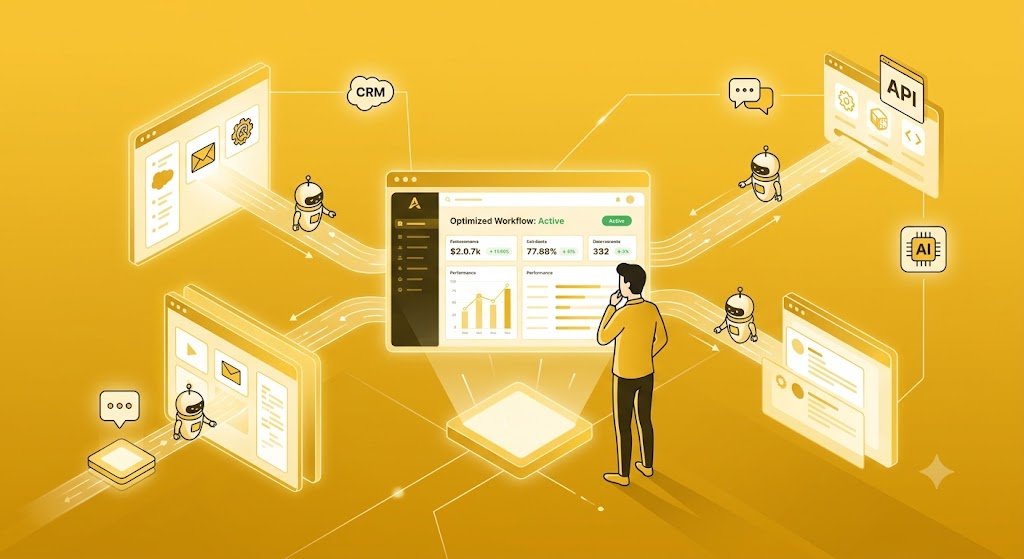
CnEL India worked on a technical GTM and Revenue Operations automation workflow designed to solve these challenges through structured data management, workflow automation, system integrations, lead enrichment, and intelligent process design.
The objective was not simply to automate individual tasks. The larger goal was to create reliable revenue workflows that connected marketing, sales, customer data, outreach, and internal operations into a more efficient system.
The project required a problem-solving mindset rather than a fixed implementation process. Each business could have different systems, processes, data structures, and requirements. Therefore, the solution needed to be flexible enough to identify the underlying problem, design an appropriate workflow, connect the required systems, test the complete process, and continuously improve it.
CnEL India’s approach focused on building practical GTM infrastructure that reduced manual work while improving data quality, lead management, and sales efficiency.
The Business Challenge
B2B organizations often accumulate multiple systems as they grow.
One system may contain customer records.
Another may handle lead research.
Another may manage outreach.
Additional applications may handle internal communication, reporting, scheduling, or customer operations.
When these systems operate independently, several problems can appear.
Inconsistent Data
Customer information may exist in multiple places with different names, job titles, email addresses, company information, or lead statuses.
Manual Data Entry
Sales teams may spend hours transferring information from one system to another.
Broken Workflows
A workflow may work correctly initially but stop functioning after a field changes, an integration is modified, or an API response changes.
Duplicate Records
The same company or contact may be added multiple times, creating confusion for sales teams.
Poor Lead Qualification
Sales representatives may receive leads without enough information to determine whether they are relevant.
Slow Follow-Up
If lead information does not move automatically through the sales process, valuable prospects may remain unattended.
Lack of Visibility
Management may struggle to understand where leads are coming from, how they are progressing, and where prospects are dropping out of the sales funnel.
The project therefore required a systematic approach to revenue operations rather than isolated automation.
CnEL India’s Approach
CnEL India structured the solution around six core stages:
Business Analysis → Data Architecture → Workflow Design → System Integration → Automation → Monitoring & Optimization
The objective was to understand the business problem first and then determine the most efficient technical solution.
1. Understanding the Business Process
The first step was understanding how the client’s revenue process actually worked.
Rather than immediately creating automations, CnEL India reviewed the existing workflow from lead acquisition through sales follow-up.
The analysis focused on questions such as:
- Where do leads originate?
- How is lead information collected?
- How is lead quality determined?
- Where is customer information stored?
- Who is responsible for each stage?
- Which tasks are repetitive?
- Which processes require human approval?
- Which systems need to exchange information?
- What happens when a workflow fails?
- How is the final outcome measured?
This helped identify the difference between the intended process and the actual process.
In many businesses, these are not the same.
A company may believe that every new lead is automatically assigned to a sales representative, while in reality some leads may remain unassigned because of missing information or an incomplete workflow.
Identifying these gaps was an important part of the project.
2. Cleaning and Structuring Business Data
Reliable automation depends on reliable data.
Before building complex workflows, CnEL India focused on organizing the underlying information.
The process included identifying:
- Duplicate contacts
- Duplicate companies
- Missing information
- Incorrect fields
- Inconsistent naming
- Outdated records
- Incorrect lead statuses
- Incomplete company information
Data fields were standardized where appropriate.
For example, a company could appear in multiple forms across different systems. Standardization helped the system recognize that these records represented the same organization.
This improved the reliability of downstream workflows.
The principle was simple:
Automate clean data first, not messy data.
3. Lead Enrichment
Another important part of the workflow involved improving the information available for sales teams.
A new lead may initially contain only basic information such as:
- Name
- Company
However, sales teams often need additional context before deciding how to approach the prospect.
The enrichment workflow could help identify information such as:
- Company size
- Industry
- Job role
- Business category
- Website information
- Location
- Potential business relevance
- Other qualification signals
This information could then be added to the appropriate customer record.
The result was a richer lead profile that allowed sales teams to make better decisions before starting outreach.
4. Designing Intelligent Workflows
Once the data structure was established, CnEL India designed automated workflows around business rules.
A typical workflow could follow a sequence such as:
New Lead → Data Validation → Enrichment → Qualification → CRM Update → Assignment → Outreach → Follow-Up → Status Update
Each stage could have specific conditions.
For example:
If a lead met the required criteria, it could continue through the sales process.
If important information was missing, the workflow could route the lead for review.
If a lead was already present in the system, the workflow could update the existing record instead of creating a duplicate.
This conditional logic made the automation more intelligent than a simple linear process.
5. Connecting Different Business Systems
B2B businesses frequently need multiple applications to exchange information.
CnEL India worked around an integration-first approach in which systems could communicate through secure interfaces, event triggers, webhooks, and structured data exchange.
For example, when an important event occurred in one system, it could trigger an action in another.
A new lead could create or update a customer record.
A qualified prospect could trigger an outreach workflow.
A reply could update the lead status.
A completed action could notify the appropriate team member.
This reduced the need for employees to manually transfer information between systems.
6. API and Webhook-Based Integrations
When pre-built connections were not sufficient, direct system integrations could be designed around APIs and event-based communication.
This allowed CnEL India to connect systems according to the client’s specific requirements.
The workflow needed to account for issues such as:
- Authentication
- Data formatting
- Required fields
- Response handling
- Error conditions
- Duplicate prevention
- Retry logic
- Data validation
The goal was not simply to make two systems communicate once.
The integration needed to remain reliable as part of the larger business workflow.
7. Outbound Sales Infrastructure
Another important area was outbound sales operations.
B2B businesses may need to manage large volumes of prospects while maintaining personalized and controlled communication.
Automation could assist with tasks such as:
- Lead segmentation
- Prospect assignment
- Contact preparation
- Outreach sequencing
- Follow-up scheduling
- Response tracking
- Lead status updates
The system was designed so that automation handled repetitive operational tasks while sales professionals retained control over important conversations.
This created a balance between scale and personalization.
8. AI-Assisted Revenue Workflows
AI could also be incorporated into GTM operations where it provided genuine value.
Potential applications included:
- Lead classification
- Customer intent detection
- Message personalization
- Data summarization
- Lead research
- Conversation analysis
- Automated response suggestions
- Internal knowledge assistance
- Workflow decision support
For example, a system could analyze incoming lead information and categorize prospects according to predefined business criteria.
Another workflow could summarize a customer conversation and update the relevant CRM record.
This reduced repetitive manual work while allowing sales teams to focus on higher-value activities.
9. Troubleshooting Broken Systems
A major part of the project involved solving existing technical problems.
In real-world GTM environments, workflows are rarely perfect.
A process may suddenly stop because:
- A field was renamed
- Data format changed
- Authentication expired
- An API returned a different response
- A required value was missing
- A webhook failed
- Duplicate data entered the workflow
- A condition was incorrectly configured
CnEL India’s troubleshooting process focused on identifying the root cause rather than applying temporary fixes.
The process generally followed:
Detect → Reproduce → Identify Root Cause → Correct → Test → Monitor
This ensured that the same problem was less likely to return.
10. Error Handling and Reliability
Automation is only valuable when businesses can trust it.
CnEL India therefore emphasized error handling as part of workflow design.
A reliable automation should know what to do when something goes wrong.
For example:
If customer information is incomplete, the workflow should not blindly continue.
If a system connection fails, the process should record the failure.
If duplicate information is detected, the system should avoid creating another record.
If an action cannot be completed, the appropriate person should be notified.
This created more resilient business workflows.
11. Multi-Client Architecture
The project environment involved supporting B2B clients with different requirements.
This meant the workflow could not depend on a single fixed process.
One client might need lead enrichment.
Another might require customer-data synchronization.
Another might need outbound automation.
Another might need an existing CRM system cleaned and reorganized.
CnEL India’s approach therefore emphasized reusable problem-solving patterns rather than identical implementations.
The same underlying principles could be adapted to different client environments.
This made the approach suitable for agency-style and multi-client revenue operations.
12. Testing and Quality Assurance
Before an automation was considered ready, the complete workflow needed to be tested.
Testing included:
- Valid lead scenarios
- Invalid data
- Missing fields
- Duplicate records
- Failed integrations
- Unexpected responses
- Workflow conditions
- Data synchronization
- Notifications
- Human handoff
The objective was to verify that the automation worked not only under ideal conditions but also when something unexpected happened.
This was particularly important for revenue workflows because a small automation error could affect hundreds or thousands of records.
Results and Business Value
The GTM and RevOps automation workflow delivered several operational benefits.
Reduced Manual Work
Repetitive data entry and information-transfer tasks could be automated.
Better Data Quality
Standardization and validation helped improve customer and lead information.
Faster Lead Processing
New leads could move through qualification and routing processes more quickly.
Improved Sales Visibility
Sales teams could access more complete information about prospects.
Reliable Integrations
Connected systems could exchange information with less manual intervention.
Faster Problem Resolution
A structured troubleshooting process made it easier to identify and fix workflow failures.
Scalable Operations
Automated workflows could handle increasing volumes without requiring the same proportional increase in manual effort.
Better Team Productivity
Sales and operations teams could spend more time on customer-facing and strategic activities rather than repetitive administrative work.
CnEL India’s Contribution
CnEL India approached the project as a technical problem-solving and revenue operations engineering challenge.
The focus was not on implementing technology for its own sake.
Every automation was connected to a business objective.
CnEL India’s contribution included:
- Business process analysis
- CRM data organization
- Lead enrichment workflows
- Automated qualification
- System integrations
- API-based communication
- Event-driven workflows
- AI-assisted processes
- Outbound sales automation
- Error handling
- Troubleshooting
- Workflow testing
- Multi-client process design
- Continuous optimization
The team focused on understanding the business problem first and selecting the appropriate technical approach afterward.
This allowed solutions to remain practical rather than unnecessarily complicated.
Long-Term Scalability
A successful GTM automation system should not only solve today’s problems.
It should also create a foundation for future growth.
CnEL India’s architecture focused on creating workflows that could evolve as client requirements changed.
Future improvements could include:
- Advanced lead scoring
- Predictive sales insights
- Automated reporting
- Intelligent account research
- More sophisticated AI agents
- Revenue forecasting
- Automated pipeline monitoring
- Advanced customer segmentation
- Cross-system analytics
- Automated workflow health monitoring
These capabilities could further reduce operational overhead and provide sales teams with better intelligence.
Conclusion
The GTM and Revenue Operations engineering project demonstrates how technical problem-solving can transform complex B2B sales processes into structured, automated workflows.
The key challenge was not simply connecting systems.
It was understanding how businesses acquire, qualify, manage, and convert leads—and then designing technology around those processes.
CnEL India’s approach combined data organization, workflow automation, system integration, AI-assisted operations, troubleshooting, and quality control to create reliable revenue infrastructure.
The result was a flexible approach capable of supporting different B2B clients and their unique operational requirements.
The core philosophy was:
Understand the business problem, design the simplest reliable solution, automate repetitive work, and keep humans focused on decisions that matter.
Through this approach, CnEL India demonstrated its ability to act not just as a development partner, but as a technical problem-solving partner capable of designing and improving the systems behind modern B2B revenue operations.