
Project Overview
The property rental industry involves a large volume of repetitive communication between landlords, property managers, rental agencies, and prospective tenants. Customers frequently ask similar questions about property availability, rent, location, amenities, lease terms, viewing schedules, application requirements, and other rental-related information.
For property management businesses handling multiple listings and a high number of inquiries, responding to every customer manually can become time-consuming and inefficient. Delayed responses can also result in missed opportunities when potential tenants move on to other properties or competitors.
CnEL India worked on the concept of an AI-powered SaaS platform for property rental services, designed to automate customer communication and help rental businesses manage inquiries more efficiently.
The core product was an intelligent conversational assistant capable of understanding customer questions, retrieving relevant property information, qualifying potential tenants, and guiding them through different stages of the rental process.
The long-term objective was to build the platform as a scalable SaaS solution that could serve multiple property managers, landlords, and rental agencies through a subscription-based model.
Rather than developing a simple chatbot, the project was approached as a complete AI-powered rental communication platform combining conversational intelligence, property data management, tenant qualification, automation, and a scalable SaaS architecture.
Client Requirement
The client wanted to build a centralized platform that could help rental businesses automate a significant portion of their customer communication.
The main requirement was an intelligent conversational system that could:
- Answer questions about available properties
- Provide accurate rental information
- Understand natural-language questions
- Recommend relevant properties
- Qualify potential tenants
- Collect basic tenant requirements
- Guide customers through the rental process
- Handle repetitive inquiries automatically
- Escalate complex conversations when human assistance was required
- Work across multiple rental businesses
- Maintain separate property information for each business
The platform also needed to be scalable.
Instead of creating a system for a single landlord, the objective was to establish a SaaS architecture capable of supporting multiple customers from the beginning.
Each property manager could potentially have:
- Their own account
- Their own property listings
- Their own business information
- Their own rental policies
- Their own chatbot configuration
- Their own customer conversations
- Their own leads
This made multi-tenant architecture and data separation important parts of the project.
The Challenge
The biggest challenge was ensuring that the AI assistant provided accurate and relevant information rather than producing generic answers.
Property rental businesses deal with constantly changing information.
A property may become unavailable.
Rent may change.
A landlord may update an amenity.
A viewing schedule may change.
New properties may be added.
Therefore, the assistant could not rely only on general language knowledge.
It needed access to the property’s actual data.
This created the need for a retrieval-based information system in which the AI could search the relevant property and business information before generating an answer.
Another challenge was understanding customer intent.
A prospective tenant might ask:
“Do you have a two-bedroom apartment near the city center under my budget?”
This question contains multiple requirements:
- Property type
- Number of bedrooms
- Location
- Budget
- Availability
The system needed to understand these requirements and use them to identify appropriate properties.
The assistant also needed to distinguish between casual questions and serious rental inquiries.
Someone asking about a property may simply be browsing, while another person may already be ready to schedule a viewing.
This made tenant qualification another important component of the solution.
CnEL India’s Approach
CnEL India designed the platform around several interconnected components:
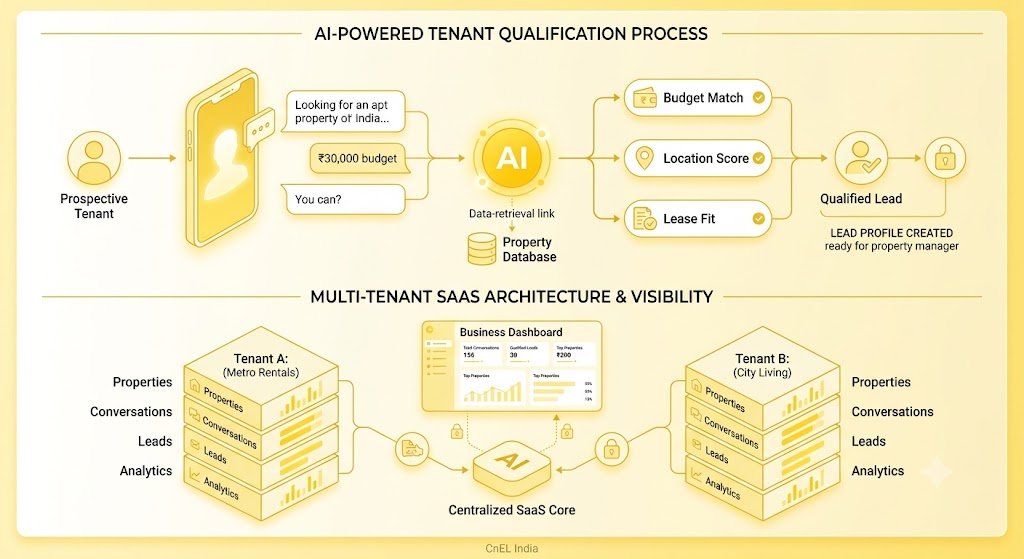
Property Data → Knowledge Retrieval → AI Conversation → Lead Qualification → Rental Workflow → Human Escalation
The system was designed so that each part supported the others.
1. Property Data Management
The foundation of the platform was structured property information.
Each rental listing could contain information such as:
- Property name
- Property type
- Location
- Monthly rent
- Bedrooms
- Bathrooms
- Available date
- Property size
- Amenities
- Parking
- Furnishing status
- Pet policies
- Lease requirements
- Additional fees
- Contact information
- Viewing availability
The platform needed to organize this information so that it could be accessed efficiently during conversations.
Data could be updated by authorized users whenever property information changed.
This was important because the AI assistant needed to work with current information rather than outdated responses.
2. AI Knowledge Retrieval
A major part of the solution involved connecting the conversational assistant with the rental business’s property information.
When a customer asked a question, the system could identify the relevant information from the available property data before generating a response.
For example, if a customer asked:
“Which two-bedroom properties allow pets?”
the system could identify the customer’s requirements and retrieve properties matching those conditions.
The assistant could then respond based on the available information.
This approach helped reduce the risk of the AI inventing property details.
The system was designed around the principle:
Retrieve relevant information first, then generate the response.
This was particularly important for rental businesses because incorrect information about rent, availability, location, or property features could negatively affect customer trust.
3. Conversational AI
The chatbot was designed to understand natural customer conversations instead of forcing users to interact through rigid forms.
Customers could ask questions in their own words.
For example:
“I’m looking for a furnished apartment for two people near the business district. My budget is around ₹30,000. What do you have available?”
The assistant could interpret the conversation and identify the key requirements.
It could then ask additional questions when necessary.
For example:
“Would you prefer a one-bedroom or two-bedroom apartment?”
This created a more natural conversational experience.
The objective was to make the customer feel as though they were communicating with an informed rental assistant rather than completing a traditional search form.
4. Property Recommendations
The platform could use the customer’s requirements to identify potentially suitable properties.
The recommendation process could consider:
- Budget
- Location
- Property type
- Bedrooms
- Bathrooms
- Furnishing
- Amenities
- Pet requirements
- Availability
- Other customer preferences
Instead of displaying a large list of unrelated properties, the assistant could focus the conversation around relevant options.
This could significantly improve the customer experience.
A customer searching for a property would not necessarily need to browse through every listing manually.
The assistant could help narrow down the available choices through conversation.
5. Tenant Qualification
Another important component was lead qualification.
Property businesses often receive inquiries from people who are at very different stages of the rental journey.
Some may simply be researching.
Others may be actively looking.
Some may already know exactly what they want.
The AI assistant could collect relevant information during the conversation, such as:
- Preferred location
- Budget
- Desired property type
- Number of occupants
- Preferred move-in date
- Rental duration
- Property requirements
- Viewing interest
Based on these responses, the platform could identify the customer’s level of interest.
A highly qualified lead could then be passed to the property manager for follow-up.
This allowed the human team to focus more of its time on promising prospects rather than answering repetitive initial questions.
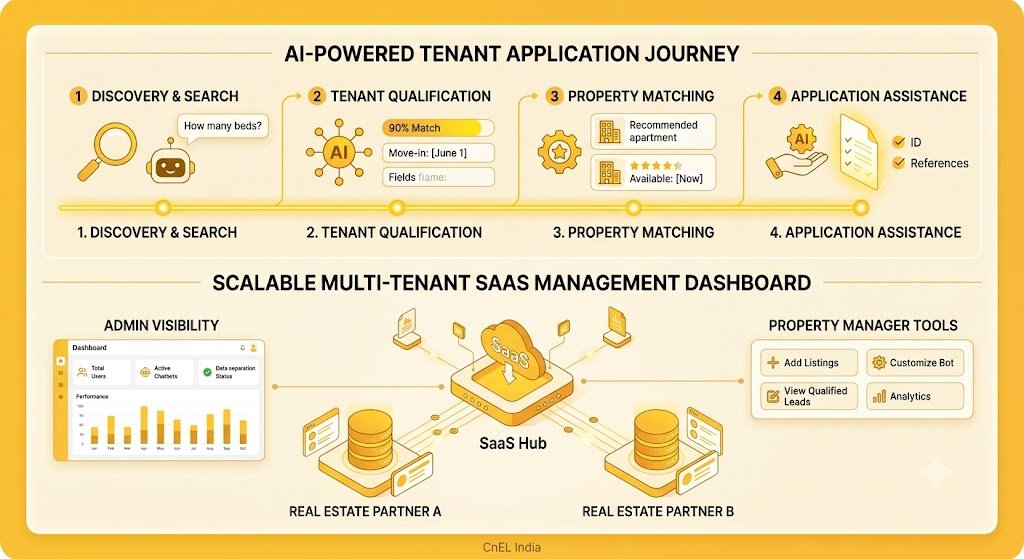
6. Rental Process Assistance
The assistant was not limited to property discovery.
It could also guide users through different stages of the rental journey.
For example, it could help answer questions related to:
- Viewing requests
- Application requirements
- Lease information
- Property policies
- Required documents
- Move-in information
- General rental procedures
The purpose was to create a continuous conversational experience.
Instead of requiring customers to contact different departments for different questions, the assistant could provide a centralized first point of communication.
7. Human Handoff
AI should not be expected to handle every situation independently.
Some conversations require human judgment or intervention.
CnEL India’s workflow therefore included escalation capabilities.
The assistant could identify situations where a human team member should become involved.
Examples could include:
- Complex rental questions
- Negotiation requests
- Complaints
- Special circumstances
- Unclear information
- High-value leads
- Issues requiring property manager approval
This created a hybrid support model:
AI handles repetitive communication → Human team handles important or complex situations.
This approach helped businesses maintain efficiency without removing human involvement from the rental process.
8. SaaS Architecture
Because the product was intended to serve multiple rental businesses, scalability was a key consideration.
The platform was designed conceptually around a multi-tenant structure.
Each business would have its own secure environment within the shared SaaS platform.
For example:
Rental Business A
- Properties
- Customers
- Conversations
- Leads
- Business settings
Rental Business B
- Properties
- Customers
- Conversations
- Leads
- Business settings
The system needed to ensure that one customer’s information was never exposed to another business.
This separation was critical for security, privacy, and operational reliability.
9. Business Dashboard
A centralized dashboard could provide rental businesses with visibility into their AI-assisted customer interactions.
The dashboard could include information such as:
- Total conversations
- New inquiries
- Qualified leads
- Property interest
- Viewing requests
- Frequently asked questions
- Lead status
- Conversation history
- Property performance
This gave property managers a clearer understanding of customer activity.
Instead of simply having a chatbot running on their website, businesses could use the platform as a communication and lead-management system.
10. Continuous Improvement
The platform was designed with continuous improvement in mind.
Customer conversations could reveal frequently asked questions and common areas of confusion.
This information could help rental businesses improve:
- Property descriptions
- FAQs
- Policies
- Customer communication
- Lead qualification questions
- Property information
The AI assistant could therefore become more useful as the business accumulated more structured information and feedback.
The objective was not simply to automate communication once, but to create a system that could continuously improve the rental customer experience.
Quality and Accuracy
Accuracy was treated as a critical requirement.
For a property rental platform, incorrect information can result in:
- Lost leads
- Customer dissatisfaction
- Wasted property-manager time
- Incorrect expectations
- Poor business reputation
CnEL India’s approach therefore emphasized controlled information retrieval.
The assistant should answer based on available business information whenever possible.
When information was unavailable or uncertain, the system should avoid confidently presenting unsupported details and instead direct the customer toward the appropriate next step.
This principle helped create a more reliable conversational experience.
Security and Data Management
Since the platform could process property information, customer conversations, and lead details, secure data handling was another important consideration.
The architecture needed to support:
- User authentication
- Role-based access
- Business-level data separation
- Secure storage
- Controlled access to customer information
- Protected conversation history
- Reliable data management
These capabilities were particularly important for a SaaS product serving multiple independent businesses.
Results and Business Value
The AI-powered rental platform offered several potential business benefits.
Faster Customer Responses
Customers could receive immediate answers to common questions rather than waiting for a property manager.
Reduced Repetitive Work
Property teams could spend less time answering recurring questions.
Better Lead Qualification
The system could collect customer requirements before passing qualified prospects to the human team.
Improved Customer Experience
Customers could search for properties and ask questions through a natural conversational interface.
Scalable Business Model
The SaaS architecture could support multiple rental businesses rather than being limited to one organization.
Centralized Information
Property data, customer conversations, and leads could be managed through one platform.
Improved Operational Efficiency
Automation could allow rental businesses to handle more inquiries without increasing their support workload proportionally.
CnEL India’s Contribution
CnEL India approached this project as a combination of AI development, SaaS engineering, conversational design, data management, and business automation.
The goal was not to create another generic chatbot.
The objective was to build an intelligent rental assistant connected to the actual business information and capable of supporting a real-world rental workflow.
CnEL India’s approach focused on:
- Understanding the rental business process
- Structuring property information
- Building an AI-powered conversational workflow
- Connecting conversations with relevant property data
- Supporting lead qualification
- Designing human escalation
- Planning for multi-business SaaS usage
- Maintaining data separation
- Creating a scalable architecture
- Building a foundation for future automation
This combination allowed the project to move beyond basic question answering toward a complete AI-assisted rental communication system.
Future Expansion
The platform could eventually be expanded with additional capabilities.
Potential future features could include:
- Automated viewing scheduling
- Lead scoring
- Property recommendation improvements
- Automated follow-ups
- Rental application assistance
- Business analytics
- Customer segmentation
- Multi-language communication
- Voice-based assistance
- Automated notifications
- Property availability synchronization
- Advanced reporting
These additions could transform the platform from an AI customer-support system into a comprehensive rental operations platform.
Conclusion
The AI-powered property rental SaaS project demonstrates how artificial intelligence can be integrated into a real-world business process to improve communication, lead management, and operational efficiency.
The central idea was to create an intelligent assistant capable of understanding customer requirements, retrieving accurate property information, recommending relevant listings, qualifying potential tenants, and guiding users through the rental journey.
At the same time, the platform was designed with scalability in mind so that multiple landlords, property managers, and rental agencies could use the service independently.
CnEL India’s approach combined conversational intelligence with structured property data, automated workflows, human escalation, and a scalable SaaS foundation.
The result was a practical model for transforming property rental communication from a largely manual process into an AI-assisted customer experience.
The key principle behind the project was:
Give customers instant, accurate assistance while giving property businesses more time to focus on qualified leads and successful rentals.
By connecting AI with real business data and structured workflows, CnEL India demonstrated how intelligent automation can become a core part of modern property rental operation