
Introduction
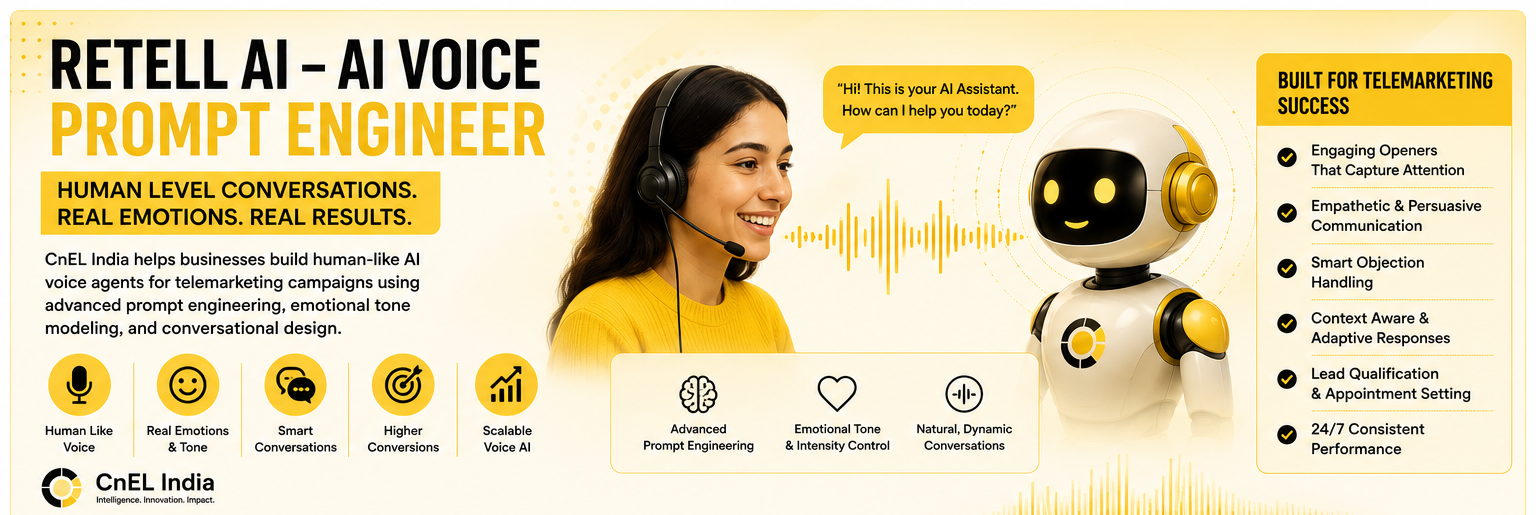
The rapid evolution of conversational artificial intelligence has transformed how businesses communicate with customers. Organizations are increasingly adopting AI-powered voice systems to handle customer engagement, lead qualification, appointment booking, sales outreach, customer support, and follow-up communication. However, despite significant technological advances, one challenge remains at the center of voice automation: creating conversations that genuinely sound human.
Most automated voice interactions fail not because the technology lacks capability, but because the conversation design lacks authenticity. Customers can quickly identify robotic responses, unnatural pauses, repetitive phrasing, and emotionless delivery. This often results in lower engagement rates, reduced trust, and poor campaign performance.
This case study explores how CnEL India can support organizations seeking to achieve human-level conversational experiences for telemarketing and customer engagement campaigns through advanced voice prompt engineering, conversation architecture, emotional modeling, and AI-driven dialogue optimization.
Rather than focusing solely on voice generation, the project emphasizes the creation of realistic, emotionally intelligent conversations that closely resemble interactions with experienced human sales representatives.
Project Background
The client’s objective is ambitious but increasingly common among forward-thinking businesses.
They seek to create AI-powered telemarketing conversations that can:
- Sound natural and conversational
- Display realistic emotions
- Adapt tone dynamically
- Maintain engagement
- Handle objections naturally
- Build rapport with prospects
- Increase conversion rates
The ultimate goal is reducing the gap between automated voice systems and skilled human callers.
Achieving this requires much more than generating speech.
It requires a complete conversational intelligence framework.
Understanding Human Communication
Before designing advanced voice experiences, CnEL India begins by understanding how humans communicate.
Human conversations are influenced by:
Emotion
People respond differently depending on emotional context.
Tone
The same sentence can convey entirely different meanings based on delivery.
Timing
Strategic pauses create realism.
Context
Responses must align with conversation history.
Intent
Every statement serves a purpose.
Adaptability
Humans adjust communication based on reactions.
These elements form the foundation of successful voice automation.
Identifying Common Problems in Voice Automation
Many AI-driven telemarketing systems struggle because they exhibit predictable behaviors.
Common issues include:
- Monotone delivery
- Repetitive phrasing
- Scripted responses
- Lack of emotional variation
- Poor objection handling
- Unnatural conversation flow
Customers often disengage within seconds when these issues become noticeable.
CnEL India addresses these limitations through conversation-first design principles.
Building a Human-Centric Conversation Framework
Instead of starting with technology, CnEL India begins with conversation design.
The framework focuses on:
Opening Engagement
Creating immediate interest.
Relationship Building
Establishing trust and familiarity.
Discovery
Understanding customer needs.
Qualification
Identifying opportunities.
Objection Handling
Managing resistance naturally.
Closing
Driving desired outcomes.
This structure mirrors successful human sales interactions.
Emotional Intelligence in Voice Conversations
One of the most important components of realistic voice interactions is emotional intelligence.
CnEL India develops emotional response models that guide conversation behavior.
Examples include:
Curiosity
Used during discovery.
Excitement
Applied when presenting opportunities.
Confidence
Important during recommendations.
Empathy
Critical during customer concerns.
Reassurance
Helpful when addressing objections.
The objective is ensuring every interaction feels authentic.
Telemarketing Campaign Architecture
Successful telemarketing campaigns require more than persuasive language.
CnEL India structures campaigns around customer psychology.
Each conversation follows a strategic flow:
- Capture attention
- Build trust
- Identify needs
- Present value
- Address concerns
- Encourage action
This creates a consistent framework while allowing conversational flexibility.
Voice Personality Development
A voice assistant should have a recognizable personality.
CnEL India develops voice personas aligned with:
- Brand identity
- Customer demographics
- Campaign goals
- Industry requirements
Examples may include:
Professional Advisor
Trustworthy and informative.
Friendly Consultant
Approachable and conversational.
Sales Specialist
Energetic and persuasive.
Customer Success Representative
Supportive and empathetic.
Consistency improves customer perception.
Advanced Prompt Engineering Strategy
Prompt engineering plays a central role in conversation quality.
CnEL India designs structured conversational instructions that govern:
- Tone
- Language style
- Emotional transitions
- Response length
- Objection handling
- Sales methodology
This reduces robotic behavior.
Dynamic Conversation Adaptation
Human conversations are unpredictable.
Customers ask unexpected questions, express doubts, and change topics.
CnEL India develops adaptive conversation frameworks capable of:
- Context retention
- Intent recognition
- Dynamic response generation
- Topic transitions
This flexibility improves realism.
Objection Handling Design
One of the most challenging aspects of telemarketing automation is objection management.
Customers commonly express:
- Lack of interest
- Budget concerns
- Timing issues
- Trust concerns
- Competitive alternatives
CnEL India builds response frameworks that address objections naturally without sounding scripted.
The focus remains on maintaining conversation momentum.
Natural Speech Pattern Optimization
Human speech includes numerous characteristics often missing from automated systems.
CnEL India incorporates:
- Strategic pauses
- Conversational fillers
- Natural transitions
- Variable sentence lengths
- Contextual emphasis
These elements increase perceived authenticity.
Customer Journey Integration
Voice interactions should not operate in isolation.
CnEL India aligns conversations with the broader customer journey.
This includes:
Awareness Stage
Initial outreach.
Consideration Stage
Information sharing.
Decision Stage
Conversion-focused discussions.
Retention Stage
Relationship nurturing.
Integrated journeys improve overall campaign performance.
Conversation Testing and Evaluation
Quality assurance is critical.
CnEL India develops structured evaluation frameworks measuring:
- Naturalness
- Engagement
- Emotional consistency
- Response accuracy
- Customer sentiment
- Conversion effectiveness
Testing helps identify improvement opportunities.
Performance Analytics Framework
Every conversation generates valuable insights.
CnEL India tracks metrics such as:
- Call completion rates
- Engagement duration
- Customer sentiment
- Objection frequency
- Conversion outcomes
Data-driven optimization improves results over time.
Continuous Improvement Methodology
Human communication evolves continuously.
AI conversations should do the same.
CnEL India establishes iterative improvement cycles involving:
- Conversation reviews
- Performance analysis
- Prompt refinement
- Emotional tuning
- Behavioral optimization
This creates ongoing enhancement.
Scaling Voice Operations
As campaigns expand, maintaining quality becomes increasingly important.
CnEL India develops scalable frameworks capable of supporting:
- Higher call volumes
- Multiple campaigns
- Different industries
- Diverse customer segments
Scalability ensures consistency.
Industry Applications
The conversational framework can support numerous sectors.
Real Estate
Lead qualification and appointment setting.
Healthcare
Patient engagement and reminders.
Finance
Consultation scheduling.
Education
Student enrollment support.
E-commerce
Customer retention and sales outreach.
Professional Services
Lead nurturing and qualification.
Each industry receives tailored conversational strategies.
Security and Compliance Considerations
Voice automation must operate responsibly.
CnEL India incorporates:
- Data privacy controls
- Consent management
- Secure communication practices
- Audit mechanisms
Compliance supports long-term sustainability.
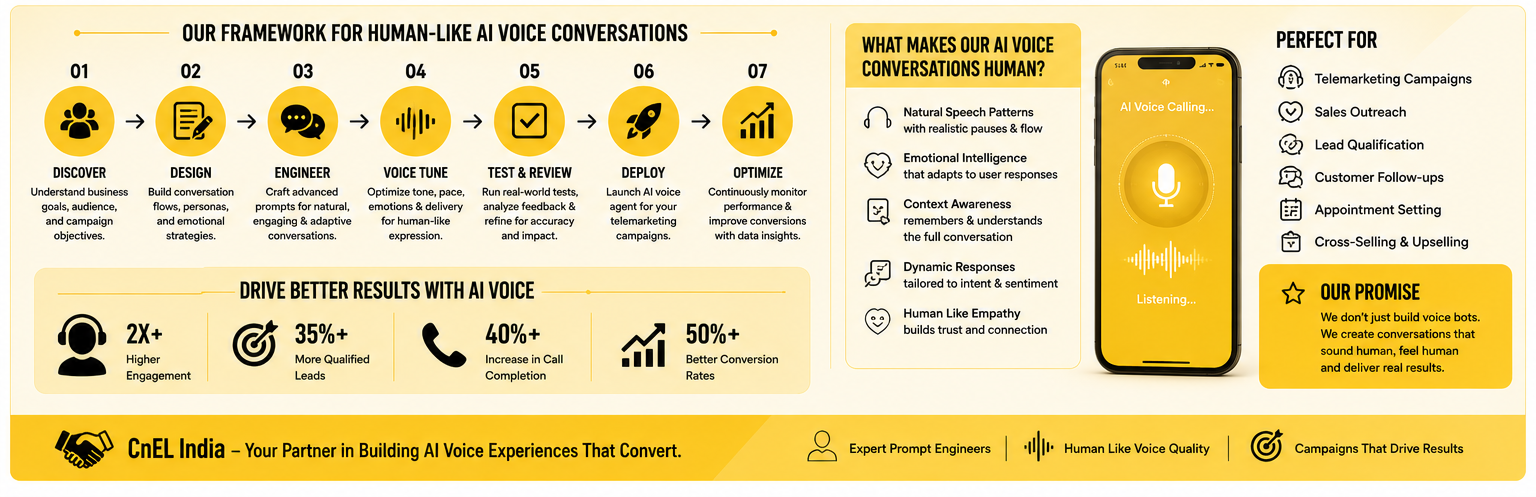
Project Delivery Framework
CnEL India follows a structured implementation process.
Phase 1: Discovery
Understand business goals.
Phase 2: Conversation Design
Create communication architecture.
Phase 3: Personality Development
Define voice characteristics.
Phase 4: Prompt Engineering
Build conversational intelligence.
Phase 5: Testing
Evaluate conversation quality.
Phase 6: Optimization
Refine performance.
Phase 7: Scale
Expand operational deployment.
Challenges Solved by CnEL India
This engagement addresses:
- Robotic conversations
- Low engagement rates
- Poor emotional expression
- Weak objection handling
- Limited adaptability
- Inconsistent customer experiences
The result is significantly more human-like communication.
Business Outcomes Delivered
Organizations implementing this approach can achieve:
- Improved customer engagement
- Higher call completion rates
- Better lead qualification
- Increased appointment bookings
- Stronger customer trust
- Enhanced conversion performance
Voice automation becomes a business growth asset rather than merely a cost-saving tool.
Why CnEL India
CnEL India combines:
- Conversation design expertise
- Prompt engineering capabilities
- Customer psychology understanding
- Telemarketing workflow knowledge
- Performance optimization methodologies
The focus is creating voice experiences that sound natural, persuasive, and emotionally intelligent.
Conclusion
This case study demonstrates how CnEL India can help organizations achieve human-like AI voice interactions through advanced conversation architecture, emotional intelligence modeling, prompt engineering, and telemarketing workflow optimization.
Rather than relying on basic scripted automation, the approach focuses on replicating the qualities that make human conversations effective: empathy, adaptability, timing, tone, and contextual understanding.
By combining strategic conversation design with continuous optimization, CnEL India enables businesses to build scalable voice engagement systems that enhance customer experiences, improve conversion rates, and support long-term growth.