
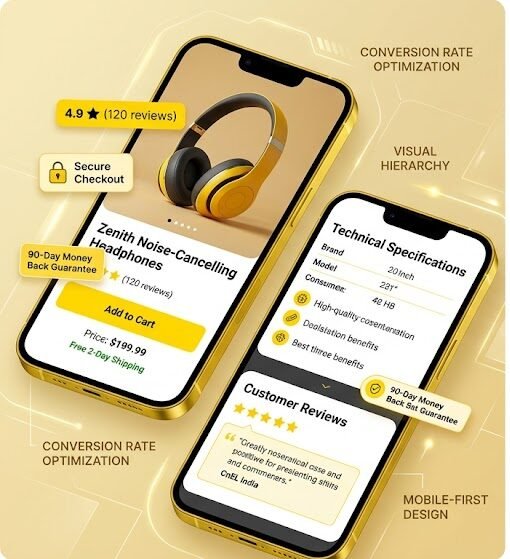
Case Study by CnEL India
Introduction
In the highly competitive world of e-commerce, a beautiful online store alone is no longer enough to generate consistent sales. Modern customers make purchasing decisions within seconds, evaluating product presentation, trust signals, pricing clarity, reviews, mobile usability, and the overall shopping experience before deciding whether to buy or leave. As a result, successful online stores focus not only on attractive visuals but also on Conversion Rate Optimization (CRO), ensuring that every design element guides customers toward completing a purchase.
Product pages and landing pages are among the most important parts of an online store because they directly influence buying decisions. A poorly structured product page can create confusion, increase bounce rates, and reduce conversions, while a thoughtfully designed page with clear information, persuasive visuals, trust-building elements, and intuitive navigation can significantly improve customer confidence and sales performance.
CnEL India specializes in creating high-converting e-commerce experiences that combine user-centered design, responsive layouts, strategic content hierarchy, trust optimization, and scalable design systems. Rather than simply redesigning pages for visual appeal, the focus is on improving the complete customer journey—from product discovery to purchase—while ensuring that every design can be reviewed, refined, and efficiently developed.
This case study explains how CnEL India approaches the redesign of product pages, home pages, and landing pages through a conversion-focused design process that enhances usability, builds customer trust, and creates long-term value for growing e-commerce businesses.
Business Background
E-commerce businesses frequently invest in advertising to bring visitors to their stores, but many lose potential customers because their pages fail to convert effectively.
Common challenges include:
-
Low conversion rates
-
Poor mobile experience
-
Confusing page layouts
-
Weak product presentation
-
Hidden calls-to-action
-
Slow decision-making
-
Limited trust signals
-
Ineffective landing pages
-
High bounce rates
-
Inconsistent branding
-
Weak visual hierarchy
-
Poor customer journey
These problems reduce the return on marketing investments and limit overall business growth.
CnEL India addresses these issues through conversion-driven design strategies that balance aesthetics with measurable business performance.
Project Objectives
The primary objective is to design high-converting e-commerce pages that improve user experience while increasing customer confidence and purchase intent.
The project focuses on:
-
Product page design
-
Landing page design
-
Home page improvements
-
Conversion optimization
-
Mobile-first design
-
Responsive layouts
-
Customer journey enhancement
-
Trust-building design
-
Visual hierarchy
-
Offer presentation
-
Design collaboration
-
Long-term scalability
Every design is prepared in a collaborative format that allows review, feedback, revisions, and approval before development begins.
Understanding Customer Behavior
Before designing any page, CnEL India studies how customers interact with online stores.
Key behavioral questions include:
-
What attracts attention first?
-
Which information builds trust?
-
When do customers hesitate?
-
What causes abandonment?
-
Which elements encourage purchases?
-
How does mobile behavior differ?
-
What influences repeat purchases?
Understanding these behaviors ensures that design decisions support real customer needs rather than relying solely on visual preferences.
Product Page Strategy
The product page is often the highest-impact page in an online store.
It must answer customer questions quickly while encouraging purchase confidence.
CnEL India structures product pages around:
-
Strong product imagery
-
Clear product title
-
Visible pricing
-
Product benefits
-
Purchase controls
-
Trust signals
-
Supporting information
-
Frequently asked questions
-
Customer reviews
-
Additional recommendations
Every section contributes to reducing purchase hesitation.
Visual Hierarchy
Customers scan pages rather than reading every word.
CnEL India establishes clear visual hierarchy through:
-
Bold headlines
-
Strategic spacing
-
Consistent typography
-
Section separation
-
Color emphasis
-
Button prominence
-
Image positioning
This guides visitors naturally through the purchasing journey.
Trust-Building Elements
Trust plays a major role in e-commerce success.
CnEL India incorporates visual trust elements such as:
-
Customer reviews
-
Secure checkout indicators
-
Return information
-
Delivery details
-
Product guarantees
-
Quality certifications
-
Brand credibility
-
Social proof
These elements help reduce uncertainty before purchase.
Offer Presentation
Even strong products can underperform if offers are poorly presented.
CnEL India improves offer visibility through:
-
Clear pricing
-
Discount presentation
-
Savings emphasis
-
Bundle offers
-
Limited-time messaging
-
Purchase incentives
-
Subscription options
-
Shipping highlights
Clear offer communication improves decision-making.
Home Page Optimization
The home page introduces the brand and directs visitors toward important products.
Instead of becoming overcrowded, the home page follows a structured flow:
-
Brand introduction
-
Featured products
-
Key benefits
-
Customer trust
-
Popular collections
-
Lifestyle imagery
-
Calls-to-action
This creates a smoother first impression.
Landing Page Design
Landing pages support focused marketing campaigns.
Unlike home pages, they remove unnecessary distractions.
CnEL India designs landing pages optimized for:
-
Product launches
-
Promotions
-
Advertising campaigns
-
Seasonal offers
-
Lead generation
-
Special collections
Every landing page supports a single primary objective.
Mobile-First Design
A significant portion of e-commerce traffic comes from smartphones.
CnEL India prioritizes mobile usability through:
-
Touch-friendly buttons
-
Readable text
-
Responsive images
-
Simple navigation
-
Optimized spacing
-
Faster loading
-
Scroll-friendly layouts
Mobile optimization helps improve conversion rates across devices.
Responsive Experience
Customers expect a consistent experience regardless of screen size.
The designs adapt across:
-
Mobile phones
-
Tablets
-
Laptops
-
Desktop monitors
-
Large displays
Responsive layouts ensure that important purchasing elements remain accessible everywhere.
Customer Journey Optimization
A successful store guides customers smoothly from discovery to checkout.
CnEL India maps the customer journey across key stages:
-
Product discovery
-
Interest
-
Information gathering
-
Trust building
-
Purchase decision
-
Checkout
-
Post-purchase confidence
Each design decision supports movement toward the next stage.
Section-Based Design System
Instead of creating isolated pages, CnEL India develops reusable page sections.
Examples include:
-
Hero banners
-
Benefit sections
-
Product highlights
-
Review blocks
-
Feature comparisons
-
FAQ sections
-
Collection previews
-
Call-to-action areas
Reusable sections improve consistency and future scalability.
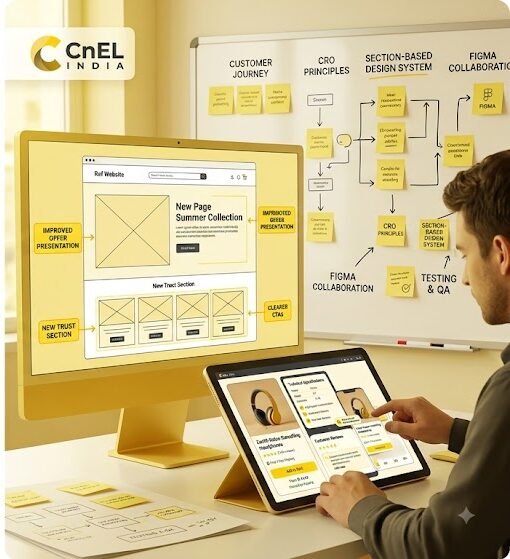
Competitor-Inspired Improvements
Businesses often provide reference websites that demonstrate preferred layouts or interactions.
CnEL India analyzes these references by identifying:
-
Effective hierarchy
-
User flow
-
Trust placement
-
Conversion techniques
-
Layout strengths
-
Mobile behavior
Rather than copying designs, successful principles are adapted to the client’s unique brand.
Collaborative Design Workflow
One major project requirement is collaborative review before development.
CnEL India follows a structured workflow:
-
Initial wireframes
-
Visual design
-
Client review
-
Feedback collection
-
Design revisions
-
Final approval
-
Development preparation
This process reduces misunderstandings and improves final quality.
Design Documentation
Clear documentation helps developers implement approved designs accurately.
Design specifications include:
-
Typography
-
Colors
-
Spacing
-
Button styles
-
Component behavior
-
Responsive adjustments
-
Image placement
-
Interaction notes
Good documentation speeds implementation.
Conversion Rate Optimization Principles
Every page incorporates proven conversion principles.
These include:
-
Clear calls-to-action
-
Reduced friction
-
Visible benefits
-
Logical information order
-
Trust reinforcement
-
Urgency where appropriate
-
Simple navigation
-
Purchase confidence
The goal is to increase completed purchases without overwhelming visitors.
Accessibility Considerations
Inclusive design benefits all users.
CnEL India improves accessibility through:
-
Readable fonts
-
Strong contrast
-
Clear navigation
-
Consistent buttons
-
Logical content order
-
Touch accessibility
Accessible stores often provide better overall usability.
Performance Awareness
Design choices influence website performance.
CnEL India considers:
-
Image optimization
-
Efficient layouts
-
Mobile loading
-
Visual balance
-
Reduced unnecessary complexity
Performance supports both customer experience and search visibility.
Long-Term Design Partnership
Unlike one-time redesign projects, this engagement emphasizes ongoing collaboration.
CnEL India supports continuous improvements through:
-
New page sections
-
Campaign landing pages
-
Product launches
-
Seasonal updates
-
Collection redesigns
-
Conversion improvements
-
Mobile refinements
This creates lasting business value beyond a single project.
Quality Assurance
Before final approval, every design undergoes detailed review.
Testing includes:
Layout Review
Checking visual consistency.
Mobile Review
Verifying responsive behavior.
User Journey Review
Evaluating navigation flow.
Trust Review
Ensuring confidence-building elements remain visible.
Conversion Review
Checking button placement and messaging.
Accessibility Review
Improving usability.
Quality assurance reduces future redesign requirements.
Business Benefits
The conversion-focused design approach provides measurable advantages.
Expected benefits include:
-
Higher conversion potential
-
Better mobile experience
-
Stronger product presentation
-
Increased customer trust
-
Improved user engagement
-
Clearer navigation
-
Better landing page performance
-
More consistent branding
-
Faster design approvals
-
Scalable design system
-
Long-term optimization opportunities
-
Improved shopping experience
Challenges Solved
CnEL India successfully addresses several common e-commerce design challenges.
Low Conversion Rates
Pages become more purchase-focused.
Weak Product Pages
Information hierarchy improves customer confidence.
Mobile Limitations
Responsive layouts improve usability.
Poor Trust Signals
Trust elements become more visible.
Inconsistent Design
Reusable sections improve consistency.
Confusing Navigation
Customer journeys become clearer.
Slow Approval Process
Collaborative design simplifies revisions.
One-Time Design Thinking
Ongoing optimization supports long-term growth.
Why CnEL India
CnEL India combines expertise in e-commerce design, conversion optimization, responsive user interfaces, customer journey mapping, design systems, collaborative workflows, and scalable digital experiences.
Rather than focusing only on making online stores visually attractive, CnEL India develops conversion-driven experiences that strengthen customer trust, simplify decision-making, improve usability, and support sustainable business growth.
Every design emphasizes clarity, performance, scalability, and measurable business outcomes.
Conclusion
This case study demonstrates how CnEL India transforms ordinary e-commerce pages into high-performing digital experiences through thoughtful product presentation, customer journey optimization, responsive design, trust-building elements, and conversion-focused layouts.
By combining structured design workflows, reusable components, mobile-first thinking, collaborative approvals, and long-term optimization strategies, the resulting online store becomes more than a visually appealing website—it becomes a powerful sales platform that supports customer confidence, improves engagement, increases conversion opportunities, and creates a scalable foundation for continued e-commerce growth.