
Project Overview
CnEL India worked on the design and implementation of a structured customer relationship management and automation system for an Australian agency serving mortgage and finance brokers. The objective was to create a reusable system that could be deployed across multiple broker businesses while still allowing each client account to be customised according to its workflows, branding, team structure, and communication requirements.
The project focused on combining customer management, enquiry tracking, appointment scheduling, automated follow-ups, AI-assisted communication, referral management, review collection, and post-settlement engagement into one organised operational framework.
Instead of creating every client system from the ground up, the approach centred around developing a master configuration that could be replicated for new broker clients. This significantly reduced onboarding effort while maintaining consistency across accounts.
The system was also designed specifically for the Australian mortgage and finance environment. This meant adapting terminology, communication processes, phone and messaging configurations, consent requirements, and customer journeys to suit Australian businesses.
Business Challenge
Mortgage brokers receive enquiries from multiple channels, including websites, referrals, phone calls, social campaigns, and existing customers. Managing these enquiries manually can create delays and inconsistent follow-up.
A new enquiry may need to move through several stages before becoming a settled loan. During this journey, brokers may need to contact the customer, schedule an appointment, conduct a pre-assessment, request information, follow up on missing documents, communicate with referral partners, and eventually maintain a relationship after settlement.
Without a structured system, several problems can occur:
- New enquiries may not be contacted quickly.
- Potential customers can remain unbooked after submitting a form.
- Follow-up messages may be missed.
- Appointment reminders may be inconsistent.
- Staff may spend excessive time chasing customers.
- Referral sources may not be tracked properly.
- Reviews may not be requested consistently.
- Past clients may become inactive.
- Different brokers may follow different processes.
The agency also wanted to provide a managed service to multiple broker clients. Therefore, the solution needed to be reusable, organised, documented, and easy to maintain.
Project Objectives
The primary objectives of the project were to:
- Build a reusable master CRM and automation structure.
- Create a complete mortgage enquiry pipeline.
- Automate enquiry capture and follow-up.
- Connect website forms with customer records.
- Introduce appointment booking and reminders.
- Create AI-assisted customer communication.
- Automate document follow-ups without storing sensitive documents in the CRM.
- Manage reviews and referral relationships.
- Create post-settlement customer engagement.
- Provide a repeatable onboarding process for new brokers.
- Localise the system for Australian businesses.
- Create clear documentation and standard operating procedures.
- Establish a structure that could support ongoing implementation and maintenance.
Master System Architecture
CnEL India approached the project as a reusable operational framework rather than a single-client setup.
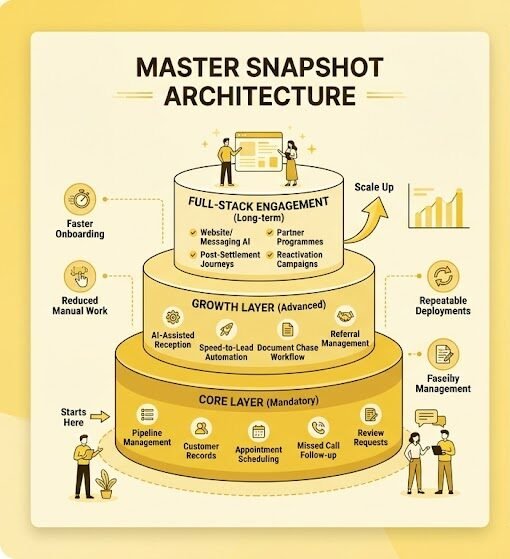
The master system was divided into several layers.
Core Layer
The core layer contained functionality required by every mortgage broker.
This included:
- Customer enquiry management
- Pipeline management
- Contact records
- Enquiry forms
- Pre-qualification journey
- Appointment scheduling
- Confirmation messages
- Appointment reminders
- Missed-call follow-up
- New-enquiry automation
- Unbooked-enquiry follow-up
- Review requests
- Shared communication inbox
- User roles
- Activity reporting
Growth Layer
The growth layer introduced more advanced automation.
This included AI-assisted inbound reception, rapid response to new enquiries, qualification questions, appointment assistance, and automated document reminders.
Full-Stack Engagement Layer
The final layer focused on longer-term customer relationships.
It included website and messaging conversations, post-settlement communication, referral programmes, past-client reactivation, partner landing pages, recurring partner updates, and controlled partner access.
This layered structure allowed each broker to start with the required core functionality and add additional capabilities as their business grew.
Mortgage Enquiry Pipeline
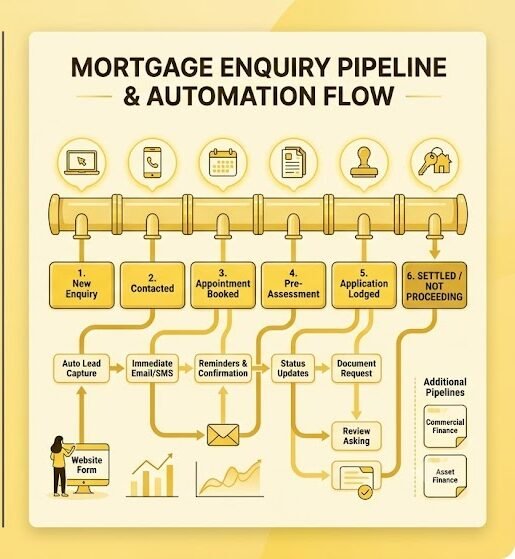
One of the most important parts of the system was the mortgage enquiry pipeline.
The customer journey was organised into clear stages:
New Enquiry → Contacted → Appointment Booked → Pre-Assessment → Application Lodged → Settled / Not Proceeding
This structure gave brokers a clear view of every active opportunity.
Additional pipelines were created for commercial finance and asset finance so that different types of enquiries could be managed separately.
Each website enquiry could automatically create a customer record and corresponding pipeline entry. This reduced manual data entry and ensured that new leads entered the correct workflow immediately.
The pipeline also provided a foundation for reporting and automation because different actions could be triggered according to the customer’s current stage.
Enquiry Forms and Qualification
CnEL India designed the enquiry process so that information submitted through the broker’s website could flow directly into the customer management system.
The existing borrower calculators remained on the agency’s website. Instead of rebuilding them, the project focused on connecting their contact-capture functionality with the CRM environment.
A pre-qualification journey was also introduced to collect relevant initial information before a broker became directly involved.
This helped brokers understand the customer’s basic requirements and allowed automated workflows to respond appropriately.
Appointment Scheduling and Broker Routing
Appointment management was another major component.
Customers could select available appointment times based on broker calendars and availability.
After an appointment was created, automated confirmations and reminders helped reduce missed appointments.
Broker routing could also be configured so that enquiries were directed to the appropriate team member based on predefined rules.
This created a more organised customer experience while reducing administrative scheduling work.
Missed-Call and Speed-to-Lead Automation
Mortgage enquiries often require a fast response. CnEL India therefore designed workflows around immediate engagement.
When a new enquiry arrived, the system could trigger an automated response and initiate a rapid AI-assisted phone interaction during permitted business hours.
The AI assistant could introduce itself as an AI system, ask approved qualification questions, capture basic information, and offer an appointment.
The purpose was not to replace the broker.
Instead, the system was designed to reduce the delay between enquiry submission and first contact.
Missed calls could also trigger automated text responses, giving customers an immediate acknowledgement and a way to continue the conversation.
AI-Assisted Reception
The inbound AI receptionist was designed with strict boundaries.
It could:
- Answer approved routine questions.
- Capture customer information.
- Take messages.
- Help customers understand the next step.
- Offer available appointments.
- Transfer or escalate conversations to a human.
The AI was explicitly identified as an AI assistant.
It was not allowed to provide credit advice, recommend financial products, assess loan applications, or make decisions on behalf of brokers.
This distinction was important because the system was intended to support administrative and communication tasks rather than replace professional financial advice.
Conversation Automation
The system also supported AI-assisted conversations through website chat and text messaging.
The AI operated from an approved knowledge base containing information that the business had authorised for customer communication.
If a question fell outside the approved knowledge area, the conversation could be escalated to a human team member.
This approach created a controlled environment where AI could handle routine communication while keeping sensitive or complex decisions with qualified professionals.
Document-Chase Workflow
Mortgage applications often require customers to provide multiple documents.
Instead of storing those documents inside the customer management system, CnEL India designed the automation around status tracking.
When documents were required, the customer could receive reminders through appropriate communication channels.
The workflow could send:
- Initial document reminders
- Follow-up messages
- Additional reminders after defined intervals
- Human escalation when necessary
The automation was designed to stop when the relevant documents were marked as received or when the customer responded.
This prevented customers from receiving unnecessary reminders after completing the requested action.
Most importantly, the system did not use the CRM as a storage location for sensitive loan documents.
Australian Localisation
The original system structure had to be adapted for Australian mortgage brokers.
CnEL India removed US-specific financial terminology and replaced it with terminology relevant to Australian broker operations.
Communication configurations were also adapted for Australian phone numbers and messaging requirements.
Consent and opt-out handling were incorporated into the communication workflows to support responsible customer messaging practices.
This localisation was important because a workflow designed for one country’s financial environment cannot simply be copied into another market without reviewing terminology, communication rules, and customer expectations.
Review and Reputation Management
Customer reviews were incorporated into the post-service workflow.
After appropriate customer interactions, automated review requests could be sent.
The system also supported a website review display so that approved customer feedback could be presented as part of the broker’s online presence.
The workflow was designed without restricting customers based on whether they were likely to leave a positive or negative review. The objective was to maintain a straightforward and transparent review-request process.
Referral Management
Mortgage brokers frequently receive business through referral partners.
CnEL India introduced referral-source tracking so that enquiries could be associated with the appropriate source.
This enabled the agency to generate periodic summaries showing referral activity.
A dedicated partner programme could also include:
- Co-branded landing pages
- Weekly referral summaries
- Partner-specific communication
- Read-only access to relevant information
This created a more structured relationship between brokers and their referral partners.
Post-Settlement Engagement
The relationship with a borrower does not necessarily end when a loan settles.
The system therefore included a post-settlement customer journey.
Customers could receive:
- A review request
- A referral request
- An invitation for an annual loan review
- Relevant follow-up communication
Past-client reactivation workflows could also be used to reconnect with customers who had not interacted with the broker for an extended period.
This helped transform the system from a simple lead-management solution into a longer-term customer relationship framework.
Testing and Quality Assurance
CnEL India treated testing as an essential part of the implementation.
Each workflow was tested in a controlled environment before being considered ready for client deployment.
Testing covered:
- New enquiry creation
- Pipeline movement
- Form submissions
- Appointment booking
- Confirmation messages
- Reminder sequences
- Missed-call responses
- AI handoffs
- AI escalation
- Document reminder stopping conditions
- Review requests
- Referral tagging
- Post-settlement sequences
- User permissions
- Communication delivery
Special attention was given to stopping conditions.
For example, if a customer completed a required action, the corresponding follow-up workflow needed to stop automatically.
This prevented duplicate or irrelevant communication.
Documentation and Deployment Process
Because the agency planned to deploy the system for multiple broker clients, documentation was a major project requirement.
CnEL India created a structured deployment process explaining how a new broker account could be configured from the master system.
The documentation covered:
- Initial account setup
- Pipeline configuration
- Workflow activation
- Calendar setup
- User configuration
- Branding customisation
- AI knowledge configuration
- Communication settings
- Testing procedures
- Final deployment checks
A walkthrough was also prepared so that future implementations could follow a consistent process.
Business Benefits
The completed system provided several operational benefits.
Faster Lead Response
New enquiries could receive immediate automated engagement, reducing delays during the initial stage.
Reduced Manual Work
Routine follow-ups, reminders, confirmations, review requests, and reactivation campaigns could run automatically.
Better Pipeline Visibility
Brokers could see where each enquiry was within the customer journey.
Consistent Customer Experience
Reusable workflows helped maintain consistent communication across different broker accounts.
Scalable Client Onboarding
The master configuration reduced the need to rebuild systems for every new broker.
Controlled AI Usage
AI was used for defined administrative and communication tasks with clear escalation rules.
Improved Follow-Up
Automated reminders reduced the possibility of enquiries or pending actions being forgotten.
Stronger Referral Tracking
Referral sources could be tracked and summarised more systematically.
Ongoing Support and Maintenance
The project was designed as an ongoing service rather than a one-time implementation.
CnEL India could support new broker onboarding, workflow customisation, AI tuning, calendar configuration, communication troubleshooting, review-system checks, and monthly reporting.
As the system evolves, the master configuration can also be updated so that improvements can be incorporated into future client deployments.
Regular monitoring is important because communication systems, business processes, customer expectations, and automation requirements can change over time.
CnEL India’s Contribution
CnEL India’s role in the project extended beyond workflow creation.
The work involved understanding the broker’s complete customer journey, converting that journey into structured automation, creating AI boundaries, testing the system, documenting deployment procedures, and preparing the architecture for repeated implementation.
The focus was on building a practical system that combined automation with human involvement rather than attempting to automate every part of the mortgage process.
This balance was especially important for financial services, where customer communication may require professional judgement and sensitive information must be handled carefully.
Future Scalability
The architecture was designed to support additional broker clients without requiring a complete rebuild for every account.
New brokers can be onboarded from the master configuration and then customised according to their branding, team members, calendars, referral relationships, and communication preferences.
Additional automation can also be introduced over time as business requirements evolve.
The layered architecture makes it possible to start with essential functionality and progressively add advanced customer engagement features.
Conclusion
CnEL India’s mortgage broker automation project demonstrates how CRM, workflow automation, AI-assisted communication, and customer engagement can be combined into a structured operational system for a specialised financial-services environment.
The key focus was not simply automation. It was creating a reusable, controlled, and scalable framework that could support the complete customer journey—from the first enquiry through appointment booking, pre-assessment, application progress, settlement, reviews, referrals, and long-term customer engagement.
By combining reusable configurations with client-specific customisation, clear AI boundaries, automated follow-ups, structured pipelines, Australian localisation, testing, and detailed documentation, the solution created a foundation that could be deployed across multiple broker businesses.
For CnEL India, the project represents an approach to building practical automation systems where technology handles repetitive operational work while human professionals remain responsible for advice, decisions, and complex customer interactions.