
Project Overview
Artificial Intelligence is transforming how businesses operate, make decisions, manage information, and develop digital products. From automating repetitive tasks to building intelligent applications, AI is becoming an important part of modern industries.
However, entering the field of AI engineering can be challenging for beginners. There are many concepts to understand, different areas to explore, and a wide range of learning resources available. Without a clear direction, learners may struggle to decide where to start, what skills to develop, and how to apply theoretical knowledge in practical situations.
CnEL India explored a learning-focused AI engineering project designed to help an individual build a strong foundation in artificial intelligence and develop the practical skills required to contribute to the AI sector.
The primary requirement was to create a simple, clear, and structured learning path. Rather than overwhelming the learner with complex technical information, the objective was to organize the learning process into understandable stages, beginning with fundamental concepts and gradually progressing towards practical AI development.
The learning journey needed to explain important AI engineering concepts, recommend useful learning resources, introduce relevant development practices, and provide practical exercises that could help transform theoretical knowledge into real-world capabilities.
The ultimate goal was to help the learner become confident in understanding, developing, and contributing to AI-powered solutions.
Understanding the Learning Requirements
The first step was understanding what the learner expected from an AI engineering roadmap.
The request was not simply for a list of online courses or technical topics. The learner wanted guidance that could explain the complete journey from beginner-level understanding to practical implementation.
The learning path needed to answer several important questions:
- What is AI engineering, and how does it work?
- Which fundamental concepts should be learned first?
- What programming and technical knowledge is required?
- How do machine learning and deep learning fit into AI engineering?
- How can someone understand and work with modern AI models?
- What practical projects should beginners build?
- Which learning resources can support continuous improvement?
- How can theoretical knowledge be applied to real business problems?
Another important requirement was simplicity. The learning material needed to avoid unnecessary complexity and explain technical concepts through practical examples.
A structured roadmap would help the learner understand what to study, why each topic matters, and how one learning stage connects to the next.
Understanding the Foundations of Artificial Intelligence
A strong AI engineering journey begins with understanding the basic principles of artificial intelligence.
Artificial intelligence refers to computer systems designed to perform tasks that normally require human-like intelligence. These tasks can include understanding language, identifying patterns, recognizing images, making predictions, and generating content.
Before moving towards advanced development, learners need to understand the different areas that contribute to AI.
1. Artificial Intelligence
The first stage introduces the broader concept of artificial intelligence.
Learners explore how intelligent systems process information, identify patterns, make decisions, and perform tasks based on available data.
Practical examples can include:
- Virtual assistants answering questions.
- Recommendation systems suggesting products.
- Systems identifying unusual financial transactions.
- Applications recognizing objects in images.
- Automated systems processing customer enquiries.
Understanding these applications helps learners connect AI concepts with real-world business requirements.
2. Machine Learning
Machine learning is an important area of AI that allows computer systems to identify patterns from data and improve their performance through experience.
Learners need to understand how systems are trained using examples and how they use learned patterns to make predictions.
Important concepts include supervised learning, unsupervised learning, classification, regression, training data, testing data, and model evaluation.
For example, a machine learning system could analyze historical sales information to estimate future demand.
Learning these concepts provides the foundation for understanding how AI systems learn from information rather than relying entirely on manually written instructions.
3. Deep Learning
Deep learning is a specialized area of machine learning that uses multi-layered neural networks to identify complex patterns.
It is widely associated with applications involving image recognition, speech processing, language understanding, and advanced generative systems.
Beginners should first understand the basic purpose of neural networks before exploring more advanced mathematical and architectural concepts.
This gradual learning approach makes complex subjects easier to understand and apply.
Developing Programming and Technical Skills
Programming knowledge is an essential part of becoming an AI engineer.
AI systems require code to process information, prepare datasets, connect different components, evaluate results, and deliver useful functionality through applications.
A structured learning path should therefore introduce programming fundamentals before moving into advanced AI development.
Programming Fundamentals
Learners should begin with basic programming concepts, including:
- Variables and data types.
- Conditional statements.
- Loops and functions.
- Lists and dictionaries.
- Object-oriented programming.
- Error handling.
- Reading and writing files.
- Working with external data.
These concepts help learners understand how software applications are structured and how different operations are performed.
The objective is not simply to memorize programming syntax. Learners should develop the ability to solve problems logically and write understandable, maintainable code.
Data Handling and Processing
AI engineering depends heavily on data.
Before information can be used to train or evaluate an AI model, it often needs to be collected, organized, cleaned, and transformed.
Learners should understand how to work with structured information, handle missing values, remove duplicate records, identify incorrect entries, and prepare datasets for analysis.
They should also learn basic statistical concepts such as averages, percentages, distributions, correlation, and variation.
These skills help ensure that AI systems receive suitable information and produce more reliable results.
Learning the Fundamentals of Data Science
Data science provides important methods for understanding information and identifying meaningful patterns.
An AI engineer needs to understand how data influences model performance and how to interpret the results produced by an intelligent system.
The learning process should introduce:
Data Collection: Understanding where information comes from and how it can be gathered responsibly.
Data Cleaning: Identifying missing, incorrect, inconsistent, or duplicate information.
Data Exploration: Examining datasets to understand patterns, relationships, and unusual observations.
Data Visualization: Presenting information through charts, graphs, and other understandable visual formats.
Statistical Analysis: Applying basic mathematical methods to interpret information and evaluate outcomes.
For example, a learner could analyze customer purchase records to identify frequently purchased products, understand customer behavior, and discover sales patterns.
Such exercises help develop analytical thinking, which is valuable across almost every AI engineering role.
Understanding Generative AI and Modern AI Models
Modern AI engineering increasingly involves systems that can generate text, images, summaries, code, and other forms of content.
Learners should understand how generative AI works at a conceptual level and how it can be used to solve practical problems.
Important learning areas include:
- Large language models.
- Natural language processing.
- Text generation and summarization.
- Prompt design and instruction writing.
- Context management.
- Model limitations and hallucinations.
- AI response evaluation.
- Responsible use of generated content.
An important part of this stage is understanding that AI-generated answers are not always correct.
Learners should develop the ability to verify information, recognize unsupported responses, and evaluate the quality of generated output.
They should also understand how the quality of instructions, input information, and available context can influence an AI system’s response.
Understanding Retrieval-Based AI Systems
Another important concept is connecting AI models with external information sources.
Some AI applications need to answer questions using business documents, product information, internal knowledge bases, or other specific datasets.
A retrieval-based approach allows relevant information to be identified and supplied to an AI model before it generates a response.
For example, a business could build an intelligent support assistant that answers customer questions using approved product documentation.
Learners should understand the general process of preparing information, retrieving relevant content, generating responses, and checking whether those responses are supported by the available information.
This provides a useful foundation for developing practical AI applications.
Exploring AI Engineering Architecture
After understanding the fundamentals, learners can begin exploring how complete AI-powered applications are designed.
AI engineering is not limited to developing or training models. It also involves connecting models with software applications, databases, user interfaces, and business workflows.
A practical learning path should introduce the main components of an AI application.
These may include:
- User input and application interfaces.
- Backend processing.
- Data storage and retrieval.
- AI model integration.
- Business logic.
- Response generation.
- Error handling.
- Security and access management.
- Testing and monitoring.
For example, an AI-powered customer support application may receive a question through a website, retrieve relevant customer information, process the request, generate a response, and display the result to the user.
Understanding how these components work together helps learners move beyond isolated experiments and begin thinking like application developers.
Building Practical AI Projects
Practical implementation is one of the most important stages of AI engineering education.
Reading documentation and watching tutorials can introduce concepts, but building projects helps learners understand how to apply those concepts in real situations.
The learning roadmap should include projects that gradually increase in complexity.
Beginner-Level Projects
Beginners can start with simple applications that introduce basic programming and AI concepts.
Examples include:
- A basic chatbot that answers predefined questions.
- A text summarization application.
- A simple customer feedback classification system.
- A basic data analysis dashboard.
- An application that organizes information into categories.
These projects help learners understand inputs, outputs, data processing, and application logic.
Intermediate-Level Projects
After gaining confidence, learners can work on more practical applications.
Examples include:
- An AI-powered document summarization system.
- A customer enquiry classification application.
- A product recommendation system.
- An intelligent FAQ assistant.
- A tool that extracts information from business documents.
- An AI-based report generation application.
These projects introduce more complex workflows, data processing, model integration, and result evaluation.
Advanced-Level Projects
Advanced learners can explore larger applications that combine multiple AI capabilities.
Possible projects include:
- A business knowledge assistant that searches internal documents.
- An AI-powered recruitment support system.
- An intelligent data analysis application.
- A customer support automation platform.
- A document processing and verification system.
- An AI-powered business reporting solution.
These projects provide experience in designing complete systems, managing different components, testing functionality, and solving practical problems.
Understanding AI Model Evaluation and Responsible Development
Developing an AI application is only one part of the process. Engineers also need to understand whether the application produces accurate, useful, and reliable results.
An AI system may generate incorrect information, misunderstand instructions, or perform differently when given unfamiliar inputs.
For this reason, model evaluation and quality assurance should be included in the learning roadmap.
Important areas include:
Accuracy: Checking whether the system produces correct results for the intended task.
Reliability: Evaluating whether similar inputs produce consistent outputs.
Testing: Trying different inputs and identifying situations where the system fails.
Bias Awareness: Understanding how biased or incomplete training information can affect outcomes.
Privacy: Protecting personal and confidential information.
Security: Preventing unauthorized access and misuse.
Human Review: Identifying situations where important decisions require human verification.
For example, an AI system used to summarize business documents should be checked to ensure that important figures, dates, and statements are not incorrectly changed or omitted.
Responsible AI development helps create systems that businesses and users can trust.
Recommended Learning Structure
A clear learning schedule can make the complete journey easier to manage.
Instead of studying every subject simultaneously, learners should progress through connected stages.
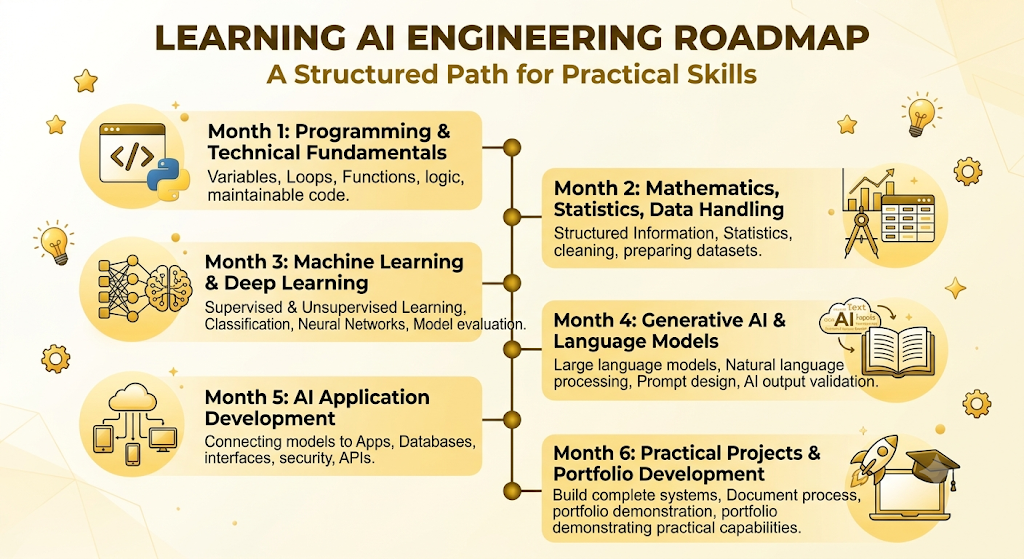
An example six-month learning structure could be:
Month 1: Programming and Technical Fundamentals
Learn programming basics, problem-solving, data structures, and fundamental software development concepts.
Month 2: Mathematics, Statistics, and Data Handling
Understand basic statistics, data preparation, data analysis, and working with structured datasets.
Month 3: Machine Learning and Deep Learning
Explore different learning approaches, model training, neural networks, and model evaluation.
Month 4: Generative AI and Language Models
Understand modern generative systems, prompt design, language processing, retrieval-based applications, and AI limitations.
Month 5: AI Application Development
Learn how to connect AI capabilities with applications, databases, interfaces, and business workflows.
Month 6: Practical Projects and Portfolio Development
Build complete projects, test their performance, document the development process, and prepare a portfolio demonstrating practical capabilities.
This is an illustrative roadmap rather than a fixed deadline. Learners may need more or less time depending on their existing programming knowledge, available study hours, and learning pace.
Learning Resources and Continuous Improvement
A strong AI engineering foundation requires continuous learning.
The field develops quickly, and new approaches, research findings, and application patterns regularly emerge.
Learners should combine different learning methods instead of depending on a single source.
Useful learning resources can include:
- Structured online courses.
- Programming tutorials.
- Official technical documentation.
- University-level educational material.
- Research papers and technical articles.
- Practical coding exercises.
- Open educational datasets.
- Developer communities and discussion forums.
- Real-world project examples.
It is also important to maintain a consistent learning routine.
For example, learners can dedicate part of their study time to understanding new concepts, another part to practical exercises, and the remaining time to reviewing previous work and documenting what they have learned.
Keeping a record of completed projects, technical challenges, and solutions can help measure progress over time.
Challenges in Learning AI Engineering
A beginner may face several challenges while entering the AI engineering field.
Too Much Information: The large number of available courses, subjects, and learning resources can make it difficult to decide where to begin.
Complex Technical Concepts: Mathematics, machine learning, and neural networks may initially appear difficult.
Limited Practical Experience: Understanding theory without building projects can make it challenging to apply knowledge.
Rapid Industry Changes: New AI capabilities and development approaches require continuous learning.
Unclear Learning Priorities: Studying advanced topics too early can create confusion and slow down progress.
A structured roadmap helps address these challenges by organizing topics in a logical sequence.
Starting with fundamentals, practicing regularly, building increasingly complex projects, and reviewing progress can make the learning process more manageable.
CnEL India’s Approach
CnEL India believes that learning AI engineering should focus on both technical understanding and practical problem-solving.
For a learning-focused project like this, the approach begins by identifying the learner’s current knowledge level and long-term objectives.
The next step is to create a structured roadmap that organizes the essential subjects into manageable stages.
Each stage should include clear learning goals, practical exercises, relevant educational resources, and examples of real-world applications.
The learning process should gradually move from programming fundamentals and data handling to machine learning, generative AI, and complete application development.
Practical projects should be included throughout the journey so that learners can apply concepts immediately rather than waiting until the end of their studies.
Progress should also be reviewed regularly to identify knowledge gaps and determine which areas require additional practice.
The objective is to develop independent problem-solving skills and the confidence to contribute to real AI engineering projects.
Expected Learning Outcomes
Following a structured AI engineering roadmap can help learners develop several valuable capabilities.
- Understand the fundamental concepts of artificial intelligence.
- Develop programming and problem-solving skills.
- Work with datasets and perform basic analysis.
- Understand machine learning and deep learning concepts.
- Explore generative AI and language-based applications.
- Build practical AI-powered software applications.
- Connect AI models with existing software systems.
- Evaluate AI outputs and identify potential errors.
- Understand responsible AI development practices.
- Create a portfolio of practical projects.
- Develop the confidence to contribute to AI-related work.
These capabilities can provide a foundation for further specialization in areas such as machine learning engineering, generative AI development, AI application development, data science, and intelligent automation.
Conclusion
Learning AI engineering requires a combination of technical knowledge, practical experience, analytical thinking, and continuous improvement.
The most effective starting point is not to study every advanced AI concept at once, but to follow a clear learning path that builds knowledge step by step.
By beginning with programming fundamentals, understanding data, exploring machine learning, learning modern generative AI concepts, and developing practical applications, learners can gradually build the skills required to contribute to the AI sector.
This project highlights the importance of making AI education accessible, structured, and focused on real-world application.
For CnEL India, it represents an opportunity to support individuals and businesses in understanding AI technologies and developing the capabilities needed to use them effectively.
As artificial intelligence continues to influence industries, a strong foundation in AI engineering can help learners participate in innovation, develop useful solutions, and contribute to the future of intelligent software development.