
Case Study by CnEL India
Introduction
Online learning has become an essential part of professional development, employee training, customer education, coaching programs, and academic learning. Businesses, consultants, educators, and training providers increasingly rely on digital courses to share knowledge with a larger audience. However, having useful training material is not enough to create an effective online learning experience.
Many organizations already have valuable content in the form of presentations, documents, recorded sessions, worksheets, guides, classroom notes, manuals, or internal training resources. The challenge is transforming this existing material into a structured, engaging, and professional online course that helps learners understand concepts, retain information, and apply what they learn in real situations.
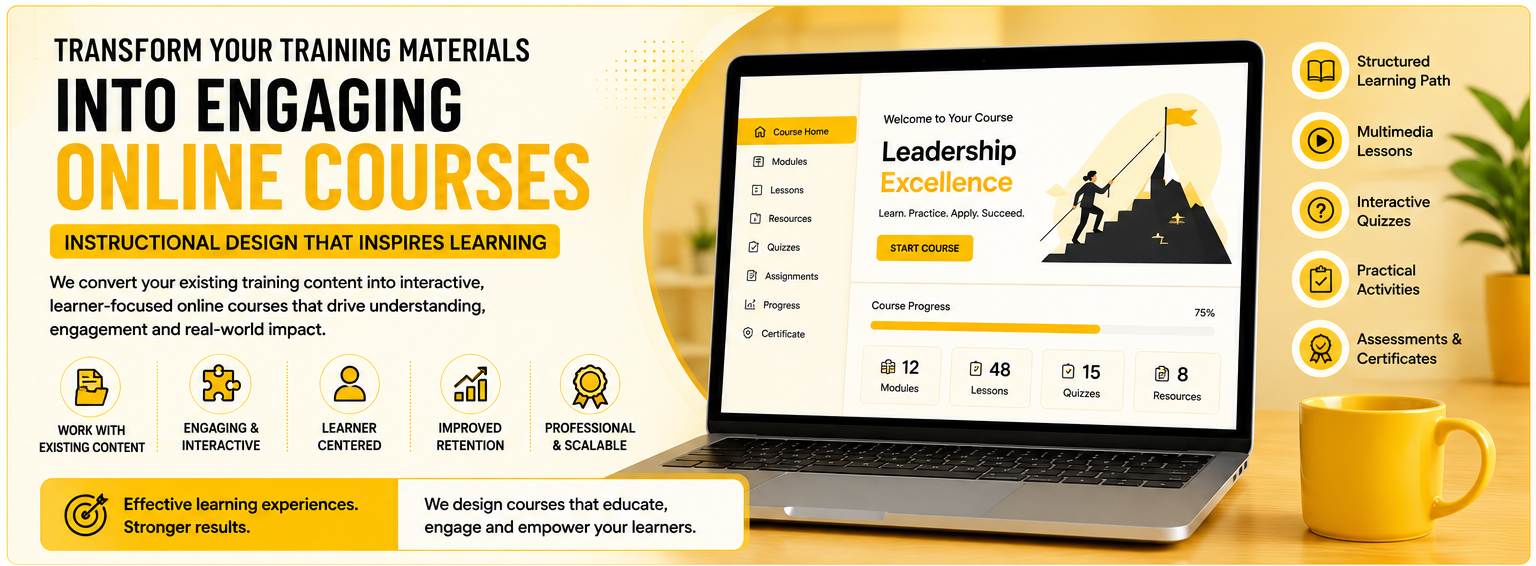
This case study explains how CnEL India supports businesses and educators by converting existing training material into well-designed online courses. The focus is not on creating entirely new subject matter from scratch. Instead, the objective is to organize, improve, and present the available content in a way that creates a clear and interactive learning journey.
The final course should be easy to follow, professionally structured, visually consistent, learner-friendly, and designed to improve participation and knowledge retention.
Business Background
Many experts and organizations have strong knowledge but struggle to convert that knowledge into a complete online learning program. Their content may have been created for live workshops, classroom sessions, internal meetings, coaching calls, or presentations. While these materials may be useful in their original format, they are often not ready for self-paced online learning.
For example, a live trainer can explain a difficult topic, answer questions, change the pace, and give examples based on audience reactions. In an online course, learners may study alone at different times and from different locations. They need clear instructions, logical modules, engaging activities, and opportunities to check their understanding without depending on a trainer in real time.
Without proper instructional design, online courses can become long, repetitive, difficult to understand, or unengaging. Learners may start the course but fail to complete it. They may watch videos without retaining the information or struggle to understand how to apply the learning in their work or daily life.
CnEL India helps solve this challenge by transforming existing training resources into organized learning experiences that are designed around the needs of the learner.
Project Objectives
The main objective of this project is to convert existing training materials into a professional online course that is clear, interactive, structured, and easy to complete.
The course should support the following goals:
- Organize existing material into logical modules
- Improve content clarity and flow
- Create engaging learning experiences
- Break complex topics into manageable lessons
- Add activities that support knowledge retention
- Develop assessments and knowledge checks
- Improve learner motivation
- Create a consistent visual learning experience
- Support self-paced learning
- Make the course easy to update in the future
The focus remains on improving the delivery and learning experience of the content while preserving the original expertise and message of the course creator.
Understanding the Existing Training Material
The first stage of the project involves reviewing the available materials.
Existing training content may include:
- Presentation slides
- Training manuals
- Worksheets
- Recorded sessions
- Written documents
- Classroom activities
- Notes from live workshops
- Process guides
- Case examples
- Frequently asked questions
- Assessment questions
- Reference materials
CnEL India reviews the material to understand the subject, audience, learning level, course goals, and expected outcomes.
This review helps identify which content is essential, which content needs simplification, which topics should be divided into smaller lessons, and where interactive elements can improve the learner experience.
Learner Audience Analysis
A course should be designed for the people who will use it.
CnEL India works to understand the learner audience before organizing the course structure.
Important learner considerations include:
- Current knowledge level
- Professional background
- Learning goals
- Time availability
- Preferred learning style
- Technical comfort
- Language level
- Common challenges
- Real-world application needs
For example, a course for new employees may require simple explanations, step-by-step instructions, and practical examples. A course for experienced professionals may focus more on advanced scenarios, decision-making, and application-based activities.
Understanding the learner helps ensure that the course is neither too basic nor too complex.
Learning Outcome Development
Every course should have clear learning outcomes.
Learning outcomes explain what learners should know, understand, or be able to do after completing the course.
CnEL India helps define outcomes that are practical and measurable.
Examples of learning outcomes may include:
- Understand a business process
- Identify key steps in a workflow
- Apply a communication technique
- Use a framework to solve a problem
- Complete a task correctly
- Recognize common mistakes
- Make better decisions in real situations
Clear learning outcomes guide the entire course development process. They help determine what content to include, what activities to create, and how to assess learner progress.
Course Structure and Module Planning
A long document or presentation should not simply be uploaded as an online course. It needs to be divided into logical sections.
CnEL India creates a structured course outline that organizes the content into modules and lessons.
A typical course structure may include:
- Course introduction
- Learning objectives
- Module overview
- Core lesson content
- Examples and demonstrations
- Practice activities
- Knowledge checks
- Summary sections
- Final assessment
- Completion guidance
Each module should focus on one clear topic or skill. This makes the course easier to understand and prevents learners from feeling overwhelmed.
Content Transformation
The core part of the project is transforming existing material into online learning content.
CnEL India improves the content by:
- Simplifying complex language
- Creating clear lesson flow
- Breaking long topics into smaller sections
- Adding headings and summaries
- Highlighting key points
- Including practical examples
- Removing unnecessary repetition
- Creating step-by-step explanations
- Adding reflection questions
The goal is not to change the client’s expertise. The goal is to make that expertise easier for learners to absorb and apply.
Interactive Learning Design
Online learners are more engaged when they participate actively rather than only reading or watching content.
CnEL India enhances courses with interactive learning elements that support engagement and retention.
These may include:
- Multiple-choice questions
- True or false activities
- Scenario-based questions
- Matching activities
- Reflection prompts
- Short exercises
- Drag-and-drop activities
- Decision-making tasks
- Knowledge checks
- Downloadable worksheets
Interactive elements help learners think about the topic and test their understanding before moving forward.
Scenario-Based Learning
Scenario-based learning helps learners connect course content with real situations.
CnEL India can convert existing examples, case studies, and real-life experiences into structured learning scenarios.
For example, instead of simply explaining how to handle a customer complaint, the course may present a situation where the learner must choose the best response.
This approach makes learning more practical and memorable.
Scenario-based learning is especially useful for professional training, customer service, leadership development, compliance education, sales training, workplace processes, and skill development programs.
Assessment Design
Assessments help measure whether learners have understood the course material.
CnEL India develops assessments that align with the course learning outcomes.
Assessment options may include:
- Short quizzes
- Module-end questions
- Scenario assessments
- Practical assignments
- Final knowledge checks
- Reflection exercises
- Completion tasks
The purpose of assessments is not only to score learners. They also help learners identify areas where they need more practice or review.
Visual Learning Experience
Visual design plays an important role in online course engagement.
CnEL India creates a consistent visual learning experience using:
- Clear layouts
- Readable typography
- Branded colors
- Simple graphics
- Organized slides
- Visual summaries
- Icons and illustrations
- Process diagrams
- Section dividers
The visual design should support learning rather than distract from it.
A clean and professional design helps learners focus on the content and creates a more credible training experience.
Video and Multimedia Content Planning
Existing training materials may include recorded sessions, demonstrations, interviews, or presentations.
CnEL India helps organize these materials into meaningful learning segments.
Long recordings can be divided into shorter lessons with clear titles, summaries, and related activities.
For example, a one-hour training recording may be transformed into several focused lessons, each covering one key topic.
This makes the content easier to navigate and allows learners to revisit specific topics when needed.
Learner Engagement Strategy
Course completion is one of the biggest challenges in online learning.
CnEL India designs engagement strategies that encourage learners to continue through the course.
These may include:
- Clear progress flow
- Short lesson formats
- Regular knowledge checks
- Practical examples
- Motivational messages
- Module summaries
- Downloadable resources
- Achievement milestones
- Clear next steps
When learners understand the value of each lesson and can see their progress, they are more likely to complete the course.
Accessibility and Usability
An online course should be easy to use for different learners.
CnEL India considers accessibility and usability by focusing on:
- Clear navigation
- Readable text
- Simple instructions
- Logical lesson order
- Mobile-friendly content
- Descriptive labels
- Clear buttons
- Organized downloads
- Easy-to-follow activities
The course should feel comfortable for learners who may not be highly technical.
Content Review and Quality Assurance
Before the course is delivered, CnEL India performs a detailed quality review.
The review includes:
- Checking lesson flow
- Verifying learning objectives
- Reviewing spelling and grammar
- Testing interactive activities
- Checking assessment accuracy
- Reviewing visual consistency
- Confirming navigation
- Ensuring links and resources work
- Checking mobile usability
- Verifying completion flow
Quality assurance ensures that learners receive a professional and reliable learning experience.
Collaboration With Subject Matter Experts
The original content creator remains an important part of the course development process.
CnEL India collaborates with the subject matter expert to ensure that the course remains accurate and aligned with the intended message.
The expert provides the knowledge, examples, and practical insights. CnEL India transforms that expertise into an effective learning structure.
This collaboration ensures that the final course is both educationally strong and factually correct.
Course Update and Scalability
Training content may need updates over time due to new processes, changing regulations, updated products, new examples, or learner feedback.
CnEL India designs courses in a way that makes future updates easier.
The content can be organized into separate modules so that one section can be updated without rebuilding the entire course.
This creates a scalable learning asset that can grow with the organization.
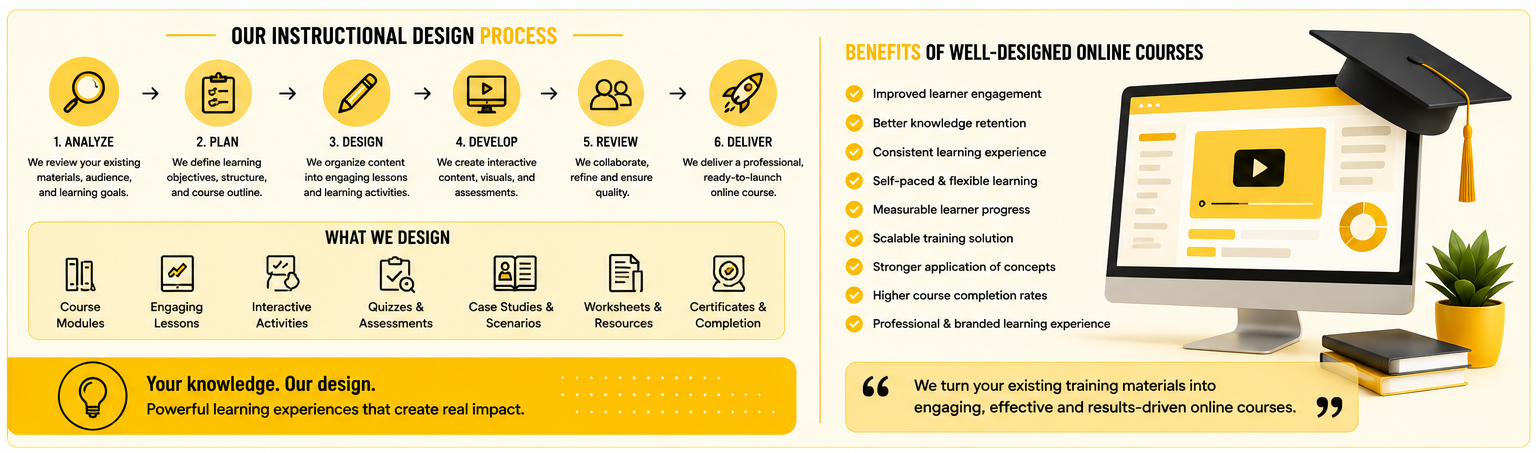
Project Delivery Framework
CnEL India follows a structured process for online course development.
Phase 1 – Content Review
Review existing training materials, audience needs, and learning goals.
Phase 2 – Learning Strategy
Define learning outcomes, course structure, modules, and assessment approach.
Phase 3 – Content Transformation
Convert existing material into structured lessons, activities, and learning resources.
Phase 4 – Interactive Design
Create engagement elements, knowledge checks, scenarios, and assessments.
Phase 5 – Visual Development
Develop a consistent and professional course design.
Phase 6 – Testing and Quality Review
Test course flow, activities, navigation, content accuracy, and usability.
Phase 7 – Final Delivery
Provide the completed course structure, learning content, and supporting resources.
Challenges Solved by CnEL India
This project helps solve common online course development challenges, including:
- Unstructured training materials
- Long and difficult lessons
- Low learner engagement
- Lack of interaction
- Weak course flow
- Poor knowledge retention
- Inconsistent visual design
- Limited assessment methods
- Difficulty converting live training into digital learning
- Lack of scalable course structure
The result is a professional online course that is easier to understand, more engaging to complete, and more effective for real learning.
Business Outcomes Delivered
A well-designed online course can provide significant value to businesses, educators, and training providers.
Expected outcomes include:
- Improved learner engagement
- Better course completion rates
- Stronger knowledge retention
- More consistent training delivery
- Reduced dependence on live sessions
- Easier onboarding and employee training
- Scalable learning programs
- Professional brand presentation
- Improved learner confidence
- Better measurement of learning progress
The course becomes a reusable training asset that can support growth over time.
Why CnEL India
CnEL India combines expertise in instructional design, learner experience planning, content organization, interactive learning development, visual course design, assessment creation, and training workflow improvement.
The approach focuses on turning existing knowledge into structured learning experiences that are clear, practical, engaging, and easy to manage.
Rather than treating online course development as simple content formatting, CnEL India focuses on the complete learner journey from the first lesson to final assessment.
Conclusion
This case study demonstrates how CnEL India transforms existing training materials into professional online courses that support meaningful learning.
By combining structured course planning, learner-focused design, interactive activities, clear content flow, practical assessments, visual consistency, and quality assurance, CnEL India helps businesses and educators create online learning experiences that are both engaging and effective.
The final result is not just a digital version of existing training material. It is a well-designed learning program that helps learners understand, retain, and apply knowledge with confidence.