
Case Study by CnEL India
Introduction
The way people discover products, services, and brands is changing rapidly. Traditional search behavior is evolving into conversational discovery, where users increasingly ask intelligent systems for recommendations, comparisons, explanations, and purchasing guidance instead of manually browsing multiple websites.
This shift is creating a new category of digital visibility where businesses must understand not only how they appear in conventional search environments but also how they are represented inside generative discovery experiences.
As organizations adapt to this new landscape, understanding brand presence, recommendation patterns, reference sources, and conversational positioning becomes increasingly important.
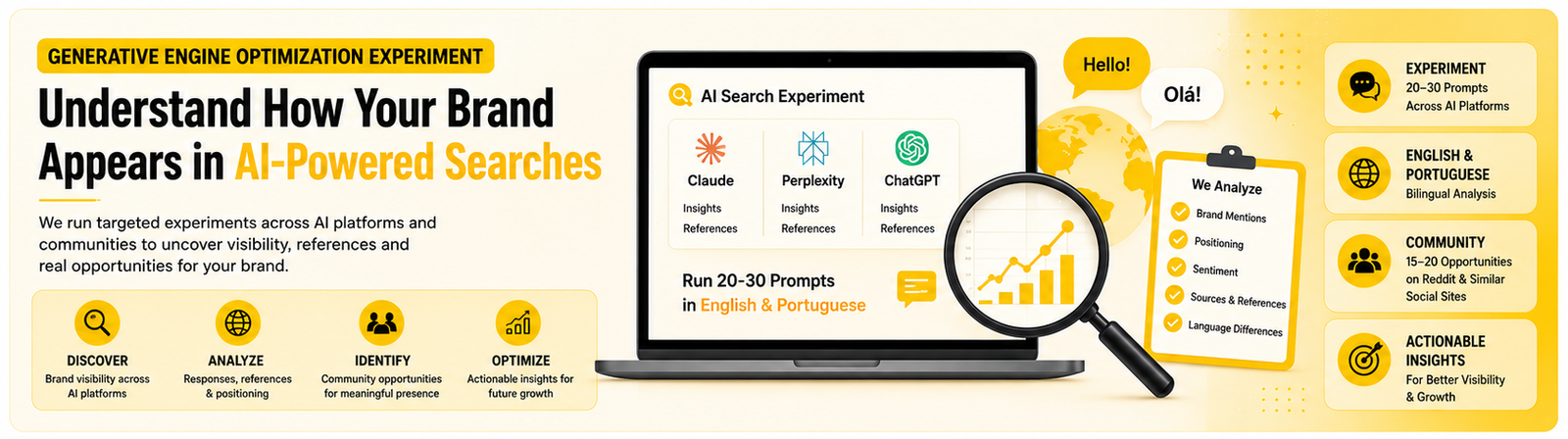
This case study explains how CnEL India can design and execute a structured Generative Engine Optimization (GEO) experiment to evaluate how a company’s brand and product appear across conversational discovery environments in both English and Portuguese markets.
The project focuses on analyzing brand visibility, identifying influence patterns, discovering conversational opportunities, and building a repeatable methodology for long-term optimization.
The objective is not manipulating conversations but understanding how modern discovery systems interpret, rank, and surface brand information.
The scope includes:
- Brand visibility experimentation
- Prompt-based discovery analysis
- Cross-language evaluation
- Conversational positioning research
- Community opportunity identification
- Reference source analysis
- Insight reporting
- Long-term optimization planning
CnEL India specializes in:
- Digital visibility strategy
- Search behavior analysis
- Brand intelligence
- Market experimentation
- Conversational discovery research
- Community engagement planning
- Growth-focused optimization
The result is a measurable framework for understanding and improving brand discoverability.
Understanding the Business Requirement
The company wants to understand how its brand appears when users search through conversational experiences.
The project has two major objectives:
Discovery Experiment
Evaluate how product and brand references appear across multiple conversational environments.
Community Opportunity Analysis
Identify meaningful opportunities where the brand could become part of relevant industry discussions.
This initiative helps the business understand current visibility and future growth potential.
Why Generative Discovery Matters
Digital discovery behavior is changing.
Users increasingly ask questions such as:
- Which provider should I choose?
- What product is best?
- What are the alternatives?
- What companies solve this problem?
When these questions generate recommendations automatically, visibility becomes more complex than traditional ranking.
CnEL India helps organizations understand these evolving patterns.
CnEL India’s GEO Research Framework
CnEL India approaches this project as a structured research and optimization initiative.
The execution model includes:
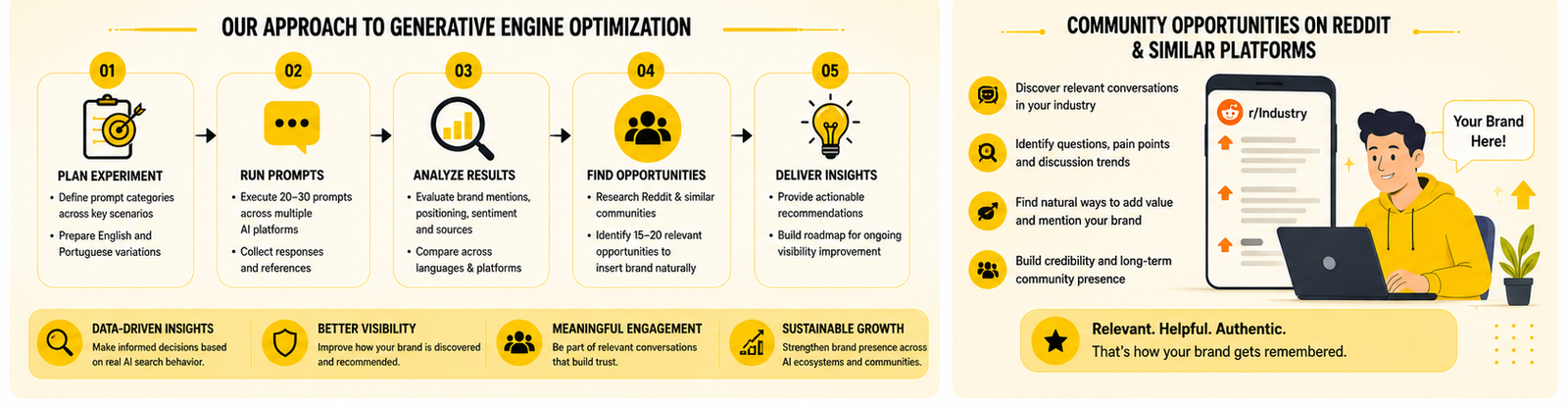
- Experiment planning
- Prompt framework creation
- Multilingual analysis
- Brand visibility measurement
- Community opportunity mapping
- Reporting and recommendations
The goal is generating insights rather than assumptions.
Phase One: Discovery Experiment Design
The first stage focuses on creating controlled experiments.
CnEL India defines:
- Prompt categories
- Testing methodology
- Comparison structure
- Language variations
- Data collection standards
This ensures results remain consistent and repeatable.
Building Prompt Scenarios
Prompt quality directly affects research quality.
CnEL India develops prompt categories including:
Direct Brand Discovery
Users searching for specific products.
Comparative Research
Users evaluating alternatives.
Educational Discovery
Users learning about industry topics.
Purchase Intent Queries
Users looking for solutions.
Recommendation Queries
Users requesting suggestions.
These categories simulate realistic customer behavior.
Multilingual Visibility Analysis
The project requires evaluation across:
- English
- Portuguese
Language significantly impacts visibility because:
- User behavior changes
- Search phrasing changes
- Cultural expectations differ
- Recommendation patterns vary
CnEL India evaluates how the same brand performs across languages.
Data Collection Methodology
Every discovery interaction is documented systematically.
CnEL India tracks:
- Prompt wording
- Response outputs
- Brand mentions
- Position of appearance
- Supporting references
- Language differences
Structured collection enables meaningful analysis.
Brand Appearance Analysis
Not all visibility creates value.
CnEL India evaluates:
- Mention frequency
- Recommendation quality
- Positioning context
- Sentiment indicators
- Competitive comparisons
The objective is understanding perception—not only presence.
Reference Source Investigation
Modern discovery systems often rely on multiple public signals.
CnEL India studies patterns related to:
- Information consistency
- Content sources
- Community references
- Authority indicators
Understanding references helps improve future visibility.
Cross-Platform Comparison
Different conversational environments often produce different outcomes.
CnEL India compares:
- Brand positioning
- Response structure
- Recommendation consistency
- Information depth
This creates a complete visibility picture.
Phase Two: Community Opportunity Research
The second stage focuses on identifying natural discussion opportunities.
CnEL India explores:
- Industry conversations
- Customer pain points
- Discussion themes
- Educational opportunities
The objective is meaningful participation.
Conversation Opportunity Identification
Community discovery requires relevance.
CnEL India identifies discussions where brands can contribute through:
- Helpful insights
- Educational value
- Problem solving
- Experience sharing
Opportunities are selected based on alignment.
Ethical Community Participation
Brand presence must remain authentic.
CnEL India prioritizes:
- Transparency
- Value-first communication
- Relevant engagement
- Community respect
The objective is building visibility through usefulness.
Industry Conversation Mapping
Community analysis focuses on identifying:
- Frequently discussed topics
- Emerging questions
- Audience frustrations
- Recommendation behavior
These insights help shape future visibility strategies.
Measuring Opportunity Potential
Each opportunity is evaluated using:
- Audience relevance
- Discussion quality
- Engagement potential
- Long-term value
Prioritization improves execution.
Brand Positioning Recommendations
After experimentation, CnEL India develops strategic recommendations including:
- Content improvements
- Visibility enhancements
- Messaging adjustments
- Community participation opportunities
The recommendations remain practical and scalable.
Insight Reporting Framework
Research outputs are organized into actionable reporting.
CnEL India delivers visibility insights covering:
- Discovery trends
- Brand appearance patterns
- Language comparisons
- Opportunity areas
- Growth recommendations
This converts experimentation into decision-making.
Scalability and Long-Term Growth
This project becomes the foundation for broader initiatives.
Future expansion may include:
- Ongoing discovery monitoring
- Additional language markets
- Brand authority development
- Community growth programs
- Performance benchmarking
Scalability enables long-term value.
Challenges Solved by CnEL India
Organizations entering conversational discovery often struggle with:
- Limited visibility understanding
- Inconsistent positioning
- Unknown recommendation patterns
- Language fragmentation
- Missed engagement opportunities
CnEL India addresses these challenges through structured experimentation.
Business Value Delivered by CnEL India
Through this engagement, CnEL India helps organizations achieve:
- Better understanding of digital visibility
- Improved brand positioning
- Stronger discovery opportunities
- Cross-language insight generation
- More informed growth decisions
The business gains actionable intelligence instead of assumptions.
Why CnEL India for GEO Research
CnEL India combines:
- Digital strategy capability
- Research execution expertise
- Brand intelligence methodology
- Multilingual analysis processes
- Community discovery understanding
The focus remains on building measurable visibility outcomes.
Long-Term Impact
Generative discovery is becoming a growing influence in how customers find and evaluate brands.
Organizations that understand visibility patterns early can improve:
- Brand awareness
- Customer trust
- Discovery efficiency
- Market positioning
This creates long-term competitive advantages.
Conclusion
This case study demonstrates how CnEL India can successfully execute a Generative Engine Optimization experiment by combining structured discovery testing, multilingual analysis, conversational visibility research, community opportunity identification, and strategic reporting.
Rather than relying on assumptions about brand presence, the project creates a measurable framework that reveals how brands appear, how users discover them, and where future growth opportunities exist.
By combining research discipline, visibility intelligence, language analysis, and strategic insight generation, CnEL India helps organizations adapt to the next evolution of digital discovery and build stronger brand presence across modern conversational environments.