
Project Overview
As businesses increasingly depend on digital technologies, the demand for artificial intelligence, automation, and cybersecurity solutions continues to grow. Organizations are looking for reliable technology partners who can help them improve operations, develop intelligent applications, protect digital infrastructure, and adapt to changing business requirements.
CnEL India explored a strategic partnership opportunity focused on developing an AI consultancy and cybersecurity agency. The objective was to bring together professionals with complementary technical expertise to build a service-oriented business capable of supporting organizations with their individual technology needs.
The proposed collaboration involved two major areas of specialization. The first focused on artificial intelligence, machine learning, software development, and the implementation of customized AI solutions. The second focused on cybersecurity, including defensive security, offensive security, and penetration testing.
Rather than operating as a conventional service provider offering predefined packages, the proposed agency would work closely with individual businesses to understand their challenges and recommend solutions based on their actual requirements.
The partnership was intended to be an active working relationship in which members would contribute their knowledge, participate in business development, and help shape the agency’s technical direction.
With the prospective partner based in the United Kingdom and the Netherlands, the opportunity also presented the possibility of building an internationally oriented service model with a diverse team.
Understanding the Business Opportunity
The first step in developing the proposed agency was understanding the growing need for integrated AI and cybersecurity services.
Businesses across different industries are adopting digital platforms, online services, automated workflows, and data-driven processes. Although these technologies create new opportunities, they also introduce challenges related to implementation, maintenance, security, and operational efficiency.
Some organizations want to introduce AI into their existing operations but do not know which processes should be automated or how to implement suitable solutions. Others need customized software, intelligent business applications, or machine learning-based systems to address specific operational requirements.
At the same time, organizations are becoming increasingly aware of cybersecurity risks. Unauthorized access, data exposure, insecure applications, and vulnerabilities in digital infrastructure can create serious operational and financial consequences.
These challenges create an opportunity for an agency that can provide both intelligent technology solutions and cybersecurity expertise.
The proposed business would focus on understanding each client’s requirements before recommending a suitable technical approach.
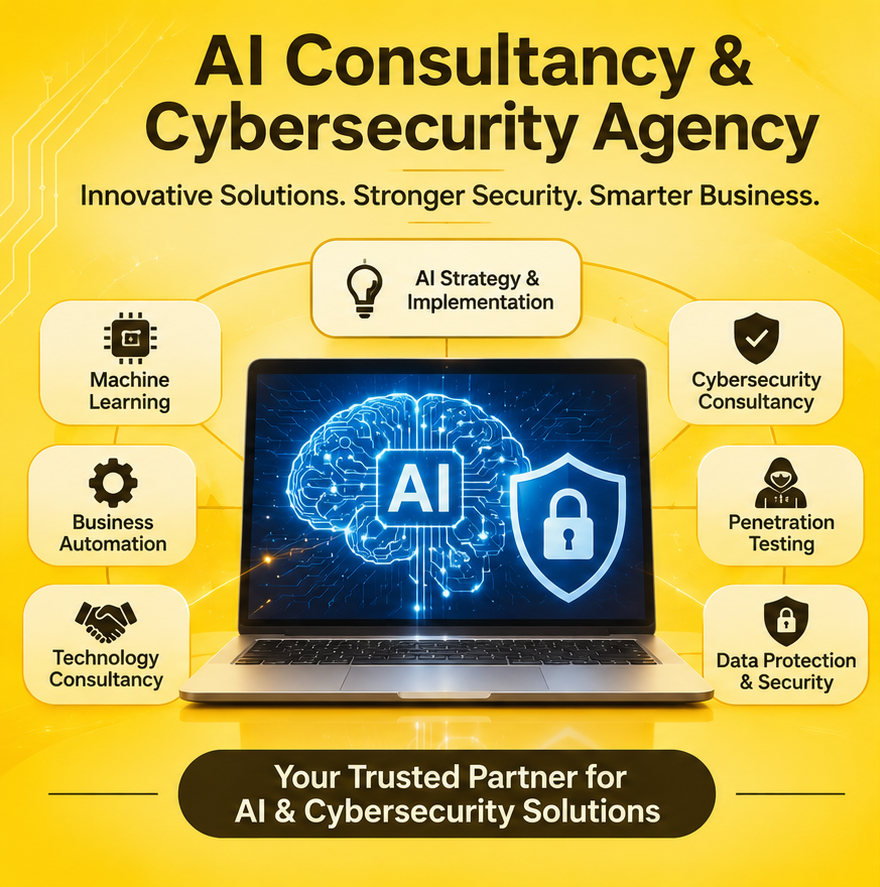
Its primary service areas would include:
- AI consultancy and business technology guidance.
- Artificial intelligence development and implementation.
- Machine learning-based solutions.
- Customized software and application development.
- Business process automation.
- Cybersecurity consultancy.
- Defensive security and infrastructure protection.
- Offensive security assessments.
- Penetration testing and vulnerability identification.
- Ongoing technical guidance and improvement.
Combining these services under one business would allow the agency to support organizations at different stages of their digital transformation.
AI Consultancy and Implementation Services
Artificial intelligence was identified as one of the primary service areas of the proposed agency.
Many businesses understand that AI can improve productivity, reduce repetitive work, and support better decision-making. However, they may lack the technical knowledge required to identify suitable applications and implement them successfully.
The agency would aim to bridge this gap by offering practical AI consultancy and development services.
Instead of recommending AI simply because it is a growing technology, the team would first examine the client’s business operations and identify areas where intelligent solutions could provide measurable value.
Potential areas of support could include:
Business Process Automation: Identifying repetitive activities that can be automated to reduce manual effort and improve operational efficiency.
Customized AI Applications: Developing intelligent applications according to individual business requirements rather than relying entirely on generic solutions.
AI Integration: Introducing AI capabilities into existing business systems and digital platforms where appropriate.
Intelligent Data Processing: Helping businesses organize, analyze, and interpret information more efficiently.
AI-Powered Customer Support: Developing solutions that assist with customer queries, routine communication, and information retrieval.
Workflow Optimization: Reviewing existing business processes and identifying opportunities to improve speed, consistency, and productivity.
For example, a business managing a large number of customer enquiries may benefit from an intelligent support system that helps organize incoming requests and provide relevant responses.
Similarly, a company performing repetitive administrative activities could benefit from customized automation that reduces the time employees spend on routine work.
The central objective would be to deliver solutions that address real business problems rather than introducing unnecessary technology.
Machine Learning and Customized Development
Machine learning would form another important part of the agency’s technical capabilities.
Different businesses have different requirements, and some challenges cannot be addressed effectively through basic automation or standard software applications.
Machine learning can help develop systems that identify patterns, process information, generate predictions, and support more informed decisions.
The proposed team would explore opportunities to develop customized machine learning applications based on project requirements.
Potential applications could include:
- Predictive analysis for business operations.
- Intelligent classification of business information.
- Pattern recognition and data analysis.
- Recommendation-based systems.
- Automated information processing.
- Intelligent customer behaviour analysis.
- Business-specific decision-support applications.
The development process would begin with understanding the business problem, reviewing available data, and identifying whether a machine learning approach was suitable.
The team would then consider the required application architecture, data requirements, implementation process, and expected outcomes.
This approach would help ensure that machine learning solutions remained connected to practical business objectives.
Cybersecurity Consultancy and Protection
The second major service area of the proposed agency was cybersecurity.
As businesses expand their digital presence, protecting their applications, systems, networks, and information becomes increasingly important.
Cybersecurity services would help organizations understand potential risks, identify weaknesses, and improve their overall security practices.
The opportunity specifically highlighted the need for professionals with experience in both Blue Team and Red Team security.
These two areas provide complementary perspectives on protecting digital environments.
Blue Team: Defensive Cybersecurity
Blue Team activities focus on identifying, monitoring, and responding to potential security threats.
The objective is to strengthen an organization’s ability to prevent unauthorized access, detect suspicious activity, and maintain the security of its digital infrastructure.
Potential service areas could include:
- Security monitoring and assessment.
- Identification of suspicious activities.
- Security configuration reviews.
- Incident response planning.
- Access control reviews.
- Network and system protection.
- Security awareness guidance.
- Recommendations for improving security practices.
Through defensive security support, the agency could help businesses understand their existing security posture and identify areas requiring improvement.
Red Team: Offensive Security Assessment
Red Team activities focus on evaluating security from the perspective of potential attackers.
Authorized security testing can help organizations understand how weaknesses in their applications, networks, or systems might be exploited.
The proposed agency would seek professionals with relevant experience in offensive security and penetration testing.
Potential services could include:
- Authorized penetration testing.
- Application security assessments.
- Network vulnerability assessments.
- Identification of configuration weaknesses.
- Security testing of digital platforms.
- Reporting of identified vulnerabilities.
- Recommendations for corrective actions.
All testing would be conducted with appropriate authorization and within an agreed scope.
The purpose would be to identify and address security weaknesses before they could be exploited by malicious actors.
Combining AI and Cybersecurity Expertise
One of the most valuable aspects of the proposed partnership was the opportunity to combine AI development with cybersecurity knowledge.
Although these areas involve different technical specializations, they can complement each other across several business applications.
For example, an organization implementing an AI-powered application may also need assistance with application security, data protection, access management, and secure system architecture.
Similarly, businesses introducing automation into their operations may need their existing infrastructure and information-handling processes reviewed to ensure that the new systems are implemented responsibly.
The proposed agency could address these requirements through coordinated technical services.
Potential combined offerings could include:
Secure AI Application Development: Building AI-powered applications while considering data protection, access permissions, and application security.
AI-Assisted Business Operations: Developing intelligent systems that improve workflows while maintaining appropriate information controls.
Application Security Reviews: Evaluating business applications and identifying potential weaknesses before deployment.
Technology Risk Assessment: Reviewing proposed digital solutions to identify technical and security considerations.
Ongoing Technical Consultancy: Supporting businesses as their technology requirements and security needs evolve.
This integrated approach could help the agency establish a broader service offering than businesses would receive from a provider focused on only one technical area.

Building a Collaborative Partnership Structure
The project was not limited to hiring individual professionals for separate assignments. The intention was to establish a strategic partnership in which members would actively participate in building and developing the agency.
This required clear responsibilities, communication, and coordination between the different areas of expertise.
The AI and development team would focus on understanding business requirements, designing technical solutions, developing applications, and implementing AI capabilities.
The cybersecurity team would contribute security knowledge, conduct authorized assessments, identify vulnerabilities, and recommend improvements.
Both sides would work together when a project required combined expertise.
A collaborative structure could include:
- Joint discussions about new business opportunities.
- Reviewing client requirements and project expectations.
- Identifying suitable technical approaches.
- Dividing responsibilities according to expertise.
- Coordinating project delivery.
- Reviewing quality and client feedback.
- Improving services based on business requirements.
- Participating in the agency’s long-term development.
This structure would encourage shared responsibility and help establish a business in which every partner contributes to its growth.
Client Acquisition and International Business Development
An important aspect of the opportunity was that the client base would be developed collaboratively.
The prospective partner was based in the United Kingdom and the Netherlands, creating an opportunity to explore international business relationships.
Rather than depending on an existing portfolio of clients, the partners would work together to identify potential businesses, understand their challenges, and introduce relevant services.
The agency could target organizations that require AI consultancy, customized development, cybersecurity support, or a combination of these services.
Potential target industries could include:
- E-commerce and online retail.
- Financial and professional services.
- Healthcare and wellness.
- Manufacturing and industrial businesses.
- Education and training.
- Technology startups.
- Digital service providers.
- Small and medium-sized enterprises.
The agency would need to communicate its services in a way that business owners and decision-makers could understand.
For example, instead of simply offering machine learning development, the team could explain how intelligent data processing might reduce manual work or improve business reporting.
Similarly, cybersecurity services could be presented through practical business benefits such as identifying application vulnerabilities, improving security practices, and reducing exposure to digital risks.
This consultative approach would help build trust and make the agency’s services more relevant to potential clients.
A Diverse and Inclusive Team
The opportunity also emphasized the importance of building a diverse and inclusive team, with particular interest in working with Palestinian professionals.
This reflected an intention to create a collaborative environment in which people with different backgrounds and experiences could contribute their technical knowledge.
For a technology consultancy, diversity can bring different perspectives to problem-solving, business communication, and service development.
A partnership based on shared professional goals, mutual respect, and clearly defined responsibilities could help create a stronger working environment.
The proposed agency would focus on evaluating individuals according to their technical capabilities, relevant experience, willingness to collaborate, and ability to contribute to the business.
This would be particularly important when bringing together AI developers, machine learning specialists, cybersecurity professionals, and business development contributors.
Project Planning and Service Development
Before launching the agency’s services, the partners would need to establish a clear development plan.
The first stage would involve reviewing the technical expertise available within the team and identifying which services could be delivered confidently.
The second stage would focus on defining service offerings, responsibilities, delivery processes, and the type of businesses the agency intended to serve.
The third stage would involve developing a portfolio of suitable capabilities, preparing service descriptions, and establishing a process for evaluating potential client requirements.
Once these foundations were established, the team could begin approaching potential clients and identifying suitable projects.
Each project would follow a structured process:
- Understand the client’s business and requirements.
- Identify the underlying technical or security challenge.
- Evaluate possible solutions.
- Define the project scope and responsibilities.
- Develop or implement the agreed solution.
- Conduct appropriate testing and reviews.
- Deliver the work and gather client feedback.
- Identify opportunities for further improvements.
This process would help the agency maintain consistency while supporting projects with different technical requirements.
Challenges and Important Considerations
Developing an AI consultancy and cybersecurity agency through a strategic partnership would involve several important considerations.
Complementary Expertise: The team would need sufficient technical knowledge across AI, machine learning, software development, and cybersecurity to deliver the proposed services effectively.
Changing Technology: AI and cybersecurity are continuously evolving fields. Team members would need to maintain current knowledge and regularly improve their skills.
Client Trust: Businesses may share confidential information about their operations, applications, and infrastructure. Professional confidentiality and responsible information handling would be essential.
Service Quality: The agency would need to establish realistic service commitments and ensure that projects were delivered according to agreed requirements.
Partnership Coordination: Working across different locations would require clear communication, defined responsibilities, and effective project coordination.
Cybersecurity Authorization: Security assessments and penetration testing would require explicit client permission, documented scope, and responsible reporting.
Client Acquisition: Since the client base would be developed together, the partners would need a consistent approach to identifying opportunities and building business relationships.
Long-Term Growth: The agency would need to expand its capabilities gradually while maintaining service quality and customer satisfaction.
Addressing these considerations would be important for building a sustainable and credible consultancy.
CnEL India’s Approach
CnEL India approaches technology projects with an emphasis on understanding business requirements and identifying practical solutions.
For an opportunity of this nature, the first priority would be to evaluate the proposed partnership structure, available technical expertise, and intended service offerings.
CnEL India’s software development and AI capabilities could contribute to the development and implementation side of the agency, including customized applications, AI integration, and business automation.
Cybersecurity services would require appropriately experienced specialists with demonstrable capabilities in defensive security, offensive security, and authorized penetration testing.
The team would need to establish clear areas of responsibility and ensure that every service offered was supported by suitable technical expertise.
The development of the agency would then focus on creating a coordinated service model that connects consultancy, implementation, security assessment, and ongoing technical support.
By combining practical development experience with specialized cybersecurity knowledge, the partnership could work toward delivering solutions that address the individual needs of businesses.
Expected Business Benefits
A successful implementation of this partnership model could create several opportunities.
Broader Technical Services: Combining AI, software development, and cybersecurity would allow the agency to address a wider range of business requirements.
Customized Business Solutions: A consultancy-led approach would help organizations receive solutions based on their actual challenges.
Improved Operational Efficiency: AI and automation services could help businesses reduce repetitive work and improve productivity.
Stronger Digital Security: Qualified cybersecurity professionals could help organizations identify vulnerabilities and improve their security practices.
International Opportunities: The UK and Netherlands connection could provide a foundation for exploring clients and partnerships across different markets.
Collaborative Growth: Shared participation in client acquisition, project delivery, and service development could support the agency’s long-term direction.
Flexible Service Model: The agency could gradually expand its offerings as new client requirements and technical capabilities emerge.
Conclusion
The AI consultancy and cybersecurity agency partnership represents an opportunity to build a technology-focused business around two important areas of modern digital transformation.
The proposed model brings together artificial intelligence, machine learning, customized development, defensive cybersecurity, offensive security, and penetration testing within a collaborative consultancy structure.
Its central objective is to understand individual business requirements and provide solutions that offer practical value rather than relying on generic service packages.
For CnEL India, this opportunity highlights the importance of combining AI and software development capabilities with specialized cybersecurity expertise through a strategic working partnership.
With clearly defined responsibilities, qualified professionals, collaborative business development, and a commitment to continuous learning, the proposed agency could establish a foundation for delivering customized technology and security services to businesses in international markets.