
Introduction
Modern businesses often have valuable information spread across multiple systems. Accounting records, invoices, customer information, field-service activities, payment records, and operational data may all exist in different places. While each system may work independently, the real business value comes from connecting this information and making it available in one reliable operating environment.
CnEL India works on exactly this type of challenge: connecting business systems, improving data reliability, and preparing operational information for intelligent analysis and automation.
This case study focuses on a mid-sized operations organization with approximately 50–100 employees that wanted to unify its accounting and operational information into a centralized AI-powered operating system.
The organization was already collecting information from its accounting and invoicing system, CompactQI, through a small on-site data agent. However, the existing data pipeline had reliability and freshness problems. The organization needed more than simply transferring data from one system to another. It needed a dependable pipeline that could continuously deliver accurate information, recognize changes in data structures, recover from failures, and provide trustworthy answers to business questions.
The project therefore involved three major challenges:
- Stabilizing the existing CompactQI data pipeline.
- Designing reliable relationships between different business records.
- Making sure the centralized AI system could produce correct answers from verified business data.
The objective was not merely to make the integration “work.” The objective was to make the information reliable enough for business decisions.
The Business Challenge
The company had already invested in building an AI-powered operating environment where business context could be analyzed centrally.
The missing piece was dependable accounting and operational data.
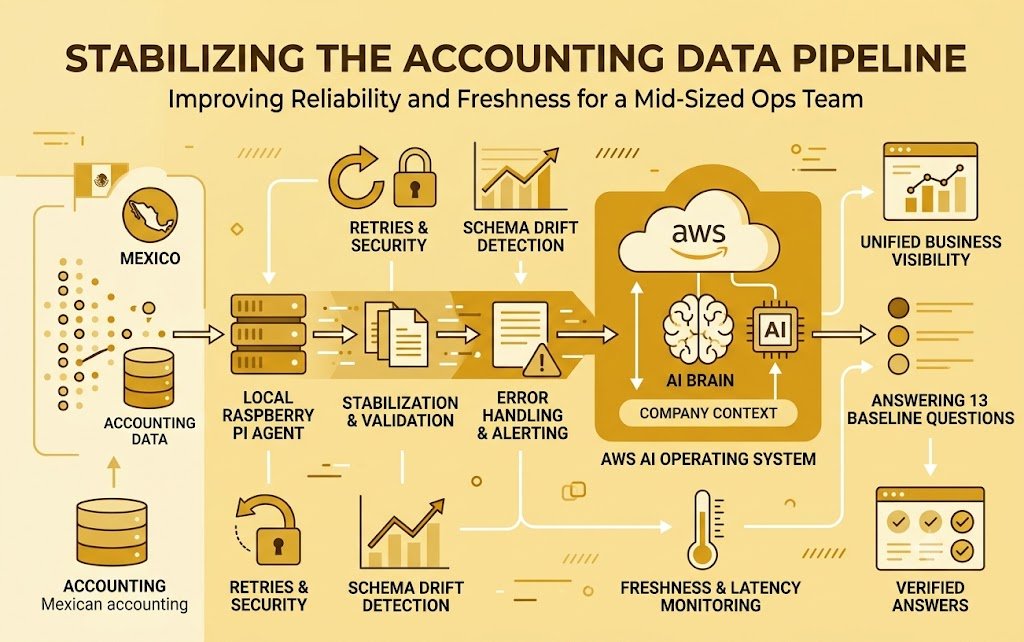
The existing setup used a Raspberry Pi-based agent to access CompactQI information and move relevant data toward the centralized environment. While the basic connection existed, several issues prevented the pipeline from being considered production-ready.
Data could become stale.
Connections could fail.
The structure of incoming information could change.
Errors were not always handled consistently.
Most importantly, different records did not yet have a sufficiently reliable relationship structure.
This created a serious business problem.
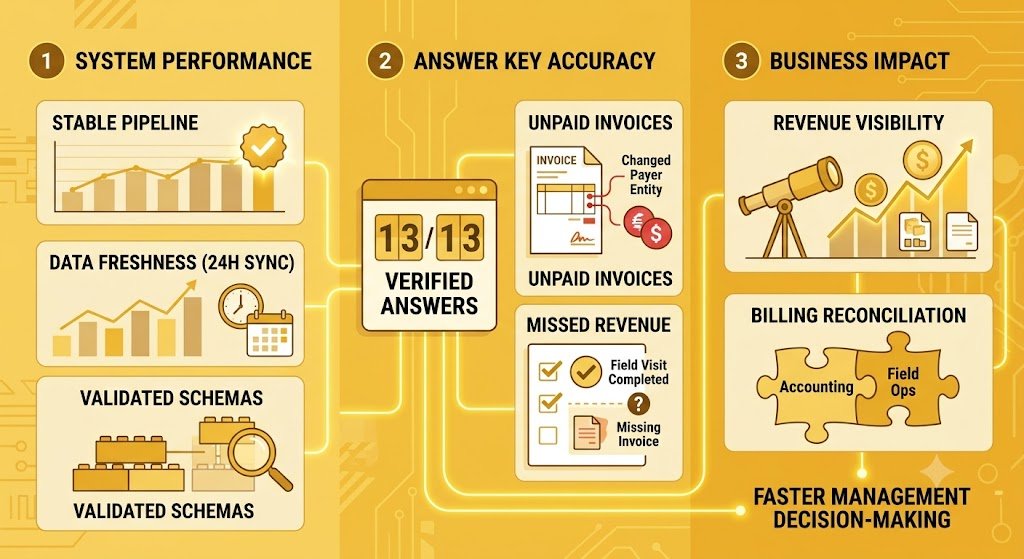
Suppose an invoice exists in the accounting system, but the payer associated with that invoice later changes. A simple lookup may incorrectly treat the old and new payer as completely different entities.
Similarly, a field visit could be completed and recorded by the operations team, but if that activity was not properly connected to the invoicing process, the company might never realize that revenue had been missed.
These are not merely technical issues. They directly affect revenue visibility, receivables, reconciliation, and management decisions.
The organization therefore needed an integration that could answer questions such as:
- How many invoices remain unpaid because the payer entity changed?
- Which completed field activities were never converted into invoices?
- How much potential revenue was missed?
- Are receivables being correctly associated with the current business entity?
- Is the accounting information current?
- Can management trust the answers generated from the centralized system?
This required a combination of integration engineering, data validation, relationship mapping, and production hardening.
Understanding the Existing Environment
CnEL India would begin by understanding the existing data flow rather than rebuilding everything from scratch.
The company already had several important components in place:
- A CompactQI environment containing accounting and invoicing information.
- A Raspberry Pi-based data collection agent.
- A centralized AI operating environment.
- A cloud-based infrastructure prepared to receive and process the information.
- Documented business requirements.
- A set of 13 verified business questions with known answers.
This existing foundation was valuable because the project was primarily about improving and completing the integration, not starting from zero.
The first stage would therefore involve reviewing how information currently moves from the accounting system through the local agent and into the centralized environment.
The objective would be to identify where information could become delayed, lost, duplicated, corrupted, or incorrectly associated.
Stabilizing the Data Pipeline
A reliable business data pipeline needs to assume that failures will happen.
Network connections can temporarily disappear.
A service can become unavailable.
A process can stop unexpectedly.
A record can arrive in an unexpected format.
An upstream system can change a field.
Instead of allowing these problems to silently break the data flow, the integration should be designed to detect and recover from them.
CnEL India would focus on strengthening the existing data collection process around several areas.
Connection Reliability
The local agent needs to maintain a dependable connection with the accounting environment.
If a connection fails temporarily, the system should not simply stop processing data.
A controlled retry mechanism can attempt the connection again after an appropriate delay. Repeated failures should be recorded so the team knows whether the issue is temporary or persistent.
This makes the system more resilient to normal infrastructure problems.
Error Handling
Every integration needs clear behavior for unexpected situations.
For example, if one record cannot be processed, the entire synchronization process should not necessarily fail.
The system should identify the problematic record, record the reason for failure, and continue processing where appropriate.
This prevents one bad record from blocking an entire batch of accounting information.
Data Validation
Incoming data should be checked before it becomes part of the centralized dataset.
Validation can include:
- Required fields being present.
- Correct data types.
- Valid dates.
- Valid monetary values.
- Expected identifiers.
- Duplicate detection.
- Unexpected or missing fields.
- Relationships between related records.
This creates a quality-control layer between the source system and the AI operating environment.
Solving the Data Freshness Problem
For an AI-powered business system, old data can be almost as dangerous as incorrect data.
If the centralized system believes that information is current when it is actually several days old, employees may make decisions based on outdated receivables, invoices, or operational activity.
The integration therefore needs a clear synchronization strategy.
Depending on the business requirements, information can be synchronized on a scheduled basis or through more frequent updates.
The important part is not simply running synchronization successfully. The system should also know when the last successful synchronization occurred.
For example, if the expected synchronization occurs every night and the process has not successfully completed for more than the acceptable threshold, the system should flag the data as potentially stale.
This provides management with visibility into the health of the information itself.
Instead of asking only:
“Is the system running?”
the organization can also ask:
“Can we trust that the information is current?”
That distinction is extremely important for business-critical AI systems.
Designing the Join Logic
One of the most important parts of this project is the relationship between different records.
Accounting and operational systems often use different identifiers.
A customer may have one identifier in one system and another identifier elsewhere.
A payer may change.
A company may be renamed.
An invoice may reference an older entity.
A field activity may be recorded independently from its eventual invoice.
Without a reliable relationship model, simply combining datasets can produce misleading results.
CnEL India’s role in this project would therefore include designing and validating the join logic.
The objective would be to determine which fields can reliably connect:
- Customers
- Payers
- Invoices
- Field visits
- Service activities
- Payments
- Operational records
The integration should prioritize stable business relationships rather than relying on a single field whenever that field can change.
Where necessary, historical relationships should also be preserved.
For example, if an invoice was originally associated with one payer and the payer entity later changed, the system should retain enough historical information to understand the relationship rather than simply replacing the old value.
This becomes particularly important for receivables analysis.
Building a Verified Answer System
A major strength of the project is that success can be measured against real business answers.
The company already has 13 pre-seeded questions with verified answers.
These questions are based on actual business interviews and operational requirements.
That means the integration can be tested against known outcomes.
Instead of saying:
“The pipeline appears to be working.”
the team can ask:
“Does the system produce the correct business answer?”
This changes the definition of success.
For example, if the verified answer indicates that a specific number of invoices remain unpaid because the payer entity changed, the integrated system must produce that same result.
If the verified answer indicates that certain field work was completed but never invoiced, the system should identify the relevant records and calculate the expected revenue gap correctly.
This testing approach provides a much stronger validation method than simply checking whether data successfully moved between systems.
Connecting the Data to the Central AI System
Once the accounting information has been stabilized and validated, it can be made available to the centralized AI operating environment.
The purpose is not to replace the underlying accounting records.
Instead, the centralized system becomes a way to understand information across different parts of the organization.
For example, management could ask a business question in natural language and receive an answer based on connected accounting and operational information.
This becomes especially powerful when multiple datasets need to be considered together.
A question about missed revenue may require comparing field activities with invoices.
A question about unpaid receivables may require examining invoices, payer relationships, and payment information.
A question about business performance may require combining operational and financial information.
The integration therefore becomes the foundation that allows intelligent analysis to operate on trustworthy business data.
Monitoring and Alerting
Production systems should not depend on someone manually checking whether data is flowing.
The integration should provide clear indicators of system health.
Important conditions to monitor include:
- Last successful synchronization.
- Number of records processed.
- Number of records rejected.
- Connection failures.
- Validation failures.
- Unexpected data changes.
- Missing required fields.
- Duplicate records.
- Processing delays.
- Data freshness.
If the data has not been updated within the expected time window, an alert should be generated.
If the structure of incoming data changes unexpectedly, the team should be notified before incorrect information spreads through the centralized system.
This approach changes monitoring from reactive troubleshooting to proactive data-quality management.
Handling Schema Changes
Business systems evolve.
A field can be renamed.
A new field can be added.
A field type can change.
A previously available value may become optional.
If the integration assumes that the data structure will never change, even a small upstream modification can cause failures.
The solution is to introduce schema validation and drift detection.
The integration can compare incoming structures against the expected structure and identify unexpected changes.
This allows the team to distinguish between:
- Normal data changes.
- Expected additions.
- Missing fields.
- Unexpected structural changes.
- Potential breaking changes.
The objective is not to prevent change.
It is to make change visible and manageable.
Production Hardening
After development and validation, the integration needs to be prepared for ongoing use.
Production hardening involves making sure the system can operate reliably without continuous manual intervention.
This includes:
- Reliable startup and recovery.
- Controlled retries.
- Safe handling of failed records.
- Duplicate prevention.
- Clear logs.
- Data validation.
- Synchronization monitoring.
- Failure alerts.
- Recovery procedures.
- Secure data movement.
- Repeatable deployment processes.
The result should be an integration that can continue operating even when individual components experience temporary problems.
Measuring Project Success
The project should ultimately be judged by measurable outcomes rather than technical activity.
Success can be evaluated using several indicators.
Data Reliability
CompactQI information reaches the centralized environment consistently without unexplained gaps.
Data Freshness
The organization can determine whether the available information is current and receive an alert when synchronization becomes stale.
Data Accuracy
Incoming records pass validation and unexpected data changes are detected.
Join Accuracy
Accounting and operational records are connected using reliable business relationships.
Answer-Key Performance
All 13 verified business questions produce the expected answers.
Operational Visibility
Management can identify unpaid work, unbilled activities, payer changes, and potential revenue gaps.
Production Readiness
The integration can recover from expected failures without requiring constant manual intervention.
Business Impact
The ultimate value of this project is not the data pipeline itself.
It is the business visibility created by reliable data.
A company may complete work every day but still lose revenue if that work is not correctly connected to billing.
Invoices may remain unpaid because business entities changed and the relationship was not preserved.
Management may see receivables totals without understanding why specific amounts remain outstanding.
An AI-powered operating system can help identify these situations, but only if the underlying information is accurate, complete, and current.
By stabilizing the accounting data flow and connecting it with operational information, the organization gains a stronger foundation for:
- Revenue-gap analysis.
- Billing reconciliation.
- Receivables monitoring.
- Unbilled-work detection.
- Payer and customer relationship tracking.
- Operational reporting.
- AI-powered business questions.
- Faster management decision-making.
CnEL India’s Approach
CnEL India approaches projects like this by focusing on the complete business workflow rather than treating integration as a simple data-transfer task.
The process begins with understanding the existing environment and business requirements.
From there, the focus moves toward:
1. Understand the data
Identify what information exists, where it originates, and how different records relate to each other.
2. Stabilize the pipeline
Improve connection handling, retries, validation, error recovery, and synchronization reliability.
3. Establish relationship logic
Determine how accounting and operational records should be connected and how historical changes should be handled.
4. Validate against real answers
Use verified business questions to confirm that the integrated data produces the expected outcomes.
5. Add monitoring
Track synchronization health, data freshness, failures, and structural changes.
6. Prepare for production
Make the complete workflow reliable enough for continuous business use.
This approach ensures that the project is measured by what the business can actually achieve with the data—not simply by whether the integration technically runs.
Conclusion
Connecting an accounting system to an AI-powered operating environment is much more than moving records from one location to another.
The real challenge is ensuring that information remains accurate, connected, current, and trustworthy throughout the entire process.
For this mid-sized operations organization, the objective is to transform an existing but unreliable accounting data connection into a dependable foundation for intelligent business operations.
By strengthening the local data collection process, improving synchronization reliability, validating incoming information, designing dependable relationships between business records, monitoring data freshness, and testing against verified business questions, CnEL India can help create a much stronger operational data foundation.
The result is an environment where management can move beyond basic reporting and begin asking meaningful business questions about unpaid invoices, missed revenue, billing gaps, receivables, and operational performance.
Most importantly, the system can distinguish between data that merely exists and data that can actually be trusted.
That is the foundation required for any AI-powered business operating system.
For CnEL India, this type of project demonstrates how integration engineering, data reliability, automation, and intelligent analysis can work together to solve practical business problems and turn disconnected operational information into actionable business intelligence.