
Case Study by CnEL India
Introduction
Modern businesses operate in an environment where speed, consistency, and customer experience directly influence growth. As organizations scale, manual processes often become barriers that reduce efficiency, increase operational costs, create delays, and limit the ability to serve customers effectively.
Tasks such as managing leads, scheduling follow-ups, maintaining customer records, tracking communication history, assigning responsibilities, generating updates, and nurturing prospects can quickly become overwhelming when handled manually.
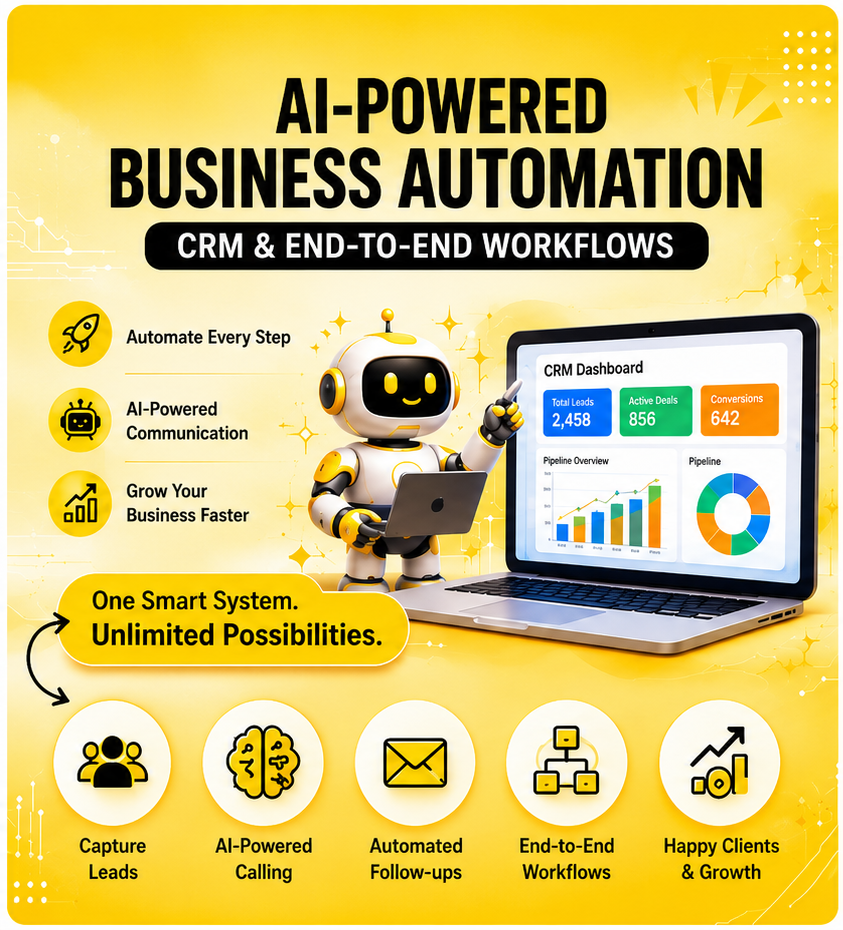
This case study explains how CnEL India can design and implement a complete AI-powered business automation ecosystem that combines customer relationship management, intelligent communication workflows, automated lead handling, and end-to-end operational pipelines.
The objective of this project is not simply introducing isolated automation. Instead, the goal is creating a connected business environment where systems communicate automatically and support daily operations with minimal manual effort.
The requested solution includes:
- Centralized customer relationship management
- Intelligent lead management
- Automated customer communication
- AI-powered calling workflows
- Automated follow-up sequences
- End-to-end business pipelines
- Scalable operational infrastructure
- Performance monitoring and optimization
CnEL India specializes in:
- Business workflow automation
- Intelligent CRM architecture
- Customer lifecycle automation
- AI-driven operations
- Process optimization
- Digital transformation solutions
- Scalable business infrastructure
The result is a business system that operates faster, more efficiently, and with greater consistency.
Understanding the Business Requirement
The company requires a unified operational system capable of automating core business activities.
Current challenges typically include:
- Manual lead tracking
- Delayed responses
- Missed opportunities
- Fragmented communication
- Inconsistent follow-ups
- Operational inefficiencies
The desired outcome is a fully connected environment where business processes run automatically while employees focus on strategic work.
The automation platform must support:
Lead capture
Collecting and organizing incoming opportunities.
Communication automation
Handling customer engagement automatically.
Workflow orchestration
Moving prospects across business stages.
Relationship management
Maintaining customer interactions.
Intelligent decision support
Prioritizing actions based on data.
CnEL India’s Automation-First Approach
CnEL India approaches automation as business architecture rather than workflow scripting.
The implementation process includes:
- Process discovery
- Business mapping
- Automation design
- System integration
- AI enablement
- Performance optimization
- Continuous improvement
Every automation decision is aligned with measurable business outcomes.
Business Process Discovery
Before automation begins, CnEL India evaluates current operations.
This stage identifies:
- Existing workflows
- Manual bottlenecks
- Customer interaction points
- Team responsibilities
- Process inefficiencies
The objective is understanding how work currently happens before introducing intelligent automation.
Designing a Centralized CRM Environment
Customer information often becomes fragmented across departments.
CnEL India designs centralized environments that consolidate:
- Customer profiles
- Lead history
- Interaction records
- Opportunity stages
- Communication logs
Centralization improves visibility and decision-making.
Intelligent Lead Management System
Lead management forms the foundation of growth.
CnEL India builds systems that automatically:
- Capture new leads
- Assign priority levels
- Categorize opportunities
- Trigger next actions
- Maintain engagement history
Automation reduces response delays and improves conversion opportunities.
Automated Lead Qualification
Not every lead requires the same level of attention.
CnEL India introduces intelligent qualification processes capable of evaluating:
- Customer intent
- Engagement signals
- Business fit
- Opportunity potential
Qualified prospects move automatically into the appropriate workflow.
AI-Powered Customer Communication
Customer communication becomes significantly more effective through intelligent automation.
CnEL India enables systems that support:
- Immediate responses
- Context-aware interactions
- Personalized messaging
- Scheduled engagement
- Consistent communication quality
Customers receive faster and more structured experiences.
Intelligent Calling Workflows
Calling remains one of the most effective engagement channels.
CnEL India creates automated calling processes that support:
- Outbound engagement
- Follow-up scheduling
- Contact prioritization
- Conversation tracking
- Workflow progression
The objective is increasing communication efficiency while reducing manual effort.
End-to-End Workflow Automation
Businesses often rely on disconnected activities.
CnEL India transforms operations into connected pipelines.
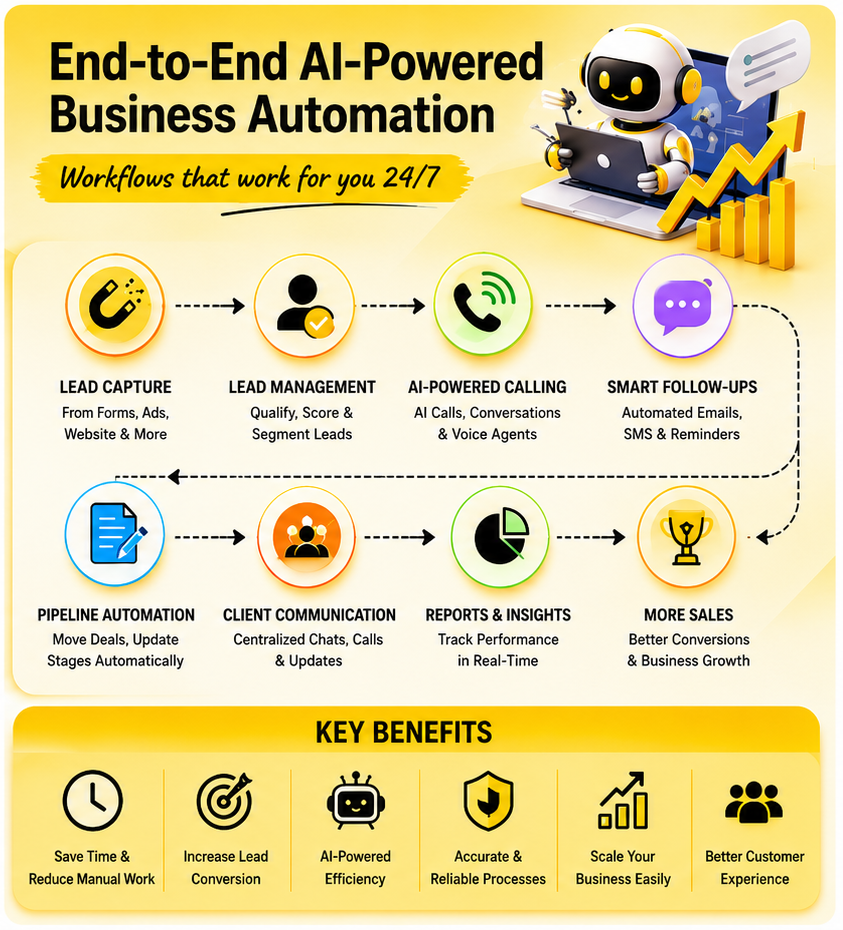
A typical automated journey includes:
Lead enters system → Qualification → Communication → Follow-up → Conversion → Customer management
This creates continuous operational flow.
Automated Follow-Up Management
One of the most common business problems is inconsistent follow-up.
CnEL India develops systems capable of:
- Scheduling interactions
- Triggering reminders
- Managing communication timing
- Escalating inactive opportunities
This improves engagement and reduces lost opportunities.
Workflow Decision Intelligence
Business operations involve hundreds of decisions daily.
CnEL India introduces intelligent workflow behavior capable of:
- Routing customers
- Triggering actions
- Assigning priorities
- Automating responses
Decision automation improves consistency.
Customer Lifecycle Management
The solution extends beyond lead generation.
CnEL India supports automation across:
- Acquisition
- Onboarding
- Engagement
- Retention
- Relationship growth
This creates long-term customer value.
Operational Visibility and Reporting
Automation systems must remain measurable.
CnEL India designs visibility layers that provide insights into:
- Pipeline activity
- Conversion performance
- Communication outcomes
- Operational efficiency
Visibility supports better business decisions.
Cross-System Integration Strategy
Business environments usually involve multiple operational systems.
CnEL India ensures smooth connectivity between:
- Customer management environments
- Communication channels
- Internal workflows
- Reporting systems
Integrated operations reduce duplication.
Scalability and Growth Planning
Automation should support future expansion.
CnEL India creates architectures capable of handling:
- Larger customer volumes
- Additional business processes
- Expanded communication channels
- Increased operational complexity
Scalable systems reduce future redevelopment.
Process Standardization
Businesses often experience inconsistency between teams.
CnEL India introduces structured processes that improve:
- Operational alignment
- Execution quality
- Communication consistency
- Customer experience
Standardization strengthens growth.
Reliability and Business Continuity
Automation systems become mission-critical.
CnEL India prioritizes:
- Stability
- Error prevention
- Process continuity
- Operational resilience
Reliable systems reduce business interruptions.
Security and Access Control
Operational platforms often manage sensitive information.
CnEL India incorporates:
- Permission structures
- Controlled access
- Secure workflows
- Protected business operations
Security supports long-term scalability.
Continuous Optimization Framework
Business requirements evolve over time.
CnEL India establishes improvement processes through:
- Workflow analysis
- Performance monitoring
- Automation refinement
- Process enhancements
Continuous optimization ensures sustained value.
Future Expansion Opportunities
Once the automation foundation is complete, businesses can expand into:
- Predictive business intelligence
- Customer personalization
- Intelligent recommendations
- Workflow forecasting
- Advanced operational automation
The architecture remains ready for growth.
Challenges Solved by CnEL India
Organizations commonly struggle with:
- Manual operations
- Delayed responses
- Disconnected customer data
- Poor follow-up consistency
- Process inefficiencies
CnEL India addresses these challenges through intelligent automation architecture.
Business Value Delivered by CnEL India
Through this engagement, CnEL India helps organizations achieve:
- Reduced manual workload
- Faster response times
- Improved customer experience
- Higher operational efficiency
- Better lead conversion
- Scalable business growth
The business becomes more efficient without increasing operational complexity.
Why CnEL India for Business Automation
CnEL India combines:
- Business process expertise
- Automation architecture capability
- CRM strategy knowledge
- AI implementation experience
- Workflow optimization skills
- Scalable operational thinking
The company focuses on building connected business environments that deliver measurable outcomes.
Conclusion
This case study demonstrates how CnEL India can successfully design and implement an AI-powered business automation ecosystem that transforms fragmented operations into connected, scalable, and intelligent workflows.
Rather than automating isolated tasks, the solution creates an end-to-end operational environment where customer relationships, communication processes, lead management, follow-ups, and business activities work together seamlessly.
By combining intelligent automation, centralized customer management, scalable architecture, communication optimization, and continuous improvement strategies, CnEL India helps organizations build the foundation for efficient and sustainable business growth.