
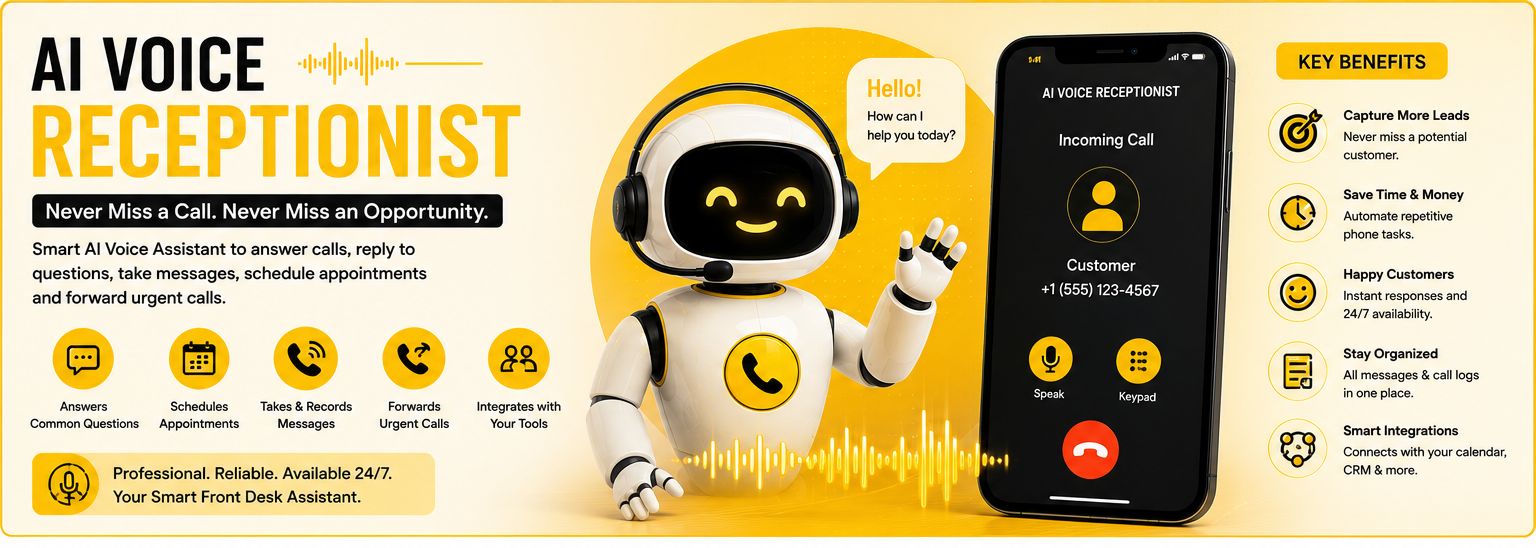
Case Study by CnEL India
Introduction
Customer communication is one of the most important aspects of running a successful business. Whether a company provides professional services, healthcare, retail, hospitality, real estate, consulting, or home services, customers expect quick responses whenever they call. Unfortunately, many small businesses struggle to answer every call because of limited staff, busy schedules, after-hours inquiries, or multiple responsibilities handled by the business owner.
Missed calls often result in missed business opportunities. Customers who cannot reach a business immediately may contact a competitor instead. Even when calls are answered, employees may spend valuable time responding to repetitive questions, taking messages manually, checking appointment availability, or forwarding calls to the right department.
CnEL India helps businesses solve these challenges by developing intelligent voice receptionist solutions that automate routine call handling while ensuring customers receive professional, friendly, and accurate assistance. These systems can answer common questions, collect caller information, route urgent requests, schedule appointments, and forward important messages to the appropriate team members.
This case study explains how CnEL India approaches the development of an AI-powered voice receptionist for small businesses, focusing on reliability, customer experience, workflow automation, and operational efficiency.
Business Background
Small businesses often rely on a handful of employees to manage sales, customer service, appointments, administration, and day-to-day operations. Incoming phone calls may interrupt ongoing work, and staff may not always be available to answer every inquiry immediately.
Some of the most common communication challenges include:
- Missed customer calls during business hours
- No response after business hours
- Repetitive questions consuming staff time
- Manual message taking
- Appointment scheduling conflicts
- Difficulty identifying urgent callers
- Slow callback processes
- Poor customer experience during busy periods
- Lack of centralized call records
- Human errors while recording customer information
As businesses grow, these problems become more noticeable. Hiring full-time reception staff may not always be financially practical, especially for startups and small organizations.
An intelligent voice receptionist provides an effective solution by handling routine conversations automatically while ensuring important conversations are transferred to the appropriate person when necessary.
Project Objectives
The primary objective of this project is to create a reliable automated voice receptionist that improves customer communication while reducing manual work for business owners and employees.
The project aims to:
- Answer incoming customer calls professionally
- Respond to frequently asked questions
- Collect caller information
- Record detailed customer messages
- Identify urgent requests
- Forward important calls to staff
- Support appointment scheduling
- Synchronize customer information with internal business systems
- Reduce missed business opportunities
- Improve customer satisfaction
- Operate consistently throughout business hours
- Support future scalability
Rather than replacing human employees, the solution is designed to support them by handling repetitive communication tasks efficiently.
Understanding Business Requirements
Every business has different communication needs.
CnEL India begins by understanding:
- Business type
- Customer demographics
- Working hours
- Frequently asked questions
- Appointment process
- Team structure
- Emergency situations
- Existing communication workflows
- Internal notification methods
- Customer expectations
For example, a healthcare clinic receives appointment requests and patient inquiries.
A plumbing service receives emergency service requests.
A law office receives consultation inquiries.
A salon receives appointment bookings.
A real estate agency receives property inquiries.
Each business requires a unique conversation flow.
Understanding these requirements ensures the receptionist reflects the company’s communication style.
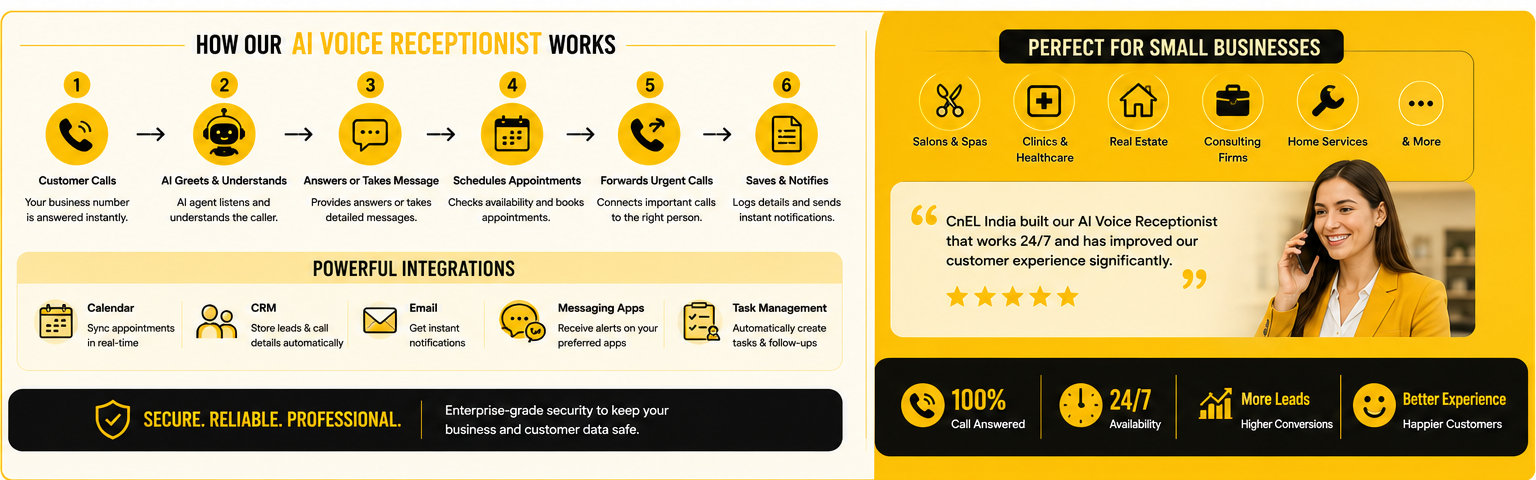
Designing the Voice Reception Workflow
The first stage is designing a structured conversation that feels natural and helpful.
The receptionist should greet callers professionally while identifying the purpose of the call.
Typical conversation stages include:
Greeting
The system welcomes the customer using a friendly introduction.
Example:
“Thank you for calling. How may I help you today?”
The greeting establishes professionalism and reassures callers they have reached the correct business.
Intent Identification
The receptionist identifies why the customer is calling.
Common intents include:
- General inquiry
- Product information
- Service request
- Appointment booking
- Appointment cancellation
- Appointment rescheduling
- Technical support
- Billing inquiry
- Existing customer follow-up
- Emergency assistance
- Leave a message
- Speak with staff
Correct identification allows the system to continue the appropriate workflow.
Frequently Asked Questions
Many businesses receive the same questions repeatedly.
Examples include:
- Business hours
- Office location
- Pricing information
- Available services
- Appointment availability
- Payment methods
- Delivery information
- Service areas
- Contact information
Automatically answering these questions significantly reduces staff workload.
Message Collection
If staff are unavailable, the receptionist collects important information.
Information may include:
- Customer name
- Phone number
- Email address
- Reason for calling
- Preferred callback time
- Additional notes
The collected information is organized clearly for employees.
Urgent Call Detection
Not every call should be handled automatically.
Certain situations require immediate human assistance.
Examples include:
- Emergency service requests
- VIP customers
- Existing client issues
- Time-sensitive requests
- Escalated complaints
- Payment disputes
The receptionist recognizes these situations and forwards the call appropriately.
Appointment Assistance
Businesses offering appointments benefit significantly from automated scheduling support.
The receptionist can assist customers by:
- Checking available time slots
- Booking appointments
- Confirming bookings
- Rescheduling appointments
- Cancelling appointments
- Sending confirmations
- Updating schedules
This minimizes manual scheduling work.
Integration with Business Workflows
An intelligent receptionist should become part of existing business operations rather than functioning as an isolated system.
CnEL India integrates voice communication with internal workflows so customer information reaches the right people quickly.
Possible workflow integrations include:
- Calendar synchronization
- Customer record updates
- Lead management
- Internal notifications
- Team messaging
- Email alerts
- Customer history
- Follow-up reminders
- Service requests
- Task creation
This ensures employees receive accurate customer information without manual duplication.
Customer Information Management
Every customer interaction generates valuable information.
Rather than losing handwritten notes or scattered emails, the system organizes customer conversations into structured records.
Typical information includes:
- Caller identity
- Contact details
- Call time
- Conversation summary
- Requested service
- Appointment information
- Priority level
- Follow-up status
- Assigned employee
- Resolution status
Well-organized records improve customer service and future communication.
Intelligent Call Routing
Not every employee should receive every call.
CnEL India designs routing rules based on business requirements.
Examples include:
Sales inquiries go to the sales team.
Technical questions go to support.
Appointment requests go to reception.
Billing questions go to finance.
Urgent emergencies go directly to management.
Existing customer calls may be prioritized over general inquiries.
This improves operational efficiency while reducing unnecessary interruptions.
Human Oversight
Automation should support people rather than replace them.
Certain conversations always require human judgment.
Examples include:
- Complex customer complaints
- Negotiations
- Legal matters
- Medical emergencies
- Sensitive financial discussions
- Escalated disputes
The system transfers these conversations to qualified staff members whenever necessary.
This creates a balanced workflow between automation and human expertise.
Voice Experience Design
Customer experience depends heavily on communication quality.
CnEL India focuses on creating voice interactions that sound:
- Professional
- Friendly
- Natural
- Clear
- Patient
- Polite
- Helpful
- Easy to understand
The conversation avoids sounding robotic by using carefully designed dialogue structures.
Callers should feel they are receiving genuine assistance rather than navigating a confusing phone menu.
Reliability and Business Continuity
Reliability is essential for customer communication.
The receptionist should operate consistently throughout business hours while minimizing downtime.
CnEL India focuses on:
- Stable call handling
- Consistent response quality
- Reliable information retrieval
- Error recovery
- Call logging
- Message preservation
- Workflow monitoring
- Backup communication paths
This ensures businesses continue receiving customer inquiries even during busy periods.
Security and Privacy
Customer conversations often contain personal information.
CnEL India designs solutions with responsible data handling practices.
Key considerations include:
- Secure customer information
- Controlled employee access
- Protected communication records
- Appropriate data retention
- Privacy-conscious workflows
- Business compliance requirements
Protecting customer trust remains a priority throughout the project.
Testing Before Deployment
Before launch, the receptionist undergoes extensive testing.
Testing includes:
Greeting Tests
Ensuring every customer receives a professional introduction.
Intent Recognition Tests
Verifying the system correctly understands customer requests.
Appointment Tests
Confirming scheduling workflows operate correctly.
Message Recording Tests
Ensuring customer information is captured accurately.
Call Transfer Tests
Checking urgent calls reach employees successfully.
Error Handling Tests
Testing unusual customer responses.
Workflow Validation
Confirming information flows correctly through business systems.
Performance Testing
Evaluating reliability under multiple incoming calls.
This testing minimizes problems after deployment.
Staff Training
Employees should understand how the receptionist supports daily operations.
Training covers:
- Reviewing customer messages
- Managing forwarded calls
- Updating business information
- Monitoring appointment requests
- Handling escalations
- Reviewing customer records
- Improving conversation flows
Well-trained employees maximize the value of the system.
Ongoing Optimization
Customer behaviour changes over time.
Businesses introduce new services, pricing, promotions, and policies.
CnEL India provides continuous optimization by reviewing:
- Frequently asked questions
- Missed customer intents
- Conversation quality
- Call completion rates
- Appointment success
- Customer feedback
- Workflow efficiency
- Business performance
Continuous improvement keeps the receptionist aligned with evolving business needs.
Business Benefits
An intelligent voice receptionist delivers measurable improvements.
Expected benefits include:
- Higher call answer rates
- Reduced missed business opportunities
- Faster customer assistance
- Lower administrative workload
- Better appointment management
- Improved customer satisfaction
- More organized customer records
- Faster response times
- Better staff productivity
- Consistent customer communication
- Improved lead capture
- Better operational efficiency
These improvements allow employees to focus on higher-value work while maintaining excellent customer service.
Challenges Solved
CnEL India helps businesses overcome common communication problems.
Missed Calls
Customers receive immediate responses instead of voicemail.
Manual Message Taking
Information is captured automatically and accurately.
Repetitive Questions
Frequently asked questions are answered without staff intervention.
Appointment Conflicts
Scheduling becomes more organized and efficient.
Slow Internal Communication
Important information reaches the correct employee quickly.
Limited Staff Availability
Businesses maintain professional communication even during busy periods.
Customer Frustration
Callers receive faster and more consistent assistance.
Why CnEL India
CnEL India combines business understanding, workflow analysis, conversational design, automation expertise, quality assurance, and customer-focused implementation.
The team believes that voice automation should simplify operations rather than complicate them.
Every solution is designed around the specific needs of the business, ensuring communication remains professional, reliable, and easy to manage.
By integrating intelligent call handling with existing workflows, CnEL India helps businesses reduce manual effort, improve responsiveness, and create better customer experiences.
Conclusion
This case study demonstrates how CnEL India develops intelligent voice receptionist solutions that help small businesses manage customer communication more efficiently.
By automating routine phone interactions, organizing customer information, supporting appointment scheduling, identifying urgent requests, and integrating communication into existing business workflows, CnEL India enables businesses to deliver faster, more consistent, and more professional customer service.
The result is a scalable communication solution that enhances operational efficiency, improves customer satisfaction, reduces missed opportunities, and supports long-term business growth without increasing administrative burden.