
Case Study by CnEL India
Introduction
Modern aesthetic clinics and beauty centers operate in a highly competitive environment where fast response times, personalized communication, appointment efficiency, and patient satisfaction directly influence revenue and reputation. Potential patients often contact clinics through messaging channels, social media, website forms, or phone calls. If a clinic responds slowly, misses a message, fails to follow up, or makes appointment booking difficult, the potential patient may choose another provider.
For many clinics, the patient journey still depends heavily on manual work. Team members spend hours replying to repeated questions, checking availability, confirming bookings, sending reminders, managing cancellations, following up after treatments, requesting reviews, and trying to reconnect with inactive patients. This manual process can be inconsistent, time-consuming, and difficult to scale as the clinic grows.
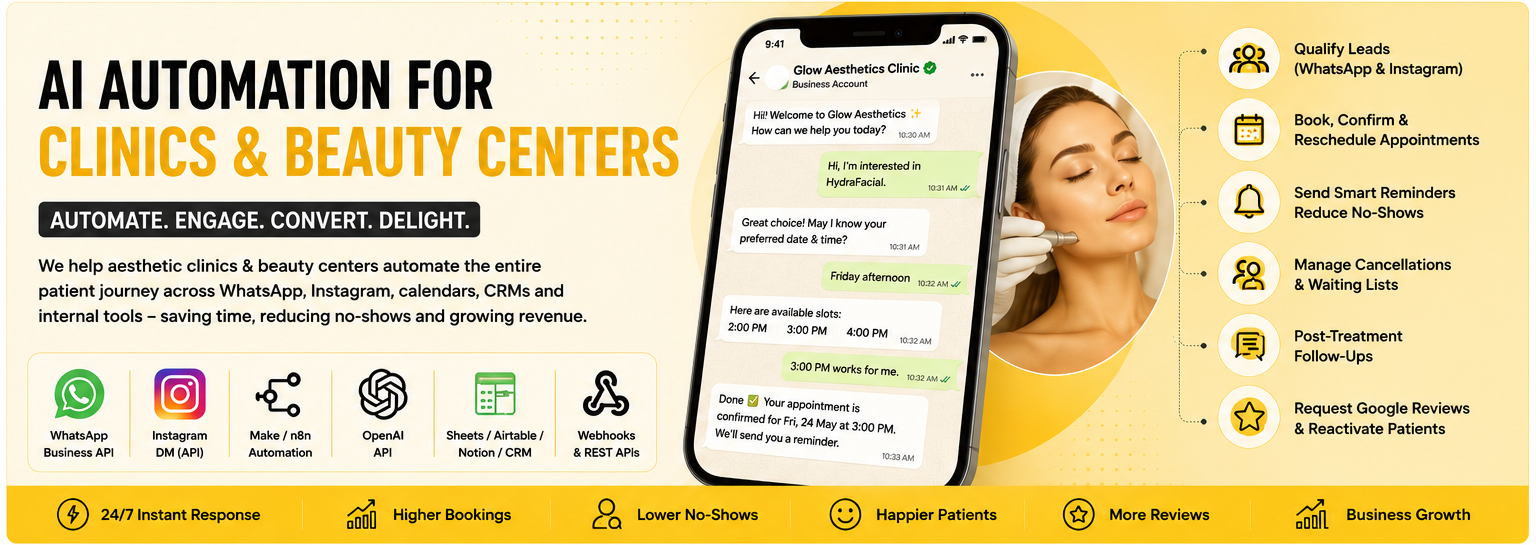
This case study explains how CnEL India can support an AI automation agency serving aesthetic clinics and beauty centers by designing, implementing, and maintaining intelligent patient journey workflows. The objective is to connect patient communication, appointment scheduling, customer records, internal operations, and follow-up processes into one coordinated automation system.
The goal is not to replace the human team. Instead, the system helps clinics respond faster, reduce repetitive work, improve appointment attendance, create better patient experiences, and ensure that no valuable lead or follow-up opportunity is missed.
Business Background
Aesthetic clinics and beauty centers receive inquiries throughout the day from people interested in treatments, consultations, pricing, availability, results, recovery periods, and booking options. These inquiries may come from social media messages, business messaging channels, advertising campaigns, website forms, referral links, or existing patient records.
The clinic team must then decide whether the person is a suitable lead, answer questions, guide them toward the right service, collect booking information, check calendar availability, send confirmation messages, and follow up if the person does not complete the booking.
As patient volume grows, this process becomes increasingly difficult to manage manually.
Common operational challenges include delayed replies, missed leads, inconsistent information, double booking risks, forgotten reminders, no-shows, cancelled appointment gaps, incomplete patient records, weak post-treatment engagement, and low review collection rates.
CnEL India approaches this challenge by creating connected workflows that support the full patient journey from the first inquiry to long-term retention.
Project Objectives
The primary objective is to build a reliable automation ecosystem that helps clinics manage patient communication and operational tasks more efficiently.
The system is designed to support:
- Faster lead response times
- Automated lead qualification
- Appointment booking support
- Confirmation and rescheduling workflows
- Reminder messages to reduce no-shows
- Cancellation management
- Waiting list activation
- Post-treatment follow-ups
- Review request campaigns
- Patient reactivation workflows
- Centralized operational visibility
- Clear workflow documentation
- Long-term maintenance and improvement
Every workflow is designed around the clinic’s real operations, service offerings, staff availability, patient expectations, and communication standards.
Understanding the Patient Journey
The patient journey does not begin when a person enters the clinic. It begins when they first see a social media post, advertisement, recommendation, or online profile.
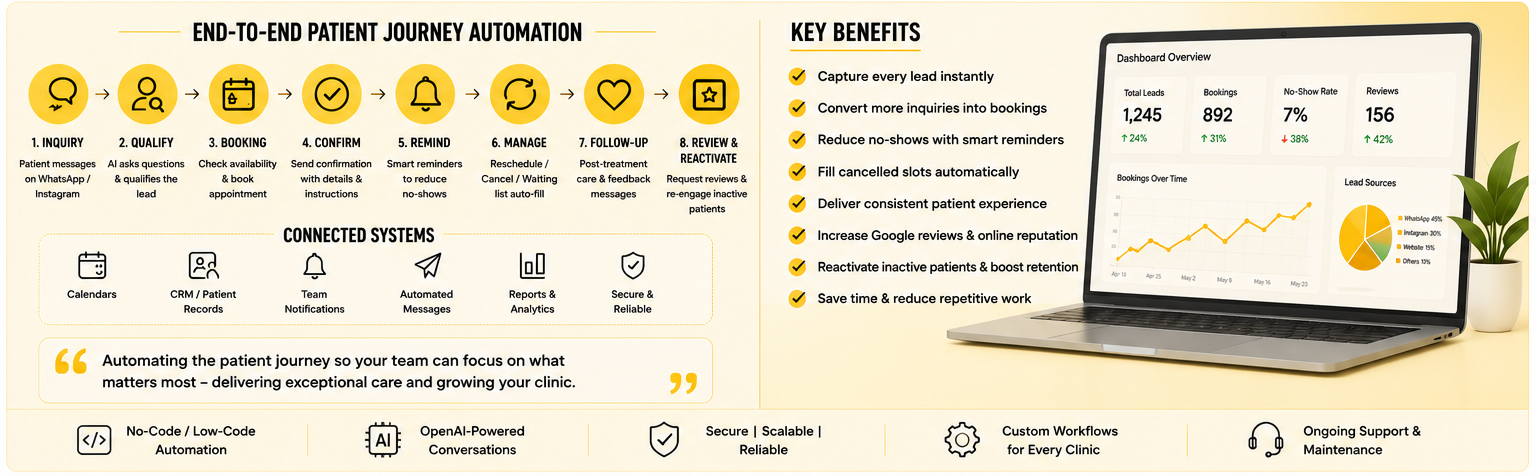
A typical journey may include the following stages:
- A potential patient discovers the clinic.
- The patient sends an inquiry.
- The clinic gathers information about the patient’s needs.
- The patient receives service-related guidance.
- The patient chooses a consultation or treatment.
- An appointment is scheduled.
- The patient receives confirmation and reminders.
- The patient attends the appointment.
- The clinic sends follow-up communication.
- The patient may leave a review, book another service, or become inactive.
- The clinic reconnects with the patient at the right time.
CnEL India designs automation around this full lifecycle rather than treating each message as an isolated task.
Lead Capture and Instant Response
The first response to a new inquiry is extremely important. A potential patient may contact several clinics at the same time, and the clinic that responds clearly and quickly often has a stronger chance of securing the booking.
CnEL India creates lead capture workflows that identify incoming messages and immediately begin an appropriate conversation.
The automated response can welcome the patient, acknowledge the inquiry, ask a few qualifying questions, provide basic guidance, and offer the next best action.
For example, the system may ask about the service category, preferred appointment time, treatment goals, location preference, or whether the patient is a new or returning visitor.
The response should feel professional, helpful, and natural. It should not feel robotic or repetitive.
If the inquiry requires medical advice, sensitive discussion, pricing approval, or a complex response, the system can transfer the conversation to a trained clinic team member.
Lead Qualification Workflow
Not every inquiry should follow the same path. Some people are ready to book immediately, while others are gathering information, comparing options, or simply asking a general question.
CnEL India develops lead qualification workflows that collect the right information without making the process feel complicated.
The workflow can identify:
- Service interest
- New or returning patient status
- Preferred location
- Preferred date and time
- Budget range where appropriate
- Urgency level
- Consultation requirement
- Suitability for a specific treatment path
This information helps the clinic prioritize leads and provide more relevant follow-up.
A high-intent lead can be guided directly toward booking, while a lead that needs more information can receive educational content or a staff follow-up request.
Appointment Booking Automation
Appointment booking is one of the most valuable parts of the system. Manual booking can lead to delays, misunderstandings, missed availability, and inconsistent records.
CnEL India creates workflows that connect patient conversations with the clinic’s scheduling environment.
The system can help patients view available appointment options, select a suitable time, confirm details, and receive booking confirmation automatically.
The workflow can also collect essential information before the appointment, such as the patient’s name, contact details, preferred practitioner, treatment interest, and any required preliminary notes.
Once an appointment is confirmed, the system updates the relevant patient record and notifies the internal team where necessary.
This creates a smoother experience for both patients and staff.
Appointment Confirmation and Reminder System
No-shows can create significant revenue loss for clinics. An unused appointment slot affects staff time, treatment room availability, and daily revenue.
CnEL India designs confirmation and reminder workflows that keep patients informed before their appointment.
The system can send a confirmation message immediately after booking, followed by reminders at carefully planned intervals.
These reminders may include:
- Appointment date and time
- Clinic location
- Preparation instructions
- Rescheduling options
- Contact information
- Important treatment guidance
The patient can confirm attendance, request a new time, or ask for assistance directly through the message flow.
This reduces uncertainty and makes it easier for patients to manage their appointments responsibly.
Rescheduling and Cancellation Management
Cancellations are unavoidable in any appointment-based business. The problem occurs when cancellations are not handled quickly enough.
CnEL India develops workflows that recognize cancellation requests and guide patients through available rescheduling options.
If a patient cancels, the system can update the appointment status, notify the relevant team members, and open the slot for other patients.
The system can also invite the patient to choose another suitable time, reducing the chance that the patient disappears from the booking pipeline.
This process improves operational efficiency and helps preserve revenue opportunities.
Waiting List Automation
Many clinics have patients who want earlier appointments but cannot find suitable availability. At the same time, cancelled appointments may remain unfilled because staff members do not have time to contact every waiting patient manually.
CnEL India creates waiting list workflows that connect cancelled slots with interested patients.
When an appointment becomes available, the system can identify suitable waiting patients based on service type, practitioner preference, location, and availability.
The selected patients receive a message inviting them to claim the available slot.
The first confirmed response can secure the appointment, while the system updates records automatically.
This helps clinics fill cancelled slots faster and maximize daily capacity.
Centralized Patient Records
A strong automation system requires organized data. Patient information should not be scattered across multiple message threads, spreadsheets, calendars, and internal notes.
CnEL India helps create a centralized record structure where important patient information can be stored and updated.
The record may include:
- Name and contact details
- Inquiry source
- Treatment interest
- Appointment history
- Booking status
- Follow-up status
- Communication history
- Review status
- Reactivation eligibility
- Internal notes
A centralized view allows the clinic team to understand the patient journey quickly and provide more personalized service.
Post-Treatment Follow-Up
The patient relationship should continue after treatment. Post-treatment communication helps clinics improve satisfaction, identify concerns early, and encourage repeat bookings.
CnEL India designs follow-up workflows that send messages after specific services or consultations.
The follow-up can ask whether the patient is feeling well, provide aftercare instructions, share helpful information, or invite the patient to contact the clinic if they have questions.
For more sensitive cases, the workflow can alert a staff member when a patient indicates discomfort, dissatisfaction, or a need for urgent support.
This combination of automation and human escalation creates a safer and more responsive patient experience.
Review Request Workflow
Online reviews are extremely important for aesthetic clinics and beauty centers. Positive reviews improve trust, support local visibility, and influence future patient decisions.
However, staff members often forget to request reviews consistently.
CnEL India builds review request workflows that send a polite message after a successful appointment or treatment period.
The message can thank the patient, invite them to share their experience, and provide a simple path to leave feedback.
The timing and wording can be adjusted based on the clinic’s brand voice and service type.
Patients who report a negative experience can be directed toward internal support before receiving a public review request. This gives the clinic an opportunity to resolve concerns professionally.
Patient Reactivation Campaigns
Many clinics have a large number of inactive patients who have not booked again for months or years. These patients may still be interested in new services, seasonal offers, maintenance treatments, or follow-up consultations.
CnEL India creates reactivation workflows that identify inactive patient segments and send relevant, respectful communication.
The message may include a personalized check-in, a reminder about a recommended follow-up period, a new treatment announcement, or a limited appointment opportunity.
Reactivation campaigns should be carefully planned to avoid excessive messaging. The focus should remain on relevance, value, and patient consent.
Internal Team Notifications
Automation should support the clinic team, not create confusion.
CnEL India builds internal notification workflows that alert staff when human action is needed.
Examples include:
- A high-value lead requests urgent support
- A patient asks a complex treatment question
- A booking requires manual approval
- A cancellation creates an urgent availability gap
- A patient reports a concern after treatment
- A payment or record issue needs attention
This ensures that the right person receives the right information at the right time.
Workflow Documentation
Clear documentation is essential for long-term success. A clinic or agency should not depend on one person’s memory to understand how the automation works.
CnEL India documents each workflow in a clear and organized format.
Documentation can include:
- Workflow purpose
- Trigger conditions
- Input data
- Decision points
- Message templates
- Internal notifications
- Error handling steps
- Maintenance guidance
- Future improvement opportunities
This makes the system easier to manage, troubleshoot, and expand.
Privacy and Responsible Communication
Patient communication requires careful handling. Clinics must protect personal information and maintain professional standards.
CnEL India designs workflows with attention to privacy, consent, data access, and secure communication practices.
Sensitive medical details should not be handled casually through automated messages. The system should identify situations where human staff involvement is necessary.
The goal is to automate routine operations while ensuring that patient trust and confidentiality remain protected.
Quality Assurance and Testing
Before any workflow is launched, CnEL India performs structured testing.
Testing includes:
- New lead message flow
- Qualification questions
- Appointment booking process
- Confirmation delivery
- Reminder timing
- Rescheduling logic
- Cancellation handling
- Waiting list activation
- Follow-up messaging
- Review requests
- Internal notifications
- Error scenarios
The system is tested with realistic situations to ensure that patients and staff receive the correct messages at the correct time.
Long-Term Maintenance and Optimization
Automation systems are not static. Clinic services, schedules, staff members, messaging rules, and patient expectations can change over time.
CnEL India supports ongoing improvement through regular workflow review, performance analysis, message refinement, issue resolution, and expansion planning.
Over time, the system can become more effective by identifying which messages lead to bookings, which reminders reduce no-shows, and which reactivation campaigns generate the strongest response.
Project Delivery Framework
CnEL India follows a structured delivery approach.
Phase 1 – Discovery and Workflow Mapping
Understand clinic operations, services, patient communication channels, booking rules, and internal processes.
Phase 2 – System Planning
Define the patient journey, data structure, communication flows, escalation rules, and automation priorities.
Phase 3 – Workflow Development
Build lead qualification, booking, reminder, cancellation, follow-up, review, and reactivation workflows.
Phase 4 – Testing and Refinement
Test every scenario and improve the system based on real operational feedback.
Phase 5 – Launch and Training
Deploy the workflows and guide the internal team on how to monitor and manage the system.
Phase 6 – Ongoing Support
Maintain, optimize, and expand workflows as new client needs arise.
Challenges Solved by CnEL India
This project solves several common clinic management challenges:
- Slow response to new inquiries
- Missed patient leads
- Manual appointment coordination
- High no-show rates
- Unfilled cancelled slots
- Inconsistent follow-up communication
- Limited review collection
- Poor patient reactivation
- Fragmented records
- Lack of workflow documentation
The result is a more organized, responsive, and scalable patient communication system.
Business Outcomes Delivered
A well-designed automation system can help clinics achieve:
- Faster lead engagement
- More appointment bookings
- Lower no-show rates
- Better staff productivity
- Improved patient experience
- Higher review generation
- Better use of cancelled appointment slots
- Stronger patient retention
- More consistent communication
- Greater operational visibility
These improvements support both patient satisfaction and business growth.
Why CnEL India
CnEL India combines expertise in workflow planning, customer journey design, business process automation, communication systems, data organization, and long-term operational support.
The approach focuses on building practical systems that clinics can use every day. Each workflow is designed to be clear, reliable, scalable, and aligned with the clinic’s brand voice and patient care standards.
Conclusion
This case study demonstrates how CnEL India can help an AI automation agency build and maintain complete patient journey systems for aesthetic clinics and beauty centers.
By connecting lead qualification, appointment booking, reminders, cancellations, waiting lists, follow-ups, review requests, patient reactivation, and internal notifications, the system reduces manual workload while improving patient communication and operational efficiency.
The final result is not simply an automated message system. It is a structured patient engagement ecosystem that helps clinics respond faster, manage appointments better, improve retention, and deliver a more professional experience at every stage of the patient journey.