
Introduction
Artificial intelligence is changing how e-commerce businesses plan, create, manage, and publish digital content. Brands are increasingly looking for ways to maintain a consistent online presence, produce engaging social media posts, and manage multiple content formats without increasing their workload.
However, producing content consistently is not simply about generating captions or images. Businesses need structured content production systems that can understand their brand identity, maintain a recognizable voice, create content for different platforms, and follow appropriate quality and compliance standards.
CnEL India recognizes the growing importance of organized AI-powered content production for modern e-commerce businesses. This case study explores a requirement from a U.S.-focused training program designed for research peptide e-commerce brands. The objective was to develop an educational AI content production module that teaches practical workflows, reusable prompts, content creation processes, and quality control methods.
The proposed training would be delivered through recorded lessons demonstrating complete content production workflows. Rather than focusing only on finished content, the program would explain how the systems are designed, how individual processes connect, and how businesses can use them to produce content more efficiently.
Understanding the Project Requirement
The client was developing a specialized training program for U.S. research peptide e-commerce brands. They wanted an experienced AI content professional to record the content production module of a larger content engine.
The requirement was different from a conventional content writing or social media management assignment. The selected professional would need to demonstrate practical experience building and operating AI-assisted content systems for e-commerce businesses.
The client would manage video editing, production, and course uploading. The primary responsibility of the content expert would be to record educational lessons and share the prompts, processes, and systems used to create different types of content.
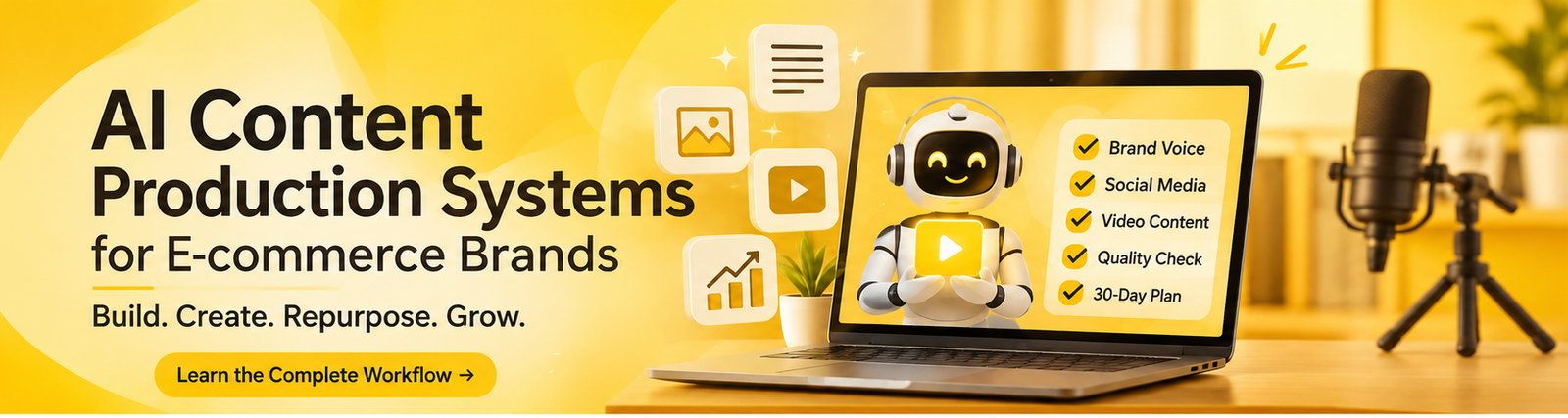
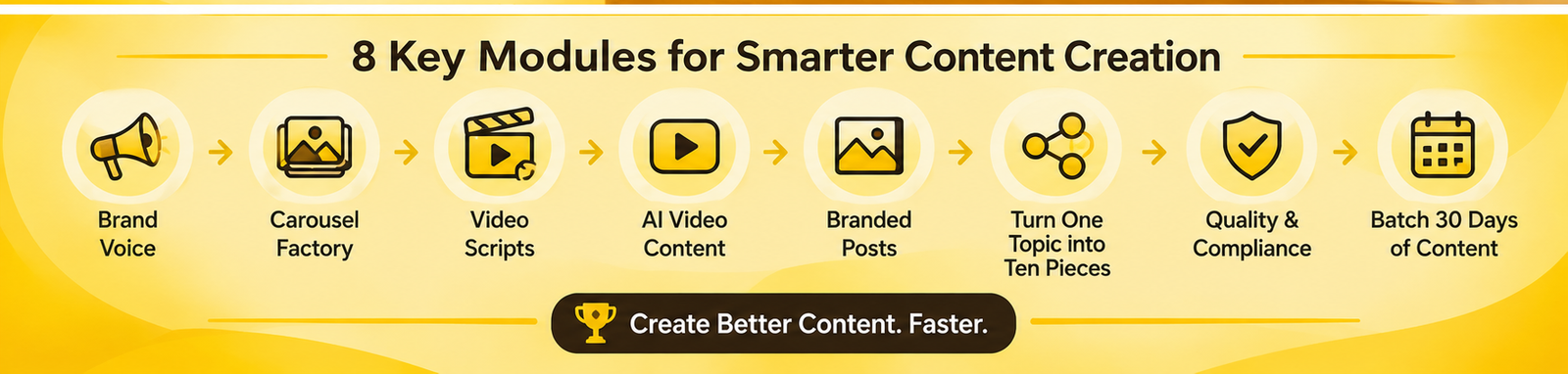
The training program needed to cover eight major areas:
- Building a consistent brand voice with AI.
- Creating a repeatable social media carousel production system.
- Developing talking-head video scripts.
- Producing AI-assisted video content.
- Creating branded static social media posts.
- Converting one topic into multiple content formats.
- Establishing content quality assurance and compliance guidelines.
- Planning and batching 30 days of content in one session.
The client also emphasized the importance of practical experience, real published examples, and awareness of restricted industries, particularly health, supplements, and peptide-related businesses.
This made the project a combination of AI content development, e-commerce marketing knowledge, instructional design, and responsible content communication.
1. Building a Consistent Brand Voice With AI
A recognizable brand voice helps businesses communicate consistently across websites, social media platforms, advertisements, emails, and other marketing channels.
Without clear guidelines, content produced by different people or through different processes can sound inconsistent. One post may appear professional, another overly promotional, and another completely disconnected from the brand’s personality.
The first module would explain how to establish a reusable brand voice framework.
Understanding Brand Identity
The process begins with understanding the business and its audience.
Important elements include:
- Brand personality and communication style.
- Target audience and customer expectations.
- Preferred language and vocabulary.
- Formal or conversational communication.
- Content themes and messaging priorities.
- Words, expressions, and claims to avoid.
These details can be organized into a structured brand voice document.
Creating Reusable Brand Instructions
Once the brand identity is understood, reusable instructions can be developed to guide future content creation.
These instructions should explain how headlines, captions, educational posts, and promotional messages should sound.
The training would demonstrate how to provide clear context and examples so that generated content remains aligned with the established identity.
Maintaining Consistency
A brand voice framework should not be treated as a one-time document. It should be reviewed and improved as the business develops.
The objective is to create a repeatable process that helps different content formats maintain a recognizable tone without requiring the entire brand identity to be explained every time.
2. Building a Social Media Carousel Production System
Carousel posts are useful for presenting information in multiple connected slides. They allow businesses to explain a topic step by step, share educational information, answer common questions, and organize complex subjects into smaller sections.
However, producing individual carousel posts manually can consume significant time.
The proposed training would introduce a repeatable carousel production system.
From Topic Selection to Slide Structure
The first step is selecting a relevant content topic.
The topic can then be divided into a logical sequence of slides:
- An attention-grabbing opening slide.
- An introduction to the subject.
- Important information or key points.
- Supporting explanations.
- Practical takeaways.
- A closing message or suitable call to action.
Each slide should communicate one main idea rather than overwhelming the reader with too much information.
Maintaining Visual Consistency
The carousel should follow the brand’s established visual identity.
This includes consistent typography, colors, spacing, heading styles, and image direction.
The training would explain how content and visual guidelines can be combined to make the carousel production process more predictable.
Creating a Repeatable Workflow
Instead of starting every carousel from scratch, businesses can establish reusable structures for different content categories.
For example, educational carousels, frequently asked questions, product information, and brand awareness posts can each follow suitable content patterns.
This creates a more organized production process and makes it easier to prepare multiple posts in batches.
3. Developing Talking-Head Video Scripts
Talking-head videos are an important part of modern digital marketing. They allow brands to communicate directly with audiences through presenters, founders, educators, or spokespersons.
However, effective video content requires more than a basic paragraph. The script must sound natural when spoken and maintain the viewer’s attention.
The training module would explain how AI can support the development of structured video scripts.
Creating an Effective Script Structure
A useful talking-head script generally contains:
Opening Hook: The first few seconds should introduce an interesting question, problem, or subject that encourages viewers to continue watching.
Main Explanation: The central section communicates the information in a simple and organized manner.
Supporting Details: Relevant examples and explanations make the message easier to understand.
Closing Message: The video concludes with an appropriate takeaway or call to action.
Making Scripts Sound Natural
Written content often sounds different when spoken aloud.
Therefore, scripts should use conversational language, manageable sentence lengths, and natural transitions.
The training would demonstrate how to refine generated scripts to reduce repetitive wording and unnecessary complexity.
It would also explain how to adapt scripts for different video lengths and social media formats.
4. Creating AI-Assisted Video Content
Video production can involve several activities, including concept development, script preparation, visual planning, narration, editing, and final review.
AI-assisted workflows can help businesses organize these activities and produce video content more efficiently.
The proposed module would explain how to move from a content idea to a complete video concept.
Video Concept Development
The process begins with identifying the purpose of the video.
Possible content formats include:
- Educational videos.
- Brand introduction videos.
- Product information videos.
- Short promotional content.
- Frequently asked question videos.
- Social media storytelling.
The format should be selected according to the audience, platform, and communication objective.
Visual Planning
Once the script is ready, the next step is planning the visual presentation.
This may include presenter scenes, supporting images, background visuals, text overlays, and transitions.
A structured visual plan helps maintain consistency between the spoken message and the content shown on screen.
Reviewing the Final Content
Generated video material should be reviewed for accuracy, clarity, visual consistency, and appropriate messaging.
For research peptide businesses, particular care is necessary to ensure that video content does not make unsupported health, treatment, safety, or performance claims.
5. Creating Branded Static Social Media Posts
Static social media posts remain an important part of e-commerce marketing. They are useful for sharing announcements, educational information, brand messages, promotional updates, and frequently asked questions.
The challenge is producing these posts regularly while maintaining a consistent visual identity.
The training would introduce a structured process for creating branded static content.
Establishing Visual Guidelines
Before creating posts, businesses should define their visual standards.
These may include:
- Brand color palette.
- Typography and heading hierarchy.
- Image selection guidelines.
- Logo placement.
- Layout and spacing.
- Text density.
- Consistent design elements.
Matching Content With Visuals
The written message and visual design should support one another.
A post containing a detailed educational message may require a different layout from a simple promotional announcement.
The content process should therefore consider both the message and its intended presentation.
Building Reusable Templates
Reusable content structures can reduce repetitive design work.
Different templates can be created for announcements, educational posts, quotations, product information, and other recurring content categories.
This allows businesses to maintain a recognizable appearance across their social media channels.
6. Turning One Topic Into Ten Pieces of Content
One of the most valuable parts of an AI content production system is content repurposing.
E-commerce businesses frequently have useful information that can be presented in several formats. Instead of developing every post independently, a single topic can become the foundation for multiple content pieces.
For example, one educational subject could be developed into:
- A detailed educational article.
- A social media carousel.
- A short talking-head script.
- A static information post.
- A short-form video concept.
- A frequently asked question post.
- An email newsletter.
- A short social media caption.
- A customer education message.
- A discussion or engagement post.
The objective is not to repeat identical information ten times. Each format should present the topic from a different angle while maintaining consistent facts and brand messaging.
Developing a Content Repurposing Framework
The process begins by identifying the central topic and its main supporting ideas.
These ideas can then be grouped according to audience interests, communication objectives, and platform requirements.
The training would explain how to create a content map that connects the original topic to its different formats.
Maintaining Consistency Across Formats
Repurposing should not introduce contradictory information or change the meaning of the original message.
Each adapted version should be reviewed to ensure that it remains accurate, relevant, and appropriate for its intended platform.
This approach helps businesses make better use of existing content ideas while reducing the time required for planning.
7. AI Content Quality Assurance and Compliance Guardrails
Quality assurance is particularly important when producing content for regulated or sensitive business categories.
Research peptide e-commerce businesses operate in an area where scientific terminology, product descriptions, and health-related statements require careful consideration.
Content must not create misleading impressions or present unsupported claims as established facts.
The training would therefore include a dedicated module covering content quality and responsible communication.
Accuracy and Fact Checking
Generated content should never be published without reviewing its accuracy.
Important checks include:
- Verifying factual statements.
- Reviewing scientific terminology.
- Identifying unsupported claims.
- Checking numerical information.
- Confirming that product descriptions match approved information.
- Removing invented evidence or misleading statements.
Responsible Health-Related Communication
For peptide-related businesses, content should be reviewed against applicable U.S. laws, advertising requirements, platform policies, and relevant regulatory guidance.
The training should distinguish general educational communication from promotional statements that could imply unapproved medical uses, treatment benefits, or guaranteed outcomes.
Content should not make unsupported claims about safety, effectiveness, diagnosis, or treatment.
Where appropriate, qualified compliance or legal professionals should review sensitive material before publication.
Brand and Platform Compliance
Different social media platforms and advertising channels may have specific restrictions.
The content review process should consider whether the message, imagery, audience targeting, and promotional language comply with the relevant platform requirements.
Establishing a Review Checklist
A reusable quality assurance checklist helps teams evaluate every piece of content before publication.
This creates accountability and reduces the possibility of publishing inaccurate, inconsistent, or inappropriate material.
8. Batching 30 Days of Content in One Session
Consistent publishing requires planning. Businesses that create content only when they need to publish something often experience delays, inconsistent quality, and unnecessary pressure.
Content batching provides a more organized alternative.
The final training module would demonstrate how to plan and prepare approximately 30 days of content in one dedicated production session.
Step 1: Establish Monthly Content Objectives
The process begins by identifying the primary communication objectives for the month.
These may include brand awareness, educational communication, audience engagement, product information, and customer support.
Step 2: Create a Monthly Topic Calendar
Relevant topics are organized into a content calendar.
The calendar should consider the intended audience, content categories, publishing frequency, and platform requirements.
Step 3: Prepare Content in Batches
Instead of switching between different tasks every day, similar activities can be completed together.
For example, all topic ideas can be prepared first, followed by scripts, captions, carousel content, and visual concepts.
Step 4: Review and Organize Content
Every content piece should pass through the established quality and compliance review process.
Approved content can then be organized according to its publishing date and platform.
Step 5: Maintain Flexibility
A monthly content calendar should provide structure without preventing businesses from responding to important updates or changing audience interests.
Regular reviews allow teams to adjust upcoming content when necessary.
Training Delivery and Knowledge Transfer
The client specifically requested recorded lessons rather than a complete course production service.
The content expert would be responsible for explaining practical workflows, demonstrating the underlying systems, and sharing reusable prompts and instructions.
The proposed training structure would therefore prioritize clarity and practical knowledge transfer.
Each lesson should include:
- A clear explanation of the topic.
- The business problem being addressed.
- A step-by-step production workflow.
- Practical examples.
- Reusable instructions and prompts.
- Common mistakes and improvement methods.
- Quality assurance considerations.
- Suggested applications for e-commerce teams.
The lessons should be understandable to business owners and marketing professionals who want to build repeatable content processes.
The objective is to help learners understand not just what AI-generated content looks like, but how a complete content production system operates.
CnEL India’s Approach and Expected Business Value
CnEL India approaches AI-powered content development with an emphasis on practical workflows, business requirements, consistency, and responsible implementation.
For a project of this nature, our proposed approach would focus on developing a structured learning experience that connects brand strategy, content planning, production, and quality assurance.
The expected benefits include:
Improved Content Efficiency: Structured workflows can reduce repetitive planning and production activities.
Consistent Brand Communication: Reusable brand guidelines help maintain a recognizable identity across different content formats.
Scalable Content Production: Repurposing and batching allow businesses to develop more content from existing ideas.
Better Team Collaboration: Documented processes make it easier for multiple team members to follow the same production standards.
Improved Quality Control: Dedicated review procedures help identify inaccuracies, inconsistent messaging, and compliance concerns before publication.
Practical Knowledge Transfer: Recorded demonstrations and reusable learning materials allow teams to apply the workflows independently.
The project also highlights the importance of combining AI-assisted content production with human judgment, subject expertise, and appropriate compliance oversight.
Conclusion
AI-powered content production is becoming an important part of e-commerce marketing, but sustainable results require more than generating individual posts, scripts, or videos.
Businesses need organized systems that connect brand identity, content strategy, production workflows, visual consistency, repurposing, and quality assurance.
This case study explores a training requirement focused on helping U.S. research peptide e-commerce brands understand and implement these systems.
The eight proposed modules cover the complete content production journey, from building a recognizable brand voice to preparing a month’s worth of content through structured batching.
A particularly important element is responsible content communication. In sensitive business categories, accuracy, appropriate claims, platform requirements, and regulatory considerations must remain central to the production process.
CnEL India recognizes the potential of AI-assisted content systems to improve business efficiency and support scalable digital marketing operations. By combining structured workflows, reusable content frameworks, practical training, and human-led quality review, businesses can develop a more consistent and manageable approach to their content production activities.