
Project Overview
Modern digital platforms are increasingly designed to connect people, manage communities, and provide personalized experiences through intelligent technologies. Businesses are looking for solutions that go beyond basic user registration and communication by combining artificial intelligence, secure access management, real-time interactions, and centralized administration.
CnEL India explored a full-stack web development project focused on building a secure, AI-powered platform that connects users through intelligent pairing and provides a structured environment for communication, collaboration, and information sharing.
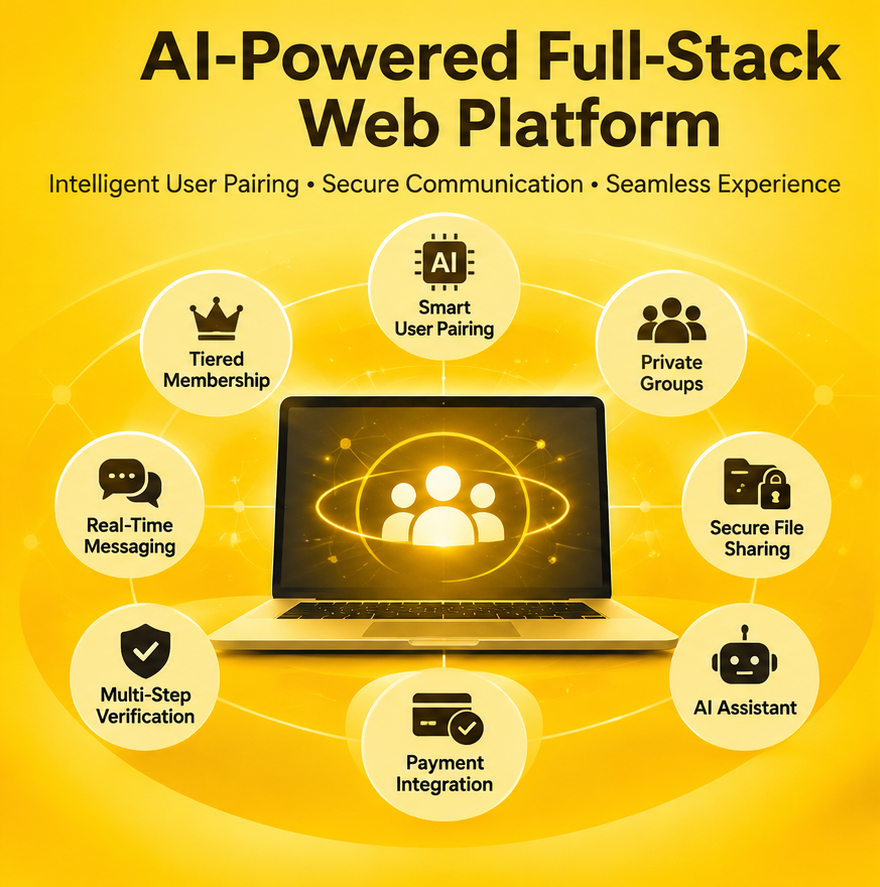
The proposed platform was designed to support multiple levels of user access, private groups, real-time messaging, attachment management, user verification, payment processing, and an integrated AI assistant.
The main objective was to create a complete web-based ecosystem where users could connect with relevant individuals, communicate privately, share information, and access features according to their membership level and verification status.
Alongside the user-facing experience, the platform required a comprehensive administrative system to manage operations, control permissions, monitor activities, process payments, and oversee the verification process.
The project required a strong focus on application architecture, database organization, privacy, security, and smooth integration between different platform components.
Understanding the Business Requirements
The first step was understanding the platform’s overall purpose and the different types of users who would interact with it.
The client wanted to develop a system where users could be intelligently paired based on relevant information, while maintaining privacy and controlled access throughout the platform.
Unlike a conventional social networking website, the proposed platform required multiple interconnected features operating within a structured permission system.
The main requirements included:
- User registration and account management.
- AI-driven user pairing and recommendations.
- Multiple membership and access levels.
- Restricted access to selected platform features.
- Private groups and community management.
- Real-time messaging between authorized users.
- Attachment uploading, sharing, and storage.
- User activity and interaction tracking.
- Payment processing and subscription management.
- Multi-stage user credential verification.
- Administrative controls and reporting.
- An integrated AI assistant for platform applications.
- Strong privacy protection and role-based permissions.
The platform also needed to support multiple user groups or organizational environments without exposing information to unauthorized users.
This made security and data separation important considerations from the beginning of the development process.
Intelligent AI-Driven User Pairing
One of the most important features of the proposed platform was intelligent user pairing.
The objective was to help users connect with individuals who were relevant to their interests, requirements, profiles, or other defined matching criteria.
Traditional platforms often depend on basic search filters or manual selection. An intelligent pairing system can provide a more personalized experience by evaluating multiple factors and identifying potentially suitable connections.
The pairing process could consider information such as:
- User interests and preferences.
- Profile information.
- Professional or personal requirements.
- Selected categories and objectives.
- Membership permissions.
- Verification status.
- Previously expressed preferences.
Based on the platform’s matching rules, the system could identify relevant users and present suitable connection suggestions.
For example, a user looking for people with a particular professional background could receive recommendations based on profile information and matching preferences.
The system would need to ensure that recommendations were relevant while respecting privacy settings and access restrictions.
It would also be important to allow users to update their information and preferences so that future recommendations could reflect their changing requirements.
The overall goal was to make user discovery more efficient, personalized, and useful.
Tiered Access and Membership Management
The platform required a multi-level access structure that allowed different users to access different features.
This approach is useful for businesses that offer subscription-based services, premium communities, or restricted platform functionality.
Instead of giving every registered user identical permissions, the system would organize access according to defined membership levels.
For example, the platform could include:
Basic Access: Users could create profiles, manage account information, and access selected public features.
Standard Access: Users could receive additional pairing opportunities, participate in approved groups, and access expanded communication features.
Premium Access: Users could receive advanced platform functionality, additional privileges, and access to exclusive communities or services.
The actual membership structure would depend on the client’s final business requirements.
The system needed to ensure that every user received only the permissions associated with their account.
Access restrictions would need to be checked whenever users attempted to enter restricted sections, join private groups, send messages, or use premium features.
This would help maintain a consistent experience while supporting different subscription models.
Private Groups and Real-Time Communication
Another major requirement was the development of private groups equipped with real-time messaging capabilities.
These groups would allow authorized users to communicate, exchange information, and collaborate within controlled environments.
Unlike public discussion areas, private groups would require specific membership permissions.
The platform would need to support:
- Creating and managing private groups.
- Inviting authorized users.
- Accepting or rejecting membership requests.
- Managing group participants.
- Sending and receiving messages.
- Viewing recent conversations.
- Sharing relevant attachments.
- Managing group access permissions.
- Tracking important group activities.
Real-time messaging would help users communicate without repeatedly refreshing the application.
For example, members of a private group could exchange messages and receive new updates while actively using the platform.
The system would also need to manage different communication permissions. Not every user should automatically be able to access every conversation or group.
Group owners and administrators could receive additional controls for managing membership and maintaining a suitable communication environment.
Attachment Sharing and Secure Storage
The platform also required functionality for uploading, storing, and sharing attachments.
Users needed a convenient way to exchange relevant documents and files through private conversations and groups.
This functionality would support a more complete communication experience by allowing users to share information beyond text messages.
Important capabilities included:
- Uploading files through the platform.
- Attaching documents to conversations.
- Sharing files with authorized group members.
- Organizing stored attachments.
- Accessing previously shared files.
- Managing file permissions.
- Removing files when permitted.
- Applying file-size and format restrictions.
Security was particularly important because attachments could contain personal, professional, or confidential information.
Files needed to be accessible only to authorized users. The platform would also need appropriate safeguards against unauthorized downloads, inappropriate file uploads, and accidental exposure.
A structured storage approach would make it easier to organize files and associate them with the correct users, groups, and conversations.
Administrative Panel and Platform Management
Alongside the user-facing application, the project required a centralized administrative panel.
The administrative system would allow authorized personnel to manage platform operations from a single location.
As the platform grows, managing users, payments, groups, subscriptions, and verification requests manually can become difficult.
A centralized panel helps simplify these responsibilities and provides administrators with better visibility into platform activity.
The proposed administrative features included:
User Management: Administrators could view user profiles, review account information, manage account status, and handle user-related requests.
Membership Management: The system would allow administrators to oversee subscription levels, access permissions, and membership changes.
Group Management: Authorized administrators could review group information, manage access, and address issues related to private communities.
Payment Management: The panel would provide access to payment records, transaction information, and subscription-related activities.
Verification Management: Administrators could review submitted credentials, monitor verification progress, and manage approval or rejection decisions.
Activity Monitoring: Relevant platform activities could be tracked to support operational management and security reviews.
The administrative interface needed to be organized and easy to use so that platform operators could perform routine activities without unnecessary complexity.
Multi-Stage User Credential Verification
A particularly important requirement was the development of a multi-tier credential verification pipeline.
The platform needed a structured process to confirm user information and establish different levels of account trust.
Depending on the business requirements, verification could involve several stages.
Stage 1: Basic Account Verification
The first stage could confirm that the user has successfully registered and provided the required basic information.
This may include verifying contact details and ensuring that mandatory profile fields are completed.
Stage 2: Document Submission
Users could be asked to submit relevant documents or credentials based on the platform’s verification policy.
The system would need to support secure submission and organized storage of the provided information.
Stage 3: Administrative Review
Authorized personnel could review submitted information and check whether it meets the required criteria.
The review process could include approval, rejection, or a request for additional information.
Stage 4: Verification Status Update
Once a decision is made, the user’s account status would be updated accordingly.
Different verification levels could determine which platform features the user is allowed to access.
The system would need to maintain clear records of verification progress and relevant administrative actions.
Because verification information may contain sensitive personal data, access would need to be restricted to authorized personnel.
Integrated AI Assistant for Platform Applications
The proposed ecosystem also included an integrated AI assistant.
The assistant was intended to help users interact with platform services and complete supported application-related tasks more conveniently.
Instead of requiring users to navigate through multiple sections for every request, an AI-powered conversational interface could provide guidance and assistance within the platform.
Possible capabilities could include:
- Answering questions about platform functionality.
- Guiding users through application processes.
- Explaining membership and access-related information.
- Helping users understand verification requirements.
- Assisting with navigation and account-related queries.
- Providing information based on authorized platform content.
- Supporting selected application workflows.
For example, a user who does not understand the credential submission process could ask the assistant for guidance and receive step-by-step instructions.
The AI assistant would need to operate within defined permissions and access boundaries.
It should not expose private information, confidential documents, or restricted account details to unauthorized users.
Its responses would also need to be evaluated for accuracy and usefulness, particularly when dealing with important account or verification-related questions.
Secure Multi-Tenant Application Architecture
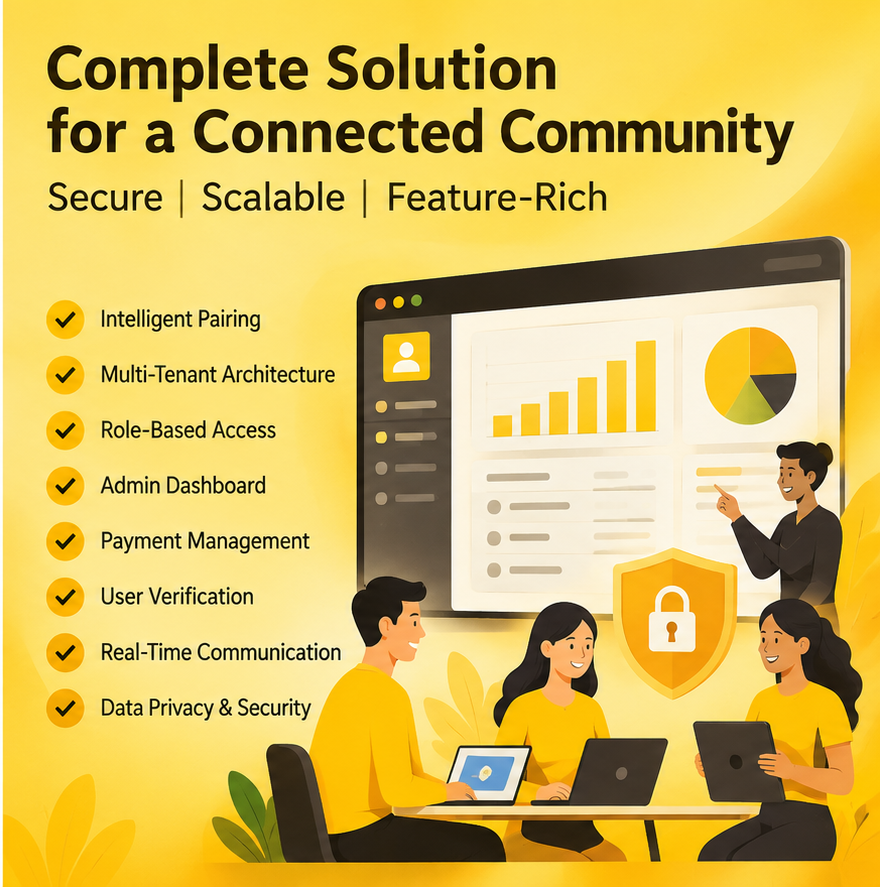
A major technical requirement was the development of a secure multi-tenant web application.
Multi-tenancy allows a single platform to support multiple separate user groups, organizations, or environments while maintaining appropriate data isolation.
For example, different organizations may use the same platform while their users, groups, conversations, and documents remain separated.
The architecture needed to ensure that information belonging to one tenant could not be accessed by another unauthorized tenant.
Important considerations included:
- Proper separation of tenant-related information.
- Secure user authentication.
- Role-based access control.
- Permission checks across platform features.
- Protected administrative functions.
- Secure handling of personal information.
- Controlled access to stored attachments.
- Reliable session management.
- Monitoring of important system activities.
Security needed to be considered throughout the application rather than added only after development.
The platform’s backend would be responsible for enforcing permissions and validating requests, ensuring that users could not bypass access restrictions simply by changing application URLs or submitted information.
Database Architecture and Information Management
The platform would generate and manage a significant amount of structured information.
This could include user profiles, subscriptions, groups, messages, attachments, verification records, payment information, and AI-related interactions.
A clean database architecture would be essential for maintaining reliable relationships between these different components.
For example, messages would need to be associated with the correct conversations and participants, while attachments would need to remain linked to the appropriate messages or groups.
Similarly, subscription records would need to connect with the relevant user accounts and access permissions.
The database design should consider:
- Clear relationships between records.
- Consistent data structures.
- Efficient searching and retrieval.
- Appropriate indexing.
- Data validation.
- Secure access.
- Reliable updates.
- Backup and recovery procedures.
A well-organized database would make the application easier to maintain and provide a stronger foundation for future expansion.
Payment Processing and Subscription Management
The platform also required integrated payment functionality to support its tiered access model.
Users may need to purchase memberships, renew subscriptions, or upgrade their access level to use additional features.
The payment process needed to connect successfully with the platform’s membership management system.
Important capabilities could include:
- Displaying available membership plans.
- Processing authorized payments.
- Recording transaction details.
- Updating subscription status.
- Managing membership renewals.
- Handling payment failures.
- Supporting permitted plan changes.
- Updating access permissions after payment confirmation.
Payment-related information would need to be handled securely, with appropriate validation and transaction records.
The platform would also need to ensure that access changes occur only after payment status has been reliably confirmed.
This would help prevent unauthorized access and reduce inconsistencies between payment records and membership privileges.
Third-Party Integrations and System Reliability
The proposed platform required several interconnected services to operate together.
These included payment processing, AI functionality, real-time communication, attachment storage, and user verification workflows.
Integrations needed to work smoothly so that information could move between different components without creating unnecessary complexity.
For example, successful payment confirmation could trigger a membership update, while completed verification could enable additional account permissions.
Similarly, new messages and group activities could generate relevant notifications for authorized users.
The platform would need proper error handling to manage situations such as failed payments, interrupted uploads, unavailable external services, or unsuccessful verification requests.
Reliable integration design would help ensure that one component’s failure did not unnecessarily disrupt the entire platform.
Challenges and Key Considerations
The project involved several important challenges.
Data Privacy: Users needed confidence that personal information, messages, and attachments would remain protected.
Multi-Tenant Security: Different organizations and user groups needed strict separation of their information.
Complex Permission Management: Access rules had to remain consistent across membership plans, private groups, administrative functions, and verification levels.
AI Pairing Accuracy: Recommendations needed to be relevant while respecting user preferences and privacy restrictions.
Real-Time Communication: Messaging needed to remain responsive and reliable as the number of users increased.
Verification Management: Multiple verification stages required clear records, controlled access, and reliable status updates.
Payment Synchronization: Membership permissions needed to reflect confirmed payment and subscription information.
Scalability: The architecture needed to support future growth in users, conversations, attachments, and platform functionality.
Addressing these challenges required careful planning, secure architecture, structured development, and thorough testing.
CnEL India’s Approach
CnEL India approaches complex full-stack platform development with a focus on understanding business requirements before beginning implementation.
For a project like this, the first step would be to review the supplied documentation, wireframes, and architectural details after the required confidentiality agreement is completed.
The development process would then be organized into clear modules, including user management, intelligent pairing, membership access, private communication, verification, payment processing, and administrative operations.
Each module would be designed with defined responsibilities and appropriate security controls.
The database architecture would be planned to maintain clear relationships between users, organizations, subscriptions, groups, messages, and verification records.
AI-related functionality would be integrated according to the platform’s requirements, with attention to response quality, matching relevance, and privacy.
The development process would also include functional testing, permission testing, integration checks, and performance reviews.
This modular approach would help make the platform easier to maintain, improve, and expand as business requirements evolve.
Expected Business Benefits
A well-designed platform of this kind can provide several important advantages.
Personalized Connections: Intelligent pairing can help users discover relevant individuals and opportunities more efficiently.
Structured Access Management: Tiered memberships allow businesses to offer different services and privileges.
Improved Communication: Private groups and real-time messaging provide a centralized environment for interaction.
Secure Information Sharing: Controlled attachment storage helps users exchange information within authorized spaces.
Simplified Administration: A centralized panel makes user, payment, verification, and platform management easier.
Better User Experience: An integrated AI assistant can guide users and simplify supported application processes.
Stronger Privacy Controls: Multi-tenant architecture and role-based permissions help protect confidential information.
Future Scalability: A modular architecture provides a foundation for introducing additional features as the platform grows.
Conclusion
The AI-powered full-stack web platform project demonstrates the complexity involved in developing a secure digital ecosystem that combines intelligent user pairing, controlled memberships, private communication, verification workflows, payment processing, and AI assistance.
The platform required much more than a conventional website. It needed a carefully planned architecture capable of supporting multiple user roles, protecting confidential information, managing complex access rules, and maintaining reliable communication between different system components.
For CnEL India, this project represents an opportunity to deliver comprehensive web application development focused on AI integration, secure backend architecture, database management, and scalable digital experiences.
By combining intelligent functionality with structured administration and strong privacy controls, businesses can create platforms that support meaningful user connections while maintaining operational reliability and security.
A successful implementation would provide a flexible foundation for future growth, new membership models, additional AI capabilities, and an increasingly connected digital user experience.