
Introduction
Marketing teams are constantly surrounded by cultural moments, changing audience interests, creator content, platform trends, brand campaigns, and performance data. The challenge is no longer simply generating creative ideas. The real challenge is identifying which opportunity matters, why it matters, what a particular brand can credibly do with it, which creator is best suited to execute it, which platform is most appropriate, and what performance can reasonably be expected.
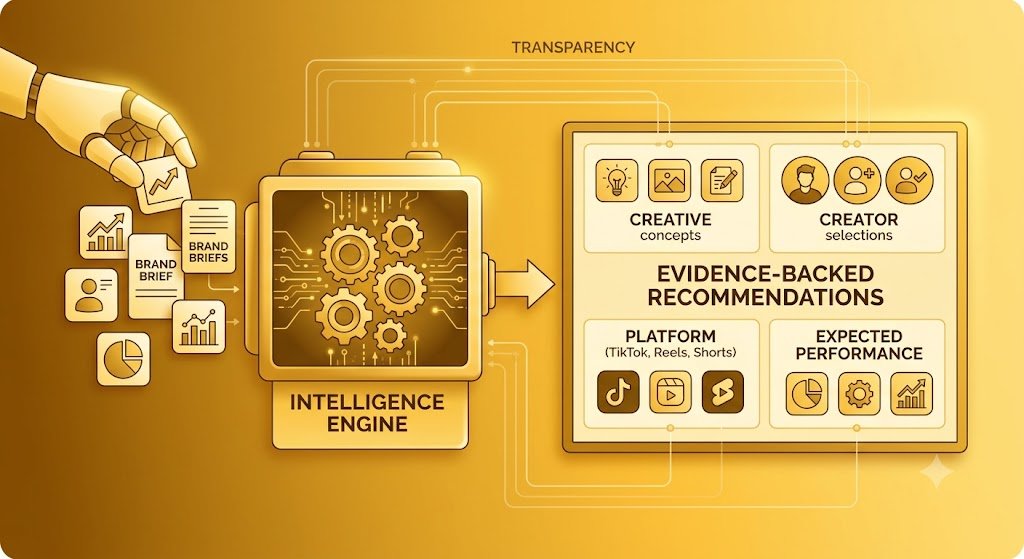
This case study focuses on the development of an AI-powered Creative and Creator Intelligence system designed for a marketing agency. The objective was to build a practical internal product that could combine cultural signals, brand information, creator performance data, audience insights, and historical results to produce evidence-backed recommendations.
The system was not intended to function as a generic chatbot or an unrestricted idea generator. Instead, it was designed as a structured decision-support system where every recommendation could be connected to supporting evidence, source information, dates, and confidence levels.
CnEL India’s approach to this type of project focuses on combining data engineering, applied artificial intelligence, recommendation logic, statistical analysis, and product development into one practical workflow.
Understanding the Business Problem
Marketing agencies often work with large amounts of fragmented information.
A team may have access to:
- Cultural and seasonal opportunities.
- Brand campaign briefs.
- Creator profiles.
- Audience information.
- Historical creator performance.
- Platform-specific metrics.
- Content trends.
- Campaign results.
- Market and category information.
- Previous creative concepts.
However, having data does not automatically create useful decisions.
A marketing team still needs to answer important questions.
Which cultural moment is actually relevant to the brand?
Can the brand participate authentically?
What type of content should be created?
Which creator has the right audience and content style?
Which platform is most suitable?
What level of performance should be expected?
What can be learned from previous campaigns?
The proposed system was designed to connect these questions into one structured decision-making process.
From Data to Recommendation
The central principle behind the system was:
Evidence → Reasoning → Recommendation
rather than:
Prompt → Generated Idea
This distinction was extremely important.
A generic AI system can produce hundreds of creative ideas, but quantity does not guarantee usefulness. An idea may sound attractive while having little connection to the brand, audience, current cultural context, or creator’s historical performance.
The proposed system therefore needed to establish an evidence layer before producing recommendations.
Each recommendation could include information such as:
- Supporting source.
- Source date.
- Relevant data points.
- Reasoning behind the recommendation.
- Confidence level.
- Historical comparison.
- Expected performance range.
This made the system more transparent and useful for professional marketing decisions.
Core System Workflow
The system was designed around a simple sequence rather than a large collection of autonomous AI agents.
A high-level workflow could be divided into four major stages:
1. Opportunity Identification
The first stage identifies potentially valuable cultural, seasonal, audience, category, or content opportunities.
Inputs may initially come from manually uploaded datasets, structured files, URLs, or other data sources.
The purpose is not to immediately generate creative concepts.
Instead, the system first asks:
- What is happening?
- When is it happening?
- Who is interested?
- Which category does it relate to?
- How strong is the opportunity?
- Is there evidence that the opportunity is gaining attention?
This creates the foundation for the next stage.
2. Brand and Audience Relevance
Once an opportunity is identified, the system evaluates whether a specific brand can credibly participate.
This is important because not every trend is appropriate for every brand.
The system can consider:
- Brand category.
- Brand positioning.
- Target audience.
- Existing communication style.
- Product relevance.
- Historical content.
- Campaign objectives.
- Cultural fit.
The goal is to avoid forced or irrelevant recommendations.
A strong recommendation should explain not only what the brand could do but also why the opportunity makes sense for that brand.
3. Creative and Creator Recommendation
After establishing relevance, the system can develop creative directions and identify suitable creators.
Creator selection should not simply be based on follower count.
A creator may have a large audience but poor relevance to a particular brand or category.
The system can evaluate factors such as:
- Audience characteristics.
- Historical engagement.
- Content category.
- Content format.
- Posting consistency.
- Historical performance.
- Audience response.
- Platform-specific results.
- Relevance to the campaign objective.
The system can then rank creators according to suitability rather than popularity alone.
4. Platform and Performance Recommendation
The final stage determines where the content may perform best and provides a realistic expected performance range.
Instead of presenting a single guaranteed number, the system can use historical baselines, medians, percentiles, and comparable content to estimate a reasonable range.
This helps marketing teams understand both opportunity and uncertainty.
Opportunity-Led Prototype
One of the first required milestones was an opportunity-led prototype.
The workflow begins with a seasonal or cultural moment combined with a specific brand brief.
The system then processes the information through several stages.
First, it identifies whether the opportunity has meaningful relevance.
Next, it evaluates the brand’s ability to participate authentically.
It then develops several possible creative directions.
After that, it identifies creators who are best suited to execute the idea.
Finally, it recommends an appropriate platform and estimates a performance range.
The result is not simply a creative concept.
It becomes a complete recommendation package connecting:
Opportunity → Brand Relevance → Creative Concept → Creator → Platform → Expected Performance
This gives marketing teams a much clearer path from an external cultural signal to an actionable campaign decision.
Creator-Led Prototype
The second major prototype followed the opposite direction.
Instead of beginning with a cultural moment, the system starts with an existing creator.
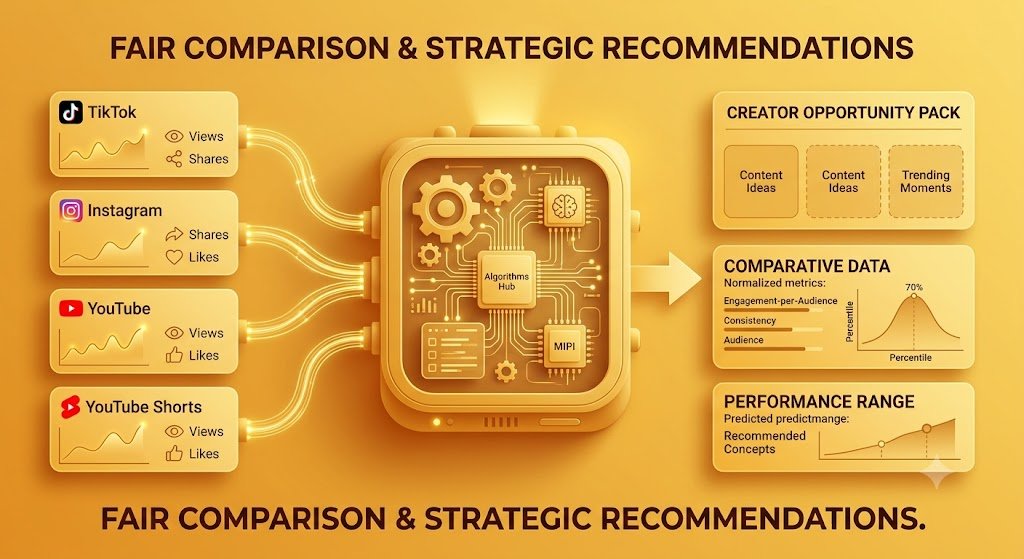
The objective is to generate a recurring opportunity pack specifically for that creator.
The system can analyze:
- Previous creator performance.
- Content categories.
- Audience behavior.
- Upcoming seasonal moments.
- Relevant trends.
- Historical strengths.
- Areas where performance can potentially improve.
Based on this information, the system can produce a weekly set of opportunities.
This creates an ongoing workflow rather than a one-time campaign recommendation.
For creators and agencies, such a system can help answer:
“What should this creator consider creating next week, and why?”
Handling Messy Data
One of the most challenging parts of the project is data quality.
Creator and marketing data often comes from different sources and may use different naming conventions, formats, measurement periods, and definitions.
For example, one source may identify engagement using one calculation while another uses a different definition.
Some datasets may contain missing values.
Others may include duplicated records, inconsistent creator names, different date formats, or incomplete audience information.
Therefore, data normalization becomes a critical part of the system.
The system needs to clean and standardize incoming information before using it for ranking or recommendation.
This includes:
- Removing duplicate records.
- Standardizing field names.
- Normalizing dates.
- Handling missing values.
- Validating numerical fields.
- Identifying inconsistent records.
- Mapping similar categories.
- Maintaining consistent creator identities.
- Creating comparable performance measurements.
Reliable recommendations depend on reliable underlying data.
Fair Creator Comparison Across Platforms
Comparing creator performance across different social platforms is not as simple as comparing raw views or likes.
Each platform has different audience behavior, content formats, algorithms, and engagement patterns.
A fair comparison therefore requires normalization.
The system can evaluate creators using several dimensions rather than relying on one metric.
For example:
- Relative engagement.
- Median views.
- Typical reach.
- Engagement per audience size.
- Performance consistency.
- Recent performance.
- Content-specific performance.
- Audience relevance.
- Platform-specific benchmarks.
Median performance can be particularly useful because a creator may have one extremely successful post that significantly distorts their average.
Percentile-based analysis can also provide useful context.
Instead of saying that a creator usually receives a specific number of views, the system can identify a typical range and compare performance against relevant benchmarks.
This creates a more realistic picture of creator capability.
Ranking and Recommendation Logic
Creator recommendations need to be explainable.
A ranking system should not simply say that Creator A is number one.
It should explain why.
For example, a creator may rank highly because:
- Their audience strongly overlaps with the target audience.
- Their historical content performs well in the relevant category.
- Their recent performance is stable.
- Their content style matches the creative concept.
- Their platform performance is stronger for the required format.
- Their audience engagement is consistent.
This creates a transparent recommendation model.
Marketing teams can then review the reasoning and decide whether the recommendation fits their business judgment.
Evidence-Based AI Recommendations
A major objective was preventing generic AI-generated recommendations.
The system therefore needs to connect AI reasoning to structured information.
Instead of allowing the AI layer to independently invent facts, relevant evidence is retrieved from approved data sources and provided as context.
The generated recommendation can then be checked against the underlying evidence.
This approach helps reduce unsupported claims and improves reliability.
Each recommendation can include:
Source → Date → Evidence → Reasoning → Recommendation → Confidence
This traceability is particularly valuable for marketing agencies because recommendations may need to be explained to clients or internal stakeholders.
Retrieval and Context Management
The system also requires an intelligent retrieval layer capable of finding relevant information from available data.
For example, when evaluating a creator for a particular opportunity, the system may need to retrieve:
- Relevant historical posts.
- Similar campaign results.
- Audience information.
- Previous category performance.
- Recent trends.
- Comparable creators.
Only the most relevant information should be passed into the reasoning stage.
This keeps the process focused and makes recommendations more consistent.
The objective is not to retrieve everything.
The objective is to retrieve the right evidence for the specific decision.
Performance Prediction
Performance prediction was another important aspect of the system.
Marketing teams rarely need a perfect prediction. What they need is a realistic expectation.
For example, rather than promising that a piece of content will receive a specific number of views, the system can estimate a range based on comparable historical performance.
Statistical measurements such as:
- Median.
- Percentiles.
- Baselines.
- Recent performance.
- Comparable content.
can help establish a reasonable range.
This approach communicates uncertainty instead of hiding it.
A recommendation with a confidence level is often more useful than an overly precise prediction that cannot be justified.
Learning From Actual Results
The system was also designed to learn from campaign outcomes.
This creates an important feedback loop.
The workflow becomes:
Recommendation → Campaign → Actual Result → Analysis → Updated Learning
For example, if a creator recommendation consistently produces strong results for a particular category, that information should influence future rankings.
Likewise, if a certain type of creative concept repeatedly underperforms, the system should be able to incorporate that learning.
Over time, this creates a continuously improving intelligence layer.
Recurring Creator Opportunity Packs
Beyond individual campaigns, the system can support recurring content planning.
A weekly opportunity pack can provide creators or agency teams with several evidence-backed ideas.
Each opportunity can include:
- Relevant upcoming moment.
- Why it matters.
- Audience connection.
- Suggested creative direction.
- Supporting evidence.
- Potential platform.
- Expected performance context.
- Confidence level.
This reduces the time marketing teams spend manually researching opportunities every week.
It also makes content planning more systematic.
Vendor-Agnostic Architecture
Another important requirement was flexibility.
Data sources may change over time.
A trend data source used today may not be the preferred source in the future. Similarly, creator analytics providers and external APIs may change.
Therefore, the system should not be tightly dependent on one provider.
Instead, external sources can be connected through replaceable data connectors.
This allows the core recommendation system to remain stable while individual data sources can be changed independently.
Such architecture improves long-term maintainability and reduces dependency risk.
Lightweight Product Experience
Although the underlying system contains significant data and AI logic, the internal user experience should remain simple.
Marketing teams should not need to understand the technical architecture to use the product.
The interface can focus on practical outputs such as:
- Opportunities.
- Brand recommendations.
- Creator rankings.
- Creative concepts.
- Platform recommendations.
- Performance ranges.
- Evidence.
- Confidence levels.
- Historical learning.
This keeps the system focused on decision-making rather than technical complexity.
CnEL India’s Approach
CnEL India approaches AI product development by combining structured data, practical automation, AI reasoning, and business-focused product design.
For a system like this, the development process would begin with the smallest useful prototype.
Instead of attempting to integrate every possible data source immediately, initial data could be supplied through structured files or manually provided information.
This allows the recommendation logic to be tested before investing significant effort into complex integrations.
The process can then evolve through the following stages:
Requirement Analysis
Understand the agency’s decision-making process and define what makes a recommendation useful.
Data Preparation
Collect, clean, normalize, and structure available creator, brand, trend, and performance data.
Recommendation Logic
Create transparent rules and ranking methods for opportunities, creators, platforms, and performance expectations.
AI Reasoning
Use AI to interpret structured evidence and convert it into understandable recommendations.
Evaluation
Test whether recommendations are relevant, consistent, evidence-backed, and useful.
Product Development
Create a lightweight internal application that allows marketing teams to interact with the system.
Feedback Loop
Capture actual campaign results and use them to improve future recommendations.
Business Benefits
An intelligent creative and creator system can provide several significant business benefits.
Faster Research
Marketing teams can reduce the time required to manually research trends, creators, and performance data.
Better Creator Selection
Creators can be selected based on relevance and evidence rather than follower count alone.
Stronger Creative Decisions
Creative concepts are connected to actual opportunities, brand positioning, and audience signals.
More Consistent Recommendations
A structured process reduces dependence on individual manual research methods.
Better Client Presentations
Evidence-backed recommendations are easier to explain and defend.
Improved Performance Planning
Historical baselines and statistical ranges provide more realistic expectations.
Continuous Learning
Campaign outcomes can feed back into the system, allowing recommendations to improve over time.
Scalable Marketing Intelligence
Once the system is established, the same framework can support multiple brands, creators, categories, and campaigns.
Conclusion
The Creative and Creator Intelligence project represents a practical application of AI beyond generic content generation.
The core value lies in connecting data, reasoning, and recommendations into one structured system.
Instead of simply asking AI to generate an idea, the system begins with evidence. It evaluates an opportunity, determines whether it is relevant to a brand, develops appropriate creative directions, identifies suitable creators, recommends a platform, and estimates a realistic performance range.
The creator-led workflow adds another dimension by continuously identifying opportunities for individual creators based on their historical performance, audience signals, upcoming moments, and current trends.
Most importantly, the system is designed around transparency.
Recommendations should be traceable to evidence, sources should have dates, confidence should be visible, and statistical assumptions should be understandable.
CnEL India’s approach emphasizes starting simple, proving the recommendation logic, and then expanding integrations as the system demonstrates value.
The long-term vision is to create an internal intelligence platform that helps marketing teams move from data to insight, insight to creative, and creative to measurable results.
By combining data engineering, AI reasoning, recommendation logic, statistical analysis, and a practical internal product experience, such a system can become a powerful decision-support layer for modern marketing teams and creator-focused campaigns.