
Introduction
Financial services businesses handle large amounts of sensitive client information every day. Employees may need to review financial documents, identify important facts, organize client information, prepare recommendations, and produce professional reports that follow strict internal standards.
Traditionally, much of this work is performed manually. Employees read documents, copy relevant information into internal records, refer to approved wording and templates, prepare reports, and then review everything before sending it to the client. Although this process can be effective, it can also be time-consuming and vulnerable to inconsistencies.
This case study explores how CnEL India could approach the development of a secure, multi-user AI-powered financial report writing application for a UK-regulated financial services firm.
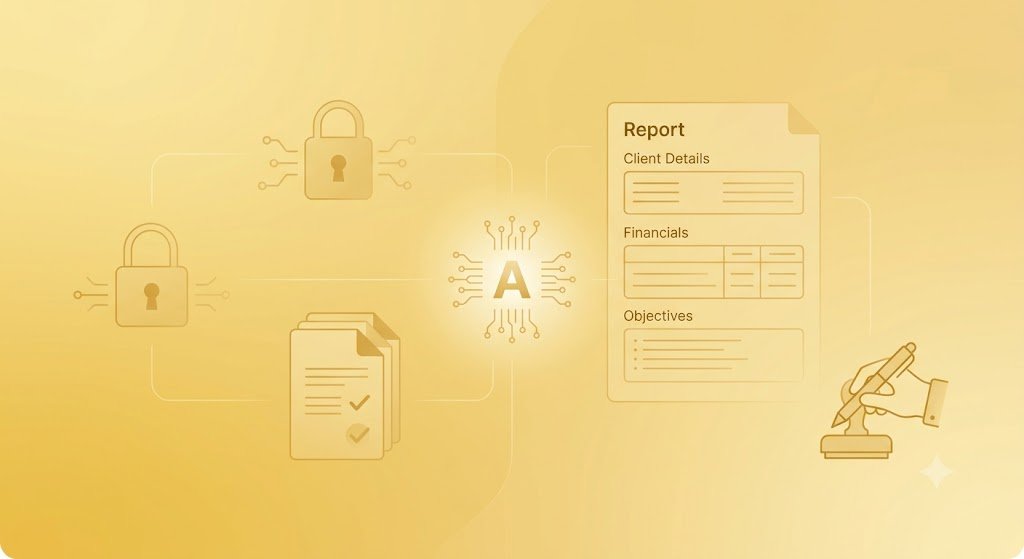
The goal is not to create a simple chatbot. Instead, the proposed solution is a secure business application that can process authorized client documents, organize evidence, generate reports using approved business rules, maintain traceability, and require human approval before any report becomes final.
Because the application would process confidential personal and financial information, security, privacy, governance, auditability, and accuracy would be fundamental parts of the architecture.
Understanding the Business Requirement
The client requires a shared application that can be used by multiple authorized employees.
An employee should be able to upload relevant client documents, after which the system can identify and organize useful information into a structured case record.
The application can then use this structured information, approved templates, internal guidance, and authorized wording to prepare a draft financial report.
The employee can review the draft, verify the supporting information, make necessary changes, and approve the final version.
The overall workflow can be represented as:
Document Upload → Information Extraction → Evidence Organization → Case Record → Report Generation → Source Verification → Human Review → Approval → Final Report
This separation is extremely important.
The system should not simply send an entire document to an AI model and ask it to “write a report.” That approach can make it difficult to determine where individual statements came from and can increase the risk of unsupported information appearing in the final document.
Instead, CnEL India’s approach would separate the process into controlled stages.
Multi-User Business Application
The application would be designed for multiple employees rather than a single user.
Different employees may have different responsibilities, so access should be controlled according to their roles.
For example, the system could support roles such as:
- Standard report users
- Senior reviewers
- Compliance reviewers
- Administrators
- System managers
A normal employee might be allowed to upload documents and prepare reports but may not be allowed to modify approved templates or internal rules.
An administrator, on the other hand, could manage templates, approved wording, instructions, and other configurable business content.
This role-based structure helps ensure that sensitive configuration cannot be changed accidentally or by unauthorized users.
Secure Document Processing
Financial reports can depend on information contained in many different documents.
These may include:
- Client forms
- Financial statements
- Supporting documents
- Identification documents
- Previous reports
- Correspondence
- Statements
- Policy-related documents
- Other financial records
The application should support common document formats such as Word and PDF.
Once documents are uploaded, the system would process them and extract relevant information.
However, extraction should not immediately become final client information.
The system should preserve the relationship between the extracted information and the original source document.
For example, if the client’s annual income is identified from a particular document, the system should retain information about where that value originated.
This creates a foundation for later verification and auditability.
Structured Case Records
One of the most valuable parts of the proposed application would be the structured case record.
Instead of keeping client information as unorganized text, the application can organize important information into defined fields.
For example:
Client Details
- Name
- Date of birth
- Contact information
Financial Information
- Income
- Assets
- Liabilities
- Expenditure
- Existing arrangements
Objectives
- Client goals
- Financial requirements
- Relevant preferences
Supporting Evidence
- Document name
- Source location
- Extracted information
- Verification status
The exact fields would depend on the firm’s internal workflow.
This structured approach allows the report-writing process to operate on organized information instead of relying entirely on free-form interpretation.
Separating Extraction from Report Writing
A key requirement in this project is separating document extraction, evidence organization, and report generation.
These should be treated as different stages.
Stage 1: Extraction
The application identifies information contained in uploaded documents.
Stage 2: Evidence Organization
The extracted information is structured and connected to its source.
Stage 3: Validation
The system identifies missing, ambiguous, or conflicting information.
Stage 4: Report Generation
Only validated and relevant information is used to prepare the report.
This architecture creates a much stronger foundation for accuracy.
For example, if two documents contain different values for the same financial figure, the application should not silently select one.
Instead, it should identify the conflict and request human review.
Grounded Report Generation
The report-writing component would generate content based on approved information rather than freely inventing content.
The system would be provided with:
- Structured case information
- Verified evidence
- Approved templates
- Internal instructions
- Approved wording
- Business rules
- Relevant examples
The generated report would then follow the firm’s predefined structure.
This helps ensure that different employees receive consistent report formats and writing styles.
The AI component would essentially operate within controlled boundaries rather than being allowed to generate unrestricted financial statements.
Approved Wording and AI-Generated Content
The client specifically requires a distinction between fixed approved wording and AI-generated content.
This is important in a regulated environment.
Some sections of a report may need to use exact language approved by the organization.
Other sections may require dynamic wording based on individual client information.
The application can therefore classify content into two categories.
Fixed Content
This includes approved language that should remain unchanged unless an authorized administrator updates it.
Dynamic Content
This includes information generated from the client’s case data and supporting evidence.
Keeping these categories separate makes the report easier to control and review.
It also reduces the possibility of the AI unintentionally changing important approved language.
Template and Instruction Management
The client should not have to modify application code every time an approved template or business instruction changes.
Therefore, templates, approved wording, and internal guidance should be managed through an administrative interface.
Authorized administrators could:
- Create templates
- Update templates
- Add approved wording
- Update business instructions
- Activate or deactivate versions
- Maintain historical versions
- Assign templates to specific report types
Every significant change should be versioned.
For example, if a report was generated using Template Version 3, the system should retain that information.
This becomes valuable during later reviews because the firm can identify exactly which template and instructions were used when the report was created.
Source Traceability
Traceability is one of the most important requirements of the project.
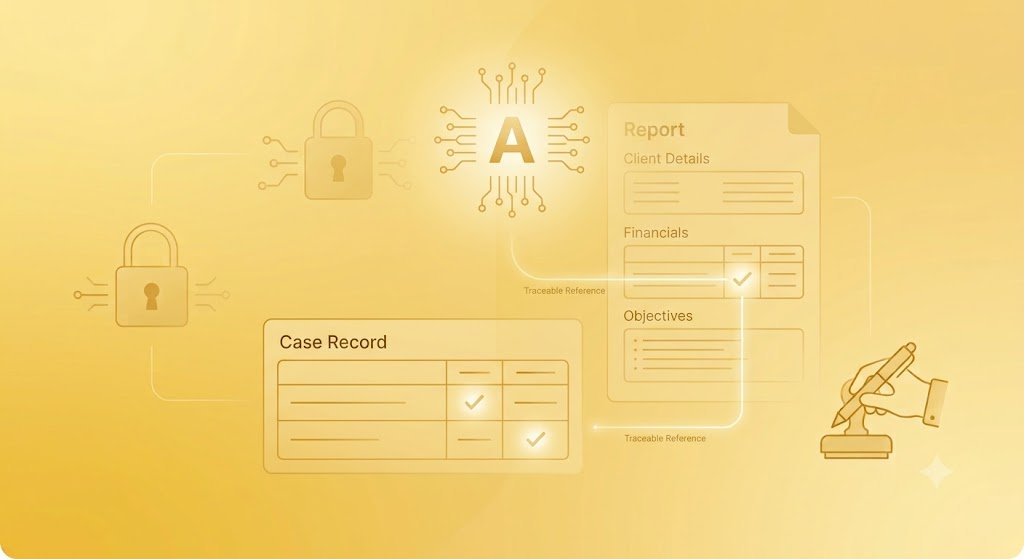
Every important generated statement should ideally be connected to supporting evidence.
For example, if a report says that a client has a specific level of annual income, the reviewer should be able to identify the document and source information supporting that statement.
This could be represented within the internal application as evidence references.
The final client-facing report does not necessarily need to expose every internal reference, but the business system should retain the information for review and audit purposes.
This creates a clear chain:
Source Document → Extracted Fact → Structured Case Record → Generated Statement → Final Report
Such traceability makes human review more effective and supports future investigation if questions arise.
Controlling Hallucinations and Unsupported Information
AI systems can sometimes generate information that is not supported by the source material.
For a financial services organization, this is a serious risk.
The application should therefore be designed around a “known information only” principle.
If the source documents do not provide sufficient information, the system should not attempt to guess.
Instead, it could flag the issue as:
- Missing information
- Ambiguous information
- Conflicting information
- Requires human verification
For example, if a document contains two different values for a financial figure, the application should highlight the discrepancy rather than choosing one without explanation.
Similarly, if an important field is missing, the system should request additional information rather than filling the gap with an assumption.
Human Review and Approval
The application should never treat AI-generated content as automatically final.
Human review should be mandatory.
A reviewer should be able to inspect:
- Extracted client information
- Supporting documents
- Generated report sections
- Source references
- Warnings
- Conflicting information
- Missing information
The reviewer can then approve, edit, reject, or request additional information.
Only after the required review process is completed should the report become final.
This human-in-the-loop approach is especially important when the output may influence financial decisions or client outcomes.
Security and Data Protection
Because the application will process personal and financial information, security should be considered from the beginning of the project.
Important areas would include:
Encryption
Sensitive information should be protected during transmission and storage.
Access Control
Only authorized employees should be able to access client information.
Authentication
The application should use secure authentication mechanisms suitable for an enterprise environment.
Role-Based Permissions
Users should only have access to functions and information appropriate to their role.
Data Retention
The firm should define how long client documents, generated reports, and audit records need to be retained.
Secure Deletion
When information reaches the end of its approved retention period, it should be securely removed according to the firm’s policies.
UK Data Residency and Compliance
Since the client operates in the UK financial services sector, data residency and privacy requirements are important architectural considerations.
The system should be designed with UK GDPR obligations and applicable regulatory expectations in mind.
CnEL India would work with the client to establish requirements around:
- Where client data is stored
- Where processing occurs
- Who can access information
- How long information is retained
- How information is deleted
- How access is logged
- How changes are recorded
- How incidents are handled
The exact compliance implementation would depend on the firm’s legal, regulatory, and internal governance requirements.
The application should support these requirements technically rather than treating compliance as a document created after development.
Audit Trail
A complete audit trail would help the firm understand what happened to each report.
The system could record events such as:
- User login
- Document upload
- Document processing
- Information extraction
- Case changes
- Template version used
- Instruction version used
- Report generation
- User edits
- Review activity
- Approval
- Finalization
This provides visibility into the complete lifecycle of a report.
If a report is questioned later, authorized personnel can review how it was produced and who approved it.
Microsoft-Centered Architecture
The client has expressed interest in using Microsoft’s cloud ecosystem and its AI services.
A suitable architecture could involve secure cloud infrastructure, enterprise authentication, controlled document storage, document processing services, AI model access, application APIs, database storage, and monitoring.
The important point is that the architecture should not be selected simply because a particular technology is popular.
The technology stack should be evaluated based on:
- Security
- Data residency
- Reliability
- Scalability
- Integration capability
- Cost
- Governance
- Maintainability
CnEL India would first map the business requirements to the architecture and then select the appropriate services.
Testing and Quality Assurance
Before production deployment, the system should undergo extensive testing.
Testing would cover:
- Document extraction accuracy
- Different document formats
- Missing information
- Conflicting information
- Report consistency
- Template behavior
- Permission controls
- User access
- Audit logging
- Data security
- Report generation
- Word document formatting
- Error handling
A large collection of representative, properly authorized test documents would be useful for evaluating the system.
The objective would not simply be to determine whether the AI can generate a report.
The real question is whether the complete workflow produces reliable, traceable, reviewable, and secure reports.
Proposed Delivery Approach
CnEL India could divide the project into several phases.
Phase 1: Discovery and Architecture
Understand the firm’s workflow, report formats, regulatory requirements, user roles, and document types.
Phase 2: Secure Application Foundation
Build authentication, permissions, secure storage, case management, and basic administration.
Phase 3: Document Processing
Implement document upload, extraction, organization, and evidence management.
Phase 4: Report Generation
Introduce structured report generation using approved templates and business instructions.
Phase 5: Review and Audit
Implement source traceability, warnings, review workflows, approvals, and audit history.
Phase 6: Testing
Test the system against representative cases and edge conditions.
Phase 7: Deployment and Support
Deploy the application securely and provide ongoing maintenance, monitoring, improvements, and support.
Business Benefits
The proposed system can provide several benefits to the financial services firm.
Improved Efficiency
Employees can spend less time manually reviewing and transferring information between documents.
Consistent Reporting
Approved templates and business rules can create more consistent reports across employees.
Better Traceability
Supporting evidence can remain connected to generated statements.
Reduced Risk
Structured workflows and mandatory review can reduce unsupported claims and accidental omissions.
Stronger Governance
Version control and audit trails provide better oversight.
Scalability
The organization can process more cases without increasing manual report-writing work at the same rate.
Better Employee Experience
Employees can focus more on reviewing and making professional judgments instead of repetitive document preparation.
Conclusion
The AI-powered financial report writer is much more than an AI writing application.
It is a secure business workflow platform for document processing, evidence management, controlled AI generation, human review, and regulatory oversight.
For CnEL India, the most important aspect of this project would be understanding that the AI component is only one part of the overall solution.
The foundation needs to be built around security, structured information, traceability, permissions, version control, auditability, and human decision-making.
The proposed workflow would allow authorized employees to upload client documents, extract and organize relevant information, identify missing or conflicting data, generate reports using approved templates and wording, verify supporting evidence, and approve final documents.
By separating extraction from evidence management and report writing, the system can provide greater control over the final output.
With appropriate security architecture, data governance, source traceability, and mandatory human approval, the application can become a valuable internal platform for a regulated financial services organization.
The ultimate objective is not to replace professional judgment. It is to reduce repetitive work, improve consistency, strengthen traceability, and help qualified employees prepare accurate client-facing reports more efficiently while maintaining the governance expected in a regulated environment.