
Project Overview
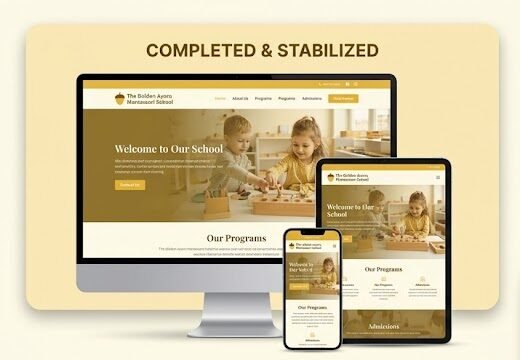
CnEL India worked on the completion and launch of an existing Montessori school website that had been left unfinished by a previous developer. The project required a developer who could understand an existing website structure, review the available files, identify incomplete areas, resolve technical and design issues, and bring the website to a polished, launch-ready stage.
The primary challenge was not simply building a website from the beginning. The development work had already started, and the available website files needed to be carefully reviewed before making further changes. Taking over an unfinished website requires a different approach because the new development team must understand what has already been implemented, what remains incomplete, which components are reusable, and whether existing code or configurations could create problems during launch.
For a Montessori school, the website also needed to provide a welcoming and trustworthy experience for parents. Information about the school, educational approach, programs, admissions, facilities, activities, and contact options had to be presented clearly across desktop and mobile devices.
CnEL India approached the project as a website completion and stabilization assignment, focusing on understanding the existing work first, completing the remaining development, improving usability, testing the complete website, and preparing it for a smooth launch.
Business Challenge
The school already had website files prepared by the previous developer, but the website was not ready for public launch. Some parts of the project were incomplete, while other areas required review and refinement.
This created several challenges for the school.
The first challenge was continuity. Starting development from an existing project meant that the new developer could not simply replace everything without understanding the existing structure. Unnecessary rebuilding could increase development time and potentially remove useful work that had already been completed.
The second challenge was identifying unfinished functionality. A partially completed website can contain pages that look finished but still have missing links, incomplete forms, placeholder content, inconsistent layouts, or sections that do not work correctly.
The third challenge was visual consistency. Educational websites need a friendly and professional appearance. Different sections created by different development stages can sometimes have inconsistent spacing, typography, buttons, images, and responsive behavior.
Another important challenge was the launch timeline. Since the school needed the website completed quickly, the development process needed to prioritize the remaining work without compromising quality.
CnEL India therefore focused on creating a structured takeover process instead of immediately modifying individual pages.
Project Objectives
The project was organized around several key objectives:
- Review the existing website files and development structure.
- Understand the current state of the website.
- Identify incomplete pages and functionality.
- Complete the remaining website development.
- Improve consistency across existing sections.
- Ensure the website works properly on desktop, tablet, and mobile devices.
- Check navigation and internal links.
- Review forms and contact functionality.
- Remove unfinished or placeholder elements.
- Improve the overall user experience.
- Perform functional and visual testing.
- Prepare the website for production launch.
- Complete the project within an efficient turnaround period.
The objective was not merely to make the website technically functional. The final result needed to feel like a complete website rather than a project that had been handed over midway through development.
Understanding the Existing Website
The first stage involved reviewing the existing website and its available files.
CnEL India examined the current page structure, layouts, reusable components, content sections, navigation system, styling, and existing functionality. This helped establish what had already been completed and what required additional development.
A takeover project requires careful documentation because the previous developer may have used a particular structure or implementation approach. Before changing anything, it is important to understand how different sections depend on one another.
The review also helped identify areas that could be retained instead of being rebuilt.
This approach reduced unnecessary development work and allowed the project to move forward faster.
Website Structure and Content Review
A Montessori school website typically contains several important information areas. Parents visiting the website may want to understand the school’s educational philosophy, available programs, learning environment, admission process, activities, facilities, and contact information.
CnEL India reviewed the website structure to ensure these important areas were easy to discover.
The navigation was organized around the user’s likely journey. Visitors should be able to move from general school information toward specific details without becoming confused.
Important pages and sections were checked for:
- Clear headings.
- Logical content hierarchy.
- Consistent navigation.
- Proper internal links.
- Readable text.
- Appropriate calls to action.
- Consistent page layouts.
- Accessible contact information.
The objective was to create a website structure that supported both information discovery and parent inquiries.
Completing the Remaining Development
After understanding the existing project, CnEL India focused on completing the unfinished sections.
This included reviewing incomplete page layouts, filling missing structural elements, correcting broken sections, completing navigation paths, and ensuring that each major page functioned as expected.
Where existing components were suitable, they were retained and refined rather than unnecessarily replaced.
This helped preserve the original development investment while bringing the unfinished sections into alignment with the rest of the website.
The development process was also organized by priority. Core pages and user-facing functionality were addressed first, followed by visual refinements and secondary improvements.
This was particularly important because the project had an urgent launch requirement.
Design Consistency
A website takeover can result in a visually inconsistent final product if different sections have been developed at different times.
CnEL India therefore reviewed the website for consistency in typography, spacing, buttons, colors, image presentation, content width, section alignment, and page structure.
The goal was to make the website feel like one unified digital experience.
For a Montessori school, the visual design needed to communicate warmth and professionalism without becoming overly complicated. Parents should be able to focus on the information they need without being distracted by unnecessary visual elements.
Consistent design patterns were applied throughout the website wherever improvements were required.
Responsive Website Development
Parents may access a school website from phones, tablets, laptops, and desktop computers.
Therefore, responsive behavior was an important part of the completion process.
CnEL India reviewed the website at different screen sizes to identify issues such as:
- Text becoming difficult to read.
- Images extending beyond their containers.
- Sections becoming too narrow or too wide.
- Buttons becoming difficult to use.
- Navigation becoming difficult on smaller screens.
- Inconsistent spacing.
- Content overlapping.
- Forms becoming difficult to complete.
Responsive adjustments were made so that the website could provide a consistent experience across different devices.
The mobile experience was treated as an important part of the final website rather than as a secondary version of the desktop design.
Navigation and User Experience
A school website needs straightforward navigation because many visitors may be first-time users.
CnEL India reviewed the navigation flow to make sure visitors could move easily between major sections.
Navigation elements were checked for proper linking and logical placement. Calls to action were also reviewed so visitors could quickly identify how to contact the school or request additional information.
The overall user journey was considered from a parent’s perspective:
Discover the school → Understand the educational approach → Explore programs → Learn about the environment → Review admission information → Contact the school.
This structure helped make the website more useful as an information and communication channel.
Forms and Contact Functionality
For a school website, contact functionality is particularly important because prospective parents may use the website to ask questions or begin the admission process.
CnEL India reviewed available forms and contact elements to ensure they were properly positioned and functional.
Form fields were checked for usability, required information, validation behavior, and successful submission flow.
Contact information was also reviewed so that visitors could easily identify the school’s communication channels.
A visually attractive website has limited business value if visitors cannot successfully contact the organization. Therefore, functionality and usability were treated as equally important as design.
Content Presentation
The website content was reviewed from a presentation perspective.
Long sections of information were structured into readable blocks with appropriate headings and spacing. Important information was given clear visual hierarchy so parents could scan pages quickly.
Educational websites often contain a considerable amount of information. Presenting that information clearly is essential for maintaining user attention.
CnEL India therefore focused on making content easier to understand without changing the school’s core message.
Images and visual sections were also reviewed for appropriate placement and responsive behavior.
Website Performance Considerations
Performance was another part of the completion process.
An unfinished website may contain unnecessary assets, inefficient page structures, large media files, or other elements that affect loading speed.
CnEL India reviewed the website structure and optimized areas where practical.
The goal was to maintain a balance between visual quality and performance. School websites often rely on photographs to communicate the learning environment, classrooms, activities, and facilities, but these visual assets must be handled carefully so they do not negatively affect the browsing experience.
Performance improvements also supported mobile users who may access the website through slower connections.
Quality Assurance and Testing
Before launch, the completed website went through structured testing.
Testing covered both functionality and visual presentation.
The team reviewed:
- Page loading.
- Navigation.
- Internal links.
- Contact forms.
- Buttons.
- Images.
- Responsive layouts.
- Mobile navigation.
- Content alignment.
- Spacing.
- Browser compatibility.
- Interactive elements.
- Error states.
- Missing content.
- Placeholder elements.
Testing was performed across different screen sizes to identify issues that might not be visible during desktop development.
The purpose was to ensure that the website did not simply look complete but actually behaved like a finished product.
Launch Preparation
Once the development and testing stages were complete, the website was prepared for launch.
Launch preparation involved reviewing the final website structure, confirming that important pages were available, checking user-facing functionality, and making sure unfinished development elements were removed.
The final review also focused on ensuring that the website presented a professional first impression.
For the school, this was particularly important because the website could be the first interaction a prospective parent has with the institution.
A reliable and polished online presence can make it easier for visitors to understand the school’s offering and take the next step toward contacting the school.
Business Benefits
Completing the website provided several practical benefits for the Montessori school.
Faster Project Completion
Taking over the existing project allowed the school to continue from its current development stage rather than starting again from scratch.
Reduced Development Waste
Existing completed work could be reviewed and reused where appropriate, reducing unnecessary redevelopment.
Improved User Experience
Clearer navigation, responsive layouts, consistent design, and functional contact elements made the website easier for parents to use.
Better Mobile Accessibility
The responsive experience ensured that families accessing the website from mobile devices could navigate and read the content comfortably.
Stronger Professional Presentation
Completing unfinished sections and resolving inconsistencies helped transform the website into a more polished representation of the school.
Launch Readiness
The final testing and review process helped prepare the website for public use with greater confidence.
CnEL India’s Contribution
CnEL India approached the project as a complete website takeover and finishing assignment rather than simply adding a few missing pages.
The work involved understanding the existing development, identifying unfinished areas, completing functionality, improving consistency, reviewing responsive behavior, testing the website, and preparing it for launch.
The key strength of the approach was structured problem solving.
Instead of assuming that the previous implementation needed to be discarded, CnEL India first analyzed the available work. This allowed the team to preserve useful components while improving the areas that required attention.
The same approach can be applied to other incomplete business websites where an organization has already invested time and resources but needs an experienced development team to take the project across the finish line.
Future Scalability
A completed school website should also be prepared for future growth.
As the Montessori school expands, the website may need additional programs, admission forms, events, announcements, galleries, staff information, parent resources, or other communication sections.
CnEL India therefore considered maintainability while completing the project.
A structured website makes future changes easier because new content and sections can be added without redesigning the entire website.
The architecture can also support future improvements such as improved inquiry management, additional forms, content updates, performance optimization, accessibility improvements, and integrations with other school operations.
Conclusion
The Montessori school website completion project demonstrates how CnEL India can take over an unfinished website, understand its existing structure, complete the remaining development, improve the user experience, and prepare the final product for launch.
The project required more than basic website development. It required careful analysis of existing work, efficient problem solving, responsive design improvements, functional testing, and attention to the needs of the school’s audience.
By approaching the project systematically, CnEL India transformed an incomplete website into a more polished, usable, and launch-ready digital presence.
For organizations that have an unfinished website because a previous developer could not complete the project, CnEL India can provide the technical support required to review the existing work, complete the remaining development, resolve issues, and move the website toward a successful launch.