

Project Overview
CnEL India worked on a specialized content and user-experience improvement project for an AI-powered health application. The primary requirement was to review approximately 4,000 words of application interface copy and AI coach messaging and make the overall communication more natural, clear, supportive, and consistent.
The project was not simply a proofreading assignment. The application contained user-facing messages that could influence how people understood information, completed actions, and interacted with an AI-based health coach. Therefore, every sentence needed to be reviewed in context rather than treated as isolated text.
The objective was to preserve the original meaning while improving readability, tone, clarity, consistency, and user confidence. Along with reviewing existing content, the project also required an assessment of important AI coach messages and recommendations for improving the underlying writing instructions responsible for generating those messages.
CnEL India approached the project as a combination of UX content review, conversational experience improvement, AI communication optimization, and content quality assurance.
Understanding the Business Challenge
Health applications require a particularly careful communication style. Users may interact with the application when they are looking for guidance, tracking personal information, completing a health-related task, or trying to understand a recommendation.
In such situations, unclear or unnatural wording can create unnecessary confusion.
The application already had a substantial amount of interface content and AI-generated coach messaging. However, the existing copy needed a detailed review to identify areas where the language could be improved without changing the intended meaning.
Several challenges had to be considered simultaneously.
First, the application needed to sound natural. Text that is grammatically correct can still feel robotic, overly formal, repetitive, or unnatural to a native English-speaking user.
Second, the communication needed to remain supportive. Health-related experiences require language that feels respectful and encouraging rather than judgmental, alarming, or overly mechanical.
Third, the application needed consistency. Different screens and messages should feel as though they belong to the same product and follow the same communication principles.
Fourth, AI coach messages required special attention. Unlike fixed interface text, AI-generated communication can vary depending on context. The instructions behind the AI therefore need to establish appropriate expectations around tone, clarity, structure, and user interaction.
The project consequently required both sentence-level improvements and broader communication recommendations.
Project Objectives
CnEL India structured the project around several key objectives:
- Review approximately 4,000 words of UI and coach messaging.
- Identify grammar, wording, and clarity issues.
- Make application copy sound natural and user-friendly.
- Preserve the original meaning of every important message.
- Improve the supportive quality of health-related communication.
- Identify inconsistencies in tone, terminology, and writing style.
- Review important AI coach messages in their actual application context.
- Recommend improvements to the AI writing instructions.
- Develop a concise voice-and-tone guide.
- Document broader UX content observations.
- Conduct a walkthrough session with the client.
- Complete one revision cycle based on client feedback.
The focus was therefore not simply on correcting mistakes. The larger goal was to create a more coherent and human-centered communication experience.
Context-Based Content Review
One of the most important aspects of the project was reviewing content in context.
A single sentence can appear perfectly acceptable when viewed independently but become confusing when placed inside an application flow.
For example, a button label, confirmation message, error message, or coaching statement may depend on what the user has just done and what they are expected to do next.
CnEL India therefore approached the content review by considering the purpose of each message.
The review considered questions such as:
- What is the user trying to accomplish?
- What information does the user need at this moment?
- Is the message immediately understandable?
- Does the wording clearly communicate the next action?
- Does the message feel supportive?
- Is the language unnecessarily complicated?
- Is the terminology consistent with other parts of the application?
- Could the wording create confusion or an unintended interpretation?
This approach helped move the project beyond conventional proofreading and toward practical UX content improvement.
Improving Clarity and Natural Language
A major part of the work involved identifying sentences that were technically correct but did not sound natural.
User-facing application copy should generally be direct and easy to understand. Long sentences, unnecessary technical language, repetitive expressions, and overly formal constructions can make an interface feel difficult to use.
CnEL India reviewed the content for these patterns and introduced clearer alternatives while maintaining the original intent.
The process focused on:
- Simplifying unnecessarily complicated sentences.
- Removing redundant words.
- Improving sentence flow.
- Making instructions more direct.
- Replacing awkward expressions.
- Improving transitions between ideas.
- Reducing unnecessary formality.
- Maintaining consistent terminology.
- Making messages easier to scan.
The objective was not to make every sentence shorter. Instead, the objective was to make every sentence more effective for its specific context.
Creating a Supportive Health Communication Style
Health-related communication requires additional sensitivity.
An AI health coach should not sound cold, dismissive, overly casual, or judgmental. At the same time, it should not become unnecessarily emotional or make exaggerated claims.
CnEL India therefore reviewed coach messaging for tone and emotional context.
The content was assessed for whether it communicated information in a respectful and supportive way. Messages were refined to encourage users without creating unnecessary pressure.
This included examining:
- Word choice.
- Emotional tone.
- Sentence structure.
- Level of directness.
- Encouragement.
- Clarity of recommendations.
- Potentially confusing or negative wording.
- Consistency of communication style.
The result was intended to be a communication experience that felt more human while remaining clear and responsible.
AI Coach Message Review
A particularly important component of the project was reviewing key AI coach messages.
AI-generated communication differs from static application copy because the output can change based on user information and conversation context. This means that improving individual example messages alone may not solve the underlying communication problem.
CnEL India therefore considered the relationship between the desired output and the instructions provided to the AI system.
The review examined whether the writing instructions clearly communicated requirements such as:
- Desired tone.
- Appropriate level of detail.
- Communication style.
- Supportive language.
- Response structure.
- Clarity.
- Consistency.
- User context.
- Appropriate boundaries.
- Avoidance of unnecessary repetition.
The goal was to make the AI’s communication behavior more consistent rather than simply correcting individual responses.
Writing Prompt Optimization
The AI writing instructions were treated as an important part of the product’s communication architecture.
If instructions are vague, AI-generated messages may vary significantly in tone and structure. A stronger instruction framework can provide clearer guidance about how the AI should communicate.
CnEL India’s recommendations focused on translating the desired brand voice into practical writing rules.
Instead of relying only on general instructions such as “be helpful” or “be friendly,” the recommendations could define what those qualities should mean in actual responses.
For example, a communication framework can establish that responses should be:
- Clear rather than complicated.
- Supportive rather than judgmental.
- Concise when a short response is sufficient.
- Context-aware rather than repetitive.
- Natural rather than robotic.
- Respectful rather than overly casual.
- Action-oriented when the user needs a next step.
These principles provide a stronger foundation for consistent AI communication.
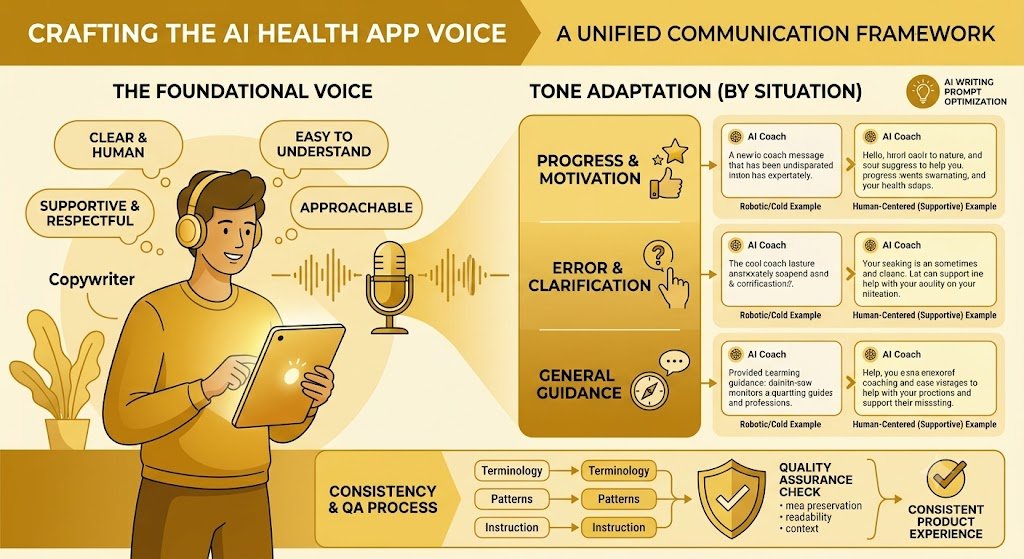
Voice and Tone Guide
Another major deliverable was a brief voice-and-tone guide.
A voice-and-tone guide provides a common reference for everyone involved in creating or maintaining product content.
The guide established practical communication principles that could be applied to both existing interface copy and future AI-generated content.
The guide could cover areas such as:
Voice
The product should communicate in a way that is:
- Clear
- Human
- Supportive
- Respectful
- Approachable
- Consistent
- Easy to understand
Tone
The tone can adapt depending on the situation while maintaining the same underlying voice.
For example, an encouraging message may sound warmer, while an error message may need to be more direct and practical. A progress message may be positive and motivating, while a clarification message may need to focus primarily on simplicity.
This distinction helped create flexibility without allowing the application’s communication style to become inconsistent.
Consistency Review
Consistency was another important part of the content audit.
Users develop expectations based on the language they encounter throughout an application. If similar actions are described using different terminology, users may wonder whether the actions themselves are different.
CnEL India reviewed terminology and messaging patterns to identify opportunities for greater consistency.
This included examining:
- Similar button labels.
- Repeated instructions.
- Common terminology.
- Sentence patterns.
- Capitalization.
- User references.
- Confirmation language.
- Error communication.
- Coaching language.
Creating consistency helps make an application feel more polished and easier to understand.
UX Writing and User Journey
The content was also considered from the perspective of the broader user journey.
A user does not experience individual sentences separately. They experience a sequence of interactions.
A message that works well at the beginning of a process may not be appropriate after the user has already completed several steps.
CnEL India therefore considered how content supports the progression of a user’s interaction with the application.
The review considered whether users received the right amount of information at the right moment and whether messages helped them understand what to do next.
This approach helped connect individual copy improvements with the overall product experience.
Content Quality Assurance
After the initial review, the revised content was checked for consistency and accuracy.
The quality-assurance process focused on ensuring that improvements did not unintentionally change the intended meaning.
This was particularly important for health-related content.
Changes were evaluated for:
- Meaning preservation.
- Grammar.
- Readability.
- Tone.
- Consistency.
- Contextual relevance.
- Clarity.
- User understanding.
The goal was to improve the language without introducing ambiguity or changing the intended communication.
Client Review and Revision
The project included a structured review process with the client.
After the initial content and communication recommendations were prepared, the findings were organized so that the client could understand not only what had been changed, but also why certain changes were recommended.
The review covered broader observations about tone, consistency, and AI-generated communication.
A 30-minute walkthrough session provided an opportunity to discuss the findings and clarify recommendations.
One revision round was then incorporated based on the client’s feedback.
This process ensured that the final content aligned with the product’s intended identity and communication goals.
Business Benefits
The project delivered benefits beyond grammatical correction.
Improved User Understanding
Clearer copy helps users understand instructions, actions, and application feedback more easily.
More Natural Communication
Refined language makes the product feel more polished and human rather than mechanically written.
Consistent Product Voice
A defined communication framework helps maintain consistency across screens and AI-generated responses.
Better AI Communication
Improved writing instructions provide clearer guidance for AI-generated coach messages.
Easier Future Content Development
The voice-and-tone guide provides a reusable reference for future interface copy and product updates.
Stronger User Experience
When content is clear, contextual, and supportive, users can navigate the application with greater confidence.
Scalable Communication Standards
The communication principles can be applied as the application introduces new features, messages, and user journeys.
CnEL India’s Contribution
CnEL India approached the project as a combination of UX content quality, AI communication design, and product experience improvement.
The work involved understanding the purpose of application messages, reviewing content in context, identifying communication patterns, improving clarity, and translating the desired communication style into practical AI writing instructions.
Rather than treating the assignment as simple proofreading, CnEL India focused on the relationship between language, user experience, and AI behavior.
This approach helped create a reusable communication foundation rather than a one-time collection of corrected sentences.
Future Scalability
The communication framework created through the project can support future product development.
As the health application grows, new features will require additional interface messages, notifications, instructions, coaching responses, and user guidance.
Without a defined communication standard, content can gradually become inconsistent as different contributors create new material.
The voice-and-tone guide and AI writing principles can help reduce that risk.
Future content can be reviewed against the established standards before being released. Similarly, new AI coach behaviors can be evaluated against the same communication principles.
This creates a scalable approach to maintaining product communication quality.
Conclusion
The AI health application project demonstrated that effective UX writing involves much more than correcting grammar.
For a product that combines health-related information with AI-powered coaching, communication needs to be clear, natural, supportive, consistent, and context-aware.
CnEL India reviewed approximately 4,000 words of application content, examined important coach messages, identified broader communication issues, recommended improvements to the AI writing instructions, and created a practical voice-and-tone framework.
The project ultimately focused on one central objective: helping the application communicate with users in a way that feels clear, trustworthy, supportive, and human while preserving the original meaning of the product’s content.
By combining detailed content review with AI communication optimization and reusable writing standards, CnEL India helped establish a stronger foundation for the application’s ongoing user experience and future content development.