
Project Overview
Professionals manage a large amount of information every day. Emails, meetings, tasks, notes, documents, travel plans, content ideas, research material, schedules, and personal projects can quickly become difficult to organize.
As the amount of information increases, people often spend significant time searching for information, remembering pending tasks, preparing schedules, writing repetitive messages, organizing notes, and moving information between different systems.
CnEL India worked on an AI-powered personal productivity and automation solution designed around the concept of a personal AI operating system and Second Brain.
The objective was to create a practical system that could understand recurring activities, organize information, automate repetitive workflows, and assist with daily planning while keeping the user in control of sensitive actions.
Rather than attempting to automate everything at once, the solution was designed as a gradual system. Workflows could be introduced one at a time, tested carefully, documented, and improved before additional processes were added.
The project combined AI-assisted decision-making, workflow automation, API-based integrations, information organization, personal knowledge management, content workflows, and human approval mechanisms.
The result was intended to be more than a collection of disconnected automations. It was designed as a connected productivity environment capable of helping manage information and recurring activities across professional and personal workflows.
Business and Productivity Challenge
Modern professionals frequently use multiple systems to manage different aspects of their lives.
One system may contain emails, another may contain tasks, another may store documents, and another may contain notes or calendar information.
The problem is not necessarily the availability of these systems. The problem is the amount of manual coordination required between them.
A typical day may involve:
- Reviewing incoming emails
- Creating tasks from messages
- Planning the day’s priorities
- Checking upcoming meetings
- Preparing responses
- Organizing notes
- Researching information
- Updating project records
- Planning travel
- Preparing content
- Reviewing previous information
- Following up on pending tasks
Many of these activities are repetitive.
The user needed a system that could reduce this administrative workload while preserving control over important decisions.
The automation also needed to be reliable.
A personal productivity system that creates incorrect tasks, sends messages without approval, loses information, or produces inconsistent results can create more problems than it solves.
Therefore, reliability, security, documentation, and human approval were treated as core requirements.
Project Objectives
CnEL India structured the project around several key objectives.
Create a Personal AI Assistant
The system needed to assist with daily professional and personal workflows.
Build a Second Brain
Important information needed to be organized so that it could be easily retrieved and reused.
Automate Repetitive Tasks
Recurring administrative activities needed to be handled automatically wherever appropriate.
Connect Different Workflows
Information should be able to move between approved systems without requiring repeated manual entry.
Maintain Human Control
Sensitive actions such as sending emails, publishing content, making bookings, or completing purchases should require approval.
Improve Daily Planning
The system should help organize priorities, tasks, schedules, and commitments.
Support Long-Term Expansion
The architecture needed to allow new workflows to be added gradually.
Understanding the Existing Workflow
The first stage involved understanding how the user currently managed information and tasks.
CnEL India reviewed the different categories of activities that could potentially benefit from automation.
These included:
- Communication
- Task management
- Scheduling
- Research
- Knowledge management
- Travel planning
- Content creation
- Social media planning
- Podcast workflows
- Video workflows
- Personal information organization
Not every activity needed immediate automation.
The project was therefore structured around prioritization.
High-value repetitive tasks could be automated first, while more complex or sensitive workflows could remain partially manual until the system became sufficiently reliable.
This approach reduced risk and allowed the automation to develop gradually.
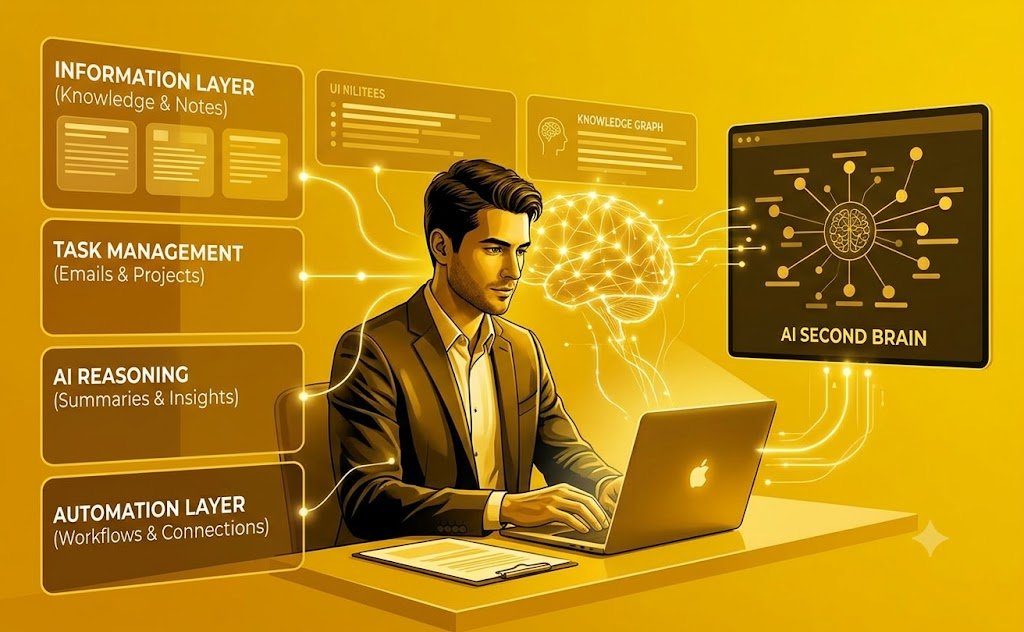
Designing the Personal AI Operating System
The central idea was to create a connected workflow environment.
Instead of treating each automation independently, CnEL India designed the system around several interconnected layers.
Information Layer
Stores and organizes useful knowledge, notes, documents, and historical information.
Task Layer
Manages tasks, priorities, deadlines, and pending actions.
Communication Layer
Processes messages and assists with drafting responses.
Planning Layer
Helps organize schedules, daily priorities, travel plans, and upcoming activities.
Automation Layer
Connects workflows and performs approved repetitive actions.
AI Reasoning Layer
Interprets information and helps determine the appropriate next step.
Approval Layer
Routes sensitive actions to the user before execution.
Documentation Layer
Records how workflows operate and how they should be maintained.
This structure creates a foundation for gradually expanding the personal AI system.
Building the Second Brain
A Second Brain is essentially a structured knowledge environment where important information can be stored, organized, and retrieved when needed.
CnEL India focused on making the knowledge system practical rather than simply creating a large collection of notes.
Information could be organized into categories such as:
- Projects
- Tasks
- Research
- Ideas
- Meetings
- Reference material
- Travel information
- Content ideas
- Personal planning
- Frequently used information
The AI layer could help summarize, categorize, connect, and retrieve information.
For example, information collected during research could later be connected to a related project or content idea.
This reduces the need for the user to remember where information was originally stored.
Task Management Automation
Task management was another important component.
Instead of manually creating every task, the system could identify actionable information from approved sources.
For example, an incoming message might contain a request requiring action.
The system could identify:
- What needs to be done
- Who is involved
- When it needs to be completed
- What information is required
- Whether the task is urgent
- Whether human confirmation is necessary
It could then prepare a structured task for review or automatically create it when the workflow was already approved.
This reduces the amount of administrative work required to maintain a task list.
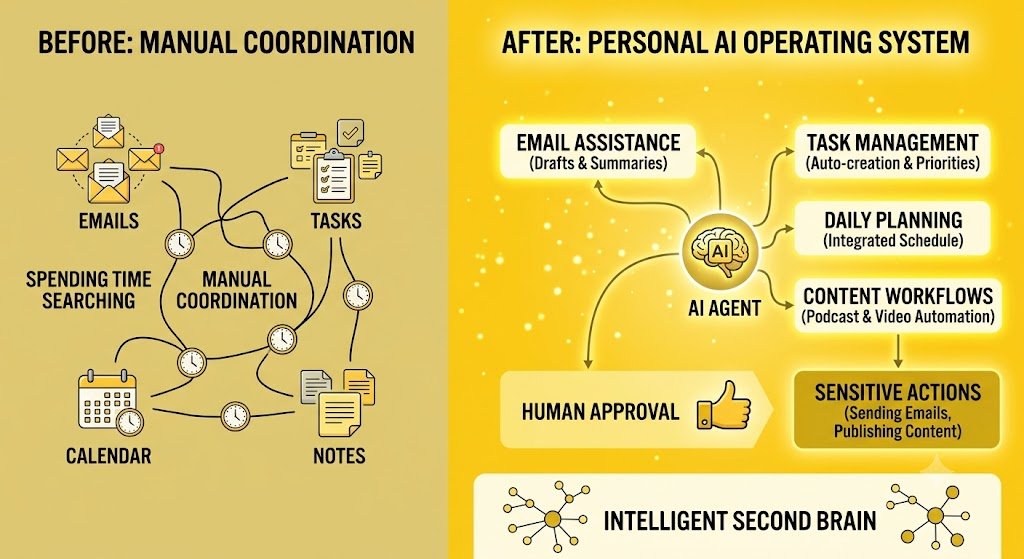
Email Assistance
Email management can consume a significant amount of professional time.
CnEL India designed the automation framework to support email-related workflows such as:
- Reviewing incoming messages
- Summarizing long conversations
- Identifying action items
- Drafting responses
- Categorizing messages
- Identifying follow-ups
- Preparing daily email summaries
The system could analyze the context of a conversation and prepare a suitable response.
However, sending the final message could remain behind an approval stage.
This is particularly important for personal and professional communication, where the user should remain responsible for the final decision.
Daily Planning
Another important objective was to create an intelligent daily planning workflow.
The system could combine information from different areas, such as:
- Pending tasks
- Upcoming meetings
- Deadlines
- Follow-ups
- High-priority projects
- Recently received requests
The AI layer could then prepare a structured daily plan.
Instead of simply listing every task, the system could organize information into categories such as:
Priority Tasks
Activities that require attention first.
Scheduled Activities
Meetings and time-bound commitments.
Pending Follow-Ups
Items waiting for action.
Optional Tasks
Lower-priority activities that can be completed if time allows.
This creates a more practical daily workflow.
Scheduling and Calendar Assistance
Scheduling involves multiple decisions and can become repetitive.
The system could assist with identifying available time, organizing commitments, and preparing scheduling recommendations.
For sensitive actions, the workflow could stop before making the final commitment.
The user would review the proposed schedule and approve the action.
This creates a balance between convenience and control.
Research and Travel Planning
The AI system could also support research-heavy workflows.
For travel planning, the system could help organize:
- Destination information
- Transportation options
- Accommodation research
- Activities
- Dates
- Estimated costs
- Itinerary structure
The important point was that the system would organize and summarize research rather than blindly making purchases.
Bookings and payments could remain behind explicit approval.
This approach reduces risk while still saving significant research time.
Podcast and Video Workflow Automation
Content production involves many repetitive steps.
CnEL India designed the framework so that AI-assisted workflows could support activities such as:
- Recording or receiving source content.
- Converting audio or video into text.
- Creating a structured transcript.
- Generating summaries.
- Identifying important sections.
- Preparing show notes.
- Extracting potential short-form content ideas.
- Preparing content descriptions.
- Creating publishing drafts.
- Sending final content for approval.
This workflow reduces the amount of manual preparation required after recording.
The user can focus more on creating the original content while the system handles repetitive post-production tasks.
Social Media Content Workflow
Social media planning can also be connected to the personal AI system.
The workflow could assist with:
- Content idea generation
- Content organization
- Repurposing long-form material
- Caption preparation
- Publishing schedules
- Content calendars
- Performance summaries
Instead of creating every post from scratch, the system could identify useful sections from existing content and prepare variations for different communication formats.
Publishing could remain subject to human approval.
This ensures that the final content reflects the user’s intended voice and messaging.
API and Workflow Integration
A major technical requirement was connecting different systems.
Instead of manually copying information between applications, the automation layer could transfer structured data between approved services.
For example:
Email Event → AI Analysis → Task Creation → Knowledge Update → Follow-Up Reminder
Another workflow could be:
Content Recording → Transcription → Summary → Content Ideas → Draft Creation → Human Approval
These workflows involve multiple stages.
CnEL India designed them so that each stage could process a specific responsibility and pass structured information to the next stage.
This makes complex automation easier to monitor and troubleshoot.
Human Approval and Safety Controls
Human approval was one of the most important aspects of the project.
Not every task should be fully automated.
The system could classify actions into different levels.
Low-Risk Actions
Examples include organizing information, generating summaries, categorizing notes, or preparing drafts.
These actions may be automated once sufficiently tested.
Medium-Risk Actions
Examples include creating tasks, updating records, or preparing communication.
These may require review depending on the workflow.
High-Risk Actions
Examples include:
- Sending external emails
- Publishing content
- Making bookings
- Completing purchases
- Sharing sensitive information
These actions could always require explicit user approval.
This layered approach allows automation to increase without sacrificing control.
Reliability and Error Handling
Reliability was treated as a fundamental requirement.
An automation system must account for situations where information is missing, ambiguous, or incorrect.
CnEL India incorporated mechanisms for:
- Input validation
- Error detection
- Workflow status tracking
- Retry handling
- Approval routing
- Action logging
- Failure notifications
- Duplicate prevention
If an AI agent was uncertain about a decision, it should not simply guess.
Instead, the workflow could pause and request human input.
This makes the system safer for real-world use.
Security and Confidential Information
A personal AI operating system may have access to sensitive professional and personal information.
Therefore, responsible information handling was an essential part of the architecture.
CnEL India focused on principles such as:
- Controlled access
- Permission-based actions
- Limited data exposure
- Secure information transfer
- Clear approval requirements
- Action logging
- Separation of sensitive workflows
The system should only access information necessary for a specific task.
This reduces unnecessary exposure and provides better control over personal information.
Workflow Documentation
A long-term automation system needs clear documentation.
Without documentation, even a successful automation can become difficult to maintain when workflows change.
CnEL India therefore emphasized documenting:
- Workflow purpose
- Inputs
- Processing steps
- Decision rules
- Expected outputs
- Approval stages
- Error conditions
- Maintenance requirements
This allows future improvements to be made without depending entirely on the original developer.
It also makes it easier to add new workflows.
Testing and Quality Assurance
Each workflow needed to be tested independently before becoming part of the broader personal AI system.
Testing included:
- Normal workflow execution
- Incorrect inputs
- Missing information
- Duplicate events
- Unclear instructions
- Approval scenarios
- Failed integrations
- Unexpected responses
- Data handling
- Final output quality
The objective was to make sure the automation behaved predictably.
Testing was especially important for workflows involving external communication or financial commitments.
These workflows needed additional approval and validation before being considered production-ready.
Business and Productivity Benefits
The solution provides several practical benefits.
Reduced Administrative Work
Repetitive activities can be automated or prepared automatically.
Better Organization
Information can be structured and connected across workflows.
Faster Research
AI-assisted research reduces time spent collecting and summarizing information.
Improved Daily Planning
Tasks, meetings, deadlines, and follow-ups can be organized into a single planning workflow.
Better Knowledge Retention
Important information becomes easier to store and retrieve.
Consistent Processes
Documented workflows reduce reliance on memory.
Controlled Automation
Human approval remains available for important decisions.
Scalable Productivity
New workflows can be added as the user’s needs evolve.
CnEL India’s Contribution
CnEL India approached the project as a long-term automation architecture rather than a one-time implementation.
The contribution included:
- Understanding existing workflows
- Identifying automation opportunities
- Designing the personal AI architecture
- Structuring the Second Brain
- Creating workflow logic
- Connecting information sources
- Designing AI-assisted processes
- Building approval mechanisms
- Implementing logging and error handling
- Supporting research workflows
- Designing content automation
- Creating documentation
- Testing individual workflows
- Preparing the system for future expansion
The emphasis remained on reliability, simplicity, and gradual implementation.
Future Scalability
The personal AI operating system can grow over time.
Additional workflows could support:
- Project management
- Financial organization
- Customer communication
- Business research
- Document processing
- Meeting preparation
- Personal knowledge management
- Automated reporting
- Content distribution
- Routine administrative tasks
The system can also become increasingly personalized as more workflows, preferences, rules, and knowledge are documented.
The objective is not to replace the user’s judgment.
Instead, the system becomes a structured digital assistant that handles repetitive work and presents useful information at the right time.
Conclusion
Building a personal AI operating system requires more than connecting an AI model to a collection of applications.
A useful system needs a clear architecture, well-defined workflows, reliable automation, structured information management, security controls, documentation, and human approval.
CnEL India’s approach focused on building these foundations gradually.
The resulting framework can help manage emails, tasks, schedules, research, travel planning, content production, social media workflows, and personal knowledge while keeping important decisions under human control.
The Second Brain component provides a structured place for information, while the automation layer turns that information into useful actions.
With proper testing, documentation, logging, and approval mechanisms, AI can become a practical part of everyday professional and personal operations.
The long-term value lies in creating a system that continuously reduces repetitive work, improves organization, and helps the user spend more time on high-value activities while retaining full control over sensitive decisions.