
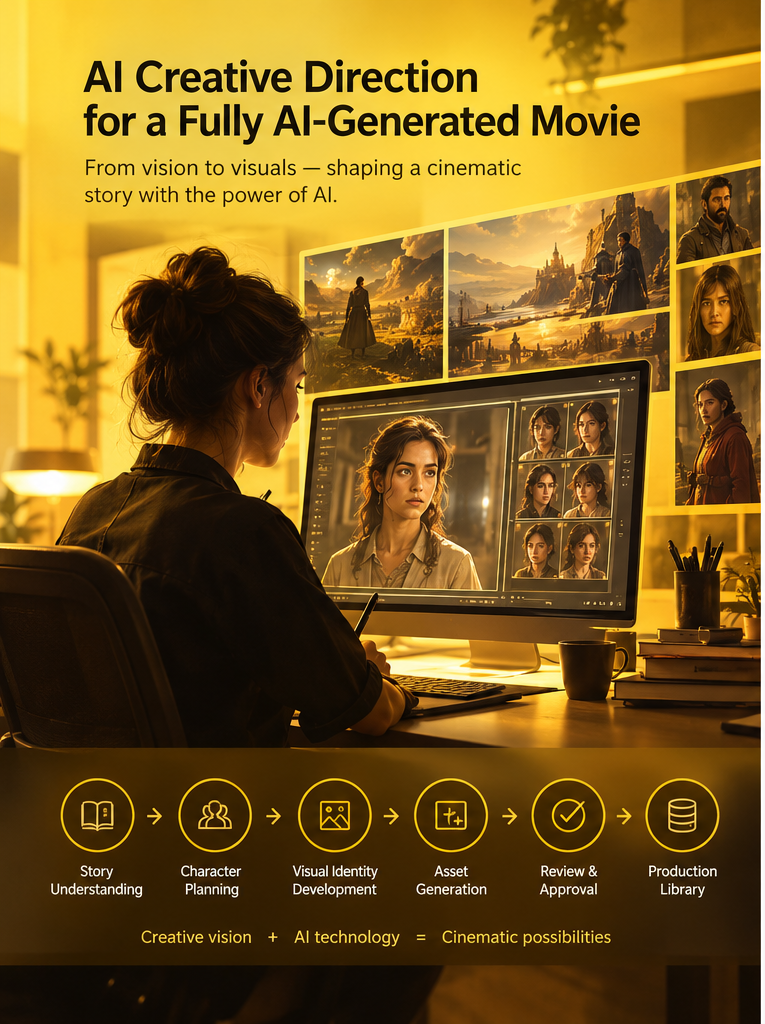
Project Overview
The film and entertainment industry is rapidly evolving as artificial intelligence becomes capable of supporting visual development, character creation, cinematic storytelling, scene generation, and post-production workflows. However, creating an entire movie with AI is significantly more complex than generating individual images or short video clips.
CnEL India worked on an AI-driven filmmaking workflow designed to support the development of a completely AI-generated movie. The project required a combination of creative direction, visual development, character consistency, storytelling, production planning, and quality control.
The objective was to establish a production pipeline where artificial intelligence could assist with the creation of a complete cinematic experience while ensuring that every creative decision remained aligned with the vision of the Creative Director.
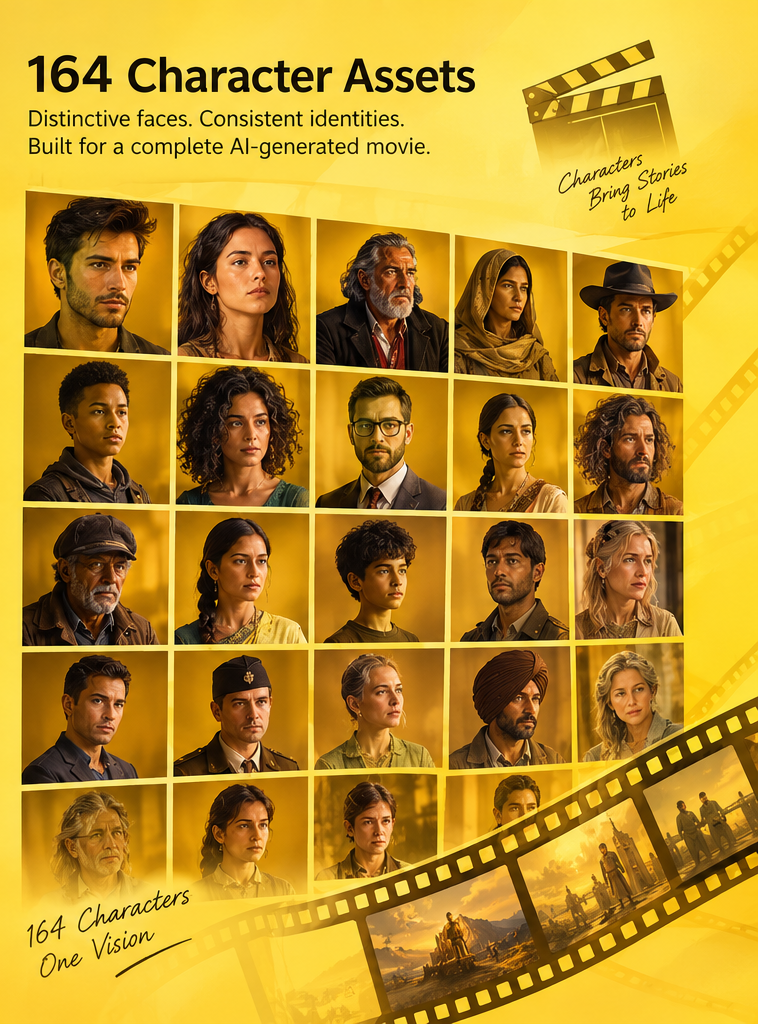
The first major production milestone was the creation of 164 character assets.
These assets formed the visual foundation for the movie and needed to be developed with consistency, storytelling relevance, and future production requirements in mind.
Rather than approaching the task as simple image generation, CnEL India treated it as a structured AI filmmaking and visual asset development project.
The Client’s Vision
The production company wanted to create a movie almost entirely through artificial intelligence.
The Creative Director already had the overall creative vision and required an AI-focused creative professional who could translate that vision into a practical production workflow.
The role involved much more than generating visuals.
The AI creative team needed to understand:
- The story and narrative structure
- Character personalities
- Character relationships
- Visual identity
- Cinematic style
- Environment requirements
- Continuity between scenes
- Emotional expressions
- Wardrobe requirements
- Camera perspectives
- Future animation and video requirements
The final movie needed to feel like one cohesive cinematic production rather than a collection of unrelated AI-generated visuals.
This was the central challenge of the project.
The Challenge
Traditional filmmaking typically relies on actors, costume designers, makeup artists, cinematographers, set designers, photographers, and production crews to maintain visual consistency.
In an AI-generated movie, many of these elements must be translated into structured digital assets and creative instructions.
A character generated successfully in one scene might look completely different in another scene if the visual characteristics are not carefully controlled.
For a large movie project, this creates a major continuity problem.
The production team therefore needed a system that could maintain consistency across a large number of characters and visual situations.
The initial requirement of creating 164 character assets introduced several challenges.
Character Identity
Every character needed a recognizable visual identity.
Important characteristics included:
- Facial structure
- Age appearance
- Hair
- Skin details
- Body structure
- Clothing
- Accessories
- Overall personality
- Visual style
These characteristics needed to remain consistent across different assets.
Emotional Range
Characters also needed to support different emotional states.
A character may appear:
- Happy
- Angry
- Sad
- Confused
- Excited
- Frightened
- Serious
- Calm
- Determined
Creating these expressions while preserving the same identity was an important part of the process.
Cinematic Requirements
The assets could not be designed only for static presentation.
They needed to support future cinematic production.
This meant considering different:
- Camera angles
- Framing
- Lighting conditions
- Expressions
- Poses
- Environments
- Clothing combinations
The character assets therefore had to function as production-ready references for later stages of the movie.
CnEL India’s Approach
CnEL India developed a structured AI creative workflow consisting of several stages:
Story Understanding → Character Planning → Visual Identity Development → Asset Generation → Consistency Review → Creative Approval → Production Library
This approach helped transform a large and potentially chaotic generation task into an organized production process.
1. Understanding the Story
Before creating the character assets, the creative requirements were analyzed carefully.
The goal was to understand the role each character played within the movie.
Characters were evaluated according to:
- Narrative importance
- Personality
- Relationships
- Visual identity
- Age group
- Role within the story
- Expected screen presence
- Emotional requirements
- Costume requirements
This prevented the asset-generation process from becoming purely visual.
Every character had a reason to exist within the story.
The creative team could therefore design the character according to its narrative purpose rather than simply creating attractive-looking images.
2. Character Asset Planning
With 164 assets required, organization was extremely important.
Instead of generating assets randomly, CnEL India established a structured character-development framework.
Each character was associated with a defined visual profile.
The profile could include:
Identity
- Name or internal character identifier
- Age range
- Gender presentation
- Physical characteristics
Appearance
- Facial features
- Hairstyle
- Body structure
- Skin characteristics
Wardrobe
- Primary clothing
- Secondary clothing
- Accessories
- Style guidelines
Personality
- General temperament
- Behavioral characteristics
- Emotional tendencies
Cinematic Requirements
- Common poses
- Expressions
- Camera perspectives
- Lighting conditions
This information created a consistent reference point for the entire production.
3. Building Character Identity
The next stage involved developing the visual identity of each character.
The objective was to create characters that were:
- Visually distinctive
- Consistent
- Appropriate for the story
- Suitable for cinematic production
- Reusable across multiple scenes
The character’s face was treated as a key identity component.
Small differences in facial structure can make an AI-generated character appear to be an entirely different person.
Therefore, the visual development process focused heavily on maintaining recognizable facial characteristics.
Hair, clothing, accessories, body proportions, and other identifying elements were also considered.
The result was a character reference that could be used repeatedly throughout future stages of production.
4. Creating the 164 Character Assets
The first major deliverable consisted of 164 character assets.
Each asset was created according to the established visual direction.
Rather than focusing solely on quantity, CnEL India emphasized production usability.
Every generated asset was evaluated against the character’s approved identity.
The team considered:
- Is the character recognizable?
- Does the character match the established appearance?
- Is the wardrobe appropriate?
- Does the expression fit the intended role?
- Does the image maintain the required cinematic style?
- Is the character suitable for future scene generation?
- Does the asset align with the Creative Director’s vision?
This quality-driven process was essential because a single inconsistent character reference could create problems across many future scenes.
5. Maintaining Visual Consistency
Consistency was one of the most important technical and creative challenges.
When creating a movie using AI, each new generation can introduce subtle differences.
For example, the same character might appear with:
- Slightly different facial proportions
- Different hairstyle
- Different clothing
- Different age appearance
- Different body structure
- Different skin characteristics
These inconsistencies can become highly visible when scenes are placed next to one another.
CnEL India therefore introduced a review process for comparing character outputs against approved references.
The team looked for visual drift and rejected assets that moved too far away from the intended identity.
This created a controlled character library that could serve as the visual source of truth for later filmmaking stages.
6. Prompt and Creative Direction
A major part of AI filmmaking is the ability to translate creative concepts into precise instructions.
CnEL India’s workflow used structured visual instructions covering:
- Character identity
- Environment
- Mood
- Lighting
- Composition
- Camera perspective
- Expression
- Pose
- Wardrobe
- Cinematic atmosphere
The goal was not simply to describe what should appear in an image.
The instructions needed to communicate how the scene should feel.
For example, a dramatic scene may require low-key lighting, a serious expression, controlled composition, and a tense atmosphere.
A lighter scene might require brighter lighting, relaxed body language, warmer surroundings, and a more open composition.
This creative translation process helped connect the Creative Director’s vision with the AI production workflow.
7. Quality Control
Generating 164 assets required a strong quality-control process.
Every asset was reviewed before being considered part of the production library.
The QC process examined several dimensions.
Visual Quality
The image needed to be sharp, coherent, and professionally presented.
Character Accuracy
The character needed to match the approved identity.
Expression
The facial expression needed to match the intended emotional direction.
Wardrobe
Clothing and accessories needed to remain consistent with the character design.
Anatomy
The team checked for:
- Incorrect hands
- Distorted fingers
- Unnatural body proportions
- Facial abnormalities
- Visual artifacts
Composition
The character needed to be positioned appropriately for future cinematic use.
Creative Alignment
Most importantly, the asset needed to satisfy the Creative Director’s intended visual direction.
This final criterion ensured that technical quality did not replace creative quality.
8. Creative Director Approval
Because the project was being developed as a movie, the Creative Director remained the final authority on creative decisions.
CnEL India’s role was to support the Creative Director by turning the creative vision into an efficient AI production process.
The workflow therefore included an approval loop:
Generate → Review → Refine → Present → Approve → Archive
If an asset did not meet expectations, it was refined rather than immediately accepted.
Feedback could relate to:
- Facial appearance
- Expression
- Wardrobe
- Mood
- Lighting
- Character personality
- Cinematic style
This collaborative approach helped ensure that AI-generated content remained aligned with the human creative vision.
9. Creating a Reusable Production Library
One of the most important outcomes of the first stage was the creation of a structured character library.
The 164 approved assets became reusable visual references for future movie production.
This provided a strong foundation for subsequent stages such as:
- Scene development
- Environment creation
- Character interaction
- Cinematic sequences
- Animation
- Video generation
- Story visualization
- Promotional material
Instead of recreating characters from scratch every time, the production team could work from established visual references.
This significantly improved the potential for consistency throughout the movie.
Business and Creative Value
The project demonstrated several important advantages of an AI-first filmmaking workflow.
Scalable Character Development
Creating a large number of character assets manually can require significant time and resources.
AI-assisted production allowed the team to develop a large character library within a structured workflow.
Faster Creative Iteration
Creative concepts could be visualized quickly and refined based on feedback.
Greater Creative Exploration
Multiple visual directions could be explored before selecting the final design.
Improved Production Efficiency
Once character references were approved, they could be reused throughout the filmmaking process.
Centralized Visual Consistency
A structured character library provided a common visual reference for future production.
Reduced Repetitive Work
AI handled much of the repetitive visual-generation process, allowing creative professionals to focus more on direction, review, and storytelling.
CnEL India’s Role
CnEL India approached the project as a combination of AI engineering, creative production, and workflow management.
The company did not treat artificial intelligence as a replacement for creative direction.
Instead, AI was positioned as a production accelerator.
Human creative judgment remained essential for:
- Story interpretation
- Character development
- Visual direction
- Quality evaluation
- Creative approval
- Continuity management
The AI workflow handled the repetitive generation process while the creative team controlled the final output.
This balance created a practical production model for large-scale AI filmmaking.
Key Outcome
The completion of 164 character assets established the visual foundation for the movie.
More importantly, the project created a repeatable methodology for AI-based filmmaking.
The team developed a structured process for:
Character Definition → Visual Generation → Consistency Management → Quality Control → Creative Approval → Production Readiness
This framework could be expanded beyond character development into complete cinematic production.
The initial asset-development stage therefore represented more than a collection of images.
It established the visual language and production infrastructure required for the movie.
Conclusion
Creating a fully AI-generated movie requires significantly more than generating individual visuals.
It requires a combination of storytelling, creative direction, visual consistency, technical understanding, asset management, quality control, and production discipline.
CnEL India’s work on the project demonstrated how these elements can be combined into a structured AI filmmaking workflow.
The creation of 164 character assets represented the first major milestone in that journey. Each character was developed with future production requirements in mind, ensuring that the assets could become reusable references throughout the movie’s development.
By combining AI-assisted visual production with human creative judgment and systematic quality control, CnEL India established a scalable approach to AI-powered filmmaking.
The project demonstrated the potential to move from isolated AI-generated visuals toward an organized cinematic production pipeline—one capable of supporting characters, scenes, environments, storytelling, and eventually an entire movie.
The most important principle behind the project was simple:
AI can accelerate filmmaking, but creative direction, consistency, and quality control turn generated content into a movie.