
Case Study by CnEL India
Introduction
In today’s B2B environment, publishing high-quality long-form content is only the first step toward building authority. Many founders, consultants, and executives invest significant time writing detailed articles that contain valuable insights, research, and industry expertise, but those articles often reach only a small portion of their potential audience. Busy decision-makers rarely consume lengthy content in a single sitting, preferring shorter, platform-specific formats that deliver key ideas quickly.
For consulting businesses, especially those operating in specialized areas like pricing strategy, packaging optimization, and revenue growth, a well-executed content distribution strategy can significantly increase visibility, generate qualified leads, and strengthen brand authority. However, manually converting every article into multiple formats, publishing across different channels, and maintaining a consistent schedule becomes increasingly difficult as content production grows.
CnEL India specializes in intelligent content management systems that combine content repurposing, workflow automation, multi-channel publishing, and scalable editorial processes. Rather than treating content creation and distribution as separate activities, the approach builds a unified system where a single long-form article becomes the foundation for an entire ecosystem of shorter, high-performing content.
This case study explains how CnEL India can transform a B2B consulting company’s content workflow into an efficient, automated, and scalable operation that maximizes the value of every published article.
Business Background
The client is a technology-enabled pricing and packaging consultancy serving business-to-business organizations. Their audience consists primarily of:
-
Founders
-
Business executives
-
Investors
-
Revenue leaders
-
Product leaders
-
Pricing professionals
-
Business decision-makers
Their long-form articles contain valuable insights on topics such as pricing strategy, packaging decisions, revenue optimization, and business growth.
While these articles establish expertise, several operational challenges limit their impact:
-
Long articles require manual repurposing.
-
Content distribution consumes significant time.
-
Publishing schedules become inconsistent.
-
Different platforms require different formats.
-
Valuable insights remain underutilized.
-
Repetitive tasks reduce productivity.
-
Content performance is difficult to scale.
CnEL India designed a centralized content management and automation workflow that solves these challenges while preserving the quality and authority of the original content.
Project Objectives
The primary objective is to create an intelligent content ecosystem where every long-form article automatically becomes the source for multiple shorter content formats while supporting organized distribution and future scalability.
The project focuses on:
-
Long-form content management
-
Content repurposing
-
Multi-format content creation
-
Editorial workflow automation
-
Multi-channel publishing
-
Content scheduling
-
Brand consistency
-
Audience-specific messaging
-
Content approval workflows
-
Performance tracking
-
Scalable operations
-
Knowledge preservation
The goal is to maximize content reach without increasing manual workload.
Understanding the Content Strategy
CnEL India begins by understanding the client’s content philosophy before designing the workflow.
The discovery process examines:
-
Content goals
-
Target audience
-
Brand voice
-
Editorial style
-
Publishing frequency
-
Content categories
-
Existing workflows
-
Approval processes
-
Distribution channels
-
Future content plans
This ensures that automation supports the client’s existing expertise rather than changing its identity.
Centralized Content Repository
Every workflow begins with a single source of truth.
CnEL India organizes long-form articles into a structured content repository containing:
-
Article title
-
Publication date
-
Primary topic
-
Keywords
-
Target audience
-
Content category
-
Status
-
Supporting assets
-
Distribution history
A centralized repository prevents duplication and simplifies future content reuse.
Content Repurposing Framework
Instead of treating each article as a one-time publication, CnEL India builds a systematic repurposing process.
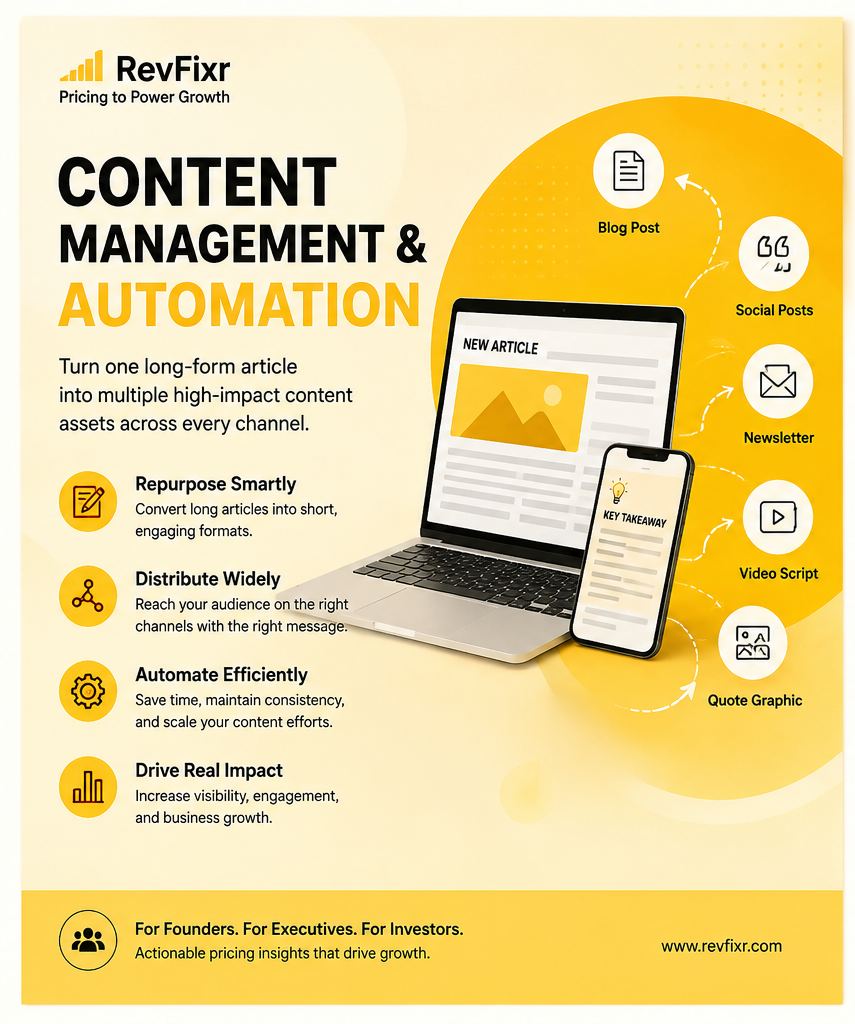
A single article can generate multiple assets, including:
-
Executive summaries
-
Social posts
-
Quote graphics
-
Business tips
-
Short educational content
-
Newsletter snippets
-
Discussion prompts
-
Carousel content
-
Video scripts
-
Key takeaways
This dramatically increases the lifetime value of every article.
Executive Summary Creation
Busy executives often prefer concise insights.
CnEL India creates executive summaries that preserve the core message while reducing reading time.
Each summary emphasizes:
-
Main insight
-
Business impact
-
Practical takeaway
-
Decision-making value
-
Clear structure
This format appeals to senior business leaders.
Short-Form Educational Content
Not every platform favors long-form reading.
The workflow converts important concepts into short educational content that communicates:
-
One idea
-
One lesson
-
One actionable insight
-
One business example
Short-form content increases engagement opportunities.
Platform-Specific Content Adaptation
Different platforms encourage different communication styles.
CnEL India adapts content based on audience expectations rather than copying identical posts everywhere.
Adaptation considers:
-
Content length
-
Reading behavior
-
Professional tone
-
Engagement style
-
Visual presentation
-
Call-to-action placement
This creates a more natural publishing experience.
Brand Voice Consistency
One major challenge in content scaling is maintaining a recognizable voice.
CnEL India preserves consistency by defining editorial guidelines covering:
-
Tone
-
Vocabulary
-
Sentence style
-
Professional positioning
-
Educational focus
-
Business credibility
Every repurposed asset reflects the original brand personality.
Editorial Workflow
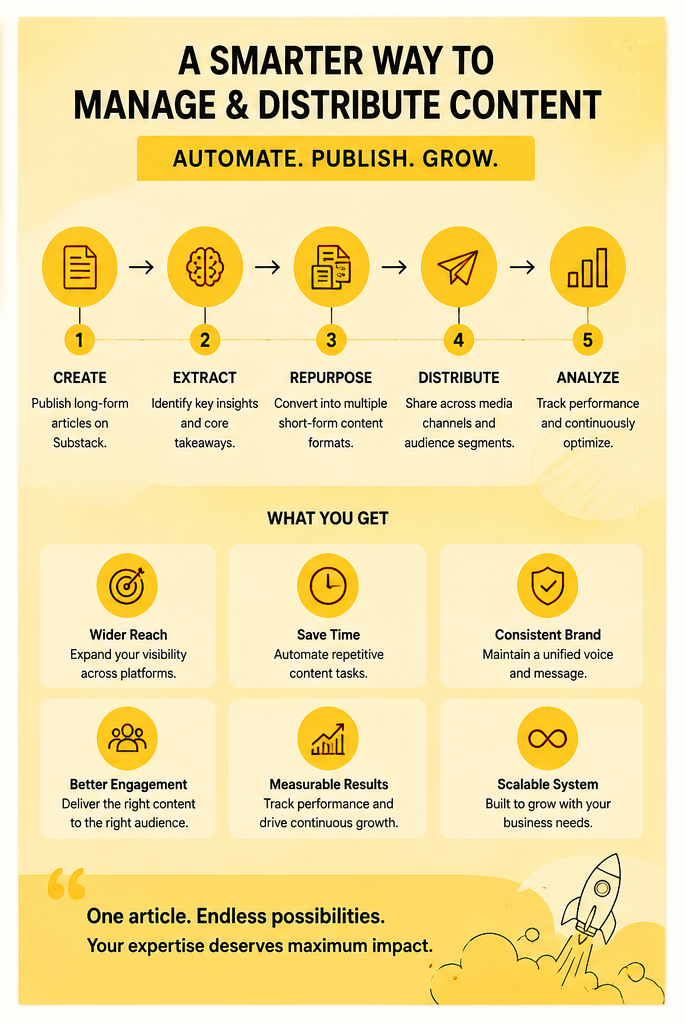
The automation system includes a structured editorial process.
Typical workflow stages include:
-
Article published
-
Content analysis
-
Key insight extraction
-
Short-form creation
-
Editorial review
-
Approval
-
Scheduling
-
Distribution
-
Performance monitoring
-
Content archive
This ensures quality while reducing repetitive work.
Content Scheduling
Consistent publishing strengthens audience engagement.
CnEL India develops scheduling workflows that support:
-
Daily publishing
-
Weekly campaigns
-
Monthly themes
-
Evergreen content rotation
-
Timely industry discussions
Organized scheduling reduces manual planning.
Multi-Channel Distribution
A single content asset can serve multiple audiences.
The distribution framework organizes publishing across appropriate channels while maintaining:
-
Consistent messaging
-
Correct formatting
-
Brand alignment
-
Audience relevance
-
Publishing history
Centralized distribution simplifies management.
Evergreen Content Strategy
Many pricing and packaging insights remain valuable long after publication.
CnEL India identifies evergreen content that can be:
-
Republished
-
Updated
-
Reused
-
Repositioned
-
Combined with new insights
This extends the lifespan of valuable knowledge.
Topic Clustering
Instead of publishing isolated content, related topics are organized into clusters.
Example themes include:
-
Pricing strategy
-
Packaging optimization
-
Revenue growth
-
Customer willingness to pay
-
Product positioning
-
Business expansion
Topic clusters strengthen long-term content authority.
Audience Segmentation
Different audiences value different messages.
CnEL India structures messaging for:
Founders
Growth-focused insights.
Executives
Strategic decision-making.
Investors
Business performance perspectives.
Revenue Leaders
Pricing execution guidance.
Product Teams
Packaging strategy recommendations.
Segmentation improves relevance.
Workflow Automation
The automation system reduces repetitive operational tasks.
Automated activities may include:
-
Content organization
-
Status updates
-
Publishing preparation
-
Scheduling support
-
Distribution tracking
-
Archive management
-
Approval notifications
Automation allows teams to focus more on strategic content creation.
Approval Management
Content quality remains essential.
CnEL India incorporates approval checkpoints where editors can:
-
Review messaging
-
Adjust wording
-
Verify accuracy
-
Maintain brand voice
-
Approve publication
Human oversight preserves professional credibility.
Content Performance Tracking
Publishing alone is not enough.
The system tracks content performance through measurable indicators such as:
-
Reach
-
Engagement
-
Click activity
-
Content popularity
-
Topic performance
-
Publishing consistency
-
Audience response
Performance insights support future optimization.
Knowledge Preservation
As the content library grows, valuable expertise should remain accessible.
CnEL India organizes content for future retrieval through:
-
Categories
-
Topics
-
Keywords
-
Publication history
-
Audience tags
-
Related articles
This transforms individual articles into a searchable knowledge base.
Scalability
The workflow is designed for long-term growth.
Future expansion can include:
-
Larger content libraries
-
Multiple authors
-
Additional business topics
-
Expanded publishing channels
-
Editorial collaboration
-
Client-facing knowledge portals
The architecture remains flexible as content operations evolve.
Security and Content Governance
Professional consulting content represents valuable intellectual property.
CnEL India supports governance through:
-
Controlled editing access
-
Approval permissions
-
Version tracking
-
Content ownership
-
Publishing history
-
Archive protection
These controls help maintain content integrity.
Testing and Validation
Before deployment, the workflow undergoes comprehensive validation.
Testing includes:
Content Accuracy
Ensuring repurposed content preserves original meaning.
Workflow Testing
Verifying process continuity.
Approval Testing
Checking review stages.
Distribution Testing
Confirming publishing readiness.
Archive Validation
Ensuring content remains organized.
Performance Verification
Confirming tracking functionality.
Quality assurance improves operational reliability.
Business Benefits
The completed content management system delivers measurable advantages.
Expected benefits include:
-
Increased content reach
-
Better thought leadership visibility
-
Reduced manual effort
-
Faster content distribution
-
Stronger publishing consistency
-
Better audience engagement
-
Improved brand authority
-
Higher content reuse
-
Scalable editorial operations
-
Better knowledge management
-
More efficient workflows
-
Long-term content value
Challenges Solved
CnEL India addresses several common content operation challenges.
Manual Repurposing
Automation reduces repetitive work.
Inconsistent Publishing
Scheduling improves consistency.
Platform Differences
Content adapts naturally.
Content Waste
Every article generates multiple assets.
Brand Inconsistency
Editorial guidelines maintain voice.
Limited Scalability
Centralized workflows support growth.
Approval Delays
Structured review improves efficiency.
Knowledge Loss
Content remains organized and reusable.
Why CnEL India
CnEL India combines expertise in content strategy, business automation, workflow optimization, editorial systems, digital publishing, knowledge management, scalable software development, and process design.
Rather than simply distributing articles, CnEL India builds intelligent content ecosystems that transform every long-form publication into a long-lasting business asset capable of generating sustained engagement, stronger authority, and measurable business value.
Every solution emphasizes scalability, consistency, operational efficiency, and future-ready content management.
Conclusion
This case study demonstrates how CnEL India transforms traditional content publishing into an intelligent, automated, and scalable thought leadership ecosystem.
By combining centralized content management, structured repurposing, audience segmentation, editorial workflows, automated distribution, evergreen content strategies, performance tracking, and scalable governance, the solution enables consulting businesses to maximize the impact of every article they create.
The result is a professional content operation that strengthens brand authority, improves audience engagement, reduces manual workload, preserves valuable business knowledge, and creates a sustainable foundation for long-term digital growth.