
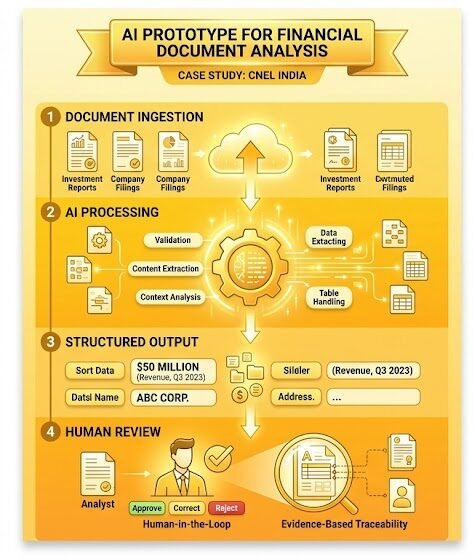
Case Study for CnEL India
Introduction
Financial organizations, investment teams, analysts, and business professionals work with large volumes of complex documents every day. Investment reports, company filings, transaction documents, financial statements, internal reports, and supporting materials contain valuable information, but extracting that information manually can be time-consuming and difficult.
A single financial document may contain hundreds of pages, tables, footnotes, charts, disclosures, historical figures, transaction details, and management commentary. Analysts often need to search through these documents to identify specific figures, understand important changes, compare information, and prepare summaries for further analysis.
The challenge becomes even greater when information is presented in different formats. Some documents may contain structured tables, while others may use narrative descriptions, scanned pages, or inconsistent terminology. Manual processing increases the possibility of missed information, transcription errors, and inconsistent interpretation.
CnEL India approached this challenge by designing an AI-powered prototype capable of reviewing financial documents and converting relevant information into structured, reviewable outputs. The objective was not simply to automate document reading, but to create a reliable workflow where extracted information could be checked by a human before being used for financial analysis.
The prototype demonstrates how intelligent document processing can reduce repetitive work while maintaining an important layer of human oversight.
Business Background
Financial analysis requires accuracy, consistency, and efficient information management.
Traditional document analysis generally involves several manual steps:
- Receiving financial documents
- Opening and reviewing files
- Searching for relevant information
- Identifying financial figures
- Reading supporting explanations
- Copying information into spreadsheets
- Preparing summaries
- Comparing figures
- Checking calculations
- Reviewing the final information
When the number of documents increases, this process becomes difficult to manage.
Analysts may spend a significant amount of time performing repetitive extraction tasks instead of focusing on higher-value activities such as interpretation, research, decision-making, and strategic analysis.
The proposed AI prototype addresses this challenge by creating a structured workflow for document ingestion, information extraction, summarization, validation, and human review.
Project Objectives
The primary objective was to build a working prototype capable of processing financial documents and transforming unstructured information into useful structured outputs.
The project focused on several key objectives:
- Upload and process financial documents
- Identify relevant financial information
- Extract important figures
- Understand document context
- Generate concise summaries
- Organize extracted information into structured fields
- Provide evidence for extracted information
- Allow human review and correction
- Identify potential extraction issues
- Evaluate accuracy
- Establish a foundation for future production development
The prototype was intentionally designed as an early-stage solution. Rather than attempting to automate every financial analysis process immediately, the focus was placed on proving the core workflow and identifying what would be required for a reliable production system.
Understanding the Financial Documents
The first stage involved understanding the types of documents that the system would need to process.
Potential document categories include:
Investment Reports
These may contain investment performance, portfolio information, asset allocations, returns, and commentary.
Company Filings
These can contain revenue, expenses, assets, liabilities, earnings, management commentary, and other corporate information.
Transaction Documents
These may contain purchase prices, transaction values, ownership information, dates, parties, and contractual details.
Internal Financial Materials
These may include internal reports, financial summaries, operational documents, forecasts, and supporting analysis.
Each document type has different structures and terminology. Therefore, the prototype needed to remain flexible rather than relying on a single fixed document format.
Document Processing Workflow
CnEL India designed the prototype around a structured processing pipeline.
The general workflow consists of:
- Document upload
- Document validation
- Content extraction
- Document segmentation
- Relevant information identification
- Financial figure extraction
- Context analysis
- Structured output generation
- Summary creation
- Human review
- Correction and validation
- Final export
This workflow ensures that extracted information does not immediately become a final analytical output without appropriate review.
Document Upload and Validation
The process begins when a user uploads a financial document.
The system validates the document to determine whether it can be processed successfully.
Validation may include:
- File format
- File integrity
- Document readability
- Page count
- Text availability
- Table presence
- Scanned content
- Document size
This initial step prevents unsuitable files from entering the analysis workflow.
Content Extraction
Once a document is accepted, the system processes its contents.
The prototype identifies:
- Headings
- Paragraphs
- Tables
- Financial figures
- Dates
- Company names
- Transaction information
- Currency values
- Percentages
- Important disclosures
The extracted content is organized so that subsequent processing can understand the relationship between different sections.
Context-Aware Financial Extraction
Financial numbers cannot always be understood in isolation.
For example, a number such as “$50 million” may represent revenue, debt, investment value, transaction value, or another financial metric.
Therefore, the system needs to understand surrounding context.
The prototype evaluates:
- The heading associated with the figure
- Nearby text
- Table labels
- Reporting periods
- Currency
- Units
- Financial terminology
- Supporting explanations
This helps reduce incorrect interpretation of individual figures.
Structured Information
One of the primary objectives was converting unstructured financial information into structured records.
A structured output may include:
- Company name
- Reporting period
- Financial metric
- Reported value
- Currency
- Unit
- Source section
- Relevant context
- Confidence indicator
- Review status
This makes extracted information easier for analysts to inspect and use.
Financial Figure Extraction
Financial documents frequently contain important quantitative information.
The prototype can identify figures such as:
- Revenue
- Net income
- Operating expenses
- Assets
- Liabilities
- Cash flow
- Investment value
- Transaction value
- Debt
- Equity
- Growth rates
- Margins
- Percentages
The system also attempts to preserve the relationship between each figure and its reporting period.
This is particularly important because the same financial metric may appear multiple times throughout a document.
Handling Tables
Financial information is often presented in tables.
Tables can contain:
- Multiple years
- Multiple business segments
- Several financial categories
- Comparative figures
- Percent changes
- Historical data
The prototype therefore considers table structure when extracting information.
Instead of treating every number as an independent value, the system attempts to understand row and column relationships.
This improves the usefulness of extracted financial information.
Summary Generation
In addition to extracting figures, the system generates summaries of important document findings.
A summary can highlight:
- Major financial results
- Significant changes
- Important transactions
- Performance trends
- Key risks or disclosures
- Management commentary
- Notable financial events
The purpose is to help analysts understand the document quickly without replacing detailed review.
Evidence-Based Outputs
Accuracy is particularly important when working with financial information.
For this reason, the prototype emphasizes traceability.
Where possible, extracted information should be connected to its original location in the document.
The review interface can provide:
- Extracted value
- Supporting text
- Document page
- Section reference
- Context surrounding the figure
This allows a reviewer to verify whether the extracted information accurately represents the original document.
Human Review Process
Human review is one of the most important components of the prototype.
Instead of assuming that every AI-generated result is correct, the workflow gives analysts an opportunity to verify the output.
A reviewer can:
- Accept an extracted value
- Correct an incorrect value
- Reject irrelevant information
- Modify a summary
- Confirm document context
- Mark an item for further investigation
This creates a human-in-the-loop workflow.
Confidence and Review Prioritization
Not every extracted item has the same level of certainty.
The system can assign confidence indicators based on factors such as:
- Quality of extracted text
- Clarity of context
- Structure of the document
- Consistency of information
- Recognition quality
- Ambiguity
Lower-confidence items can be prioritized for human review.
This allows analysts to focus their attention where it is most needed.
Accuracy Validation
Accuracy was treated as a core project requirement.
CnEL India designed the prototype with validation in mind rather than focusing solely on extraction speed.
Testing can compare AI-generated outputs against manually verified information.
Important evaluation areas include:
- Figure accuracy
- Context accuracy
- Date accuracy
- Currency accuracy
- Table interpretation
- Summary quality
- Source traceability
This process helps identify weaknesses before the workflow is considered for production.
Handling Ambiguous Information
Financial documents sometimes contain unclear or conflicting information.
For example, the same metric may appear in:
- A summary section
- A detailed table
- A footnote
- A management discussion
The prototype should not blindly select one value without considering context.
Instead, ambiguous information can be flagged for human review.
This is particularly important for financial workflows where incorrect assumptions can lead to incorrect analysis.
Data Privacy and Security
Financial documents may contain sensitive business information.
Therefore, security must be considered throughout the system architecture.
Important areas include:
- Secure document handling
- Controlled user access
- Data encryption
- Secure storage
- Access logging
- Permission management
- Controlled document deletion
- Protection of extracted information
A production implementation would require additional security controls based on the organization’s specific regulatory and operational requirements.
User Interface
The prototype requires a simple interface that allows users to complete the document analysis workflow without unnecessary complexity.
A typical interface can provide:
Document Upload
Users can upload financial materials.
Processing Status
Users can see whether a document is waiting, processing, completed, or requires attention.
Extracted Information
Structured financial information is displayed clearly.
Evidence View
Users can review the original document context.
Summary
Important findings are presented in a concise format.
Review Controls
Users can approve, correct, or reject results.
This creates a transparent and practical user experience.
Prototype Architecture
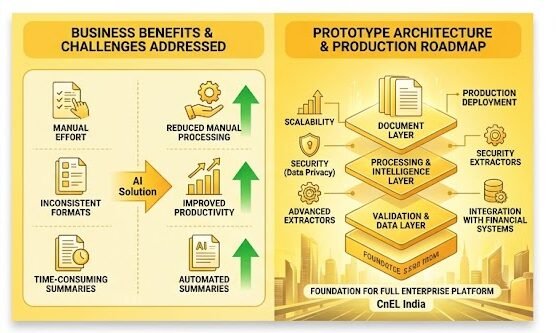
The solution can be organized into several logical layers.
Document Layer
Responsible for receiving and managing uploaded financial documents.
Processing Layer
Responsible for extracting and preparing document content.
Intelligence Layer
Responsible for identifying relevant information, understanding context, and generating structured outputs.
Validation Layer
Responsible for confidence evaluation, review workflows, and quality checks.
Application Layer
Provides the user interface and manages the overall workflow.
Data Layer
Stores structured results, review decisions, document metadata, and system information.
This modular structure makes the prototype easier to expand.
Scalability Considerations
Although the initial project is a prototype, CnEL India designed the workflow with future expansion in mind.
A production system may eventually need to process:
- Hundreds of documents
- Thousands of pages
- Multiple document categories
- Multiple organizations
- Large financial datasets
- Concurrent users
The architecture should therefore support asynchronous processing, scalable storage, background workloads, and efficient information retrieval.
Production Roadmap
The prototype also helps identify what would be required for production deployment.
Future development could include:
- Advanced document classification
- Improved extraction accuracy
- More financial document formats
- Automated validation
- Advanced comparison features
- Historical document analysis
- Multi-user collaboration
- Enterprise access control
- Audit trails
- Advanced reporting
- Integration with internal financial systems
The prototype provides the foundation for evaluating these requirements.
Challenges Addressed
Manual Data Extraction
Automated extraction reduces repetitive document review.
Large Document Volumes
Structured processing makes large documents easier to analyze.
Inconsistent Formats
Flexible processing supports different document structures.
Context Misinterpretation
Context-aware extraction improves understanding of financial figures.
Lack of Traceability
Evidence-based outputs allow reviewers to verify results.
Accuracy Concerns
Human review reduces the risk of unverified information entering analysis.
Time-Consuming Summaries
Automated summaries help analysts understand documents faster.
Business Benefits
The solution can provide several important business benefits:
- Reduced manual document processing
- Faster information extraction
- Improved analyst productivity
- Structured financial information
- Better document understanding
- More consistent workflows
- Easier review processes
- Improved traceability
- Reduced repetitive work
- Strong foundation for automation
Most importantly, the prototype creates a controlled balance between automation and human expertise.
Why CnEL India
CnEL India combines expertise in AI application development, document processing, business automation, data management, custom software development, workflow design, and enterprise application architecture.
The approach focuses not only on demonstrating artificial intelligence capabilities but also on building practical workflows around them.
For financial document analysis, this means prioritizing accuracy, traceability, human review, security, scalability, and maintainability.
CnEL India’s methodology allows organizations to start with a focused prototype, evaluate its performance using real-world documents, identify limitations, and gradually move toward a production-ready solution.
Conclusion
This case study demonstrates how CnEL India can develop an AI-powered financial document analysis prototype capable of converting complex financial materials into structured, reviewable information.
The solution combines document processing, context-aware information extraction, financial figure identification, structured data generation, automated summaries, evidence-based outputs, confidence assessment, and human validation.
The most important principle is that automation should support financial professionals rather than remove necessary oversight. By giving analysts the ability to review and correct extracted information before it reaches downstream analysis, the system provides a safer and more practical approach to intelligent financial document processing.
The prototype also creates a clear path toward production. Once accuracy, document coverage, security, scalability, and workflow requirements have been validated, the solution can be expanded into a full enterprise platform capable of processing larger document volumes and supporting more advanced financial analysis.
For CnEL India, this project represents an opportunity to combine AI with practical business automation and create a reliable financial intelligence workflow that saves time, improves information accessibility, and provides a strong foundation for future innovation.