
Case Study by CnEL India
Introduction
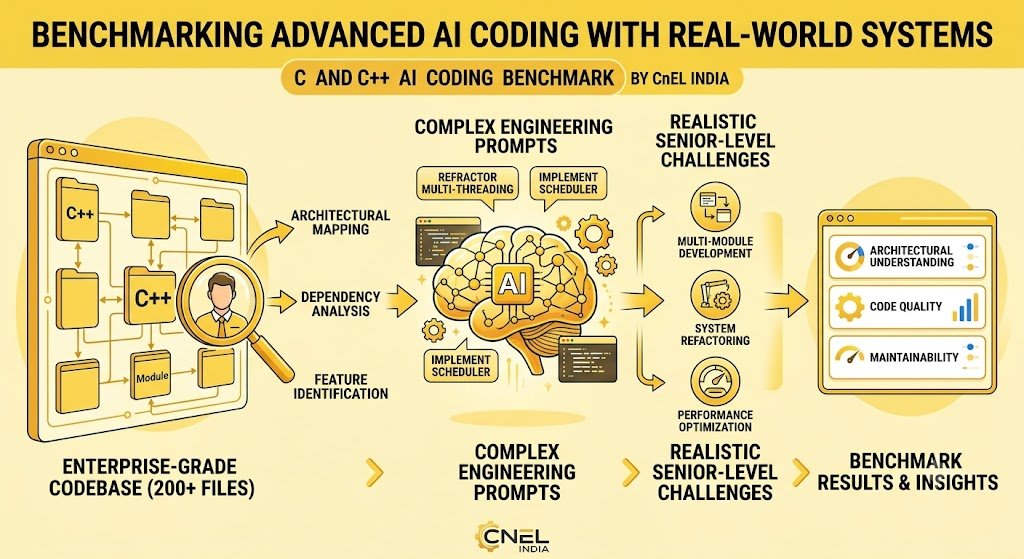
As artificial intelligence continues to transform software development, organizations are increasingly focused on evaluating how well intelligent coding systems can solve real-world engineering problems. While many AI systems perform well on small programming exercises or algorithmic challenges, they often struggle when working with large, enterprise-grade software projects containing hundreds or even thousands of interconnected source files.
Modern software engineering is no longer limited to writing isolated functions. Senior developers are expected to understand complete software architectures, analyze dependencies, implement complex features, improve performance, maintain backward compatibility, optimize memory usage, and ensure long-term maintainability. These responsibilities require deep technical knowledge, architectural thinking, and an understanding of how changes in one component affect the entire application.
To accurately evaluate advanced coding intelligence, organizations require realistic engineering tasks based on large production-quality codebases rather than simplified coding exercises. These benchmark tasks must simulate the complexity that experienced software engineers face every day.
CnEL India specializes in designing enterprise software engineering solutions, system architecture analysis, software modernization, performance optimization, and intelligent evaluation platforms. This case study demonstrates how CnEL India develops a structured benchmarking environment that measures the capability of intelligent coding systems using complex C and C++ software engineering challenges while maintaining high standards of technical accuracy, scalability, and documentation.
Business Background
Large software products used in industries such as telecommunications, healthcare, finance, manufacturing, automotive systems, scientific computing, cybersecurity, and industrial automation often contain extremely complex architectures.
These systems typically include:
- Hundreds of source files
- Multiple software modules
- Shared libraries
- Memory management components
- Multi-threaded processing
- Hardware communication layers
- Network services
- Database interfaces
- Security components
- Configuration systems
- Logging mechanisms
- Performance optimization layers
Understanding such software requires far more than basic programming knowledge.
Organizations developing intelligent coding systems require realistic engineering benchmarks that accurately reflect enterprise software development challenges.
Project Objectives
The primary objective of this project is to create high-quality engineering benchmark tasks that evaluate advanced coding capabilities within large software systems.
The project focuses on:
- Enterprise codebase analysis
- Software architecture understanding
- Complex engineering task creation
- Feature implementation scenarios
- System refactoring challenges
- Technical documentation
- Architectural reasoning
- Performance evaluation
- Software maintainability
- Developer guidance
- Quality assurance
- Benchmark standardization
The final solution enables organizations to measure software engineering intelligence using realistic development environments.
Understanding Business Requirements
CnEL India begins by understanding the objectives of the benchmarking platform.
Requirement analysis includes:
- Evaluation goals
- Software complexity
- Benchmark difficulty
- Engineering standards
- Documentation expectations
- Review methodology
- Quality requirements
- Future scalability
- Validation process
- Performance expectations
This ensures the benchmark reflects real engineering practices.
Enterprise Codebase Selection
Choosing appropriate software projects is critical.
CnEL India identifies software applications that meet strict quality standards.
Evaluation criteria include:
- Large project size
- Production-quality architecture
- Multiple software modules
- Long-term maintainability
- Active development history
- Clear project organization
- Comprehensive functionality
- Real-world engineering relevance
The selected codebase should resemble software maintained by experienced engineering teams.
Codebase Architecture Analysis
Before creating benchmark tasks, engineers thoroughly analyze the application’s structure.
Architecture analysis includes:
- Software modules
- Component relationships
- Data flow
- Processing pipelines
- Memory architecture
- Configuration systems
- Input processing
- Output generation
- Internal communication
- Dependency management
Understanding the architecture ensures benchmark tasks remain realistic.
Software Dependency Analysis
Large applications contain numerous interconnected components.
CnEL India examines:
- Module dependencies
- Shared functionality
- Common utilities
- Internal services
- Processing chains
- Configuration relationships
- Resource management
- Interface communication
Dependency analysis helps identify appropriate implementation points.
Feature Engineering Scenarios
Rather than testing isolated programming problems, benchmark tasks simulate realistic engineering work.
Example feature categories include:
- Resource scheduling
- Performance optimization
- Memory improvements
- Concurrent processing
- Data synchronization
- Processing pipelines
- Configuration enhancements
- User functionality
- Error handling
- System optimization
Each scenario reflects work commonly performed by senior software engineers.
Software Refactoring Challenges
Long-term software maintenance often requires improving existing code rather than creating new functionality.
CnEL India develops benchmark scenarios involving:
- Code restructuring
- Performance improvements
- Modularization
- Reducing complexity
- Improving maintainability
- Eliminating duplication
- Simplifying architecture
- Enhancing readability
These exercises evaluate architectural understanding.
Multi-Module Development
Enterprise software rarely requires changes in a single file.
Benchmark tasks may involve modifications across:
- Core processing modules
- Utility libraries
- Configuration systems
- User interface components
- Resource managers
- Validation modules
- Service layers
- Supporting utilities
This reflects real production development.
Software Navigation Assessment
Senior developers must quickly understand unfamiliar software.
Benchmark tasks evaluate the ability to:
- Locate functionality
- Understand relationships
- Identify implementation points
- Trace execution flow
- Analyze dependencies
- Review existing patterns
- Understand architecture
Efficient navigation demonstrates engineering maturity.
Technical Reasoning Documentation
Engineering work requires clear technical explanations.
CnEL India develops comprehensive documentation covering:
- Architectural overview
- Implementation strategy
- Design decisions
- Engineering assumptions
- Component interactions
- Dependency analysis
- Expected modifications
- Technical justification
Detailed documentation improves benchmark quality.
Architectural Complexity Evaluation
Some software systems contain hidden complexity that inexperienced developers often overlook.
The benchmarking process evaluates understanding of:
- Layered architecture
- Module communication
- Shared resources
- Processing dependencies
- Internal abstractions
- Resource ownership
- Lifecycle management
- Execution flow
This measures deeper engineering knowledge.
Performance Considerations
Enterprise software must remain efficient after modifications.
Benchmark tasks consider:
- Processing speed
- Memory utilization
- Resource allocation
- Thread coordination
- Scalability
- Response time
- System stability
- Computational efficiency
Performance awareness is an essential senior engineering skill.
Code Quality Standards
CnEL India emphasizes professional software quality.
Engineering tasks promote:
- Readable code
- Modular design
- Consistent structure
- Meaningful naming
- Error handling
- Maintainability
- Reusability
- Documentation
Quality standards improve long-term software sustainability.
Validation Framework
Every benchmark task undergoes rigorous validation.
Validation includes:
- Technical accuracy
- Architectural consistency
- Implementation feasibility
- Documentation quality
- Engineering relevance
- Difficulty assessment
- Production realism
- Review compliance
Validated benchmarks produce reliable evaluation results.
Engineering Workflow
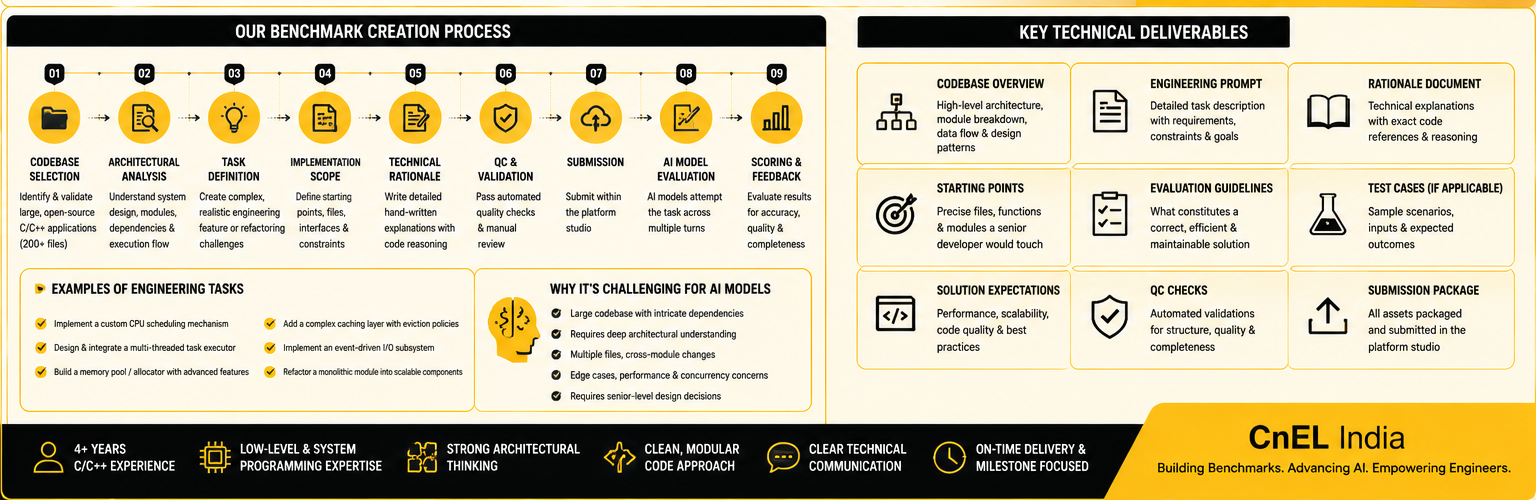
The benchmark creation process follows a structured methodology.
Typical workflow:
- Codebase selection
- Architecture analysis
- Dependency mapping
- Feature identification
- Task definition
- Technical documentation
- Validation
- Quality review
- Final benchmark preparation
Structured workflows ensure consistency.
Software Testing Considerations
Benchmark tasks encourage engineering practices that preserve software reliability.
Testing expectations include:
- Functional verification
- Integration testing
- Performance validation
- Resource monitoring
- Error handling
- Regression prevention
- Stability verification
- Compatibility assessment
Testing supports production-quality development.
Documentation Standards
Professional engineering requires complete documentation.
CnEL India prepares documentation including:
- Architecture overview
- System components
- Module relationships
- Development guidelines
- Design rationale
- Implementation notes
- Validation procedures
- Maintenance recommendations
Comprehensive documentation improves future maintainability.
Scalability
Benchmark platforms should support continuous expansion.
The architecture accommodates:
- Additional codebases
- New benchmark categories
- Multiple engineering domains
- Larger applications
- More evaluation scenarios
- Continuous improvements
Scalability ensures long-term usefulness.
Security Considerations
Enterprise software evaluation requires secure handling of benchmark assets.
Security practices include:
- Controlled access
- Data protection
- Version management
- Audit tracking
- Secure storage
- Access permissions
- Integrity verification
- Review controls
Security maintains benchmark reliability.
Business Benefits
Organizations receive significant advantages from enterprise engineering benchmarks.
Expected benefits include:
- Better evaluation accuracy
- Realistic engineering assessments
- Higher benchmark quality
- Improved developer measurement
- Consistent evaluation standards
- Better architectural analysis
- Reliable performance assessment
- Strong documentation
- Improved software quality
- Scalable evaluation platform
- Faster engineering reviews
- Better hiring and research insights
Challenges Solved
CnEL India addresses several challenges associated with software engineering evaluation.
Simplified Coding Tests
Replaced with enterprise-level engineering scenarios.
Limited Architecture Assessment
Comprehensive codebase analysis improves evaluation.
Weak Documentation
Detailed technical reasoning strengthens understanding.
Unrealistic Benchmarks
Production-grade software provides authentic engineering challenges.
Performance Oversight
Resource optimization becomes part of evaluation.
Software Complexity
Large applications better represent real development environments.
Inconsistent Evaluation
Standardized benchmark creation improves fairness.
Scalability Limitations
Framework supports continuous benchmark expansion.
Why CnEL India
CnEL India combines expertise in enterprise software engineering, system architecture, low-level programming, software modernization, code quality analysis, performance optimization, technical documentation, intelligent evaluation systems, and scalable application development.
Rather than creating basic programming exercises, CnEL India develops enterprise-grade engineering benchmarks that accurately measure architectural understanding, implementation quality, software maintenance capabilities, and senior-level engineering skills.
Every solution emphasizes realism, scalability, technical precision, maintainability, and long-term business value.
Conclusion
This case study demonstrates how CnEL India develops advanced software engineering benchmark systems capable of evaluating intelligent coding capabilities using realistic enterprise applications.
By analyzing large production codebases, designing complex engineering scenarios, documenting architectural reasoning, validating implementation strategies, ensuring software quality, and maintaining scalable evaluation standards, CnEL India enables organizations to assess advanced software engineering capabilities with greater confidence.
The result is a robust, secure, and future-ready benchmarking platform that reflects real-world development practices, supports continuous innovation, improves engineering assessment quality, and provides a strong foundation for evaluating the next generation of intelligent software development systems.