
Artificial intelligence has become one of the most discussed technologies in recent years. It is transforming the way businesses operate, how people communicate, how information is processed, and how decisions are made. From online shopping recommendations to customer support, healthcare, education, manufacturing, and finance, artificial intelligence is influencing nearly every industry.
Despite its growing popularity, many people still find the topic confusing. Technical terminology, complex explanations, and constant news about new developments often make artificial intelligence seem difficult to understand. As a result, many business owners, students, professionals, and entrepreneurs simply want someone to explain what artificial intelligence is, how it works, and how they can use it effectively in their daily lives or businesses.
The discussion focuses on an individual seeking guidance rather than technical services. Instead of requesting a specific project or solution, the goal is to have a conversation that explains artificial intelligence in simple language and explores practical ways to work with it. This highlights an important reality: many people are not looking for advanced technical knowledge. They simply want to understand the technology well enough to use it confidently.
This article provides a beginner-friendly explanation of artificial intelligence, explores its practical applications, discusses common misconceptions, and outlines how individuals and businesses can begin working with it successfully.
What Is Artificial Intelligence?
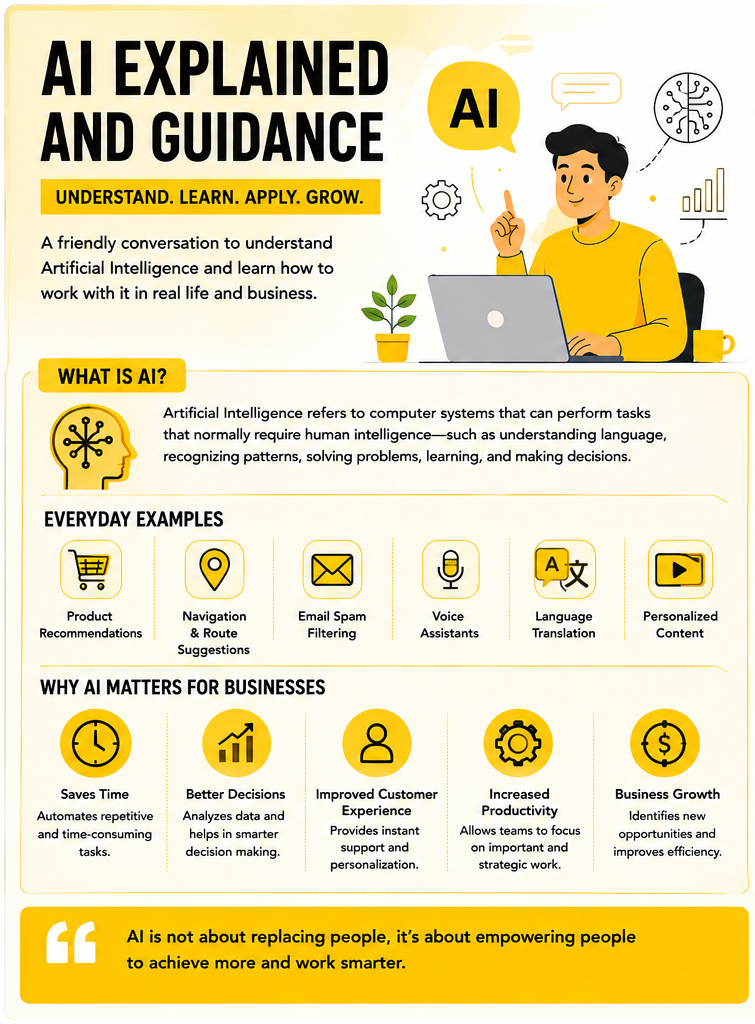
Artificial intelligence refers to computer systems designed to perform tasks that normally require human intelligence. These tasks may include understanding language, recognizing patterns, solving problems, making predictions, analyzing information, or learning from previous experiences.
Rather than following only fixed instructions, many intelligent systems can improve their performance by analyzing large amounts of data and identifying relationships within that information.
This ability allows them to assist people in completing complex or repetitive work more efficiently.
Why Artificial Intelligence Matters
Modern businesses generate enormous amounts of information every day.
Examples include:
- Customer inquiries
- Sales reports
- Website traffic
- Product information
- Financial records
- Inventory data
- Marketing performance
Manually processing all this information takes significant time.
Artificial intelligence helps organize, analyze, and interpret large volumes of data much faster than traditional methods.
This allows businesses to make better decisions while reducing repetitive work.
Artificial Intelligence Is a Tool, Not a Replacement
One of the biggest misconceptions is that artificial intelligence completely replaces human workers.
In reality, it functions best as an assistant.
People continue making important decisions, providing creativity, building relationships, and applying judgment.
Artificial intelligence helps by handling repetitive or time-consuming tasks, allowing people to focus on higher-value activities.
The strongest results usually come from combining human expertise with intelligent technology.
Everyday Examples
Many people already interact with artificial intelligence without realizing it.
Common examples include:
- Product recommendations while shopping online
- Navigation and route suggestions
- Email spam filtering
- Voice assistants
- Language translation
- Personalized content recommendations
- Fraud detection in banking
These systems help improve convenience and efficiency during everyday activities.
Why Businesses Are Interested
Companies increasingly explore artificial intelligence because it offers opportunities to improve productivity.
Potential benefits include:
- Faster decision-making
- Improved customer service
- Better marketing insights
- Reduced manual work
- More accurate forecasting
- Increased operational efficiency
Rather than replacing existing processes completely, businesses often integrate intelligent systems gradually.
Small improvements accumulated over time can produce significant long-term benefits.
Learning Before Implementing
The discussion emphasizes understanding before implementation.
Many organizations feel pressure to adopt new technology simply because competitors are doing so.
However, successful adoption begins with education.
Before introducing artificial intelligence into a business, owners should understand:
- What problems they want to solve
- Which tasks consume excessive time
- Which processes could become more efficient
- What outcomes they expect
Clear objectives lead to better results than adopting technology without a defined purpose.
Common Business Applications
Artificial intelligence supports many different business activities.
Examples include:
- Customer support
- Content creation
- Sales forecasting
- Market analysis
- Inventory planning
- Financial reporting
- Data organization
- Workflow automation
Each application addresses different business challenges.
Choosing the right use depends on individual business needs rather than following general trends.
Improving Customer Service
Customer service often involves repetitive questions.
Examples include:
- Shipping information
- Business hours
- Return policies
- Product availability
- Order status
Artificial intelligence can assist by providing immediate responses to common inquiries.
This reduces waiting times while allowing human support teams to focus on more complex customer needs.
Supporting Marketing Activities
Marketing requires significant planning and creativity.
Businesses regularly produce:
- Website content
- Email campaigns
- Social media posts
- Product descriptions
- Promotional materials
Artificial intelligence can assist with brainstorming ideas, organizing information, and creating first drafts.
Human review remains important to ensure accuracy, originality, and consistency with the company’s brand identity.
Making Better Decisions
Business decisions become stronger when supported by reliable information.
Artificial intelligence helps identify:
- Customer behavior patterns
- Sales trends
- Seasonal demand
- Market opportunities
- Purchasing habits
Rather than relying entirely on assumptions, businesses can make more informed decisions using available data.
Saving Time
Time savings represent one of the greatest advantages.
Many daily tasks are repetitive.
Examples include:
- Organizing documents
- Preparing reports
- Categorizing information
- Scheduling activities
- Summarizing data
Reducing time spent on routine work allows employees to focus on strategic planning, customer relationships, and innovation.
Improving Productivity
Productivity is not simply about working faster.
It also involves reducing errors, improving consistency, and completing more valuable work within the same amount of time.
Artificial intelligence contributes by assisting with repetitive processes while maintaining consistent performance.
Businesses often experience improved efficiency without increasing staffing requirements.
Understanding Its Limitations
Although artificial intelligence is powerful, it has limitations.
It may occasionally:
- Misinterpret information
- Produce inaccurate responses
- Lack important context
- Generate outdated conclusions
- Require human correction
For this reason, critical decisions should always involve human oversight.
Verification remains essential.
Human Judgment Remains Essential
Some business activities require qualities that technology cannot fully replace.
These include:
- Empathy
- Creativity
- Leadership
- Ethical decision-making
- Negotiation
- Relationship building
Artificial intelligence supports these activities but does not eliminate the need for human involvement.
Successful organizations combine technology with human expertise.
Learning Through Conversation
The discussion highlights another important point.
Many people learn best through conversation rather than technical documentation.
A guided discussion allows beginners to:
- Ask questions
- Clarify confusing concepts
- Explore practical examples
- Connect technology with their own business
Learning becomes much easier when explanations use familiar situations instead of technical language.
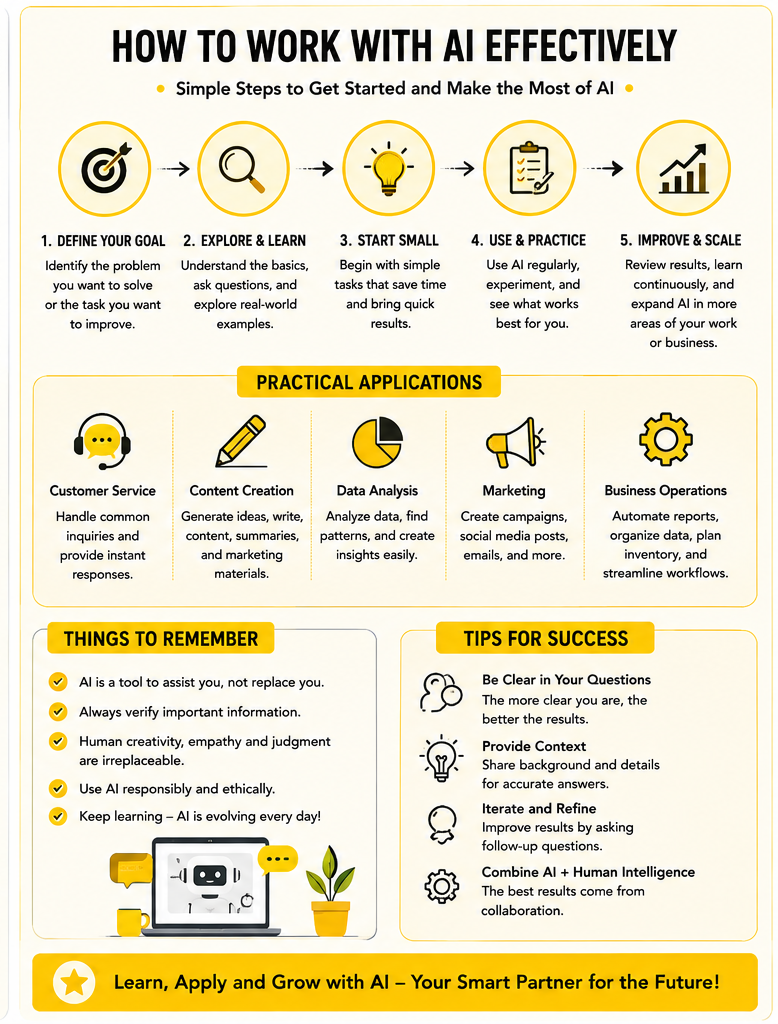
Starting Small
Businesses often believe they must transform every process immediately.
However, gradual implementation usually produces better results.
Organizations can begin with one or two simple improvements before expanding further.
This allows employees to become comfortable with new technology while minimizing disruption.
Identifying Opportunities
Before adopting artificial intelligence, businesses should identify repetitive activities.
Questions to ask include:
- Which tasks consume the most time?
- Which activities involve repetitive data entry?
- Where do employees spend unnecessary effort?
- Which decisions require large amounts of information?
Answering these questions helps identify areas where intelligent systems may provide the greatest benefit.
Continuous Learning
Artificial intelligence continues evolving rapidly.
New capabilities appear regularly.
Businesses therefore benefit from maintaining a learning mindset.
Rather than trying to master everything immediately, individuals should focus on understanding fundamental concepts first.
Building knowledge gradually creates greater confidence over time.
Ethical Considerations
Responsible use remains important.
Businesses should consider:
- Data privacy
- Customer transparency
- Information security
- Fair decision-making
- Accuracy
Using artificial intelligence responsibly builds trust while reducing potential risks.
Ethics should remain an important part of every implementation strategy.
Preparing for the Future
Artificial intelligence is expected to influence even more industries in the coming years.
Professionals who understand its capabilities and limitations will likely be better prepared for future workplace changes.
Learning about artificial intelligence today is not simply about technology.
It is also about developing skills that support long-term adaptability.
Building Confidence
Many beginners initially feel overwhelmed.
However, understanding develops gradually.
Learning typically progresses through several stages:
- Understanding basic concepts
- Observing practical examples
- Experimenting with simple applications
- Expanding knowledge through experience
Confidence grows naturally through consistent learning rather than attempting to understand every technical detail immediately.
Practical Advice for Beginners
Individuals beginning their artificial intelligence journey should focus on:
- Learning basic concepts
- Asking questions
- Exploring real-world examples
- Identifying everyday business applications
- Practicing regularly
- Reviewing results carefully
- Continuing education
Curiosity often becomes the most valuable learning tool.
Conclusion
Artificial intelligence represents one of the most significant technological developments of the modern era, but understanding it does not require advanced technical knowledge. At its core, it is a collection of technologies designed to assist people in analyzing information, solving problems, improving efficiency, and supporting better decision-making.
For beginners, the most effective approach is to start with practical understanding rather than technical complexity. Learning how intelligent systems can assist with customer service, marketing, business operations, reporting, and routine administrative work provides a solid foundation for future growth. Equally important is recognizing that artificial intelligence works best alongside human judgment, creativity, and experience rather than replacing them.
The discussion reflects a growing interest among individuals who simply want guidance through conversation before deciding how to use artificial intelligence in their personal or professional lives. This learning-first approach allows people to build confidence, understand real-world applications, and make informed decisions about adopting new technologies. As artificial intelligence continues to evolve, those who develop a strong understanding of its possibilities and limitations will be better equipped to use it responsibly, efficiently, and successfully in an increasingly digital world.