

Case Study by CnEL India
Introduction
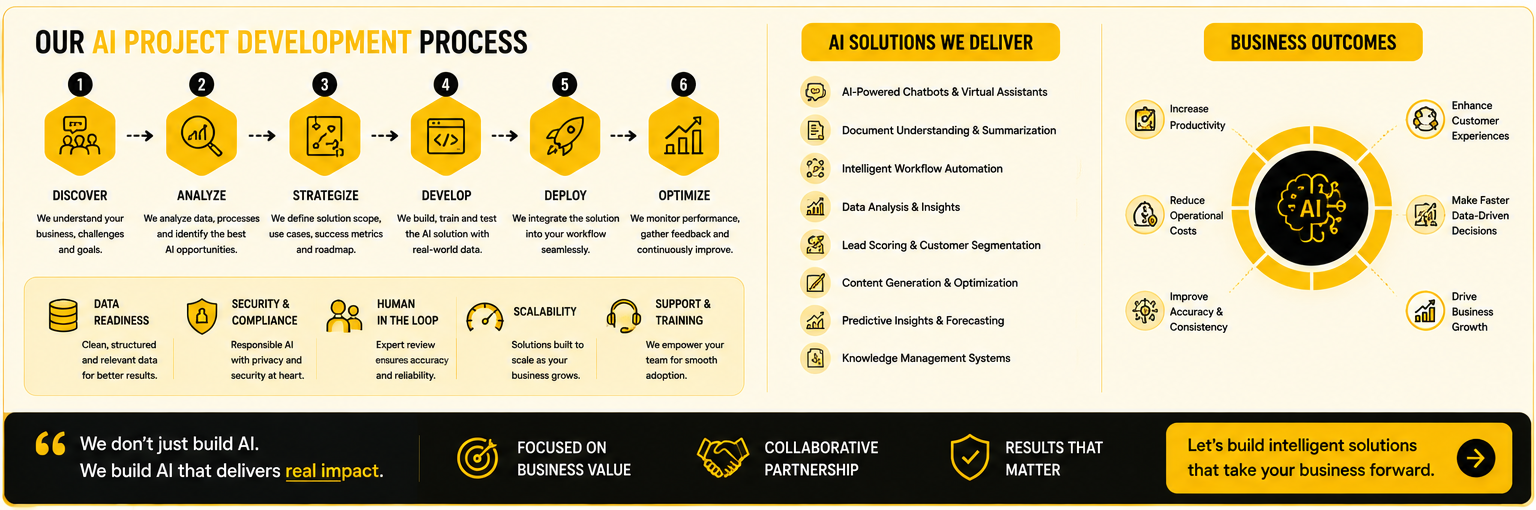
Businesses across industries are exploring artificial intelligence to improve efficiency, strengthen customer experiences, reduce repetitive work, support better decision-making, and create new digital services. However, moving from an idea to a practical AI-enabled project is not always simple. Many organizations understand that AI can create value, but they may not know where to begin, which processes are suitable, what data is required, how to measure success, or how to implement an AI strategy without creating unnecessary complexity.
This is where an AI expert becomes valuable.
CnEL India supports organizations that want to develop practical AI-based projects by helping them analyze requirements, identify suitable opportunities, define a clear implementation strategy, and guide the project from concept to deployment. The focus is not on using AI for the sake of it. The focus is on finding meaningful use cases that solve real business problems and create measurable outcomes.
This case study explains how CnEL India can support a client seeking an AI expert for project development. It covers the challenges businesses face when planning AI initiatives, the structured approach followed by CnEL India, the role of AI strategy in project development, and the expected outcomes of a well-planned implementation.
Business Background
Artificial intelligence is now influencing how businesses communicate, manage data, support employees, analyze documents, process customer requests, create content, forecast demand, organize knowledge, and automate workflows.
Despite the growing interest, many businesses struggle with questions such as:
- Which business process should be improved first?
- Is AI the right solution for the problem?
- What type of data is required?
- How can AI fit into existing systems?
- What risks need to be considered?
- How should the project be tested before launch?
- How can the business measure success?
- How can the team continue using and improving the solution after delivery?
Without a structured plan, an AI project can become unclear, expensive, or disconnected from real business needs. A business may invest in a solution that looks impressive but does not solve a meaningful problem. It may also introduce automation without defining who reviews results, how errors are handled, or what happens when the system needs human input.
CnEL India helps reduce this uncertainty by connecting business goals with practical AI development planning.
Project Objective
The primary objective of this project is to provide expert support for planning, developing, and implementing AI-enabled solutions that align with the client’s business needs.
The project aims to:
- Understand the client’s business goals
- Analyze existing processes and challenges
- Identify suitable AI opportunities
- Define the scope of the project
- Recommend a practical implementation roadmap
- Improve workflow efficiency
- Reduce repetitive manual work
- Support better data use
- Improve customer or employee experiences
- Create scalable solutions
- Establish testing and quality review processes
- Support long-term improvement after launch
The final goal is to create an AI project that delivers real value, rather than a disconnected experiment.
Understanding Business Requirements
Every successful project begins with understanding the business context.
CnEL India starts by learning how the organization currently operates. This includes its services, customers, internal teams, workflows, existing systems, pain points, and growth plans.
The discovery process may examine:
- Customer communication workflows
- Sales and lead management
- Support requests
- Document handling
- Data collection
- Reporting processes
- Knowledge sharing
- Content workflows
- Internal approvals
- Repetitive administrative work
- Operational bottlenecks
- Existing digital systems
The purpose is to identify where people spend too much time, where errors occur, where information is difficult to access, and where customers may experience delays.
For example, a business may receive a high number of repetitive customer questions. Another organization may spend hours reviewing documents or creating reports. A service provider may struggle to organize incoming leads. A growing company may have useful data but no simple way to turn it into actionable insights.
These situations can become strong starting points for AI project development.
Identifying Practical AI Opportunities
Not every task needs AI. Some problems can be solved with better processes, clearer documentation, improved website structure, or basic automation.
CnEL India evaluates whether AI is genuinely useful for each opportunity. The team considers the expected value, complexity, available data, user needs, risk level, and long-term maintainability.
Suitable AI opportunities may include:
- Customer inquiry assistance
- Lead qualification support
- Document summarization
- Knowledge base search
- Internal information retrieval
- Report generation
- Data classification
- Content support
- Workflow routing
- Appointment or request management
- Feedback analysis
- Product recommendation support
- Sales communication assistance
- Operations monitoring
- Employee support systems
The selected use case should be practical, measurable, and connected to a clear business outcome.
AI Strategy Development
Once the right opportunity is identified, CnEL India develops a project strategy.
The strategy defines what the solution should do, who will use it, what information it needs, how it should interact with existing workflows, and how success will be measured.
A strong AI strategy includes:
- Business objective
- Target users
- Key use cases
- Input sources
- Expected outputs
- User journey
- Human review requirements
- Data handling approach
- Quality standards
- Testing plan
- Implementation timeline
- Improvement process
- Success metrics
This strategy acts as a roadmap for the entire project.
For example, if the goal is to improve customer support, the strategy may define the types of questions the system can answer, the information sources it can use, the situations that require human escalation, the expected tone of communication, and the process for reviewing unanswered questions.
AI Solution Planning
CnEL India helps clients choose the right structure for their AI project.
Depending on the requirement, the solution may be designed as:
- An internal employee support system
- A customer-facing assistant
- A document analysis workflow
- A knowledge retrieval system
- A content review process
- A lead management assistant
- A reporting support system
- A workflow automation solution
- A data classification system
- A recommendation system
The design is based on the business problem, not on a one-size-fits-all approach.
For instance, a legal services company may need a solution that helps organize and summarize internal documents. A real estate business may need support for qualifying property inquiries. A healthcare administration team may need a system that helps organize appointment-related communication. A manufacturing company may need a way to review operational reports and identify recurring issues.
Each solution requires a different structure, workflow, and level of human involvement.
Data and Knowledge Preparation
AI systems need relevant and organized information to provide useful results.
CnEL India helps clients identify and prepare the information required for the project. This may include:
- Business documents
- Service information
- Product details
- Customer questions
- Internal policies
- Process documents
- Training materials
- Frequently asked questions
- Reports
- Support records
- Product catalogs
- Knowledge base content
- Historical communication data
The goal is to make the information clear, relevant, and suitable for the intended use case.
Data preparation is important because poor-quality or outdated information can lead to poor-quality outputs. CnEL India helps establish a structured process for reviewing and maintaining the knowledge used by the solution.
Human Review and Quality Control
AI should not operate without appropriate quality control, especially in business environments where accuracy matters.
CnEL India designs projects with clear human review points.
Human review may be required when:
- A response involves sensitive information
- A customer request is complex
- A decision requires professional judgment
- The system has low confidence
- A document contains unusual content
- A request falls outside the defined scope
- A response may affect a customer relationship
- A process requires approval before completion
This approach helps businesses use AI efficiently while maintaining accountability and control.
The goal is to support people, not remove important human judgment from business processes.
Workflow Integration
An AI project becomes more useful when it fits naturally into existing work.
CnEL India analyzes how teams currently receive information, complete tasks, communicate with customers, store documents, and manage approvals. The AI solution is then designed to support these existing workflows rather than forcing teams to change everything at once.
For example, an AI-supported lead process may receive incoming inquiries, identify key details, organize them by priority, and prepare a summary for the sales team. The sales team can then review the information and respond more quickly.
A document support workflow may organize incoming files, extract important details, create summaries, and send them to the appropriate team member for review.
This kind of integration helps businesses adopt AI more easily because the solution becomes part of everyday work.
Prototype Development
Before full implementation, CnEL India can create a focused prototype.
A prototype allows the client to test the idea with a smaller set of workflows, users, and information. This reduces risk and helps identify improvements early.
The prototype stage may include:
- Defining a limited use case
- Preparing sample data
- Creating initial workflows
- Testing expected outputs
- Reviewing accuracy
- Collecting user feedback
- Identifying edge cases
- Improving instructions
- Measuring early results
A prototype helps answer important questions before a larger rollout.
For example:
- Does the solution save time?
- Are the outputs useful?
- Do users understand how to use it?
- Is the information accurate enough?
- Where is human review needed?
- What should be improved before expansion?
This approach supports smarter investment and stronger project planning.
Testing and Evaluation
Testing is a critical part of AI project development.
CnEL India evaluates the solution using realistic business scenarios. The testing process checks whether the system provides useful, accurate, clear, and appropriate outputs.
Testing may focus on:
- Accuracy
- Relevance
- Response quality
- Consistency
- Speed
- Ease of use
- Error handling
- Human escalation
- Data privacy considerations
- Workflow fit
- User satisfaction
The team may create test scenarios based on real business cases. This helps ensure the solution works not only in ideal situations but also in more complex or unexpected cases.
Performance Measurement
A successful AI project should have clear success metrics.
CnEL India helps clients define measurements that reflect business value.
Possible metrics include:
- Reduction in manual work
- Faster response time
- Increase in completed inquiries
- Improved lead qualification
- Better customer satisfaction
- Reduced processing time
- Improved reporting speed
- Fewer repetitive tasks
- Higher employee productivity
- Better information access
- Improved workflow consistency
- Reduced error rates
These measurements help the business understand whether the solution is delivering the intended result.
Training and Adoption Support
A new AI solution is only valuable if people know how to use it.
CnEL India supports user adoption by helping teams understand the purpose, workflow, limitations, and best practices of the solution.
Training may include:
- How the system supports daily work
- What types of tasks it can handle
- When to review results
- When to escalate an issue
- How to provide feedback
- How to maintain information quality
- How to identify errors
- How to use outputs responsibly
Clear adoption support helps employees feel more confident and reduces resistance to new technology.
Ongoing Improvement
AI projects should not be treated as one-time launches.
As the business grows, customer needs change, documents are updated, and new workflows emerge. The solution may need adjustments to remain useful.
CnEL India supports ongoing improvement through:
- Performance review
- User feedback collection
- Knowledge updates
- Workflow refinement
- Output quality review
- New scenario testing
- Expansion planning
- Error analysis
- Feature enhancement
This helps the AI solution remain relevant over time.
Common Challenges Solved
CnEL India helps clients solve several common project development challenges.
Unclear AI Direction
Many businesses want to use AI but do not know where to start. CnEL India identifies practical use cases based on business priorities.
Too Much Manual Work
Repetitive tasks can slow teams down. AI-supported workflows can help organize information, prepare drafts, summarize documents, and reduce routine workload.
Poor Information Access
Employees may struggle to find important documents or answers. A structured AI solution can improve information retrieval and knowledge access.
Slow Customer Response
Businesses can improve response preparation and inquiry management by using AI-supported communication workflows.
Inconsistent Processes
AI can help standardize common tasks, improve documentation, and support more consistent output quality.
Lack of Testing and Governance
CnEL India helps define quality checks, human review processes, and clear boundaries for responsible use.
Expected Outcomes
A well-planned AI project can create meaningful business improvements.
Expected outcomes include:
- Clear AI implementation roadmap
- Better understanding of AI opportunities
- Reduced repetitive workload
- Faster internal processes
- Improved customer communication
- Better use of business data
- More organized knowledge management
- Stronger workflow consistency
- Improved decision support
- Better team productivity
- Scalable digital processes
- More confident technology adoption
The final solution is designed to create measurable value and support long-term business growth.
Why CnEL India
CnEL India combines business analysis, AI strategy, workflow planning, solution development, quality evaluation, and implementation support.
The team understands that AI projects need more than technical knowledge. They require a clear understanding of business operations, user needs, data quality, workflow design, and practical adoption.
CnEL India focuses on creating solutions that are useful, manageable, and aligned with real business goals.
Instead of treating AI as a separate technology project, CnEL India helps businesses integrate it into meaningful workflows that improve efficiency, service quality, and decision-making.
Conclusion
This case study demonstrates how CnEL India can support organizations seeking an AI expert for project development.
By analyzing business needs, identifying practical AI opportunities, creating implementation strategies, preparing information, designing workflows, testing solutions, and supporting adoption, CnEL India helps clients move from AI ideas to real business outcomes.
The result is a structured, scalable, and human-centered AI project that helps organizations improve operations, support teams, and create stronger customer experiences.