

Introduction
For modern eCommerce businesses, traffic alone does not create growth. Sustainable growth happens when businesses can understand visitor behavior, measure outcomes, optimize campaigns, and connect marketing activity directly to sales performance.
Many online stores invest in advertising but struggle because their measurement infrastructure is incomplete, outdated, duplicated, or incorrectly configured. When tracking systems become fragmented across business accounts, pages, assets, and store environments, campaign decisions become unreliable.
This case study explains how CnEL India can execute a complete tracking reset and integration project involving business asset cleanup, new tracking configuration, social channel setup, and synchronized commerce operations.
The objective is not simply creating a new tracking setup.
The objective is establishing a clean, scalable, and conversion-ready digital foundation that supports future customer acquisition and performance marketing.
This implementation combines:
- Business asset cleanup
- Tracking infrastructure setup
- Store synchronization
- Social presence configuration
- Event measurement
- Conversion visibility
- Data governance
- Scalable growth preparation
CnEL India approaches this engagement as a commerce enablement and marketing operations transformation project.
Understanding the Business Requirement
The requested project appears simple on the surface:
- Remove outdated business assets
- Establish a clean business environment
- Create a brand presence
- Connect store infrastructure
- Enable conversion tracking
However, behind these steps sits an important operational challenge.
Improper account structures and duplicate tracking systems often create:
- Duplicate conversion events
- Incorrect reporting
- Campaign optimization issues
- Data conflicts
- Attribution inaccuracies
CnEL India focuses first on establishing operational clarity before introducing new configurations.
Evaluating Existing Digital Infrastructure
Every successful migration begins with assessment.
Before making changes, CnEL India evaluates:
- Existing business assets
- Historical tracking configuration
- Connected store environments
- Page ownership structures
- Asset permissions
- Event ownership
- Existing advertising relationships
This prevents accidental disruption.
The objective is preserving useful assets while removing outdated dependencies.
Cleaning Legacy Business Structures
Businesses frequently accumulate unused digital assets over time.
Common issues include:
- Old business portfolios
- Unused tracking assets
- Duplicate accounts
- Unclear ownership
- Historical testing environments
These create confusion during campaign execution.
CnEL India establishes a structured cleanup process.
Designing a Clean Asset Structure
After identifying legacy assets, the next step is simplification.
CnEL India creates a structured environment designed around:
Business Ownership
Clear administrative control.
Marketing Operations
Organized advertising access.
Tracking Governance
Unified measurement systems.
Commerce Integration
Reliable store connectivity.
This creates long-term stability.
Creating a New Brand Presence
A professional social presence is more than a profile.
It becomes a customer trust layer.
CnEL India structures the brand environment to support:
- Consistent identity
- Store alignment
- Advertising readiness
- Customer engagement
The goal is establishing a recognizable commerce presence.
Structuring Business Identity Correctly
Identity structure influences future scalability.
CnEL India organizes:
- Brand naming consistency
- Category alignment
- Profile presentation
- Customer-facing information
Consistency improves credibility.
Designing Conversion Measurement Infrastructure
Tracking infrastructure becomes the core growth engine.
CnEL India builds systems that measure meaningful actions.
Examples include:
- Page visits
- Product views
- Add-to-cart actions
- Checkout progression
- Purchases
These interactions create measurable business intelligence.
Event Architecture and Data Flow
Tracking is not just collecting clicks.
CnEL India maps the customer journey.
Typical event flow includes:
Discovery
User visits.
Interest
User explores products.
Intent
User adds products.
Purchase
Customer completes transaction.
Each interaction contributes to optimization.
Connecting Store and Marketing Ecosystems
Commerce systems perform best when connected.
CnEL India synchronizes:
- Store catalog structure
- Product availability
- Inventory visibility
- Conversion signals
This enables seamless operation.
Store Synchronization Framework
Store synchronization ensures consistent communication.
CnEL India validates:
- Product matching
- Event alignment
- Data transmission
- Asset ownership
Synchronization reduces reporting gaps.
Catalog and Product Visibility
Products should become marketing-ready.
CnEL India structures:
- Product organization
- Collection visibility
- Availability validation
- Dynamic updates
Catalog accuracy improves customer experience.
Preparing Advertising Readiness
Tracking without activation provides limited value.
CnEL India prepares the environment for future growth through:
- Audience preparation
- Measurement readiness
- Campaign scalability
This supports efficient advertising.
Customer Journey Mapping
Understanding movement improves optimization.
CnEL India maps:
- Awareness stage
- Engagement stage
- Purchase stage
- Retention stage
Journey visibility supports decision-making.
Eliminating Duplicate Event Problems
Duplicate signals create inaccurate reporting.
CnEL India prevents issues including:
- Double purchases
- Event inflation
- Conflicting attribution
Measurement integrity remains protected.
Mobile and Cross-Device Considerations
Customers move across devices.
CnEL India validates tracking consistency across:
- Desktop sessions
- Mobile browsing
- Multiple customer touchpoints
This improves visibility.
Permission and Access Governance
Business assets require controlled ownership.
CnEL India establishes:
- Administrative access
- Operational permissions
- Security controls
This reduces future management problems.
Testing and Validation
Configuration alone is insufficient.
CnEL India performs structured validation including:
- Event testing
- Store connectivity checks
- Tracking confirmation
- Conversion verification
Reliability becomes measurable.
Reporting Readiness
Businesses need visibility after implementation.
CnEL India prepares reporting structures to support:
- Traffic understanding
- Conversion analysis
- Performance tracking
Reporting becomes actionable.
Long-Term Growth Enablement
The value of implementation extends beyond launch.
The environment supports:
- Future campaigns
- Retargeting opportunities
- Customer acquisition
- Performance scaling
Infrastructure becomes a business asset.
Operational Simplicity
One objective of the implementation is reducing complexity.
CnEL India simplifies:
- Account management
- Store administration
- Marketing coordination
Operations become easier to maintain.
Scalability Planning
Growth introduces new requirements.
CnEL India prepares the environment for:
- Additional campaigns
- New product launches
- Expanded commerce activity
Scalability reduces future rework.
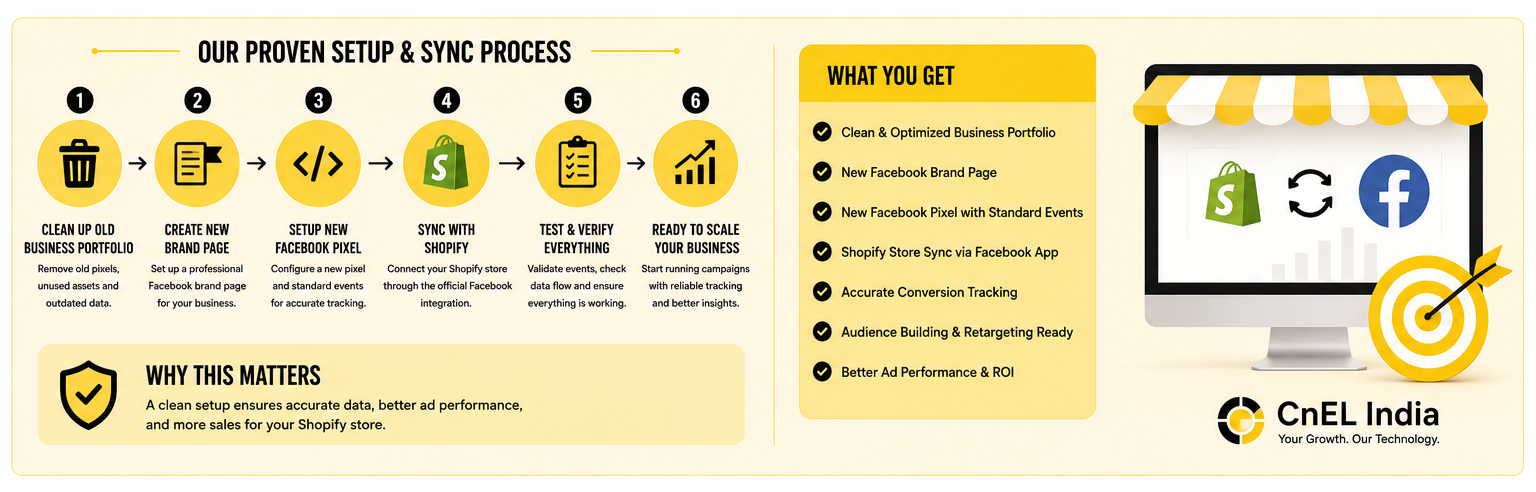
Delivery Methodology
Implementation follows a structured execution model.
Phase 1 — Asset Audit
Review existing setup.
Phase 2 — Cleanup
Remove unnecessary assets.
Phase 3 — Environment Creation
Prepare business infrastructure.
Phase 4 — Store Synchronization
Connect commerce systems.
Phase 5 — Testing
Validate functionality.
Phase 6 — Handover
Prepare operational readiness.
Challenges Solved by CnEL India
This implementation addresses:
- Fragmented business assets
- Duplicate tracking
- Store synchronization issues
- Reporting inconsistencies
- Growth limitations
The result is a cleaner operational environment.
Business Outcomes Delivered
After implementation, businesses benefit from:
- Reliable conversion measurement
- Better campaign readiness
- Cleaner operational structure
- Improved reporting confidence
- Stronger commerce visibility
The foundation becomes scalable.
Why CnEL India
CnEL India combines:
- Commerce implementation experience
- Digital operations understanding
- Tracking architecture knowledge
- Store optimization thinking
- Long-term scalability planning
The focus is building systems that remain useful as businesses grow.
Conclusion
This case study demonstrates how CnEL India can execute a complete business asset cleanup, tracking setup, social presence configuration, and commerce synchronization project to create a clean and scalable digital foundation.
Rather than treating tracking as a one-time configuration task, the approach establishes an integrated ecosystem that supports measurement, marketing performance, operational clarity, and long-term growth.
By combining structured setup, store synchronization, event governance, and scalable planning, CnEL India enables businesses to move from fragmented operations to measurable and growth-ready commerce infrastructure.